Previous Lecture Todays Lecture Slides for Lecture 5 ENEL 353: - - PowerPoint PPT Presentation

previous lecture today s lecture slides for lecture 5
SMART_READER_LITE
LIVE PREVIEW

Previous Lecture Todays Lecture Slides for Lecture 5 ENEL 353: - - PowerPoint PPT Presentation

ENEL 353 F13 Section 02 Slides for Lecture 5 slide 2/19 ENEL 353 F13 Section 02 Slides for Lecture 5 slide 3/19 Previous Lecture Todays Lecture Slides for Lecture 5 ENEL 353: Digital Circuits Fall 2013 Term ranges for


slide-1
SLIDE 1

Slides for Lecture 5

ENEL 353: Digital Circuits — Fall 2013 Term Steve Norman, PhD, PEng Electrical & Computer Engineering Schulich School of Engineering University of Calgary 18 September, 2013 ENEL 353 F13 Section 02 Slides for Lecture 5 slide 2/19

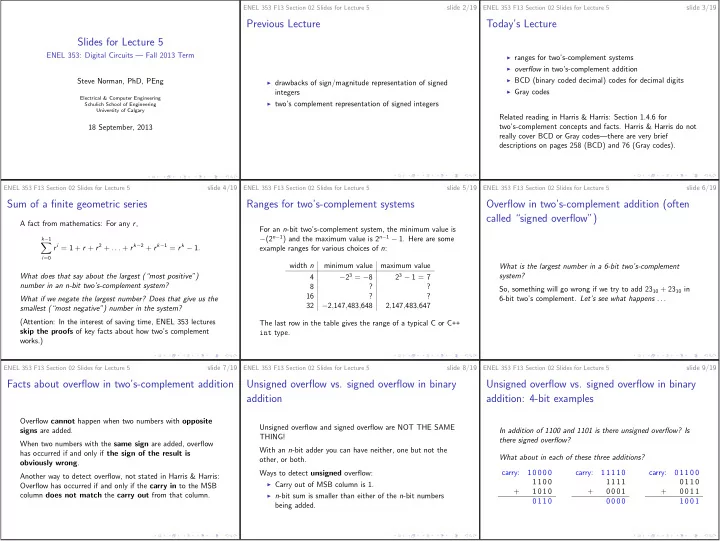
Previous Lecture

◮ drawbacks of sign/magnitude representation of signed integers ◮ two’s complement representation of signed integers ENEL 353 F13 Section 02 Slides for Lecture 5 slide 3/19

Today’s Lecture

◮ ranges for two’s-complement systems ◮ overflow in two’s-complement addition ◮ BCD (binary coded decimal) codes for decimal digits ◮ Gray codes Related reading in Harris & Harris: Section 1.4.6 for two’s-complement concepts and facts. Harris & Harris do not really cover BCD or Gray codes—there are very brief descriptions on pages 258 (BCD) and 76 (Gray codes). ENEL 353 F13 Section 02 Slides for Lecture 5 slide 4/19

Sum of a finite geometric series

A fact from mathematics: For any r, k−1
  • i=0
r i = 1 + r + r 2 + . . . + r k−2 + r k−1 = r k − 1. What does that say about the largest (“most positive”) number in an n-bit two’s-complement system? What if we negate the largest number? Does that give us the smallest (“most negative”) number in the system? (Attention: In the interest of saving time, ENEL 353 lectures skip the proofs of key facts about how two’s complement works.) ENEL 353 F13 Section 02 Slides for Lecture 5 slide 5/19

Ranges for two’s-complement systems

For an n-bit two’s-complement system, the minimum value is −(2n−1) and the maximum value is 2n−1 − 1. Here are some example ranges for various choices of n: width n minimum value maximum value 4 −23 = −8 23 − 1 = 7 8 ? ? 16 ? ? 32 −2,147,483,648 2,147,483,647 The last row in the table gives the range of a typical C or C++ int type. ENEL 353 F13 Section 02 Slides for Lecture 5 slide 6/19

Overflow in two’s-complement addition (often called “signed overflow”)

What is the largest number in a 6-bit two’s-complement system? So, something will go wrong if we try to add 2310 + 2310 in 6-bit two’s complement. Let’s see what happens . . . ENEL 353 F13 Section 02 Slides for Lecture 5 slide 7/19

Facts about overflow in two’s-complement addition

Overflow cannot happen when two numbers with opposite signs are added. When two numbers with the same sign are added, overflow has occurred if and only if the sign of the result is
  • bviously wrong.
Another way to detect overflow, not stated in Harris & Harris: Overflow has occurred if and only if the carry in to the MSB column does not match the carry out from that column. ENEL 353 F13 Section 02 Slides for Lecture 5 slide 8/19

Unsigned overflow vs. signed overflow in binary addition

Unsigned overflow and signed overflow are NOT THE SAME THING! With an n-bit adder you can have neither, one but not the
  • ther, or both.
Ways to detect unsigned overflow: ◮ Carry out of MSB column is 1. ◮ n-bit sum is smaller than either of the n-bit numbers being added. ENEL 353 F13 Section 02 Slides for Lecture 5 slide 9/19

Unsigned overflow vs. signed overflow in binary addition: 4-bit examples

In addition of 1100 and 1101 is there unsigned overflow? Is there signed overflow? What about in each of these three additions? carry: 1 0 0 0 0 1 1 0 0 + 1 0 1 0 0 1 1 0 carry: 1 1 1 1 0 1 1 1 1 + 0 0 0 1 0 0 0 0 carry: 0 1 1 0 0 0 1 1 0 + 0 0 1 1 1 0 0 1
slide-2
SLIDE 2 ENEL 353 F13 Section 02 Slides for Lecture 5 slide 10/19

Codes

In this course, a code is a system for representing numbers or symbols with sequences of 1’s and 0’s. Codes we’ve seen so far in this course: unsigned binary, sign/magnitude, two’s complement. Some other important codes: ASCII code for text, BCD code for base ten numbers, Gray codes. ENEL 353 F13 Section 02 Slides for Lecture 5 slide 11/19

BCD: Binary Coded Decimal

Each digit in a BCD-encoded decimal number is represented by a 4-bit “word”. For example, in 16-bit BCD, how would 198510 be encoded? decimal BCD code digit “word” 0000 1 0001 2 0010 3 0011 4 0100 5 0101 6 0110 7 0111 8 1000 9 1001 ENEL 353 F13 Section 02 Slides for Lecture 5 slide 12/19

An application of BCD encoding: Simple calculators

Keyboard input is base ten, and so is display output. To keep the design as simple as possible, it makes sense to store numbers and do arithmetic in base ten. Photo from www.oldcalculatormuseum.com/us1.html ENEL 353 F13 Section 02 Slides for Lecture 5 slide 13/19

How each digit in the calculator is displayed

Each digit uses a “7-segment display”—a collection of 7 LEDs. (More modern equipment uses LCDs instead of LEDs—LCDs use much less power.)

BCD−to− seven− segment decoder 4−bit BCD word 7 bits turn segments

  • n or off
ENEL 353 F13 Section 02 Slides for Lecture 5 slide 14/19

BCD Arithmetic Algorithms, Circuits and Software

A BCD-based calculator needs logic circuits and microprocessor software to do BCD arithmetic: addition, subtraction, multiplication, division. Past years’ versions of ENEL 353 spent a little time explaining how to do BCD addition. Students in ENEL 353 in Fall 2013 will NOT be tested on BCD addition or any other kind of BCD arithmetic. ENEL 353 F13 Section 02 Slides for Lecture 5 slide 15/19

Gray codes

In an n-bit Gray code, each code word differs from the previous one in only one bit
  • position. Also the first and
last codes differ in only one bit position. That is NOT true for n-bit unsigned binary encoding! 3-bit 3-bit unsigned Gray number binary code code 000 000 1 001 001 2 010 011 3 011 010 4 100 110 5 101 111 6 110 101 7 111 100 ENEL 353 F13 Section 02 Slides for Lecture 5 slide 16/19

Construction of Gray codes

Start with 1-bit Gray code . . . 1-bit num- Gray ber code 1 1 Duplicate previous Gray code in reverse order . . . incomplete 2-bit num- Gray ber code 1 1 2 1 3 1st half gets leading 0, 2nd half gets leading 1 . . . complete 2-bit num- Gray ber code 00 1 01 2 11 3 10 Repeat this process until the code has the desired number of bits. ENEL 353 F13 Section 02 Slides for Lecture 5 slide 17/19

Construction of Gray codes, continued

Let’s use the construction algorithm to generate the 3-bit Gray code. Do it yourself: Starting with the 3-bit Gray code, use the construction algorithm to generate the 4-bit Gray code, and check your work against the table on the next slide. ENEL 353 F13 Section 02 Slides for Lecture 5 slide 18/19

4-bit Gray code

number Gray code number Gray code 0000 8 1100 1 0001 9 1101 2 0011 10 1111 3 0010 11 1110 4 0110 12 1010 5 0111 13 1011 6 0101 14 1001 7 0100 15 1000
slide-3
SLIDE 3 ENEL 353 F13 Section 02 Slides for Lecture 5 slide 19/19

Next Lecture

A little more about Gray codes. Introduction to logic gates. Related reading in Harris & Harris: Section 1.5