
SLIDE 1
Stacey Schmick Shoecraft
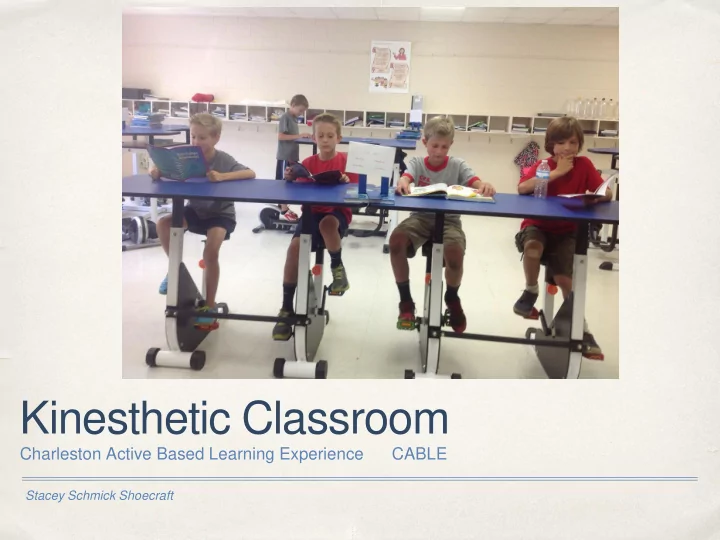
Kinesthetic Classroom
Charleston Active Based Learning Experience CABLE
Kinesthetic Classroom Charleston Active Based Learning Experience - - PowerPoint PPT Presentation
Kinesthetic Classroom Charleston Active Based Learning Experience CABLE Stacey Schmick Shoecraft A few things... Learning Mission: discuss HOW to create a Kinesthetic classroom with brain blasts Participate, it helps you OWN it!
Stacey Schmick Shoecraft
Charleston Active Based Learning Experience CABLE
✤ Learning Mission: discuss HOW to create a Kinesthetic
✤ Participate, it helps you OWN it! ✤ Questions? Put on a post it note, give it to me, & I will
Special accommodations led me to have an epiphany!
One child with special needs made an impact on the rest of the class. Everyone else liked the movement too.
01
"I need to cross my mid-line!"
01
✤ Math Madness game to reinforce
math skills
✤ Start with a warmup to get them
motivated
✤ How game is played
01
Open House 2012 I asked for parents to donate their old equipment. Little did I know...
I wanted this but didn't know how to come up with the money.
When a student wrote a blog, it got the attention of others. Hmmm,...
Business Lunches: The letter writing process begins!
AWESOME RAINBOWS!
01
✤ Student letters to local
companies and hospitals
✤ I wrote several grants ✤ Donations from friends ✤ Student sold toys on eBay to
donate money
✤ PTO assistance ✤ Generous support from admin
✤ Behavior ✤ ADHD/ADD ✤ Gifted ✤ Resource ✤ Remember: movement doesn't inhibit learning, we
Still a work in progress with CofC but...one student went up 69 points and another 70!
Three Questions: How much time? What about during testing? Do YOU need a stretch?
01
✤ Walk and Talk ✤ YouTube ✤ GoNoodle ✤ Pintrest/Teachers Pay Teachers ✤ Discs/stretch bands ✤ Kinesthetic tables ✤ Yoga balls
Cool School Report
We realize it isn't just our classroom but the school, the district, and the nation!
http://www.schooltube.com/video/a076effb0a4a4d419ac3/ABL%20highdef
Education is the key to helping people understand WHY movement is important.
Breyer, MD, Breyer Sr., JJ, Criddle, O, Smail, KM, and Shoecraft S., Department of Health and Human Performance
PURPOSE
The Effects of the Kinesthetic Learning during 5th Grade Math
The reduction of physical activity programs in schools has created an imbalance in academics and
participate in 60 minutes of moderate to vigorous exercise daily, which can be accomplished in one session or mini sessions throughout the week (Rabbia F 2002). Many students sit still for close to five of the seven hours they are in school, causing students to become unfocused as they have no
about 60 minutes of physical education a week, teachers have to find other opportunities to get their students active. This study’s main purpose is to investigate the effect of exercise on academic learning in a 5th grade classroom. The introduction
physical activity while simultaneously participating in classroom academics.
Time on task is being observed to understand if it is practical that students can do their work while actively using the tables. Heart rate is being measured to see if there is a training effect with use of these tables that could benefit the student. Balance is being measured to study the effect of daily aerobic activity on overall physical fitness. The purpose of this study is to investigate if 5th grade male and female students benefit from using Kinesthetic desks during active learning environment.
Twenty-nine male and female 5th grade students in a classroom with kinesthetic tables participated in active learning for 8 weeks. Heartrate: Resting heartrates were taken daily prior to and throughout the math block.
Time on task: Students were observed during active learning blocks
material, looking up a word in the dictionary.
material silently, looking at board during instruction, listening to peer.
touching another student, drawing or writing that is unrelated, turning around in seat, fidgeting for at least 3 consecutive seconds.
about unrelated issues, talking when prohibited, making unauthorized comments, calling out answers.
window, passively listening to another student talk about unrelated topics. Balance: Students were assessed on balance prior to and after the 8 week duration of the study. The modified stork stand was used as the assessment tool. Students were timed in seconds for two trials on both right and left standing legs, in eyes open and closed conditions.
Time on task was observed using the BOSS system While student showed to be either actively or passively engaged only 38% of boys were actively using the tables while 51.4% of girls were actively using the tables. 18% of the class did not actively use the tables throughout the study. Boys were more passively engaged while girls were more actively engaged. Heartrate data was collected using MIO heartrate monitors. Resting heartrate taken after sitting quietly for 5 minutes. Heartrate was then taken in 5 minute increments thereafte Heartrate fluctuations seen in students showed that with kinesthetic desk their heartrates were elevated when active as opposed to being sedentary. No significant changes were found in resting heartrate Balance was measured using the modified stork stand test Improvements were found in both eyes closed conditions. Significant improvements were observed in the eyes open condition with left leg standing. 86% of participants were self-reported to be right leg dominant. Fairclough SJ, Beighle A, Erwin H, Ridgers ND. (2012). School Day Segmented Physical Activity Patterns of High and Low Active Children. BMC Public Health, 12, 406. Khalsa, G.K., Morris, G.S.D., & Sifft, J.M. (1988). Effect of educational kinesiology on staticbalance of learning disabled students. Perceptual and Motor Skills, 67, 51-54. Rabbia F, Grosso T, Genova GC, Conterno A, De Vito B, Mulatero P, Chiandussi L,Veglio L. (2002). Assessing Resting Heart Rate in Adolescents: Determinants and Correlates. Journal of human hypertension, 16, 327-332. Shapiro, E.S. (2004). Academic skills problems: direct assessment and intervention (3rd ed.). New York: Guilford Press. Shumway-Cook, A., & Woollacott, M.H.(1985). The growth of stability: postural control from a developmental perspective. J Mot Behav,17,131-147. Williams CA, Armstrong N, Powell J. (2000). Aerobic Responses of Prepubertal Boys to Two Modes of Training. British Journal of Sports Medicine, 34, 168- 173. Wilson, M.S., & Reschly, D.J. (1996). Assessment in school psychology training and practice. School Psychology Review, 25, 9-23.
Based on our research findings, the use of kinesthetic tables in an academic learning environment can be beneficial to time on
There was no significant increase in balance, therefore it can not be concluded that the desks increased overall physical fitness. Further research should include a longer study with the utilization of these desks in the classroom. Major limitations of the current research were the inability to control the use of the machines by the student, the intensity at which they exercised throughout the day, and time restraints to conduct pre- and post- balance tests.
Individuals utilizing kinesthetic desks will be more attentive and focused during active learning. There will be an overall increase in heartrate in students utilizing kinesthetic desks during active learning. Individuals utilizing kinesthetic desks will improve balance as an indicator of overall physical fitness.
INTRODUCTION HYPOTHESIS METHODOLOGY RESULTS
Heartrate Trends
Balance
Time on Task
KEY OUTCOMES REFERENCES Tables/Graphs CONCLUSION
Department of Health and Human Performance, College of Charleston, May 2014
Add to your Smartboard and use the dice! Takes less than a minute to do.
01
✤ YOU are an important part of
making this happen.
✤ 2 important dates ✤ Questions? ✤ Ideas?