21st Century Transportation for Wisconsin Peter Skopec Director, - - PowerPoint PPT Presentation

21st century transportation for wisconsin
SMART_READER_LITE
LIVE PREVIEW

21st Century Transportation for Wisconsin Peter Skopec Director, - - PowerPoint PPT Presentation

21st Century Transportation for Wisconsin Peter Skopec Director, Wisconsin Public Interest Research Group Image Credit: Tom Wang/Shutterstock; Flickr user SounderBruce, CC BY-SA 2.0 WISPIRG: Grassroots Organizing, Advocacy & Research The


slide-1
SLIDE 1

Peter Skopec

Director, Wisconsin Public Interest Research Group

21st Century Transportation for Wisconsin

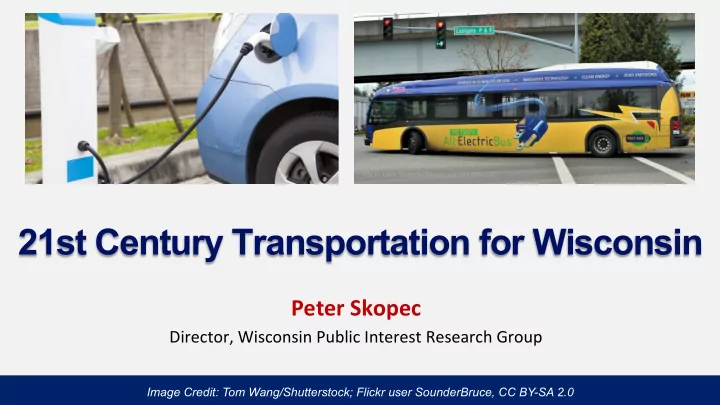
Image Credit: Tom Wang/Shutterstock; Flickr user SounderBruce, CC BY-SA 2.0
slide-2
SLIDE 2

WISPIRG: Grassroots Organizing, Advocacy & Research

slide-3
SLIDE 3

The Benefits of EVs: Cleaner Air, Lower Emissions, Consumer Savings

  • Exposure to diesel soot and

ground-level ozone is linked to higher mortality rates.

  • EVs have half the carbon footprint
  • f gasoline-powered cars over their

lifetime.

  • On average, it costs about half as

much to drive an EV as it does to drive a gasoline-powered car.

Sources: Union of Concerned Scientists, 2015; Quian Di et al., 2017; Dept. of Energy, 2018; Image Credit: Lorenz Markus Flickr, CC BY 2.0

slide-4
SLIDE 4

2016: +38% 2017: +32%

EV Sales Are at an All-Time High

Source: Veloz, Sales Dashboard, 2018.

slide-5
SLIDE 5

Cities Need to Prepare for More EVs Hitting the Road

  • Madison could see 9,000 EVs on

the road by 2030, requiring up to 280 additional public and workplace charging locations.

  • Milwaukee could have 17,000

EVs on city streets by 2030. Milwaukee will need more than 600 additional public and workplace charging stations by 2030.

Calculations based on data from National Renewable Energy Laboratory, U.S. Census Bureau, Dept. of Energy

slide-6
SLIDE 6

Estimated # of Public Plugs Needed by 2030 Current # of Public Plugs in City Limits

City

Population (2010 Census) Projected Number of EVs in City Limits by 2030 Public & Workplace Level 2 Chargers Needed Public Fast Chargers Needed Existing Level 2 Chargers Existing Fast Chargers Green Bay

104,057 4,000 144 6 6

Appleton

72,623 2,900 104 4 5

Oshkosh

66,083 2,400 86 4 3 1

Calculations based on data from National Renewable Energy Laboratory, U.S. Census Bureau, Dept. of Energy

slide-7
SLIDE 7

So What Should Communities Do?

Improve residential access to on-street charging.

Image Credit: Tim Kiser via Wikimedia, CC BY-SA 2.5; Jason Cartwright via Flickr, CC BY 2.0.

slide-8
SLIDE 8

So What Should Communities Do?

Support public, “semi-public” & workplace charging stations.

Image Credit: WISPIRG staff; Nicolas.boullosa, from Flickr, via Wikimedia, CC BY 2.0.

slide-9
SLIDE 9

So What Should Communities Do?

Incentivize EV parking and charging, and reform parking policies.

Image Credit: Vitavia, via Wikimedia, CC BY 2.0; Visitor7 via Wikimedia, CC-BY-SA-3.0.

slide-10
SLIDE 10

So What Should Communities Do?

Encourage electric shared mobility options like carsharing, ridesharing and bikesharing.

Image Credit: Deb Nystrom via Wikimedia, CC BY 2.0; Staff

slide-11
SLIDE 11

The Importance of Electric School & Transit Buses

  • 95% of U.S. school buses,

carrying some of the most vulnerable passengers, run

  • n diesel.
  • More than 60% of U.S.

transit buses run on diesel, and another 18% run on natural gas.

  • Only 0.2% of U.S. buses are

all-electric.

Sources: Robert Pudlewski, School Transportation News, 4/2017; U.S.DOT, 2017; Image credit: Rockford’s New Country Q98.5 via YouTube (with permission)

slide-12
SLIDE 12

All-Electric Buses Are Cleaner, Healthier, Often Cheaper

Source: California Air Resource Board, 2017.

slide-13
SLIDE 13

All-Electric Buses Are Cleaner, Healthier, Often Cheaper

Source: Clinton Global Initiative V2G EV School Bus Working Group; National Renewable Energy Laboratory

State leaders should use VW “Dieselgate” settlement funds to help transit agencies and school districts buy all-electric buses.

slide-14
SLIDE 14

Electrification Alone Won’t Fix Our Transportation System

To create a clean and effective 21st century transportation system for Wisconsin, we have to get people to drive less. That means:

  • No new highway expansions
  • More public transportation
  • More active transportation (walking,

biking etc.)

  • Compact community development
  • Smart pricing
slide-15
SLIDE 15

Peter Skopec

WISPIRG Director

(608) 268-1656 peter@wispirg.org