
SLIDE 1
1
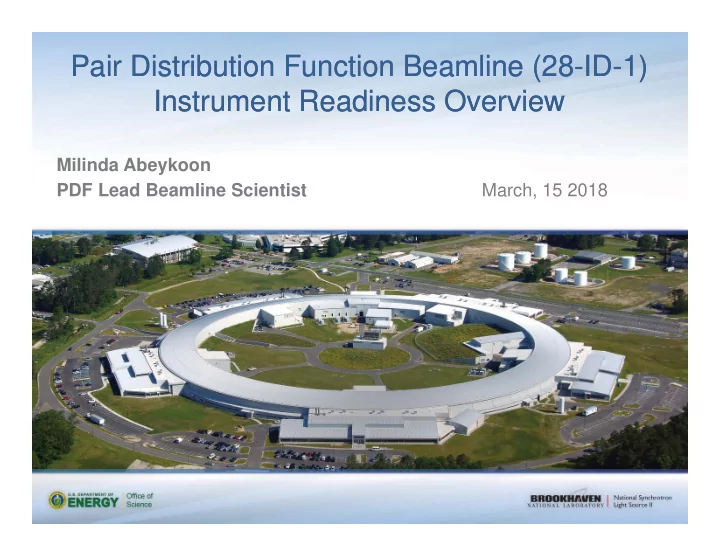
Pair Distribution Function Beamline (28-ID-1) Instrument Readiness Overview Pair Distribution Function Beamline (28-ID-1) Instrument Readiness Overview
Milinda Abeykoon PDF Lead Beamline Scientist March, 15 2018
Pair Distribution Function Beamline (28-ID-1) Pair Distribution - - PowerPoint PPT Presentation
Pair Distribution Function Beamline (28-ID-1) Pair Distribution Function Beamline (28-ID-1) Instrument Readiness Overview Instrument Readiness Overview Milinda Abeykoon PDF Lead Beamline Scientist March, 15 2018 1 Outline Outline
1
Pair Distribution Function Beamline (28-ID-1) Instrument Readiness Overview Pair Distribution Function Beamline (28-ID-1) Instrument Readiness Overview
Milinda Abeykoon PDF Lead Beamline Scientist March, 15 2018
2
Outline Outline
Beamline Layout, IRR Scope, Commissioning Sequence
– Radiation Safety Components, Other Credited Controls, EPS, Controls, Diagnostics, Utilities
– Beamline Staff
3
Scientific Program Scientific Program
can be used to explore local structural fluctuations in complex materials.
(WAXS), and complementary Small Angle Scattering (SAXS).
resolved studies of materials in their real world applications (Ex. Batteries, fuel-cells, etc.).
O1
Slide 3 O1
This does not address the scientiffic aspects of PDF
Owner, 3/8/2018
4
5.11Å 4.92Å 4.26Å 3.76Å 2.84Å 2.46Å 1.42Å
Pair distribution function (PDF) gives the probability of finding a neighbor atom at a distance “r” from a given atom.
Two dimensional representation of the PDF Two dimensional representation of the PDF
5
Carbon buckyballs
What the PDF can say about the crystal structure
What the PDF can say about the crystal structure
6
Reviews Reviews
Event Date 28‐ID PDR
SBM PDR (FMB Oxford)
SBM FDR (FMB Oxford)
VFM PDR (Winlight X) April 25, 2016 VFM FDR (Winlight X) June 20‐21, 2016 BTS PDR (Axilon)
BTS FDR (Axilon) March 8‐9, 2017 RSC Preliminary Review February 13, 2018 RSC Final Review February 28, 2018
Radiation Survey Procedure Radiation Survey Procedure
Beamlines, XPD/PDF (28‐ID) Radiation Survey Procedure (NSLSII‐28ID‐PRC‐001)
O2
Slide 6 O2
Include Year, and include RSC preliminary and final review?
Owner, 3/8/2018
7
Beamline Design Parameters Beamline Design Parameters
Photon Source 3‐pole wiggler Operational Energies 39 keV, 64 keV, 75 keV, and 117 keV Monochromator type Focusing Laue (Si Crystal) Energy Bandwidth (ΔE/E) ≈ 0.7 % with a horizontal fan of 0.3 mrad on the SBM Beam size at sample (0.25 x 0.25) mm – (1 x 1) mm Flux at sample at 500 mA: 1013 photons/sec/0.1% BW at 75 (keV) Detectors 2 PerkinElmer area detectors, 2 scintillator counters, and 2 photodiodes each embedded in a beamstop. Monochromator crystals
8
28-ID Beamline Layout 28-ID Beamline Layout
PDF IRR Scope
9
PDF FOE Components
Side Bounce Monochromator (SBM) White beam stopper PDF Vertically Focusing Mirror XPD Vertically Focusing Mirror SBRS3 Beam Diagnostic Module SBRS2 PDF PSH XPD PSH PDF Guillotine (50.8 mm Pb) PDF SLW2 SBM Vessel
10
Beamline Layout (3-D) Beamline Layout (3-D)
PDF Experimental End‐Station
Monochromatic beam stop Optics Conditioning Module Detector Bridge Sample Table
Detector 1 Detector 2 SAXS Tube Beam stop Beam stop
ECS
Gas chamber
11
Beamline Layout (3-D) Beamline Layout (3-D)
PDF Experimental End‐Station
Optics Conditioning Module Detector Bridge Sample Table
SAXS Tube
12
IRR Scope IRR Scope
PDF IRR Scope Only Includes:
the FOE downstream and hutch B upstream walls.
delivery system.
13
Commissioning Sequence Commissioning Sequence
All equipment in the FOE at 75 keV at 375 mA
Experimental hutch B and the end-station at 75 keV
Experimental hutch B and the end-station at other discrete energies
Note: Radiation survey already performed without crystal in SBM after installing the PDF shielded beam transport. BSA document NSLSII‐28‐ID‐1‐PLN‐001.pdf
14
Self-Identified Pre- and Post-Start Findings Self-Identified Pre- and Post-Start Findings
Pre-start findings:
None
Post-start findings:
None
15
Ray Tracing: Synchrotron Beam (Horizontal) Ray Tracing: Synchrotron Beam (Horizontal)
Drawing
16
Drawing
Ray Tracing: Synchrotron Beam (Vertical) Ray Tracing: Synchrotron Beam (Vertical)
17
SBM vacuum vessel added as a radiation safety component in FLUKA
17
Plan View (y=0) Elevation View (x=0) SBM vacuum chamber
18
GB on FMK2 aperture – O/B side Total Dose Rates (mrem/h)
18
Plan View (y=0) Elevation View (x=0) With SBM Vacuum Chamber included 0.1 0.1
19
GB on FMK2 aperture – O/B side Total Dose Rates (mrem/h)
19
D/S Wall (Contact) D/S Wall (30cm)
20
GB on FMK2 aperture – beam hitting I/B side Total Dose Rates (mrem/h)
20
Plan View (y=0) Elevation View (x=0) With SBM Vacuum Chamber included 0.1 0.1
21
GB on FMK2 aperture – O/B side Total Dose Rates (mrem/h)
21
D/S Wall (Contact) D/S Wall (30cm)
CONCLUSION: DOSE RATES ARE WITHIN ACCEPTBLE LIMITS
0.05 0.05
22
Synchrotron Beam (FLUKA calculations) Synchrotron Beam (FLUKA calculations)
Conclusions:
10.37 ° 18 mm 50 mm
23
compliances found with the previously-reviewed part of 28-ID that are deemed either minor or acceptable based on conservative FEA or dose calculations.
(Reference. RSC review on Feb. 28, 2018, & Memo:pdf_rsc2018_V002)
adequate shielding for GB and SR.
(Reference: 28ID-PDF_BeamlineRadiationShieldingAnalysis_180307)
roof were all below 0.05 mrem/h (on contact). In one case, including the SBM Vacuum chamber (under Configuration Control) reduces the dose rate a foot away to less than 0.05 mrem/h thus meeting NSLS-II requirements.
Conclusions of RSC review and FLUKA analysis Conclusions of RSC review and FLUKA analysis
O3
Slide 23 O3
Owner, 3/8/2018
24
Hazard Identification and Mitigation Hazard Identification and Mitigation
design/construction and commissioning (SBMS & ISM)
Hazard Mitigation Radiation Shielding, PPS, ARM Pressure Safety FEA calculations, over‐pressure tests, burst disks Electrical EEI, grounding, installation according to code Detector Bridge large moving mass PPS interlocked motion. (Reference: NSLSII‐28ID1‐WIN‐ 002, PDF End Station Bridge Safe Operation, E‐stop and Interlock Test)
*** The detector bridge only allows positioning of the attached detectors and does not manipulate other equipment or material as is common for industrial
definition (Reference: BSA Memo, NSLSII‐28ID1‐MEM‐001)
25
PDF Radiation Safety Components PDF Radiation Safety Components
Photon Shutter Guillotine Monochromatic Beamstop SBM Vessel Shielded Beam transport
26
Shielded Enclosures and Transport Pipes Shielded Enclosures and Transport Pipes
Hutch A (FOE): (Not in PDF IRR Scope)
Shielded Beam Transport:
Hutch B (mono beam hutch) (Not in PDF IRR Scope)
(H) x 305 mm (V) x 25 mm (t) lead
27
Other Credited Safety Components Other Credited Safety Components
interlock system and search and secure procedure to ensure personnel safety during normal operation of the beamline. It also monitors critical DI water flow to the white beam stop (and to the first 28‐ID mask) to ensure the safe operation of the radiation shielding components. In the event that water flow is lost, the PPS system will close the photon shutter to shut off the synchrotron beam.
thermal status of various components of the beamline to ensure the safe operation
windowless operation of the PDF beamline.
28 28
Controls Controls
Delta Tau Motion Controllers are installed in 3 Roof Racks
29
Beam Diagnostics Beam Diagnostics
Optics Conditioning Module (OCM) Beam Diagnostic Module (BDM)
30
Utilities Utilities
include beamline experimental gas handling system which is being installed)
Note- most Utilities systems including LN2, PCHW, & DI water were previously designed, installed, & reviewed. Only PDF connections (SBM cooling system) to these systems are within PDF IRR scope.
31
PDF Beamline Staff PDF Beamline Staff
Lead Beamline Scientist
Authorized Beamline Staff Eric Dooryhee (XPD Lead Scientist, DISC Program manager) Beamline Supporting Staff Ed Haas (Beamline Mechanical Engineer) Christopher Stelmach (Beamline Design Engineer) Oksana Ivashkevych (Beamline Control Engineer ) John Trunk (DISC Program Technical Coordinator)
BDN Staff BDN Staff
Project Manager Julian Adams Project Controls Peter Selgrad, Phillip Hollabaugh, Business Operations Heather Turbush
** All staff members have completed the required training
32