Outline Threshold Homomorphic Cryptosystems (THCs) Basic examples - - PDF document

outline
SMART_READER_LITE
LIVE PREVIEW

Outline Threshold Homomorphic Cryptosystems (THCs) Basic examples - - PDF document

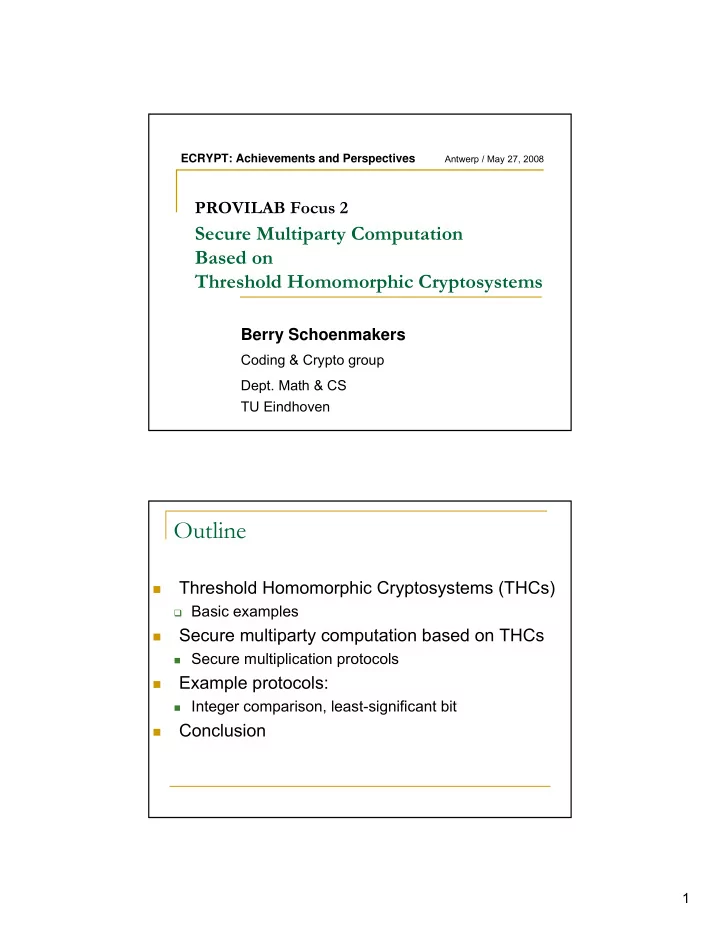
ECRYPT: Achievements and Perspectives Antwerp / May 27, 2008 PROVILAB Focus 2 Secure Multiparty Computation Based on Threshold Homomorphic Cryptosystems Berry Schoenmakers Coding & Crypto group Dept. Math & CS TU Eindhoven Outline


slide-1
SLIDE 1

1

PROVILAB Focus 2

Secure Multiparty Computation Based on Threshold Homomorphic Cryptosystems

Berry Schoenmakers

Coding & Crypto group

  • Dept. Math & CS

TU Eindhoven

ECRYPT: Achievements and Perspectives Antwerp / May 27, 2008

Outline

  • Threshold Homomorphic Cryptosystems (THCs)

Basic examples

  • Secure multiparty computation based on THCs

Secure multiplication protocols

  • Example protocols:

Integer comparison, least-significant bit

  • Conclusion
slide-2
SLIDE 2

2

Threshold Homomorphic Cryptosystems

=

Public Key Cryptosytems + Homomorphic Encryption + Threshold Decryption

Tetra Hydro Cannabinol

THC: threshold t out of n parties

Distributed Key Generation protocol

all n parties generate a shared private key

Homomorphic Encryption algorithm

like ordinary public key encryption

probabilistic but with a homomorphic property: E(x) * E(y) = E(x+y)

Threshold Decryption protocol

any t parties can jointly decrypt ciphertexts

slide-3
SLIDE 3

3

Popular choice of THCs

Homomorphic ElGamal

Eg,h(m,r) = (gr, hr gm)

DDH assumption Pros:

  • efficient DKG to share

private key α = logg h [Ped91,…,AF04]

  • allows for elliptic curves

(exponential security)

Cons:

  • limited decryption (only full

decryption of gm, from which m needs to be recovered still).

Paillier

En(m,r) = (1+n)m rn mod n2

RSA

  • like assumption

Pros:

  • full decryption of message m

Cons:

  • expensive DKG for generating a

shared RSA modulus [Gil99,ACS02]. Cost of DKG may dominate total cost.

  • nly subexponential security

Popular choice of THCs (cont.)

ELGamal-Paillier amalgam (CraSho’02, DamJur’03)

Eg,h,n(m,r) = ( gs mod n, (1+n)m (hs mod n)n mod n2 )

DDH and RSA-like assumption Pros:

  • full decryption of message m
  • expensive DKG now only at system setup

(single, system-wide RSA modulus n for all users)

Cons:

  • large overhead due to large ciphertexts, e.g. compared to ElGamal

combined with elliptic curves

  • even if secure computation is mostly bitwise (Boolean circuits)
  • relies on two assumptions:
  • factorization of RSA modulus n is actually a trapdoor
slide-4
SLIDE 4

4

Example homomorphic properties

Homomorphic ElGamal

Group <g> of prime order q. Private key α Zq. Public key h = gα. Encryption of message m Zq:

(a, b) = (gr, hr gm), random r Zq

Homomorphic properties:

Additively homomorphic:

(a, b) (a', b') = (aa', bb')= ( gr+r' , hr+r' gm+m' )

Multiplication by a constant:

(a, b)c = ( ac, bc ) = ( grc , hrc gcm )

Random re-randomization (blinding):

(a, b) (gr', hr') = ( gr+r' , hr+r' gm )

Shorthand notation:

  • Additive homomorphic:

E(m) * E(m’) = E(m+m’)

  • Multiplication by a constant:

E(m)c = E(c m)

  • Random re-randomization:

E(m) * E(0) = E(m)

Secure multiparty computation based on THCs

Focus actually on: Secure Function Evaluation

slide-5
SLIDE 5

5

Secure Function Evaluation

Circuit for f

P1: x E(x) E(y) P2: y E(f(x,y)) input stage

  • utput

stage evaluation stage f(x,y)

Secure Function Evaluation from THCs

Franklin, Haber (1993)

  • Boolean circuits
  • uses GM-ElGamal variant (factoring-based), hard DKG
  • secure against passive adversaries

Jakobsson, Juels (2000) “Mix and Match”

  • Boolean circuits
  • uses ElGamal, easy DKG
  • secure against active, static adversaries

Cramer, Damgård, Nielsen (2001)/Damgård, Nielsen (2003)

  • arithmetic circuits
  • uses factoring-based cryptosystems (e.g., Paillier), hard DKG
  • secure against active, static/adaptive adversaries

Schoenmakers, Tuyls (2004) “Conditional Gate”

  • “enhanced Boolean” circuits or “restricted arithmetic” circuits
  • more powerful and more efficient than Mix and Match
  • uses ElGamal, easy DKG
  • secure against active, static adversaries
slide-6
SLIDE 6

6

Arithmetic Circuits

Addition gates:

Input: E(x) , E(y) Output: E(x + y) For free because of homomorphic property:

E(x) * E(y) = E(x + y)

Multiplication gates:

Input: E(x) , E(y) Output: E(x y) Requires a protocol, using threshold decryption

For simplicity, in this talk: two, semi-honest parties

Multiplication Gate [CDN01,DN03]

Input: E(x) and E(y) Output: E(xy) P1 sends E(r1), E(y)r1 for random r1 P2 sends E(r2), E(y)r2 for random r2 Threshold-decrypt E(x)E(r1)E(r2) to obtain:

r = x+r1+r2

Output: E(y)r / (E(y)r1 E(y)r2) = E(xy) Full decryption of r required (e.g. Paillier)

Random value r, statistically hides any information on x

slide-7
SLIDE 7

7

Conditional Gate [ST04]

Input: E (x) , E (y) Output: E (x y) Hard, using ElGamal! General solution using just homomorphic ElGamal

encryption would solve the Diffie-Hellman problem (computing gxy from gx and gy ), even knowing the private key for decrypting E(x) and E(y).

Thus, use restricted multiplication gates

Assume multiplier x is only two-valued!

Conditional Gate - Protocol

Input: E[x], E[y], with x{1,-1} Output: E[xy] Protocol:

Party 1 picks random s1{1,-1}, and sets:

E[x]s1 = E[s1x], E[y]s1 = E[s2y]

Party 2 picks random s2{1,-1}, and sets:

E[s1x]s2 = E[s1s2x], E[s1y]s2 = E[s1s2y]

Threshold decrypt E[s1s2x]

z = s1s2x

Publicly compute, using s1

2=s2 2=1:

E[s1s2y]z = E[s1s2y s1s2x] = E[xy]

Uniform random value in {1,-1}: does not reveal any information

  • n x
slide-8
SLIDE 8

8

Two examples

Integer comparison Least-significant bit

Integer comparison x>y

Input: E[x], E[y] Output: x > y (public output) 1st attempt (like equality test):

form E[x-y] multiply with random “positive” r to form E[r(x-y)] threshold decrypt to get r(x-y) decide x>y based on “sign” of r(x-y)

… problem: non-uniform value for r(x-y)

slide-9
SLIDE 9

9

Integer comparison x>y

Resort to bit-by-bit methods: x = (xm-1,…,x0)2 , y = (ym-1,…,y0)2 Input: E[x0],…,E[xm-1] , E[y0],…,E[ym-1]

Output: x>y

Intuitively: compare most significant bits, until 1st difference found. But one must hide where the difference is found!!!

Use a circuit (oblivious program): data-independent execution path Central goal: find efficient circuits

  • Ignore addition (for free)
  • Minimize # of multiplication gates

computational complexity

  • Minimize depth of circuit (longest critical path) round complexity

Circuits for x >y [ST04]

  • Counterintuitive lsb-to-msb traversal beats msb-to-lsb traversal
  • lsb-to-msb circuit:

traverse x and y starting at least significant bit if difference found, record whether xi > yi (i.e., xi = 1 and yi = 0) continue all the way to the end, keeping last recorded result

t0 = 0, ti+1 = (1−(xi yi)) ti + xi (1 − yi) = (1− xi − yi + 2 xi yi) ti + xi − xi yi

  • utput: tm
  • Per iteration only 2 multiplications: xi yi and (1−xi − yi + 2 xi yi) ti
  • Depth is m (linear)

Can be improved easily to a depth log2 m circuit with 3m muls (PKC’07).

slide-10
SLIDE 10

10

LSB Gate [ST06]

Input: E(x) Output: E(lsb(x)) “least-significant bit of x” Let M denote message space of E. Assume: 0 ≤ x < 2m with m << log |M| Use statistical security parameter k with

m+k < log |M|

LSB Gate - Protocol

Party 1 and party 2 jointly generate a

encrypted random bit b and random integer r{0,..,2m+k-1-1}, and posts: E[b], E[r]

Threshold decrypt E[x+b+2r]

z = x+b+2r

Let z0 denote the least-significant bit of z.

Publicly compute:

E[b]z0 = E[ b z0] E[b + z0 – 2 b z0] = E[b z0] = E[lsb(x)]

slide-11
SLIDE 11

11

Concluding remarks

Comparison THC and VSS based

(V)SS = (Verifiable) Secret Sharing

Semi-honest case vs malicious case

THC expensive in semi-honest case:

but easy to go to malicious case universal verifiability for free

VSS can be really cheap in semi-honest case

but expensive and complicated to go to malicious case Communication complexity

for THC complexity depends linear on n (assuming broadcast) for VSS complexity is quadratic in n (each pair of parties)

Computational vs information

  • t

heoretic security

VSS can achieve information-theoretic security

slide-12
SLIDE 12

12

EU projects (with TUE involvement) related to secure multiparty computation

CACE (FP7 EU):

Computer Aided Cryptography Engineering

  • Incl. tools for zeroknowledge proofs and secure multiparty

computation

SecureSCM (FP7 EU):

Secure Supply Chain Management Companies along a supply chain want to reach a global optimum,

but without giving away their own (local) data

?

slide-13
SLIDE 13

13

Author’s address

Berry Schoenmakers

Coding and Crypto group

  • Dept. of Math. and CS

Eindhoven University of Technology P.O. Box 513 5600 MB Eindhoven Netherlands

berry@win.tue.nl http://www.win.tue.nl/~berry/