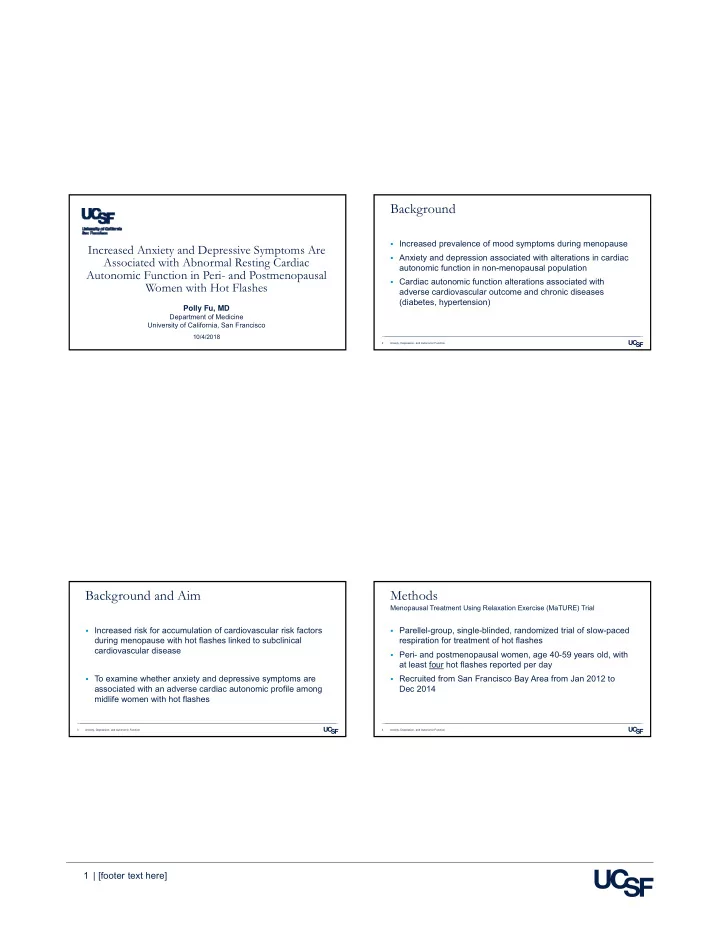
Background Increased prevalence of mood symptoms during menopause - - PDF document

background
SMART_READER_LITE
LIVE PREVIEW

Background Increased prevalence of mood symptoms during menopause - - PDF document

Background Increased prevalence of mood symptoms during menopause Increased Anxiety and Depressive Symptoms Are Anxiety and depression associated with alterations in cardiac Associated with Abnormal Resting Cardiac autonomic function in


slide-1
SLIDE 1

1 | [footer text here]

Increased Anxiety and Depressive Symptoms Are Associated with Abnormal Resting Cardiac Autonomic Function in Peri- and Postmenopausal Women with Hot Flashes

10/4/2018

Polly Fu, MD

Department of Medicine University of California, San Francisco

Anxiety, Depression, and Autonomic Function 2

Background

  • Increased prevalence of mood symptoms during menopause
  • Anxiety and depression associated with alterations in cardiac

autonomic function in non-menopausal population

  • Cardiac autonomic function alterations associated with

adverse cardiovascular outcome and chronic diseases (diabetes, hypertension)

Anxiety, Depression, and Autonomic Function 3

Background and Aim

  • Increased risk for accumulation of cardiovascular risk factors

during menopause with hot flashes linked to subclinical cardiovascular disease

  • To examine whether anxiety and depressive symptoms are

associated with an adverse cardiac autonomic profile among midlife women with hot flashes

Anxiety, Depression, and Autonomic Function 4

Methods

Menopausal Treatment Using Relaxation Exercise (MaTURE) Trial

  • Parellel-group, single-blinded, randomized trial of slow-paced

respiration for treatment of hot flashes

  • Peri- and postmenopausal women, age 40-59 years old, with

at least four hot flashes reported per day

  • Recruited from San Francisco Bay Area from Jan 2012 to

Dec 2014

slide-2
SLIDE 2

2 | [footer text here]

Anxiety, Depression, and Autonomic Function 5

Methods

Menopausal Treatment Using Relaxation Exercise (MaTURE) Trial

  • Anxiety and depressive symptoms assessed as continuous

scores

  • Spielberger State Trait Anxiety Inventory
  • Hospital Anxiety and Depression Scale
  • Beck Depression Inventory-II

Anxiety, Depression, and Autonomic Function 6

Methods

Menopausal Treatment Using Relaxation Exercise (MaTURE) Trial

  • Resting cardiac autonomic function assessed via impedence

cardiography and ECG

  • Respiratory sinus arrhythmia (RSA): Parasympathetic activity
  • Pre-ejection period (PEP): Sympathetic activity

Anxiety, Depression, and Autonomic Function 7

Methods

Menopausal Treatment Using Relaxation Exercise (MaTURE) Trial

  • To determine associations between anxiety, depression, and

cardiac autonomic markers

  • Multivariable repeated measures linear regression models
  • Adjusted for age and body mass index
  • Corrected for multiple comparisons with Benjamini-Hochberg

procedure

Anxiety, Depression, and Autonomic Function 8

Results

  • Among 121 participants (mean age 53 years old)
  • Mean of 8 hot flashes per day
  • No significant differences in anxiety and depressive symptoms

between paced respiration and music control groups

  • Resting cardiac autonomic markers were similar at baseline and

at 12 weeks with no significant between-group differences

slide-3
SLIDE 3

3 | [footer text here]

Anxiety, Depression, and Autonomic Function 9

Results

Anxiety, Depression, and RSA (Marker of Parasympathetic Activity) Respiratory Sinus Arrhythmia β (SE) P-value STAI – State Anxiety

  • 0.16 (0.01)

0.06 STAI – Trait Anxiety

  • 0.03 (0.01)

0.006 HADS Anxiety

  • 0.06 (0.02)

0.02 Beck Depression Inventory

  • 0.03 (0.01)

0.04 HADS Depression

  • 0.07 (0.03)

0.03

STAI – Spielberger State Trait Anxiety Inventory; HADS – Hospital Anxiety and Depression Scale

Anxiety, Depression, and Autonomic Function 10

Results

Anxiety, Depression, and PEP (Marker of Sympathetic Activity) Pre-Ejection Period β (SE) P-value STAI – State Anxiety

  • 0.24 (0.09)

0.02 STAI – Trait Anxiety

  • 0.11 (0.10)

0.24 HADS Anxiety

  • 0.31 (0.27)

0.25 Beck Depression Inventory

  • 0.09 (0.17)

0.60 HADS Depression

  • 0.40 (0.36)

0.26

STAI – Spielberger State Trait Anxiety Inventory; HADS – Hospital Anxiety and Depression Scale

Anxiety, Depression, and Autonomic Function 11

Summary

Among peri- and postmenopausal women with hot flashes,

  • Greater self-reported anxiety and depression were associated

with lower cardiac vagal tone

  • Greater self-reported state anxiety was associated with

higher resting sympathetic nervous system activation

Anxiety, Depression, and Autonomic Function 12

Summary

  • Our findings are consistent with prior studies showing lower

resting parasympathetic activity in patients with clinical anxiety disorders and major depressive disorder

  • From cardiovascular risk standpoint, lower RSA associated

with hypertension, hyperglycemia, and obesity. Lower RSA was also a strong predictor of sudden cardiac death after myocardial infarction

slide-4
SLIDE 4

4 | [footer text here]

Anxiety, Depression, and Autonomic Function 13

Conclusions

  • Midlife women with increased anxiety and depressive

symptoms may have an unfavorable cardiac autonomic profile with potential implication for their overall cardiovascular risk

Anxiety, Depression, and Autonomic Function 14

Acknowledgements

  • Alison J. Huang, MAS, MPhil
  • Caroly J. Gibson, PhD, MPH
  • Wendy Berry Mendes, PhD
  • Michael Schembri, BS

MaTURE trial was funded by National Center for Complementary and Integrative Health grant #5R01AT005491