SLIDE 1
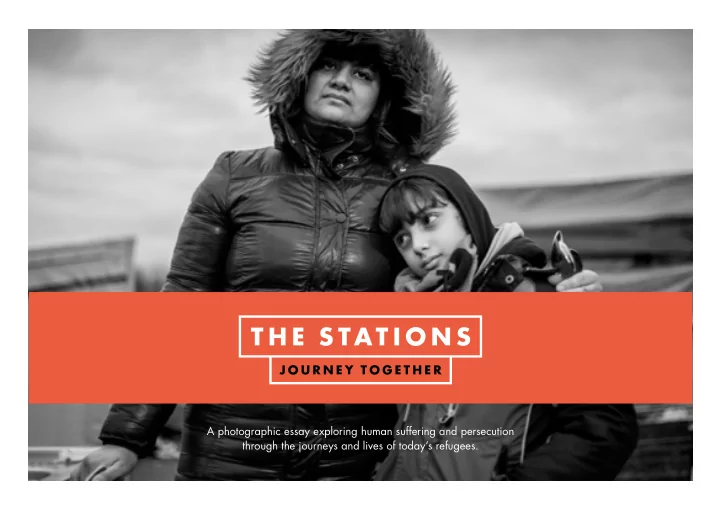
A photographic essay exploring human suffering and persecution through the journeys and lives of today’s refugees.
SLIDE 2 1 2 3 4 5 6 7 8 9 10 1 1 12 13 14
Alone Betrayed Justice Words Outlaw Humiliation Burden Compelled Sold Murder Grace Family Trust Borrowed
SLIDE 3
SLIDE 4 1
ALONE
STATION 1/14
Amira lefu Syria to escape the continual bombardment of her home town, which terrifjed and traumatised her six young children. As her husband has lefu her, Amira is raising her children alone in a bedsit in Beirut, Lebanon. Her oldest son, who is ten, can’t go to school because he has to work to provide for the
- family. Struggling with the day to day
reality of their lives, Amira worries about what lies ahead for them all in an unfamiliar country, far from family and friends. Battling with the crushing emotional and psychological weight of what lied ahead, Jesus chose to do what love required of him. Although he knew that he would have to face the ordeal alone, he had hoped that his friends would at least support him. But when he returned to where he had lefu them in the Garden of Gethsemane, he discovered they had fallen asleep. It takes efgort to stay alert and ‘awake’ , to engage with the stories of torment, anguish and sufgering that are ofuen masked by the phrase ‘refugee crisis’ . Weariness, preoccupation with our
- wn concerns and apathy can so ofuen
get the better of us.
SLIDE 5
SLIDE 6 STATION 2/14
A kiss between playmates in a camp for Syrian refugees, the beauty of innocent and unguarded afgection. To love in this way requires our own vulnerability and openness, and that we honour another’s trust in us. Jesus knew that Judas planned to betray him, but didn’t go on the
- fgensive in a bid to stop him, instead
he remained open, vulnerable. How do we respond when those we love let us down, hurt us or betray us? How do we treat those who are vulnerable to us? Countless refugees who have lefu their homes in the hope of fjnding shelter have been betrayed every step of the way, by governments, by traffjckers, even, in some cases, by their own communities and families. Many have put themselves at our mercy. How will we respond?
BETRAYED
2
SLIDE 7
SLIDE 8 STATION 3/14
Forced to fmee ISIS because he worked for the British forces, this man and his family are also having to live with the reality of the onset of Alzheimer’s. His hope was that the British, who he considered his friends, would provide
- refuge. But until now, he has been
stuck in a camp in France, where his health is deteriorating. When Jesus was tried by the Sanhedrin, the supreme court of the time, there were so many religious leaders who opposed him in it that the chances of him getting a fair hearing were slim. Tie trial refmects how justice is compromised if the instruments of law are used to serve narrow interests and powerful elites. In the case of the Iraqis and Afghanis who helped British forces, the question
- f what is the right thing to do seems
clear cut. But decision making is so
- fuen clouded by other considerations.
JUSTICE
3
SLIDE 9
SLIDE 10 STATION 4/14
Like many Syrians, this little girl and her family are marooned in a tiny fmat in Beirut, forced to survive on what little they can earn and handouts from friends. Tiis is the experience
- f many who have been forced to
leave Syria to escape the fjghting, although the focus has been mostly on those who are trying to reach Europe. Ofuen obscured by our perceptions of the crisis, their stories exemplify the disjuncture between reality and all the rhetoric, spin and strategising, policies and pronouncements that surround it. Peter didn’t want to believe Jesus when he told him he would let him down, insisting that he would remain his loyal friend, no matter what. But in the end, Jesus experienced the chasm between the reality Peter hoped to conjure with words and good intentions and the fact that, under pressure, he denied that he even knew Jesus. Numerous announcements, political posturing, claims that we are doing all we can. What is the reality of our response to the refugee crisis?
WORDS
4
SLIDE 11
SLIDE 12 STATION 5/14
Abdullah, a young Eritrean artist, has worked alongside others to decorate the makeshifu church that has become an important focal point in the Calais camp. Amid the bleakness of Tie Jungle it has provided a haven for people who want to pray and refmect and experience the warmth
Jesus’ enemies appealed to Pilate because as governor he had the power to execute him. Tie events that unfolded were about the Roman leader’s attempts to keep the peace, avoid stirring up trouble and maintain his position as opposed to doing the right thing. Pilate tried difgerent strategies, attempted to fjnd a way out by presenting Barabbas to the crowd in the hope that they would agree to Jesus’ release. During all of this, Jesus said very little, but what he did say suggests he was operating according to a difgerent set of rules and values. What defjnes us? At a time when the authorities are seeking to tag refugees and otherwise put a question mark
- ver their identity, the churches,
theatres, cafés that have sprung up in the camps are a symbol of creative resistance, a sign that people have the potential to move to a difgerent rhythm, to be something other than what the authorities dictate.
OUTLAW
5
SLIDE 13
SLIDE 14 STATION 6/14
Karzan, a Kurdish refugee from Iran, wants desperately to be able to look afuer his family. He has felt keenly the humiliations of being a refugee, of existing in a no man’s land, of being stripped of his identity, of not being able to speak the language of the country where he longs to bring his wife and young family to live. He’s faced insults and violence, closed borders and closed doors. But he’s endured, learnt a new language and found a home for his family. Karzan now lives in the UK and is waiting for his wife and seven-year-old son to arrive from Tehran afuer four years of being separated. Together, he and I chose this concept using barbed wire to best represent the trials and tribulations he has endured in recent years as a refugee living in the UK. Tie crown of thorns was an ironic mockery, part of a ritual of humiliation and violence that was worse than any animal would receive. Yet it was Jesus’ actions and his choices while enduring such torture that would ultimately defjne him. Refugees are humiliated and diminished in many ways, from the language we use, to the building of fences, the use of barbed wire and
- tagging. In spite of this, many, like
Karzan, are determined to overcome the obstacles they face and shape their
- wn destiny. In another context, theirs
might be told as inspirational stories of triumph over adversity.
HUMILIATION
6
SLIDE 15
SLIDE 16 STATION 7/14
Tiis woman cares for her two disabled children in a cramped room on the roof of a house in Lebanon. Aged 17 and 24, her sons need constant care, which made the journey from her home in Syria extraordinarily arduous. Despite the diffjculty of their living conditions, she shows remarkable dignity and courage, and is determined to do the best for her children. By determining not to shrink back from carrying his cross, Jesus demonstrated his willingness to sufger in order to meet the demands
- f something bigger than himself,
namely love. By calling on others to do the same, he challenges the tendency towards wanting only a comfortable life and urges us instead to engage with needs that are beyond our own. A narrative of stepping up, of being willing to sufger for the sake of others, can seem out of sync with a culture so
- fuen focused on living a beautiful life.
Signifjcantly, it suggests that we have responsibility, not only for our actions, but also of our government’s.
7
BURDEN
SLIDE 17
SLIDE 18 STATION 8/14
Two men from completely difgerent backgrounds and traditions who have formed a remarkable and unlikely
- friendship. Tiey have both sufgered
a great deal in recent years - one was seriously injured in a car accident when he stopped to help a driver whose car had broken down, the other has been the victim of a violent attack. Tirown together by circumstances, they have become the best of friends and have supported one another on the road to recovery. Exhausted and close to death, Jesus could not go on, so Roman soldiers
- rdered Simon of Cyrene to carry
his cross. One of the crowd until that point, Simon didn’t have much choice but to do what he was ordered to do. Tie situation may have been beyond his control, but later accounts suggest that this was to be a life-changing experience for Simon and future generations of his family. Living in constricted circumstances, in situations not of their choosing, refugees have found lasting
- friendships. Others can’t resist the
call to be good neighbours, travelling to the camps as volunteers, opening up their homes and communities to people in need.
8
COMPELLED
SLIDE 19
SLIDE 20 STATION 9/14
Showing remarkable courage, this woman walked hundreds of miles in order to be with her children and husband who had gone ahead of her to Beirut. She had planned to remain in Syria until her baby was born, but was desperate to be reunited with
- family. Tiere had been problems with
the pregnancy, which meant that she walked for weeks knowing her unborn child had died. With no access to medical care in Beirut, she became dangerously ill and depressed, until friends stepped in and helped her pay the medical fees. When Jesus spoke to the women who were weeping for him, he responded by pointing to the diffjculties they and their children would face. In doing this, he positioned women at the centre of the drama, acknowledging that the unfolding of events would have implications for them and their children. Although ofuen sidelined and marginalised, women’s experiences are part of the refugee crisis too. If we instate the stories of women and girls who are fmeeing their homes, we get a fuller picture that includes traffjcking, sexual exploitation and further dimensions to the story of confmict.
9
SOLD
SLIDE 21
SLIDE 22 STATION 10/14
On his journey from Syria to establishing a new life for him and his children in Beirut, this man has encountered dreadful violence, blackmail and death threats. He knows that if he goes back to Syria he could well be executed because relatives who have turned against him seem willing to stop at nothing in order to exact their revenge. Afuer hearing his extraordinary story of courage and perseverance, I asked him if he would be willing to have his portrait taken to represent one of ‘Tie Stations’ . We both decided that a modern day interpretation of the crucifjxion - A hooded and naked stance of surrender
- would be the most appropriate image
for him to re-enact to best represent his
- experience. We drove together into the
mountains on the outskirts of Beirut and found a derelict building. Tiere, away from the crowds, we spent time creating the composition. To him, this shot was the most powerful of all the images. Jesus’ crucifjxion illustrates the lengths his opponents were prepared to go to in order to protect their ideals, interests and power. Tieir intent may have been one of cold calculation, but Jesus’ execution was enabled by people whose judgement and very humanity seemed lost in a great swell of emotion. Fear, resentment, anger, greed, indifgerence and moral certitude - they all played a part in this drama. Tie idea that politics or ideology gives us a ‘license to kill’ sits at odds with free speech in a democratic society. Nevertheless, religious ideology and Western foreign policy has used this as justifjcation to eliminate and silence opposition. It may seem shocking that a man or woman could be put to death by their enemies, but the refugee crisis is, for many, a life or death situation. What will be the implications if attitudes towards refugees continue to harden? Is it time to step back, take stock, examine our own humanity, and ask ourselves if we know what we are doing?
10
MURDER
SLIDE 23
SLIDE 24
STATION 11/14
11
GRACE
We don’t know much about this man, we can’t even be sure he’s telling the truth about who he is and why he’s on the run. What did he do that he had to leave his home in such a hurry? Whatever the reality of his story, he seems to want to make amends in some way, and fjnds solace in contributing to the wellbeing of people in the camp in whatever way he can. Jesus was accused of rebellion, of stirring up trouble and undermining his religion by fmouting the Sabbath and other traditions. It was said he insulted God, that he had questionable morals because he was involved with the wrong people. As he was dying, people abused and insulted Jesus, but another man who was being crucifjed nearby told them to stop. We don’t know much about this man, either, except that he was condemned as a thief - although some accounts say he was a revolutionary. But we do know that the last words he heard in the midst of all the horror and violence were not of condemnation, or shame, but of promise and hope. Frequently people are categorised into those who are ‘deserving’ of our help and support and those who are not. Tie consequences for those who are deemed ‘unworthy’ can be terrible, however, as they are consigned to a no-man’s land where basic human rights and justice are denied.
SLIDE 25
SLIDE 26 STATION 12/14
12
FAMILY
In a fmat in Birmingham, a mother holds a photograph of the two teenage children she longs to see again. A criminal gang in Iraq murdered her husband by beheading him - and lefu his head on the doorstep of the family
- home. Afuer the same gang kidnapped
- ne of her children, and held him for
three days, Salma fmed, arriving in Syria in 2011. When fjghting there escalated, she fmed again with her young family to Turkey and then paid traffjckers who transported them to the UK in freezing conditions in a truck. Her teenage son and daughter were living with their grandmother all this time, but when she died, they set ofg to fjnd their mother. Tiey got as far as Calais, where they are still living
- alone and desperate to be reunited
with their mother and the rest of their family. All the families’ documentation was lost when their house in Iraq was destroyed, and the mother has no proof that they are her biological children. In one of his fjnal acts, Jesus bound together his mother Mary and his friend John as mother and son, knowing that they would need each other’s love and support. We seem instinctively to understand the importance and value of family. Is there a way that we can extend this awareness towards all families and be willing to let them be reunited,
- r create new networks of support
and friendship for those lefu without a family?
SLIDE 27
SLIDE 28 STATION 13/14
13
TRUST
A father holds onto his daughter. In the dire conditions of the camp, the daughter trusts him to protect her, care for her, and is held by his determination to build a better future for them both. In the midst of physical and mental torment and the terror of abandonment, Jesus’ fjnal words from the cross were words of trust - that love is stronger than any other force used against him. Fear about what lies ahead can erode
- ur belief in love and make goodness
and kindness appear unrealistic, irresponsible even. But what if we were to trust a little, allow ourselves to hope that things could work out? Could new narratives open up and creative solutions emerge?
SLIDE 29
SLIDE 30 STATION 14/14
14
BORROWED
Ahmed is a landowner in Lebanon, who has given Syrian refugees space where they can pitch their tents and develop some facilities such as a
- school. He asks a fair price, provides
good facilities, visits regularly and is getting to know the people who are living there. Joseph of Arimathea lent a tomb so that Jesus could be buried hastily before the beginning of Passover. Tiis was the start of the waiting time, the in-between time, while out of sight and against all hope, a new story was readying itself to be told. Is the refugee crisis a story ripe for disruption? Could the downward spiral of events be reversed, and if so, what new stories might break
- ut to alter the course of the current
desperate narrative?
SLIDE 31
SLIDE 32 Tie refugee crisis evokes strong
- emotions. Tie feeling that many
people have is one of powerlessness, a sense of despair that the scale of the situation is just too big. How can we move on from the sense of paralysis we ofuen feel, the feeling that there’s nothing that we can do to help? Perhaps you could start by wearing the ‘Journey Together’ wristband as the fjrst step towards showing solidarity for refugees, or simply
- fger your friendship and support.
You might even be ready to go a step further and ofger a room in your home. Many volunteer and grassroots projects were started by individuals and groups who wanted to help. Perhaps the most efgective are the
- nes that listen to refugees and work
side by side with them. You don’t have to start something new, there is a variety of projects and campaigns that would value your involvement. For more information visit: www.thestations.org.uk