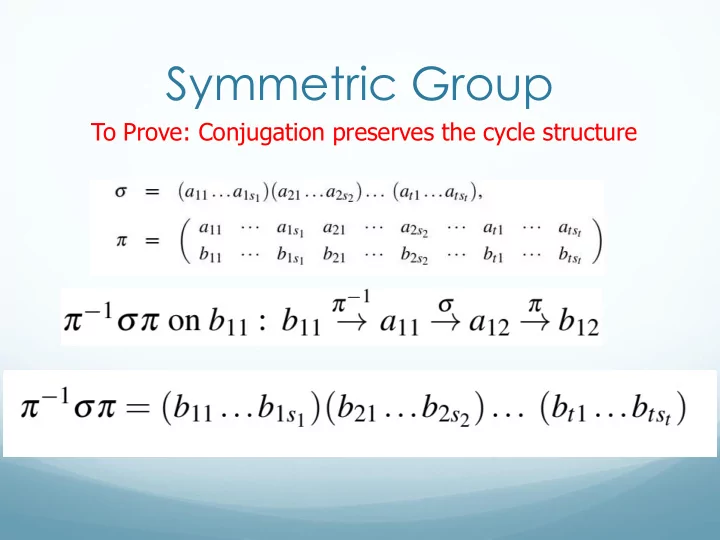
SLIDE 1
Symmetric Group
To Prove: Conjugation preserves the cycle structure
SLIDE 2
Cayley Theorem proof
For a finite group G={g1 = e, g2, g3, ….gn } Define a map to symmetry Πg defined as Show that Πg is isomorphic to G and hence G is
a subgroup of the symmetry group of degree n.
SLIDE 3
Semi-direct products
SLIDE 4
Generators of alternating groups
Show that the alternating group is generated by the set of all the three-cycles on n letters.
SLIDE 5 Bilateral axis
If the principal axis is in the plane of mirror
symmetry, then it is called bilateral axis
Principal axis is bilateral if we have U2 two-fold
axis perpendicular to principal axis
Point group with the bilateral n-fold axis
requires Ck
n to be conjugate to Cn-k n
Using this, write the conjugate classes of
Dihedral Dn and Cnv groups
SLIDE 6
Dihedral groups
SLIDE 7
Tetrahedral, cubic groups
Principal axis is bilateral if we have Try to write the
group elements of the proper group symmetry of the cube called Octohedral symmetry and denoted as O
Similarly, proper group symmetries of the
regular Tetrahedron is denoted as T
Then including improper reflection planes, we
have Oh, Td – try to write the conjugacy classes
SLIDE 8 Tetrahedral molecule
C2 Three C2 C3 Four 3-fold axes Pure Rotations give group T
SLIDE 9 Including reflections
σ is the mirror (reflection) plane six mirror reflection planes (6σ) S4 is a rotation by 90° followed by a mirror reflection a tetrahedral Structure has total 24 symmetry operations
SLIDE 10
Representation of
What is reducible and irreducible representation?
SLIDE 11
Examples
Write two-dimensional matrix representation for the
group C3v
Write 3-dimensional matrix representation for
symmetric group of degree 3
What is the difference Can we a matrix S such that the above 3-dimensional
matrices can be brought to block diagonal form?
SLIDE 12
Reducible Representation
If we can find a S which diagonalises or block
diagonalises n * n matrix representations of the group elements of the group
Is there such S ? That may become tedious if matrix
size is large.
Further, for a given group how many non-trivial
representations which cannot be further broken into diagonal or block diagonal form? Such representations are called irreducible representations (irreps).
SLIDE 13 Reducible and Irreducible
Bring it to block-diagonal form if not diagonal
Each block-diagonal component is called irreducible representation We discussed in class, (i) two-dimensional rep of C3v (ii) another three-dimensional rep of C3v Claim : 2d rep is irreducible but 3d rep is reducible.
SLIDE 14 Notations
Characters χ(trace of matrices)do not change under similarity
- transformations. Characters will be same for all the group elements within
the same class.
For abelian groups, number of classes=h (order of G)
Aim is to find the number of irreducible representations Гα (g), their dimensions ℓα for every group G and the characters χα(g)
Гred(g)=∑ aα Гα (g) where aα gives # of times irrep α appears in the
reducible representation
Postulates: (i)
Number of Гα (g) is equal to number of classes (p)
(ii)
∑ (ℓα )2 = h
SLIDE 15 Great Orthogonality theorem
number of elements in class i
SLIDE 16 Character Tables
Using the orthogonality properties of the great
- rthogonality theorem, let us work out the character
table C2v and for symmetric group of degree 3
Write character table for C4 and C4v
SLIDE 17
Mulliken Symbol Notation
One-dimensional irreps are denoted by A if character
for Cn is 1
One dimensional irreps are denoted by B if character
for Cn is -1
Two dimensional irreps are denoted by E Three dimensional irreps are denoted by F or T We introduce subscript g(gerade) or u(ungerade)
depending on σh character is +1 or -1 respectively
SLIDE 18
Character table
SLIDE 19
Symmetric group and irrep diagrams
Recall number of classes is equal to number of irreps.
So, the same Young diagrams used for cycle structure can be used to denote irreps.
Symmetrizer – horizontal row of boxes-trivial
representation is denoted by this diagram
Antisymmetrizer- vertical column of boxes-A2 of S3 is
denoted by vertical column of 3 boxes
Other diagrams are called mixed representations.
SLIDE 20 Mixed representation diagrams
How do we determine the dimensions of any Young
- diagram. Symmetrizer and antisymmetrizer diagrams
are 1-dimensional irreps. To find dimensions of mixed rep of ς(n), use hook formula:
Count the number of boxes the hook for every box traverses. I have indicated two hooks- one traversing 1box and the other traversing 4 boxes. Do for all boxes. Dimension of irrep diagram is n! / hook number
SLIDE 21
Resolve reducible into irreps
For reducible rep :
Гred(g)=∑ aαГα (g) where aα gives # of times irrep α appears in the reducible representation
SLIDE 22 Irreps in reducible representation
Using the orthogonality property, aα for reducible representation Гred is
Typically, a system with symmetry group G when acted by an external perturbation will no longer have G as symmetry. In fact, it will be subgroup K C G. Then the irreps of G will be reducible representation for K
SLIDE 23 Regular representation-definition
Take the multiplication table of as rows and columns of
matrix representation
Write the 4 * 4 matrix elements using
where δ(e)= 1 and zero otherwise
Are they diagonal matrices? Are they reducible representation?
Write the characters of the regular representations (trace of the matrix Г ) denoted as χreg(g) and obtain aα
Please work this out and we will discuss in the next class
SLIDE 24
Hamiltonian and symmetry
For system with symmetry group G, Hamiltonian H
commutes with the elements of G : [H,g]=0
Implies, Ψ(x) and g Ψ(x) will have same energy
eigenvalue
If Ψ(x) is a non-degenerate eigenfunction of H, then g
Ψ(x) = c Ψ(x)
If Ψ(x) is one of the degenerate eigenfunction of H,
then g Ψ(x)= linear combination of the set of degenerate eigenfunctions
SLIDE 25 Character table and degeneracy
Character table gives the characters and dimensions of the
irreducible representations α’s
Гα(g) irrep for group G will act on ℓα dimensional basis states
ξi where i takes 1,2 , …. ℓα.
Гα(g) ξi = will be linear combinations of ξi’s
Both Гα(g) ξi and ξi have same energy if H is invariant under the group symmetry G- hence dimensionality ℓα> 1
- f irreps indicate degenerate eigenfunctions
Relook at particle in a 2-d square box and its group
symmetry which allows 2-fold degenerate wavefunctions
SLIDE 26
Character table and basis states
g z= (+1) z is eigenvalue eqn with eigenvalue +1 for all g which are characters of irrep A1. Similarly acting on axial vectors and x,y coordinates will shown the eigenvalues matching with the other irreps as we discussed in class.