
SLIDE 1
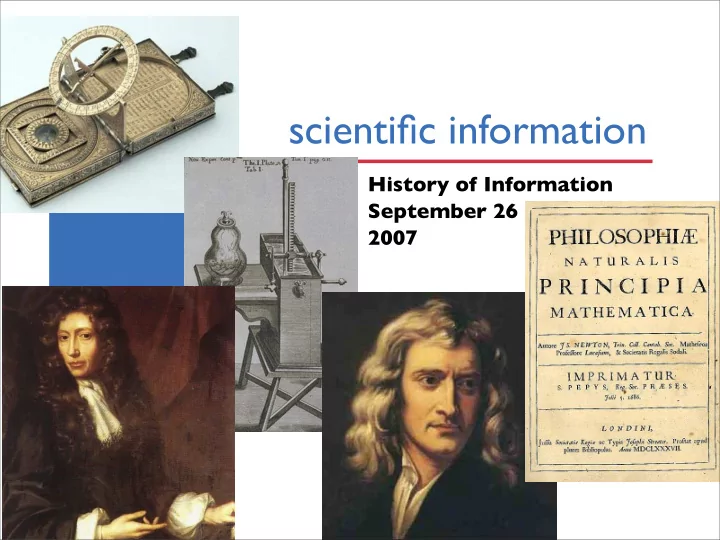
scientific information History of Information September 26 2007 - - PowerPoint PPT Presentation
scientific information History of Information September 26 2007 overview the scientific revolution the English experience the background & the model an example kill or cure problems with the model science in the history of information
HofI Introduction -
2
HofI Introduction -
"The Scientific Revolution outshines everything since the rise of Christianity and reduces the Renaissance and Reformation to the rank of mere episodes, mere internal displacements within the system of medieval Christianity".
Herbert Butterfield, The Origins of Modern Science, 1300-1800, 1948
3
http://www.library.usyd.edu.au/libraries/rare/modernity/images/copernicus1-1.jpg
HofI Introduction -
4
HofI Introduction -
5
"Printing ... the most useful invention ever found
Polite .. encrease the Knowledge of Letters ... all useful Arts and Sciences ... Perfection of Human Knowledge.” Defoe, Regulation of the Press, 1704
HofI Introduction -
English Civil War, 1642-1651 Commonwealth & Protectorate, 1649-1659 Restoration, 1660 Great Plague, 1665 Fire of London, 1666 Glorious Revolution, 1688
6
"Those dreadful
revolutions, which cannot be beheld upon Paper, without horror.”
Sprat, History
HofI Introduction -
7
HofI Introduction -
7
HofI Introduction -
"the advancement of Real Knowledge"
8
HofI Introduction -
"the advancement of Real Knowledge"
8
"reliable truth-generating practices were put in place and institutionalized"
Steven Shapin, A Social History of Truth, 1994
HofI Introduction -
the impulse to order things and facts
explanation prediction calculation replication
9
"The Experiments that
be made at the charge
Curators at least shall be appointed for the Inspection of those which cannot be perform'd before the Society: by them the bare report of matter
stated and return'd.”
Sprat, History
"Facts are stubborn
things" Smollett, Gil Bas, 1749
HofI Introduction -
tall tales
And of the Cannibals that each other eat, The Anthropophagi, and men whose heads Do grow beneath their shoulders.
10
HofI Introduction -
tall tales
And of the Cannibals that each other eat, The Anthropophagi, and men whose heads Do grow beneath their shoulders.
10
HofI Introduction -
tall tales
And of the Cannibals that each other eat, The Anthropophagi, and men whose heads Do grow beneath their shoulders.
10
"Having in our company Captn. Minnes, with whom I was much pleased to hear him talk in fine language, but pretty well for all that. Among other things, he and the other Captains that were with us tell me that negros drowned look white and lose their blackness, which I never heard before" Samuel Pepys, Diary, 11 April, 1662
HofI Introduction -
A lioness hath whelped in the streets; And graves have yawn'd, and yielded up their dead; Fierce fiery warriors fought upon the clouds, In ranks and squadrons and right form of war, Which drizzled blood upon the Capitol;
11
HofI Introduction -
"Sir Thomas Crewe .... hath heard at the Committee for examining the burning of the city, ... .that it was done by plots ... it was bragged by several Papists that upon such a day in such a time, we should find the hottest weather that ever was in England; and words of plainer sense"
"We talked much of Nostradamus his prophecy of these times, and the burning of the City of London, some of whose verses are put into Booker's Almanac this year .... My Lady Carteret hersilf did tell us how abundance of pieces of burnt paper were cast by the wind .. .she took
than these words: "Time is, it is done" February 3, 1666/7
12
"La sange du juste à Londres fera faute Bruslez par foudre de vingt trois le six, La dame antique cherra de place haute De meme sute plusiers seront occis"
"It is indeed a disgrace to the Reason, and honor of mankind, that every fantastical Humorist should presume to interpret all the secret Ordinances
though he be never so ignorant of the very common Works of Nature, that lye under his Feet. There can be nothing more injurious than this, to mens public, or privat peace. This withdraws our obedience, from the true Image
his pow'r, which are fram'd by our own imaginations. This weakens the constancy of human actions. This affects men with fears, doubts, irresolutions, and terrors. It is usually observ'd, that such presaging, and Prophetical Times, do commonly fore-run great destructions, and revolutions
presages, and prodigies themselves did signify no such events. For this melancholy, this frightful, this Astrological humor disarms mens hearts, it breaks their courage; it confounds their Councils, it makes them help to bring such calamities on themselves"
HofI Introduction -
respect for the past?
For there is mention made, both of Salt-peter and Aqua fortis, in the Writings of Geber, a Spanish More, and an Alchymist; but at what time he lived is unknown, though it be certain, some hundreds of years before Raimund Lully; who about the year 1333. published some of his Books, wherein he treats of Salt-peter and Aqua
the foresaid Monk, being a skilful Alchymist, had a design to draw a higher Spirit from Peter than the common Aqua fortis, and that he might better open the body of Peter, he ground it with Sulphur and Charcoal, by which Composure he soon became the Inventour of Gun-powder.
14
HofI Introduction -
building a movement
It was therefore, some space after the end of the Civil Wars at Oxford, in Dr. Wilkins his Lodgings, in Wadham College, which was then the place of Resort for Vertuous, and Learned Men, that the first meetings were made, which laid the foundation of all this that follow'd. The Vniversity had, at that time, many Members
reasoning; and was also frequented by some Gentlemen, of Philosophical Minds, whom the misfortunes of the Kingdom, and the security and ease of a retirement amongst Gown-men, had drawn thither.
15
"The Royal Society
November 28, 1660, when 12 men met after a lecture at Gresham College, London, by Christopher Wren (then professor of astronomy at the college) and resolved to set up “a Colledge for the promoting of Physico- Mathematicall Experimentall Learning.” Britannica
HofI Introduction -
16
HofI Introduction -
"the King came and stayed an hour or two laughing at Sir W. Petty, who was there about his boat; and at Gresham College in general; at which poor Petty was, I perceive, at some loss; but did argue discreetly, and bear the unreasonable follies of the King’s objections and other bystanders with great discretion; .. but the King ... cried him down with words only. Gresham College he mightily laughed at, for spending time only in weighing of ayre, and doing nothing else since they sat."
17
"I have sent one to weigh Air at the Picque of Teneriff that's the lightest
considerable Cargo
Sheerness and the Isle of Dogs Air is the heaviest. Now if I have a mind to take Countrey Air, I send for, may be, forty Gallons of Bury Air, shut all my windows and doors close and let it fly in my Chamber..” Shadwell, Virtuoso
Nature alone, which could pleasantly entertain them ... Trials in Chymistry,
their discoveries ... [as now in Paris], where they have at last turn'd their thoughts, from Words to experimental Philosophy Their purpose is, in short, to make faithful Records, of all the Works of Nature, or Art, which can come within their reach: that so the present Age, and posterity, may be able to put a mark on the Errors, which have been strengthned by long prescription: to restore the Truths, that have lain neglected to separate the knowledge of Nature, from the colours of Rhetorick, the devices
They have labor'd to inlarge it, from being confin'd to the custody of a few; or from servitude to private interests. They have striven to preserve it from being over-press'd by a confus'd heap
much up by General Doctrines They have studi'd, to make it, not onely an Enterprise of one season, or
a popular, an uninterrupted Work.
They have attempted, to free it from the Artifice, and Humors, and Passions of Sects; to render it an Instrument, whereby Mankind may obtain a Dominion over Things, and not onely over one anothers Iudgements. And lastly, they have begun to establish these Reformations in Philosophy, not so much, by any solemnity of Laws, or ostentation of Ceremonies, as by solid Practice, and examples: not, by a glorious pomp of Words; but by the silent, effectual, and unanswerable Arguments of real Productions. Members ... different Religions, Countries [note he mentioned earlier the French equivalent], and Professions ... not to lay the Foundation of an English, Scotch, Irish, Popish, or Protestant Philosophy; but a Philosophy of Mankind. ... the Church of England ought not to be apprehensive to settle a constant Intelligence ... the general Banck, and Free-Port of the world
I do not get the impression that the science Sprat speaks of is in reference to the same science we think of today. It seems that the society is more of a sort of a professional union. .... I do not get the impression that they are exchanging scientific theories or research. More ... theoretical ideas and current events than actual practical knowledge... more oriented toward professions than academic science. --Danny Bean This model of investigation really doesn't look like our method of science today ... very different ideas of what kind of person qualifies to carry out
TOO DOGMATIC Sprat seems to describe science as the process of trying to find the one truth to describe a phenomenon. And once that truth is found, all other opinions are wrong or weaker (Pages 61-63). This is very different from how science is viewed today. --Jeff Lai
does Prat seem to you to be talking about science as we think of it today?
TOO MUCH POLITICS
The intent of his writing, however (concerning its political purpose), is directed toward the people in the name of civil administration and how the Royal Society benefits the public.
[A]lthough philosophically Thomas nails many modern ideas, a lot of what he spends time talking about isn't about science as politics.
there is a lot more political influence on Sprat's definition of science, as it revolves around this particular society and social
not so apparent in our view of science today. --Jonathan Lesser
does Prat seem to you to be talking about science as we think of it today?
TOO INSULAR
Reading this excerpt lead me to believe that The Royal Society's "Philosophy of Mankind" was limited to the Caucasian nationalities
the methods of scientific inquiry remain the same and so too have its applications; however, there have been notable changes in science as a practice and science as a community. --Nathan Murthy I pondered about this for a while and couldn't help but wonder if he believed that the knowledge of nature could be understood by people from different countries but only discerned in England. --Roger Guerrero
does Prat seem to you to be talking about science as we think of it today?
TOO INSTRUMENTAL I believe the environmental movement is beginning to dispute the often destructive goal of human domination over its environment. -- Columbani Claiming to use the natural and real world through experimentation does not constitute science. One can observe and "experiment," however if one does not properly apply the scientific method, this is still not science. -- Anthony Shu I don’t know how Sprat defined Nature (with a capital ‘N’) so there could be a distinction about the focus of mastering nature. Did “Nature” mean just environment and our resources? Did “Nature” encompass human nature and human disease and malfunctioning? --Melissa Wong
does Prat seem to you to be talking about science as we think of it today?
NOT INSTRUMENTAL ENOUGH Science in my opinion has become much more privatized and controlled by
does Prat seem to you to be talking about science as we think of it today?
TOO PHILOSOPHICAL
It seems that he speaks of "science" in a much more philosophical sense --Ryan Luecke Sprat's science is quite different from the way we think of science today. ... Here, we see science as more of a process of rational thinking and it includes philosophy which we do not associate with science today. However, there are more similarities than meet the eye. ...This idea of finding truth by disregarding emotion and personal prejudice is highly regarded by the Royal Society. So in many ways, the science of 400 years ago did in fact lead to the science we have today --Nisha Desai Prat mentions “philosophy” many times in this reading which is why I think that the science that he is referring to is more abstract and in regard to intellectual ideas
does Prat seem to you to be talking about science as we think of it today?
DIVIDED I am reminded of its clear pronunciation in the split between U.C. Berkeley's physicists Earnest Orlando Lawrence, who represented the experimentalist tradition
tradition on the other. --Colin Elbasani As he writes, he seems to have his critics in the back of his mind, because he makes several points as pre-emptive strikes against what they may say.
what he eventually describes is incongruent with the popular view of science, despite what so many high school science teachers have tried to instill by making teenagers memorize words like "hypothesis" and "independent variable". Sprat talks broadly about the very fundamentals that compose the scientific method,
does Prat seem to you to be talking about science as we think of it today?
Sprat’s explanation of the mission of the Royal Society lays out the very basic foundations of what we consider experimental science and the scientific methods. He anticipates friction between the new ways of approaching the world and the dogma of previous ages; ... Today, the conflict between science and dogma is present evident in the debate over evolution. --Dennis Bedford Sprat explains the idea of peer revision, which is an essential part of science today. He says: “For by despising men, for not being absolutely excellent; we keep them from being so: while admonitions, join'd with praises; and reproofs, with directions; would quickly bring all things to a higher perfection” --Bernard Carreon He stresses the incremental nature of science, that scientists "insinuate their useful alterations, by soft, and unperceivable degrees." This is a departure from the often epochal nature of science in ancient times --Alex Castle It is this advance to empiricism that the Royal Society provided modern science with a foundation.
Essentially, this is along the same ideas today, where logic and scientific figures conflict with more theological beliefs which are supported mainly by faith, rather than science. --Mike Manalo
does Prat seem to you to be talking about science as we think of it today?
Above all, the fundamental trust in “the Method”, the scientific method, that Sprat talks about seems so quintessential to science both today and when the Royal Society was first conceived --Tom Meagher towards the end Prat does take a different approach when he speaks of inventions and their possibility of curing diseases --Kyle Murray this type of professional scientific society is markedly different than today’s scientific community which is a far more diverse, egalitarian, “open-source” society filled with social activists, scientists, attorneys and regular citizens from all aspects of life. --Rohan Verma
does Prat seem to you to be talking about science as we think of it today?
HofI Introduction -
"to teach people to plow, to sow, to plant to spin, to build houses, to find out new countries" experimenting experimental philosophy arts & improvement of arts systems
30
HofI Introduction -
"to print a Paper of advertisements... wherein will be contained heads or substance of the inquiries they are most solicitous about, together with the progress they have made and the information they have received from other hands ... a short account of such
accidentally occur."
31
HofI Introduction -
corresponding secretary Henry Oldenberg, 1662 Journal des Scavans, 1665 Philosophical Transactions, 1665 advertisements, articles, abstracts Boyle, random publication v Hooke, ordered
32
HofI Introduction - 33
HofI Introduction - 33
HofI Introduction -
Edward Moxon, Mechanic Exercises 1677-
"hunger during the war, taken together with the liberation of the press, resulted in an
that themselves carried ideological weight, signifying a movement from a society where secret know-how was passed on orally, to a society in which knowledge was available publicly.
Diane Purkiss, The English Civil War, 2006
John Ziman, Public Knowledge, 1967
34
"Cunning or Sleight,
Hand ... cannot be taugt by Words, but is
Practice and Exercise” Moxon, Mechanick Exercises
Mistakes about the SWEATING-SICKNES, and its Cure.
TO shew the great Utility of the Royal Society, he sayes They will be able by degrees to purchase such Extraordinary Inventions, which are now close lock’d up in Cabinets; and then to bring them unto one Common Stock, which shall be upon all
there may come very much hurt to mankind. If any certain remedy should be found out against an Epidemicall disease, if it were suffer’d to be engross’d by one man, there would be great Swarms swept away, which otherwise might be easily sav’d. I shall instance in the Sweating-Sickness. The Medicine for it was almost Infallible. But, before that could be generally published, it had almost dispeopled whole Towns. If the same disease should have returned, it might again have been as destructive, had not the Lord Bacon ta-ken care to set down the particular course of Physick for it in his History of Henry the Seventh, and so put it beyond the possibility of any private man’s invading it. This out to be imitated in all other Soveraign Cures of the like nature to avoid such dreadful casualties. One would think by the words of our Historian, That the Cure of the Sweating-Sickness, were recorded by no Body but the Lord Bacon that it was almost Infallible; that the Sweating-Sickness did not return again; And that the Cure was rather concealed (and needed to be generally published) at first, then to be discovered by Observation and Experiments of those that first fell sick. But there is no such thing: for the same cure is related by Polydore Virgil, and Holinshed in their Histories of Henry the Seventh. And the same sickness did rage in the twenty second year of the said King his Reign, as well as the first. And the Cure related was so far from being almost Infallible, that my Lord Bacon only saies it commonly recovered the sick: and after it was so generally known, yet the twenty second year of that Kings Reign, many dyed of it (as Holinshed saith) howbeit not in the same number, by reason of the remedy found out at the beginning of it. To convince the Reader of the truth of what I say, and to shew how unacquainted
Mistakes about the SWEATING-SICKNES, and its Cure.
TO shew the great Utility of the Royal Society, he sayes They will be able by degrees to purchase such Extraordinary Inventions, which are now close lock’d up in Cabinets; and then to bring them unto one Common Stock, which shall be upon all
there may come very much hurt to mankind. If any certain remedy should be found out against an Epidemicall disease, if it were suffer’d to be engross’d by one man, there would be great Swarms swept away, which otherwise might be easily sav’d. I shall instance in the Sweating-Sickness. The Medicine for it was almost Infallible. But, before that could be generally published, it had almost dispeopled whole Towns. If the same disease should have returned, it might again have been as destructive, had not the Lord Bacon ta-ken care to set down the particular course of Physick for it in his History of Henry the Seventh, and so put it beyond the possibility of any private man’s invading it. This out to be imitated in all other Soveraign Cures of the like nature to avoid such dreadful casualties. One would think by the words of our Historian, That the Cure of the Sweating-Sickness, were recorded by no Body but the Lord Bacon that it was almost Infallible; that the Sweating-Sickness did not return again; And that the Cure was rather concealed (and needed to be generally published) at first, then to be discovered by Observation and Experiments of those that first fell sick. But there is no such thing: for the same cure is related by Polydore Virgil, and Holinshed in their Histories of Henry the Seventh. And the same sickness did rage in the twenty second year of the said King his Reign, as well as the first. And the Cure related was so far from being almost Infallible, that my Lord Bacon only saies it commonly recovered the sick: and after it was so generally known, yet the twenty second year of that Kings Reign, many dyed of it (as Holinshed saith) howbeit not in the same number, by reason of the remedy found out at the beginning of it. To convince the Reader of the truth of what I say, and to shew how unacquainted
Mistakes about the SWEATING-SICKNES, and its Cure.
TO shew the great Utility of the Royal Society, he sayes They will be able by degrees to purchase such Extraordinary Inventions, which are now close lock’d up in Cabinets; and then to bring them unto one Common Stock, which shall be upon all
there may come very much hurt to mankind. If any certain remedy should be found out against an Epidemicall disease, if it were suffer’d to be engross’d by one man, there would be great Swarms swept away, which otherwise might be easily sav’d. I shall instance in the Sweating-Sickness. The Medicine for it was almost Infallible. But, before that could be generally published, it had almost dispeopled whole Towns. If the same disease should have returned, it might again have been as destructive, had not the Lord Bacon ta-ken care to set down the particular course of Physick for it in his History of Henry the Seventh, and so put it beyond the possibility of any private man’s invading it. This out to be imitated in all other Soveraign Cures of the like nature to avoid such dreadful casualties. One would think by the words of our Historian, That the Cure of the Sweating-Sickness, were recorded by no Body but the Lord Bacon that it was almost Infallible; that the Sweating-Sickness did not return again; And that the Cure was rather concealed (and needed to be generally published) at first, then to be discovered by Observation and Experiments of those that first fell sick. But there is no such thing: for the same cure is related by Polydore Virgil, and Holinshed in their Histories of Henry the Seventh. And the same sickness did rage in the twenty second year of the said King his Reign, as well as the first. And the Cure related was so far from being almost Infallible, that my Lord Bacon only saies it commonly recovered the sick: and after it was so generally known, yet the twenty second year of that Kings Reign, many dyed of it (as Holinshed saith) howbeit not in the same number, by reason of the remedy found out at the beginning of it. To convince the Reader of the truth of what I say, and to shew how unacquainted
Mistakes about the SWEATING-SICKNES, and its Cure.
TO shew the great Utility of the Royal Society, he sayes They will be able by degrees to purchase such Extraordinary Inventions, which are now close lock’d up in Cabinets; and then to bring them unto one Common Stock, which shall be upon all
there may come very much hurt to mankind. If any certain remedy should be found out against an Epidemicall disease, if it were suffer’d to be engross’d by one man, there would be great Swarms swept away, which otherwise might be easily sav’d. I shall instance in the Sweating-Sickness. The Medicine for it was almost Infallible. But, before that could be generally published, it had almost dispeopled whole Towns. If the same disease should have returned, it might again have been as destructive, had not the Lord Bacon ta-ken care to set down the particular course of Physick for it in his History of Henry the Seventh, and so put it beyond the possibility of any private man’s invading it. This out to be imitated in all other Soveraign Cures of the like nature to avoid such dreadful casualties. One would think by the words of our Historian, That the Cure of the Sweating-Sickness, were recorded by no Body but the Lord Bacon that it was almost Infallible; that the Sweating-Sickness did not return again; And that the Cure was rather concealed (and needed to be generally published) at first, then to be discovered by Observation and Experiments of those that first fell sick. But there is no such thing: for the same cure is related by Polydore Virgil, and Holinshed in their Histories of Henry the Seventh. And the same sickness did rage in the twenty second year of the said King his Reign, as well as the first. And the Cure related was so far from being almost Infallible, that my Lord Bacon only saies it commonly recovered the sick: and after it was so generally known, yet the twenty second year of that Kings Reign, many dyed of it (as Holinshed saith) howbeit not in the same number, by reason of the remedy found out at the beginning of it. To convince the Reader of the truth of what I say, and to shew how unacquainted
seeking truth?
"Women do not bring into the world at one time real children, and at another time counterfeits which are with difficulty distinguished from them" Socrates, Theaetatus "If falsehood, like truth, had only one face, we would be in better shape, For we would take as certain the opposite of what the liar said. But the reverse
Montaigne, "Of Lyars" "Our thoughts and beliefs 'pass,' so long as nothing challenges them, just as bank-notes pass so long as nobody refuses them." William James, Pragmatism
HofI Introduction -
"so great a Number of Contemporaries ... that lov'd truth so zealously; sought it so constantly; and upon whose labours, mankind might so freely rely"
"Mistakes about the Sweating-Sicknes"
37
Cramp be thou faintless As our Lady was sinless When she bare Jesus Pepys
HofI Introduction -
"so great a Number of Contemporaries ... that lov'd truth so zealously; sought it so constantly; and upon whose labours, mankind might so freely rely"
"Mistakes about the Sweating-Sicknes"
37
Cramp be thou faintless As our Lady was sinless When she bare Jesus Pepys
HofI Introduction -
black death: 1347 plague again: 1665 in London, of about 1/2 million, 100,00 died
"[W]ar, plague, famine -- reduced the population of France by the end of the reign to its lowest point for three centuries." Blanning
38
This is a most heroick Invention: For by such concealments, there may come very much hurt to mankind. If any certain remedy should be found out against an Epidemical disease; if it were suffer'd to be ingross'd by
be great swarms swept away, which
easily sav'd.
The plague is much in Amsterdam, and we in fears of it here, which God defend. Pepys, December 31, 1663 The talk upon the 'Change is, that De Ruyter is dead, with fifty men of his own ship, of the plague, at Cales, June 30, 1664 We were told to-day of a Dutch ship of 3 or 400 tons, where all the men were dead of the plague, and the ship cast ashore at Gottenburgh. September 24, 1664 Thence to the Coffee-house with Creed, where I have not been a great while, where all the newes is
In the evening home to supper; and there, to my great trouble, hear that the plague is come into the City (though it hath these three or four weeks since its beginning been wholly out of the City); but where should it begin but in my good friend and neighbour's, Dr. Burnett, in Fanchurch Street: which in both points troubles me mightily. June 10, 1665 The towne grows very sickly, and people to be afeard of it; there dying this last week of the plague 112, from 43 the week before,. The Mortality Bill is come to 267; June 29th, 1665 Above 700 died of the plague this week. July 13, 1665 I hear the sickness is... almost every where, there dying 1089 of the plague this week. July 19,
HofI Introduction -
40
HofI Introduction -
41
HofI Introduction -
inoculation Tibet, 11th century Turkey, ? 16th century England, France 18th century
"gradual eradication of small pox was responsible for much of the population growth that occurred in England in the eighteenth century."
42
"It is whispered in Christian Europe that the English are mad and maniacs: mad because they give their children smallpox to prevent their getting it, and maniacs because they cheerfully communicate to their children a certain and terrible illness with the object
cowardly and unnatural: cowardly in that they are afraid of giving a little pain to their children, and unnatural because they expose them to death from smallpox some time in the future'. To judge who is right in this dispute, here is the history of this famous inoculation which is spoken of with such horror outside England." Voltaire, Letters on England
HofI Introduction -
1603: regular bills of mortality 1611: incorporation of parish clerks counting by "searchers" 1629: other deaths 1728: age of deceased 1837: last bills
44
HofI Introduction -
politics and population William Petty, RS (1623-1687) surveyor Political arithmetic of Ireland velocity of circulation natural vs market price economic surplus population change
45
HofI Introduction -
46
HofI Introduction -
46
HofI Introduction -
battle with 'declinists'
46
HofI Introduction -
John Graunt, RS Natural and Political Observations ... upon the Bills of Mortality 1662
47
His Majesty gave this particular charge to His Society, that if they found any more such Tradesmen, they should be sure to admit them all, without any more ado Pepys
HofI Introduction -
48
HofI Introduction -
"The Old-Women Searchers, after the mist
grout fee ... cannot tell whether this emaciation or leanness were from a phthisis, or from an Hectick Fever, Atrophy, &c. or from an Infection of the Spermatick parts ... onely hated persons, and such, whose very Noses were eaten off were reported by the searchers to have died of this too frequent Malady."
49
HofI Introduction -
50
HofI Introduction -
51
"And thither anon come all the Gresham College, and a great deal of noble company: and the new instrument was brought called the Arched Viall, where, being tuned with lute-strings, and played on with keys like an organ, a piece of parchment is always kept moving; and the strings, which by he keys are prssed down upon it, are grated in imitation of a bow, by the parchment; and so it is intended to resemble several vialls played on with one bo, but so basely and harshley, that it will never do. But, after three hours' stay, it could not be fixed in tune"
HofI Introduction -
"The wits .. had powerful strategies at their disposal for challenging the worth
any printed statement".
53
HofI Introduction -
"I will write my Name in each Book with my own Hand"
Course of Experimental Philosophy, 1734 "These men had discovered the central, overwhelming paradox rending early modern print culture. The only really effective way to guarantee the authenticity of their printed sheets was to abandon the defining element of print itself. ... they returned to inscribing their authorship by hand"
54
HofI Introduction -
"from the honor, and reputation, of these Men ... Gentlemen, free and unconfind'd"
"shop arithmetic"
55
"Some men ... have ... made use of such experiments of mine, as I have strong motives to think they never made nor saw, only because they had been related by one, after whom they thought they might without a hazard of their credit deliver any matter of fact" Boyle New Experiments Touching Cold, 1665
HofI Introduction -
Philosophical Transactions "report an untruth" "there is less credit to be placed in the Narrations of some of our Virtuosi, who have been so mistaken in their Accounts ... with what negligence and imperfectness will they register thing? how un-philosophical will their memories be?"
56
HofI Introduction -
"it suffices, if many of them be plain, diligent, and laborious
bring not much knowledg, yet bring their hands, and their eyes uncorrupted"
57
"Put an advertisement in the Courant "by that Means, you'll have the Assistance of the most able Men in the Kingdom."
Centilivre, Love's Contrivance,1703
HofI Introduction -
58
HofI Introduction -
59
HofI Introduction - 60
HofI Introduction - 61
HofI Introduction -
"the further they are to the north, the more gross and brutish they are" Al Masudi (871-957) quantification and visualization Alfred Crosby, The Measure of Reality, 1997
62
HofI Introduction -
63
HofI Introduction -
64
HofI Introduction -
65
HofI Introduction -
66
HofI Introduction -
67
HofI Introduction -
68
HofI Introduction -
"It was Giotto who opened the door of truth to those who have subsequently brought the art of painting to perfection" Vasari, Lives of the Artists, 1550
69
Giotto, 1267- 1337 Jesus before the Calif, 1305 Florence, 14c
HofI Introduction -
Alberti, Della Pitura, 1435 "The most captivating and imaginative painter to have lived since Giotto would certainly have been Paolo Uccello, if only he had spent as much time on human figures and animals as he spent, and wasted, on the finer points of perspective ... he found pleasure
difficult, or rather impossible, problems of perspective."
70
Uccello,1397-1475 Chalice, c 1450 Piero della Francesca, 1422-92 The Flagellation, 1463-4
HofI Introduction -
71
Albrecht Durer, 1471-1528 Reclining nude in perspective, 1528
construzione legittima
HofI Introduction -
"There were no uniform maps in the era when the voyages were made" Portugal and treason Prussian maps as state secrets ships and weighted maps
72
HofI Introduction -
73
HofI Introduction -
74