
SLIDE 1
QPRC Conference 2017 University of Connecticut Storrs, CT
Karel Kupka, Jaroslav Jansa, Martin Sikora, Vladimír Grygar
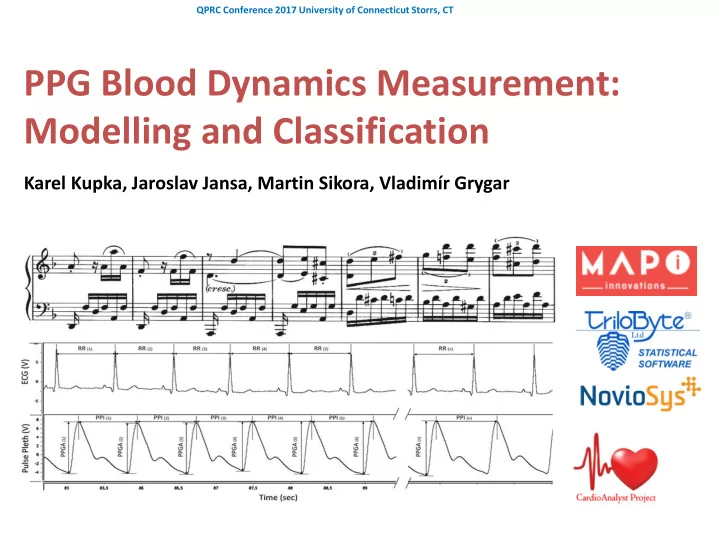
PPG Blood Dynamics Measurement: Modelling and Classification Karel - - PowerPoint PPT Presentation
QPRC Conference 2017 University of Connecticut Storrs, CT PPG Blood Dynamics Measurement: Modelling and Classification Karel Kupka, Jaroslav Jansa, Martin Sikora, Vladim r Grygar QPRC Conference 2017 University of Connecticut Storrs, CT
QPRC Conference 2017 University of Connecticut Storrs, CT
Karel Kupka, Jaroslav Jansa, Martin Sikora, Vladimír Grygar
First mentioned in 1930 During last years uncovered diagnostic potential in cardiology and cardiovascular and related diseases –
preventive use.
cardiovascular system.
TriloByte Statistical Software - TriloByte Statistical Academy - TriloByte Research. Pardubice 2017
CardioAnalyst
QPRC Conference 2017 University of Connecticut Storrs, CT
TriloByte Statistical Software - TriloByte Statistical Academy - TriloByte Research. Pardubice 2017
CardioAnalyst
PPG curves have been measured with commercial finger oximeters: Nonin WristOx2™, Model 3150 @ 60Hz sampling rate CONTEC Pulse Oximeter CMS50FW @ 50Hz
QPRC Conference 2017 University of Connecticut Storrs, CT
TriloByte Statistical Software - TriloByte Statistical Academy - TriloByte Research. Pardubice 2017
CardioAnalyst
P0 : Basal value for comparing easily in wave evaluation P1 : Initial systolic negative wave (intensity of cardiac output) P2 : Late systolic re-increased wave (vascular compliance) P3 : Late systolic re-decreased wave (residual blood volume)
QPRC Conference 2017 University of Connecticut Storrs, CT
TriloByte Statistical Software - TriloByte Statistical Academy - TriloByte Research. Pardubice 2017
CardioAnalyst
poorely defined. The final APPG pulse curve is extremely sensitive on the smoothing algorithms and their free-parameters settings.
points are often not present or the actual curve is not assignable unambiguously to any of the listed „normalized“ shapes. Assessment of the PPG is then strongly subjective and interpretations of the same curve may thus differ substantially.
minimum or maximum) disappears or is not detectable, or inversely, there is a multiplet of points instead of one, etc.
QPRC Conference 2017 University of Connecticut Storrs, CT
TriloByte Statistical Software - TriloByte Statistical Academy - TriloByte Research. Pardubice 2017
CardioAnalyst
Parametrization of the identified pulse in a continuous parametric space and assigning diagnosis (or, more quantitatively, probabilities of diseases) to subsapaces of certain combinations of parameters. We used two approaches. One is based on orthogonal polynomial approximation, second is based on harmonic (again orthogonal) approximation. The latter approach proved to be more adequate and useful. Time stability of the signal, eg. on daily basis can be monitored with Hotelling control chart routinely used in technology and manufacturing processes. This chart is based on Mahalanobis distances in the parametric space. PPG signal was complemented by baroplethysmographic (BPG) signal to extend informative content by simultaneous blood pressure curve and combine both signals.
QPRC Conference 2017 University of Connecticut Storrs, CT
CardioAnalyst
TriloByte Statistical Software - TriloByte Statistical Academy - TriloByte Research. Pardubice 2017
Simultaneous PPG and BPG curves were recorded using specially developed and manufactured measuring finger probe shown on the following figures. This probe must be made of rigid, non-elastic material to record pressure correctly.
Simultaneous measurement of relative pressure BPG (Baroplethysmography) and PPG (Photoplethysmography) curves
QPRC Conference 2017 University of Connecticut Storrs, CT
CardioAnalyst
The displayed curves (in blue) represent 32 different patients and their cardiovascular system. The pulse shape depends of its state, on the micro-circulation and haemodynmics of the blood flow. Parametrization (in red) using orthogonal harmonic function system (linear harmonic regression) will transform the patient´s waves into points in multivariate space. Here, they can be classified (with classical Fisher discrimination, Mahalanobis metric, Neural networks or Vapnik´s Support Vector Machines) and assigned into corresponding group of probable diagnoses. The plots below suggest that the waveform (in fact, several tens of repeated waveformsin each plot) of a single patient is rather stable (except cases of arythmia), which implies relative stability of the respective classification.
TriloByte Statistical Software - TriloByte Statistical Academy - TriloByte Research. Pardubice 2017 QPRC Conference 2017 University of Connecticut Storrs, CT
The procedure
CardioAnalyst
TriloByte Statistical Software - TriloByte Statistical Academy - TriloByte Research. Pardubice 2017
Raw signal Baseline correction – controlled by # of inflections Smoothing: Reinsch cubic spline: Minimize
1 2 2
1 1 1
n R i i i
s x x d n
2
2 d
with constraint
2 2 2 end start
d f x dx dx
QPRC Conference 2017 University of Connecticut Storrs, CT
The procedure
CardioAnalyst
TriloByte Statistical Software - TriloByte Statistical Academy - TriloByte Research. Pardubice 2017
First Derivative Second Derivative Pulse Detection Normalized Waveform
QPRC Conference 2017 University of Connecticut Storrs, CT
The procedure
CardioAnalyst
TriloByte Statistical Software - TriloByte Statistical Academy - TriloByte Research. Pardubice 2017
Linear Spectrum Log Spectrum
QPRC Conference 2017 University of Connecticut Storrs, CT
CardioAnalyst
TriloByte Statistical Software - TriloByte Statistical Academy - TriloByte Research. Pardubice 2017 1 1 2 2 1
sin cos sin 2 cos2 ... sin cos sin cos
m m m m m i
y a a x b x a x b x a mx b mx a a mx b mx
Harmonic regression Thirteen parameter model parameters: X1 X2 X3 X4 X5 X6 X7 X8 X9 X10 X11 X12 X13
Twenty-one parameter model parameters: X1 X2 X3 X4 X5 X6 X7 X8 X9 X10 X11 X12 X13 X14 X15 X16 X17 X18 X19 X20 X21
QPRC Conference 2017 University of Connecticut Storrs, CT
The procedure
CardioAnalyst
TriloByte Statistical Software - TriloByte Statistical Academy - TriloByte Research. Pardubice 2017
13-par model 21-par model HRV- profile
QPRC Conference 2017 University of Connecticut Storrs, CT
The procedure
CardioAnalyst
TriloByte Statistical Software - TriloByte Statistical Academy - TriloByte Research. Pardubice 2017
Classification in 13d / 21d
QPRC Conference 2017 University of Connecticut Storrs, CT
CardioAnalyst
This plot is based from the real data from 100 patients and subsequent projection of rhe wave parameters in the first two principal components.
Every point in the 2D-projection on the following plot represent a waveform of a single
circles represent an example of clustering/classifying 100 patients into diagnostic groups based on the waveform shape. The simple Harmonic Regression model:
TriloByte Statistical Software - TriloByte Statistical Academy - TriloByte Research. Pardubice 2017 QPRC Conference 2017 University of Connecticut Storrs, CT
CardioAnalyst
TriloByte Statistical Software - TriloByte Statistical Academy - TriloByte Research. Pardubice 2017
QPRC Conference 2017 University of Connecticut Storrs, CT
Number of Clusters detection Identified 4 health status clusters
AIC identifies four groups of patients with different PPG curve shapes without knowledge of their diagnosis
CardioAnalyst
TriloByte Statistical Software - TriloByte Statistical Academy - TriloByte Research. Pardubice 2017
QPRC Conference 2017 University of Connecticut Storrs, CT
Predicting age Modelling Diastolic pressure
Patient age or diastolic pressure is roughly predictable based on PPG curves.
CardioAnalyst
TriloByte Statistical Software - TriloByte Statistical Academy - TriloByte Research. Pardubice 2017
Least Squares Robust M-estimate Welsch
QPRC Conference 2017 University of Connecticut Storrs, CT
Patient systolic pressure predicted by PPG curves. Robust regression finds better fit for 80% of patients.
CardioAnalyst
TriloByte Statistical Software - TriloByte Statistical Academy - TriloByte Research. Pardubice 2017
Classification of three different healthy patients using Vapnik´s Support Vector Machines Vladimir Vapnik in NEC Lab Princeton, NJ
QPRC Conference 2017 University of Connecticut Storrs, CT
CardioAnalyst
TriloByte Statistical Software - TriloByte Statistical Academy - TriloByte Research. Pardubice 2017
Linear kernel RBF Kernel
QPRC Conference 2017 University of Connecticut Storrs, CT
Three classification models to predict probability of arteriosclerosis based on PPG curves.
CardioAnalyst
TriloByte Statistical Software - TriloByte Statistical Academy - TriloByte Research. Pardubice 2017
Linear kernel RBF Kernel
QPRC Conference 2017 University of Connecticut Storrs, CT
CardioAnalyst
TriloByte Statistical Software - TriloByte Statistical Academy - TriloByte Research. Pardubice 2017
2-neuron 1 layer
QPRC Conference 2017 University of Connecticut Storrs, CT
3-neuron 1 layer
CardioAnalyst
TriloByte Statistical Software - TriloByte Statistical Academy - TriloByte Research. Pardubice 2017
QPRC Conference 2017 University of Connecticut Storrs, CT
Actual Cross-val misclass rate for 13 pars
Best prediction reached with relatively simple single layer 4-neuron neural network with less than 3% miclassification.
CardioAnalyst
TriloByte Statistical Software - TriloByte Statistical Academy - TriloByte Research. Pardubice 2017
Volume capacity PPG (original PPG signal) APPG waveforms Combined PPG and BPG Signal Analysis
The relationship between PPG and BPG curves can be visualized by phase diagrams which plot the pressure against PPG
Further work
QPRC Conference 2017 University of Connecticut Storrs, CT
CardioAnalyst
TriloByte Statistical Software - TriloByte Statistical Academy - TriloByte Research. Pardubice 2017
QPRC Conference 2017 University of Connecticut Storrs, CT
The photoplethysmographic (PPG) waveform, also known as the pulse oximeter waveform, is one of the most commonly displayed clinical waveforms. First described in the 1930s, the technology behind the waveform is simple. The waveform, as displayed on the modern pulse oximeter, is an amplified and highly filtered measurement of light absorption by the local tissue over time. It is optimized by medical device manufacturers to accentuate its pulsatile
cardiovascular, respiratory, and autonomic systems. All modern pulse oximeters extract and display the heart rate and
monitor for cardiac arrhythmia, particularly when used in conjunction with the electrocardiogram (ECG). With slight modifications in the display of the PPG (either to a strip chart recorder or slowed down on the monitor screen), the PPG can be used to measure the ventilator-induced modulations which have been associated with hypovolemia. Research efforts are under way to analyze the PPG using improved digital signal processing methods to develop new physiologic parameters. It is hoped that when these new physiologic parameters are combined with a more modern understanding of cardiovascular physiology (functional hemodynamics) the potential utility of the PPG will be expanded. The clinical researcher's objective is the use of the PPG to guide early goal-directed therapeutic interventions (fluid, vasopressors, and inotropes), in effect to extract from the simple PPG the information and therapeutic guidance that was previously
Photoplethysmography. Anaesthesiology - Hemodynamic Monitoring Devices. Volume 28, Issue 4, December 2014, Pages 395–406. Aymen A. Alian, M.D. (Professor of Anesthesiology, Yale University School of Medicine) Kirk H. Shelley, M.D., PhD. (Professor of Anesthesiology, Yale University School of Medicine)
CardioAnalyst
TriloByte Statistical Software - TriloByte Statistical Academy - TriloByte Research. Pardubice 2017 QPRC Conference 2017 University of Connecticut Storrs, CT
Recent references
Metabolic syndrome (MetS) increases the risk of the subsequent development of cardiovascular disease. This study aimed to determine if the harmonic indexes of finger photoplethysmography (PPG) waveforms can be used to discriminate different arterial pulse transmission conditions between MetS and healthy subjects. Three-minute PPG signals were obtained in 65 subjects, who were assigned to 3 age-matched groups (MS, with no less than three MetS factors; pre-MS, with one or two MetS factors; Control: with no MetS factor). FDT (foot delay time) and amplitude proportions (Cn) and their standard deviations (SDn) and coefficients of variations (CVn) were calculated for harmonics 1 to 10 of the PPG waveform. FDT was smaller in MS than in Control. C1 and C2 values were significantly smaller, whereas C4–C9 values were significantly or appeared to be larger in MS than in pre-MS. Most of the SDn and CVn values were largest in MS. This study is the first to demonstrate that harmonic-analysis indexes of the beat-to- beat PPG waveform can provide information about MetS-induced changes in the arterial pulse transmission and cardiovascular regulatory activities. The present findings may therefore be useful in developing a noninvasive and easy-to-perform technique that could improve the early detection of cardiovascular diseases.
Characteristics of beat-to-beat photoplethysmography waveform indexes in subjects with metabolic syndrome. Microvascular Research, Volume 106, July 2016, Pages 80–87 Yaw-Wen Changa, Hsin Hsiub, Shu-Han Yangb, Wen-Hwei Fanga, Hung-Chi Tsaib, National Defense Medical Center, Taipei, Taiwan Taiwan University of Science and Technology, Taipei, Taiwan
CardioAnalyst
TriloByte Statistical Software - TriloByte Statistical Academy - TriloByte Research. Pardubice 2017 QPRC Conference 2017 University of Connecticut Storrs, CT
Recent references
In office and clinical practice settings, standard methods do not exist to objectively quantify lower extremity venous dysfunction. This pilot feasibility study examined venous refill time, an objective measure of skin microcirculation reflux, using photoplethysmography in 13 patients with known chronic venous disorders. The test was found to be feasible and easy to administer and provided
relationships among clinical signs, comorbid conditions, and objective findings with the severity of venous dysfunction in patients with suspected or known chronic venous disorders.
A pilot study of venous photoplethysmography screening of patients with chronic venous
Teresa J. Kelechi, PhD, RN (Medical University of South Carolina, USA) Rebecca B. McNeil, PhD (Biostatistics Unit, Mayo Clinic, Jacksonville, FL, USA)
CardioAnalyst
TriloByte Statistical Software - TriloByte Statistical Academy - TriloByte Research. Pardubice 2017 QPRC Conference 2017 University of Connecticut Storrs, CT
Recent references
Noninvasive Monitoring by Photoplethysmography. Clin Perinatol 39 (2012) 573–583, 2012 Elsevier. Rakesh Sahni, MD, College of Physicians and Surgeons, Columbia University, New York, NY, USA
The development of pulse oximetry is unarguably the most important advance in clinical monitoring in the past 3 decades. Pulse oximeters, which compute blood oxygen saturations (SpO2) using photoplethysmography with at least 2 different light wavelengths,
display a photoplethysmogram (PPG) to help clinicians distinguish between reliable SpO2 measurements (associated with clean, physiologic waveforms) and unreliable measurements (associated with noisy waveforms). Because of the success of pulse oximetry and recent advances in digital signal processing, there is growing research interest in seeking circulatory information from the PPG and developing techniques for a wide variety of novel applications. This article reviews the basic physics of photoplethysmography, physiologic principles behind pulse oximetry operation, and recent technological advances in the usefulness of the PPG waveform to assess and monitor the microcirculation and intravascular fluid volume during intensive care.
CardioAnalyst
TriloByte Statistical Software - TriloByte Statistical Academy - TriloByte Research. Pardubice 2017 QPRC Conference 2017 University of Connecticut Storrs, CT
Recent references
CardioAnalyst
TriloByte Statistical Software - TriloByte Statistical Academy - TriloByte Research. Pardubice 2017 QPRC Conference 2017 University of Connecticut Storrs, CT