Original Abstract: Firms environmental behaviour is expected to be - - PDF document

original abstract firms environmental behaviour is
SMART_READER_LITE
LIVE PREVIEW

Original Abstract: Firms environmental behaviour is expected to be - - PDF document

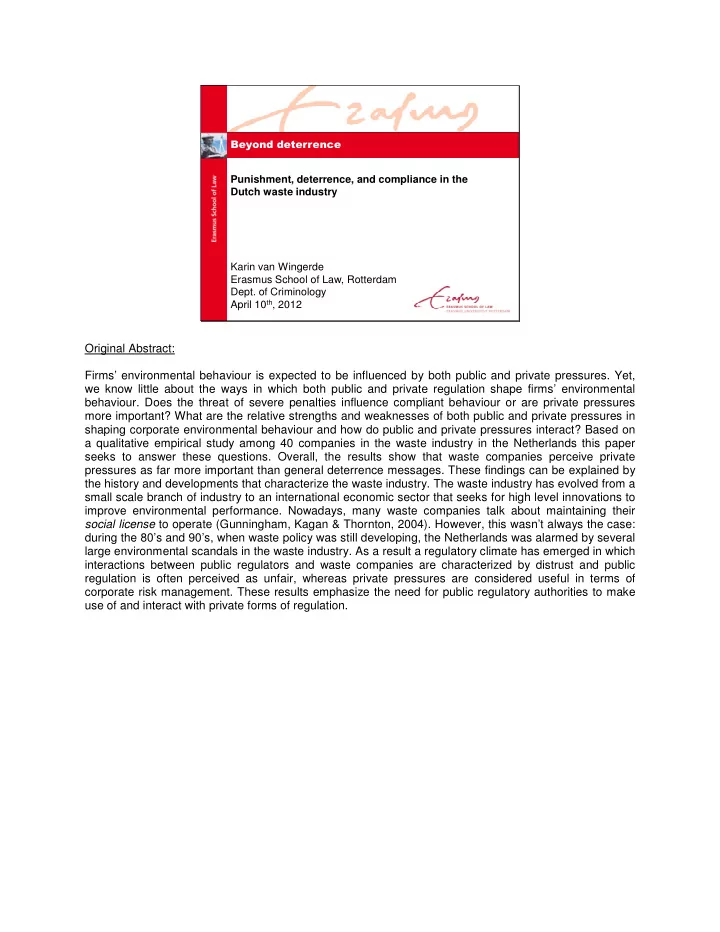
Punishment, deterrence, and compliance in the Dutch waste industry Karin van Wingerde Erasmus School of Law, Rotterdam Dept. of Criminology April 10 th , 2012 Original Abstract: Firms


slide-1
SLIDE 1
  • Punishment, deterrence, and compliance in the

Dutch waste industry Karin van Wingerde Erasmus School of Law, Rotterdam

  • Dept. of Criminology

April 10th, 2012

Original Abstract: Firms’ environmental behaviour is expected to be influenced by both public and private pressures. Yet, we know little about the ways in which both public and private regulation shape firms’ environmental

  • behaviour. Does the threat of severe penalties influence compliant behaviour or are private pressures

more important? What are the relative strengths and weaknesses of both public and private pressures in shaping corporate environmental behaviour and how do public and private pressures interact? Based on a qualitative empirical study among 40 companies in the waste industry in the Netherlands this paper seeks to answer these questions. Overall, the results show that waste companies perceive private pressures as far more important than general deterrence messages. These findings can be explained by the history and developments that characterize the waste industry. The waste industry has evolved from a small scale branch of industry to an international economic sector that seeks for high level innovations to improve environmental performance. Nowadays, many waste companies talk about maintaining their social license to operate (Gunningham, Kagan & Thornton, 2004). However, this wasn’t always the case: during the 80’s and 90’s, when waste policy was still developing, the Netherlands was alarmed by several large environmental scandals in the waste industry. As a result a regulatory climate has emerged in which interactions between public regulators and waste companies are characterized by distrust and public regulation is often perceived as unfair, whereas private pressures are considered useful in terms of corporate risk management. These results emphasize the need for public regulatory authorities to make use of and interact with private forms of regulation.

slide-2
SLIDE 2

Overview

  • Background: the control paradox
  • Aim & methodology
  • The general deterrent effect of sanctions
  • Private pressures: social license pressures &

management based regulation

  • Putting things into perspective: the waste industry in the

Netherlands

  • Conclusion & discussion
slide-3
SLIDE 3

Background: the control paradox

  • Public demand for increasing supervision and

deterrent sanctions in reaction to corporate scandals

  • And at the same time, a public demand for

decreasing administrative and regulatory burdens, resulting in governance and regulatory capitalism

In the Summer of 2006 the Probo Koala, an oil, bulk, and ore carrier ship, arrived in the port of Amsterdam to discharge 554 tons of slops, which is a hazardous waste comprising a mixture of gasoline, water, and caustic soda. The ship was chartered by the private company Trafigura, which is one of the world’s largest independent oil trading companies. During the discharge of the waste it appeared that the waste was much heavier contaminated than Trafigura had communicated and that the company that was supposed to process it couldn’t process it for the fee that both parties had agreed upon. After that, the ship left Amsterdam and about a month later the waste was found dumped throughout Abidjan, the main city of Ivory Coast which supposedly killed 16 people and caused the illness of many others. In the aftermath of the disaster the European Commission issued a new directive that compelled the Member States of the European Union to enforce environmental violations by means of criminal law. The underlying assumption posited was that imposing severe penalties sends a threat message to other companies as well and deters them from non compliant behaviour in the future. This reaction illustrates how society deals with scandals, incidents and large cases of corporate misconduct more in general. In reaction to these scandals we see a strong public demand for increasing supervision and harsher, more deterrent sanctions. This shift towards more punitive sanctions is usually justified by the aim of achieving deterrence, the belief that the threat of sanctions motivates companies to comply with the law. My study addresses this assumption and focuses on how & to what extent the threat of sanctions motivates companies in the waste industry to comply with environmental regulations. However, at the same time we see a strong public demand for decreasing the administrative and regulatory burdens of increased supervision and enforcement. Over the past years, this has resulted in more and more regulation away from governments by other actors such as companies itself, the media, rating agencies, certification agencies, and civil society. In sum, two contradictory developments characterize the regulation of corporate behaviour. On the one hand, the public demand for governmental supervision and deterrent sanctions is ever increasing. At the same time there is also a demand for decreasing the administrative and regulatory burdens of increased supervision and enforcement resulting in other mechanisms of social control. Therefore, the impact of sanctions cannot be studied in isolation, but we should study its role and impact compared to and in interaction with other mechanisms of social control. In this study I specifically focus on social license pressures and management-based regulation.

slide-4
SLIDE 4

Aim & methodology

  • Research aim

– Assess the role and importance of deterrence versus private pressures – Interpretive research approach

  • Methodology

– Qualitative empirical study among 40 companies in the waste industry in the Netherlands – Interviews, observations, document analysis

My study addresses the notion of deterrence and focuses on the role and importance of the threat of sanctions compared to private pressures, more specifically social license pressures and management- based regulation? This study aims at providing an interpretive understanding of organizational responses to sanctions as well as the organizational processes through which compliance is constructed. So I am not focusing on compliance per se, but on how companies interpret and respond to legal sanctions as opposed to private mechanisms of social control. To answer these questions I have conducted a qualitative empirical study among 40 companies in the waste industry in the Netherlands. The empirical design consists mostly of in-depth, lengthy interviews with environmental managers and directors of waste companies as well as interviews with public and private regulators. But I also had the opportunity to observe and follow the implementation process of a compliance management system at one firm for a longer period of time. The data obtained during the interviews was confronted with documents, analysis of media content and relevant literature as well as interviews with public and private regulators.

slide-5
SLIDE 5

Measuring deterrence

  • Fear of detection and legal punishment

– Knowledge of enforcement actions – Perceptions of the risks associated with environmental violations – Compliance measures

  • Studied by making use of ‘signal cases’
  • Inspired by Thornton, Gunningham & Kagan

(2005)

  • Criminal and administrative penalties

Deterrence assumes that companies are amoral rational calculators that will only comply with the law if it is economically sensible to do so. So only if the costs of criminal behaviour, in terms of the risk of getting caught and the type and size of the penalty exceed the benefits, they will comply with the law. To study the role and importance of deterrence in shaping firms’ environmental compliance I focused on three elements:

  • If a sanction is imposed to a company do other companies actually learn about it as well?
  • If they learn about it do they fear the possible consequences in terms of being detected and being

punished?

  • And in response to hearing about penalties do companies actually take compliance measures in
  • rder to make sure that they are not in violation of regulations?

This was studied by asking the interviewees to respond to the descriptions of two signal cases (Thornthon, Gunningham & Kagan, 2005), one concerned with a criminal case, the other with an administrative case.

slide-6
SLIDE 6

Deterrence: findings

  • Sanctions have little effect in terms of

awareness

– “The penalty doesn’t draw attention. What matters is what happened, what was the problem, that is what triggers a reaction”

  • Weak signal, weak threat

– “it’s a joke”; “purely symbolic” – (Administrative) violations without moral meaning

Findings

  • The interviews showed that sanctions didn’t have much effect in terms of the awareness they
  • created. Many environmental managers simply claimed not to know about sanctions against other
  • companies. In general respondents remembered the first signal case in which the company and

its executives were criminally prosecuted much better than the administrative case. In 31 of the 44 cases the respondents remembered the criminal case, while in only 18 of the 44 cases they remembered the second case. (This as such not so surprising because criminal cases tend to receive more attention in the media as compared to administrative penalties). More importantly, although I had asked them to speak about the sanctions they remembered, they spoke about cases more in general. They didn’t remember the sanctions, but they did remember what had happened and the violations that had led to penalty. For example, in the criminal case there was a huge fire that caused a lot of damage to the local surroundings. Most of the environmental managers did recall the fire and its consequences in terms of pollution, while only two of them knew that the company as well as its 3 executives were criminally prosecuted.

  • The first explanation for these results is that sanctions only provide a very weak signal and

therefore impose only a weak threat. Most of the interviewees believed that penalties for environmental violations are nothing compared to the profits of waste companies. Moreover, they believed that many sanctions were imposed for violations that are either administrative or quite technical in nature. And the problem with those violations is that they simply don’t have the same moral meaning as for example being punished for dumping toxic materials in the water and being punished doesn’t involve the same loss of face.

  • The second explanation is that the penalty itself and the public regulator that imposes it simply

don’t have an important position on the corporate horizon. During the interviews the environmental managers provided many illustrations of the importance of private pressures

slide-7
SLIDE 7

Private pressures

  • Social license pressures: demands and

expections emerging from surrounding civil society (Gunningham, Kagan & Thornton, 2004)

  • Management based regulation: internal

compliance procedures and reporting systems aimed at achieving public goals (Coglianese & Lazer, 2003)

I distinguished between two types of private pressures:

  • Social license pressures: meaning the demands and expectations from the local community and

environmental interest groups.

  • Management based regulation: The whole system of internal controls, compliance management

systems, and audits by internal regulators or (semi) external auditors as for example certification authorities.

slide-8
SLIDE 8

Environmental managers about social license pressures

  • “The money is not an issue, reputation is what it’s all

about”

  • “Although we are a privately held company, when you

are working with waste, you are owned by the public, so we have to be sensitive to public concerns”

  • “It works against you when you don’t establish a good

relationship with the public. Being a good neighbour is crucial, or you will create a potential problem”

  • “You need to be proactive: don’t wait for complaints, but

try to locate potential problems, fix them, and communicate about it to the public”

Many environmental managers spoke about their relationship with their local community and about keeping their social license. So not the regulator who comes only once of twice a year is a central motivation, but their neighbours whom they see everyday and vice versa, who smell and see the company everyday. The reputation towards the public and their relationship with their local community can be a powerful influence for compliance behaviour and sometimes even leads to beyond compliance behaviour. For instance, the last quote comes from a firm that hired two ‘odor experts’ , who drive through the local area twice a day trying to locate any smells coming from the incinerator of the company. This is definitely not compelled by regulations, but it did help to improve their reputation with the local community. The interviews provided several examples of companies that did take certain compliance measures in order to maintain their social license. Another example concerns a company that obtained a legal license for a mobile installation for the demolition of construction waste. Those installations create a lot of dust and noise as well and during the process of obtaining the legal license the local community had often expressed their concerns about an increase in noises and dust and they were fairly hostile towards the installation, so after obtaining the license, the company decided not to effectuate it because of their relationship with the public.

slide-9
SLIDE 9

Environmental managers about management based regulation

  • Public regulation:

– “just a snapshot of compliance, you need to be in control all the time” – “Punishment doesn’t teach you anything”

  • Whereas management based regulation:

– “aims at exposing weakspots and improving compliance” – “Internal controls backed by audits are a much better indicator for how well risks are being managed” – “I am more afraid of the internal auditor than of the public regulator, because they (internal regulators, kvw) are much tougher to convince that everything is in order” – “Our names are written in sand”

The interviewees were quite explicit about the role and importance of management based regulation compared to public regulation. They provided several examples on the differences between both types of

  • regulation. The best example is probably the case of a violation of emission standards. Public regulators

focus on the output, or whether or not the standards have been violated, whereas management based regulation focuses on the why and how: so how did it happen and what went wrong. And that provides much clearer assessments of what to change in order to improve compliance. So, in general the environmental managers felt that public regulation provides just a snapshot of compliance and punishment itself doesn’t teach the company anything, whereas management based regulation, backed by the fresh eyes from external certification authorities are a much better indicator of how well risks are being managed. Furthermore, they felt that the consequences of management based regulation are much more serious than penalties by public regulators. One manager mentioned for example that his name was written in sand meaning that he could be replaced by the headquarters if he didn’t make sure that the company was in compliance.

slide-10
SLIDE 10

Putting things into perspective (1): The waste industry’s quest for respectability

Putting things into perspective

  • The waste industry is a relatively young branch of industry. It developed rapidly during the ‘70s

and ‘80s when, due to environmental regulations, the treatment and processing of waste suddenly became profitable. It attracted a lot of entrepreneurs who tried to make it in this industry. At the same time, however, this also attracted businessmen that were less inclined to properly handle the waste and during the ‘80s and early ‘90s, when environmental policy was still developing, the Netherlands was alarmed by several huge environmental scandals in the waste

  • industry. The first scandal concerned a company, Uniser, specialized in processing chemical
  • wastes. Uniser was located at an industrial area south of Rotterdam next to one of the main

waterways in the Netherlands. Instead of processing the wastes properly, Uniser dumped almost everything into the water. On the premises of the company regulators found a secret system of pipes that led the waste streams run into the waterway. The 3 directors were eventually sentenced to 2,5 years of imprisonment. Unfortunately, Uniser was only the beginning of scandals, because in the years after that there were many more which eventually even led to a parliamentary inquiry in 1996 into the role of the government subsidizing a company that also systematically dumped hazardous waste into the water.

  • In reaction to these scandals a regulatory climate has emerged in which waste companies are

met with intensified controls and tight regulatory pressures and which is characterized by a huge amount of distrust between regulators and waste companies. But only since the beginning of this century things have begun to change. Waste companies became more and more aware that in

  • rder to secure their future they needed to change their behaviour and needed to gain the trust of

regulators as well as the general public. So the industry became much more professionalized, waste companies invested a lot in environmental performance, they hired highly educated professionals responsible for environmental compliance, and firms put a lot of effort in adjusting their appearances towards the public.

  • The pictures show some examples of this quest for respectability.
slide-11
SLIDE 11

Putting things into perspective (2): mismatch between public regulation and industry’s reality

  • Public regulation

– Sees firms as amoral calculators – Command-and-control – Prescribing behaviour

  • Waste industry’s

reality

– 21st century firms – Weak signal, weak threat – Managing important risks

Mismatch between public regulation and industry’s reality I think that today there is a situation in which most firms tend to have outgrown the public regulator in terms of their size and level of professionalism. Current regulatory policy based on the view of the industry in its 80s and 90s which relies heavily on command and control regulation isn’t well adjusted to that situation. To these firms deterrence isn’t relevant. First of all, because they don’t see themselves as amoral calculators, but as respectable businesses, and, secondly, because legal sanctions are simply not deterrent enough. They place the public regulator on a whole different level of importance than civil society and management based regulation. To them, public regulatory policy is focused on prescribing behaviour and on output measures, thereby running the risk of only capturing low-hanging fruits instead

  • f managing important risks. Environmental managers provided many examples of inspections during

which they were fined for relatively minor violations. For instance in one case a couple of batteries fell out the storage box and the company was fined 1.500 euro’s. To them compliance isn’t about whether or not batteries are stored in a box, but about governing that their emissions are within the safety margins and about making sure that the risks of a chemical fire of spill are minimized. But even more importantly, this strategy puts a huge strain on trust, which is central to a constructive dialogue as well as to gaining trustworthy information (Gunningham & Sinclair, 2009).

slide-12
SLIDE 12

Conclusion & discussion

  • Public regulation and enforcement: establishing

minimum standards and drivers for significant improvements of environmental compliance,

  • But: lack flexibility and authority to influence

large & complex firms

  • Emphasizes the need for public regulators to

interact with private forms of regulation

In conclusion: Traditional forms of regulation place a lot of emphasis on the role of the public regulator in controlling and enforcing compliance with environmental regulations. I think that the waste industry is a perfect example

  • f the fact that regulation and enforcement are important drivers for professionalization and better

compliance, but after a while might be experienced as to tight and as ‘going by the book’. Especially with large, international oriented firms we need to question whether this emphasis on controlling and enforcing is in the best interest of the environment. I think that the challenge for public regulatory authorities is to make use of and interact with private forms of regulation.