Norway- Country report Ministry of Agriculture and Food: Evaluation - - PowerPoint PPT Presentation

norway country report
SMART_READER_LITE
LIVE PREVIEW

Norway- Country report Ministry of Agriculture and Food: Evaluation - - PowerPoint PPT Presentation

Norway- Country report Ministry of Agriculture and Food: Evaluation 2015- February 2016: Climate change and challenges for Agriculture- Knowledge status -need of new knowledge. Adaptation. Evaluate Norwegian climate policy related to new IPCC


slide-1
SLIDE 1

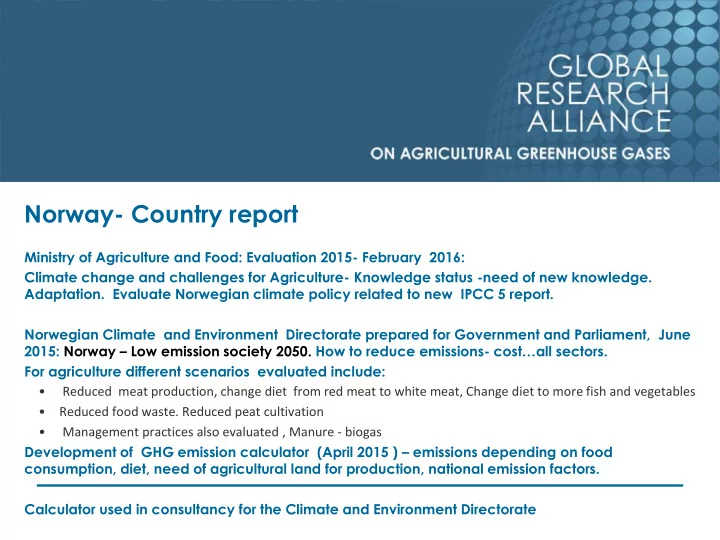
Norway- Country report

Ministry of Agriculture and Food: Evaluation 2015- February 2016: Climate change and challenges for Agriculture- Knowledge status -need of new knowledge.

  • Adaptation. Evaluate Norwegian climate policy related to new IPCC 5 report.

Norwegian Climate and Environment Directorate prepared for Government and Parliament, June 2015: Norway – Low emission society 2050. How to reduce emissions- cost…all sectors. For agriculture different scenarios evaluated include:

  • Reduced meat production, change diet from red meat to white meat, Change diet to more fish and vegetables
  • Reduced food waste. Reduced peat cultivation
  • Management practices also evaluated , Manure - biogas

Development of GHG emission calculator (April 2015 ) – emissions depending on food consumption, diet, need of agricultural land for production, national emission factors. Calculator used in consultancy for the Climate and Environment Directorate

slide-2
SLIDE 2

Reduced GHG emissions Norway. Calculations – Low emission society 2050

1000 tonn CO2-ekv Compared to 2012 Without CO2

  • Incl. CO2

Without CO2 Incl CO2 Todays emissions 4 835 6 310 100 % 100 % Emissions 2050 (6,7 mill inhabitants) Todays practice and efficiency 5 990 7 512 124 % 119 % 10 % increase in cereal and forage yields 5 864 7 369 121 % 117 % Increased milk prodction /cow 5 497 6 999 114 % 111 % Referencescenario 2015 5 083 6 207 105 % 98 % Red to white meat 4 580 5 693 95 % 90 % Stop in cultivation of peatsoil 5 051 6 021 104 % 95 % Less food waste 4 984 6 102 103 % 97 % Biogass from manure 4 922 6 056 102 % 96 % From meat to vegetables 4 427 5 532 92 % 88 % Low emission scenario 4 182 5 140 87 % 81 %

slide-3
SLIDE 3

Need of agricultural area for the different measures mill daa (1 daa = 0.1 ha )

Total Cereals Other food crops Harvested forage grasland , meadow Other agricultur al area Todays area 9,9 3,0 0,2 4,7 1,5 0,5 Emissions 2050 (6,7 mill inhabitants) Todays practice and efficiency 12,8 4,0 0,3 6,1 2,0 0,5 10 % increase in cereal and forage yiields 11,7 3,6 0,3 5,6 1,8 0,5 Increased milk prodction /cow 11,6 3,9 0,3 5,2 1,7 0,5 Referencescenario 2015 10,5 3,7 0,3 4,5 1,5 0,5 Red to white meat 9,9 3,8 0,3 4,0 1,3 0,5 Stop in cultivation of peatsoil 10,5 3,7 0,3 4,5 1,5 0,5 Less food waste 10,2 3,6 0,3 4,4 1,4 0,5 Biogass from manure 10,5 3,7 0,3 4,5 1,5 0,5 From meat to vegetables 9,4 3,3 0,3 4,0 1,3 0,5 Low emission scenario 9,1 3,2 0,3 3,9 1,3 0,5

slide-4
SLIDE 4

Climate change – agricultural challenges: Effects of climate change. Adaptation to climate

  • change. Reduction of GHG emissions.

Halm til biovarme

Ragnar Eltun Bioforsk Øst Apelsvoll

Longer growing season (1- 3 months )- New possibillities: Higher yields, increased number of harvests, new varietes, new crops, crops for

  • ther purposes like energy , better quality.

Change in agricultural management recommendations like fertilisation, plant health (weed, diseases, fungi ) , soil tillage, increased need of environmental measures

slide-5
SLIDE 5

Challenges – wetter climate

  • Adaptation to wetter climate:
  • Harvesting:
slide-6
SLIDE 6

Wetter conditions-plant production

Robust plant materiale adapted to wet soil conditions and compacted soils Unstable winter conditions. Reduced winter survival.

slide-7
SLIDE 7

Svanhovd, Pasvik valley.7 km from Nickel,Russia

The Meadow warm experiment

  • Contact. Hanna Silvennoinen@nibio.no
  • Istallation of an experimental system to test; Increased temperature flux and

show what the effects might be on food production for populations in the high north and measure changes in greenhouse gas emissions.

  • Plots of meadow are heated up by three degrees Celsius and monitored by a

complex system of sensors and imaging devices in the field, remote satellite imagery from above and laboratory tests of soil samples. Test of biochar stabilty under northern heated conditions- effect of biochar –ability to hold heavy metal in polluted soils.

  • A collaboration of a dozen scientists across Norway will keep track of plant

production, soil moisture, nutrients, microbial communities, heavy metal concentrations and greenhouse gas emissions in the soil and in the air above the heated sites.

  • Will heated plots be a carbon sink or a carbon source?
  • Effect on plant production? higher production

higher emissions - microbiology activity in soil * Effect of biochar- warmer northern conditions

slide-8
SLIDE 8

Meadow warm_ Experimental set up

slide-9
SLIDE 9

Biochar research

Climate and Environment Directorate: Biochar is calculated as one of the most efficient measures to store carbon and reduce GHG-emissions from agriculture . Biochar is not available for farmers. Effect on agricultural soils ?

  • Biochar and effect on C- storage and GHG emission

in Norwegian soil. Contact: Adam O.Toole. Bioforsk

  • Surface Properties and chemical composition of

corncob and miscanthus biochars: effects of production temperature and method. Contact Alice

  • Budai. Bioforsk
  • Stability of Biochar Series in Soils and Induced

Priming Effects. Contact: Daniel Rasse, Alice Budai, Bioforsk.daniel.rasse@nibio.no Adam.o.toole@nibio.no alice.budai@nibio.no

slide-10
SLIDE 10

Field trial in Norway – 2010-14

Ås

(University of Life Sciences, field station)

  • Biochar inverse

ploughed in the fall of

  • 2010. New application in

2012 and 2014.

  • Crops – 2011 Oats

2012 Barley 2013 Oats 2014 Oats

  • Fertilizer: 150 kg N ha-1
slide-11
SLIDE 11

Measurments 2011 - 2014

  • CO2-flux measurement:

Closed static chambers, Infrared gas analyzer (IRGA)

  • CO2 from biochar:

repeated δ13C measurements with Piccaro G1101-i, and keeling plot method.

  • N2O fluxes: Larger closed

chambers, measured via GC

slide-12
SLIDE 12

Results – Soil respiration

Pyreg miscanthus biochar at 8 and 25 t per ha does not significantly increase soil CO2 efflux.

mai jun jul aug sep

  • kt

50 100 150 200 250 300 350

Control Feedstock 8 tC/ha Biochar 8 tC/ha Biochar 25 tC/ha

2012

jun jul aug sep

  • kt

Soil CO2 flux (g C m-2) 100 200 300 400 500

Control Feedstock 8 tC/ha Biochar 8 tC/ha Biochar 25 tC/ha

Date of 2011 mai jun jul aug sep Soil CO2 flux (g C m-2) 50 100 150 200 250

2011 2014

slide-13
SLIDE 13

Cumulative C losses – 2012

C4 plant-C loss CO2-C loss Contribution to CO2 C loss from straw and biochar g m-2 g m-2 % Control 279

  • Straw 8 t C ha-1

303 63.4 7.9% Biochar 8 t C ha-1 262 2.2 0.7% Biochar 25 t C daa-1 307 2.4 0.3%

In the field, Pyreg miscanthus biochar appeared to decompose at about 0.5% per growing season (June – October). Growing season 2012 (initial fall and spring periods not captured)

slide-14
SLIDE 14

apr mai jun jul aug sep

  • kt

µg N2O-N m-2 h -1

200 400 600 800 1000 1200 1400

Control BC8 BC25 BC25 new

fertilization harvest

N2O flux 2012

O’Toole et al. in prep

  • No statistically

difference between treatments.

  • Large variations.
  • Peak after

fertilization

  • High peak in

September after harvest and no plant growth.

slide-15
SLIDE 15

Soil N2O flux 2014

10 20 30 40 50 60 70 80 5/1/2014 5/21/2014 6/10/2014 6/30/2014 7/20/2014 8/9/2014 8/29/2014 9/18/2014 10/8/2014 10/28/2014

µg N2O-N m-2 hr-1

Control BC aged BC new

Fertilization (110 kg N ha-1) Harvest Fertilization (30 kg N ha-1)

* * *

slide-16
SLIDE 16

Recorded Year From To Frequency Treatments (number of replicates) Parameters Control MC8 BC8 BC25 BC25new Depth Soil moisture 2011 June October 24 h 4 4 4 4 4 NO3-/NH4+ 2012 April September x7 4 4 4 4 4 1 Heat fluxes 2012 April June 30 min 8 8 1 Soil moisture 2012 June September 4 h 3 3 3 6 1 Soil moisture 2012 September October 1 h 3-10 1-5 2-5 1 Temperature 2012 September October 1 h 2 2 2 1 N2O fluxes 2012 April September x10 4 4 4 Soil moisture 2014 June November 15 min 3-4 3-4 2-3 2 Temperature 2014 June November 15 min 3-4 3-4 2-4 2 CO2 fluxes 2014 June October x5 4 4 4 4 4 δ13C CO2 fluxes 2014 June October x5 4 4 4 4 4 N2O fluxes 2012 May October x15 4 4 4

Weather data from 2011 to 2014 Air temperature Soil temperature at 6 depth Air humidity and pressure Wind speed and direction Solar radiation PAR Precipitation Soil and plant properties Agricultural management Plant parameters Soil bulk density Soil hydraulic properties Soil texture Soil OC content COUP Model

Parameterization Calibration Validation

Crop yield and height from 2011 to 2014

Modeling approach Christophe Moni, GRA:cross-cutting C- N modelling

slide-17
SLIDE 17

Restoration of cultivated peatlands

  • Measurements over the last 3 years.
  • Examined the effect of drain blocking on GHG fluxes.
  • Measured:
  • Ecosystem Respiration with dark chambers
  • Water table
  • Plant species composition
  • Blocked the drains at the start of year 3.
  • Measured the response of ecosystem respiration to drain blocking.
  • Post drain blocking in year 3.
  • Single campaign with high frequency measurements to compare

currently cultivated with the abandoned plots.

  • Contact: Simon Weldon.nibio.no , Arne Grønlund, Nibio
slide-18
SLIDE 18

In Cultivation Old abandoned >60 år Measurement sites Recently abandoned <10 år

slide-19
SLIDE 19

High emissions of CO2- years after abandoned Low losses of N20 (no fertilization). Rewetting 1 year. No effect/reduction on CO2 losses or increase in CH4- emissions. Dry year- need longer measurement period.

slide-20
SLIDE 20

Nitrous oxide emissions from clover rich leys

during the long northern winter

Ievina Sturite1, Synnøve Rivedal1, Peter Dörsch2

1NIBIO, 2 NMBU Iievina.sturite@nibio.no peter.doerch@nmbu.no

slide-21
SLIDE 21

Materials and methods

kløver 0% 15% eller 30%

110 kg N ha-1

cattle slurry

Fureneset

clover 0% 30% 100%

Tjøtta

Undisturbed Removed

slide-22
SLIDE 22

Conclusions

Clower in grasslands promotes off-season N2O emissions under northern winter conditions Removal of foliage did not reduce gasseous losses under the conditions encountared at our sites More than70 % of N2O was lost during winter. N content in clower leaves reduced by 82 %. Increased N- content in straw and roots . Highest emission during thawing soil. Contact;ievina.sturite@nibio.no; peter.doerch@nmbu.no

slide-23
SLIDE 23

Cropping systems- environmental effects- (emissions og GHG and nutrient loss to surface and drainage water. Contact - Peter Dörsch, Audun Korsæth

* Measurement of N2O i lang term field trials (NMBU and NIBIO, Apelsvoll ) . 20 year of measurements cropping systems, crops, fertilizer, soil tillage. Yield, runoff losses surface and drainage water. * Development of equipment for automatic measurements of N2 O in field. Project DRAINIMP: Effect of drainage status on N2O emissions. Peter Dörsch

slide-24
SLIDE 24

Project; Mitigation of Greenhouse gas emission from cropped soils by mafic Mineral applications (MIGMIN)”.

  • Purpose : Innovative strategies for pH regulation in acid soils – field

research– increased yield with less GHG emissions.

  • Dolomite, Olivine a.o for regulating pH.
  • Peter Dörsch, Lars Bakken (NMBU Nitrogen Group), Nina Simon (Ife)

and Pål Tore Mørkved (UiB)

Automatic N2O emission measurements in cooperation with EU prosjekt (NORA – N2O Research Alliance, Marie Curie ITN, 2013-2016) lead by NMBU Nitrogen group. Contact Lars Bakken (lars.bakken@nmbu.no) Peter Dörch (peter.doerch@nmbu.no) NMBU = Norwegian University of Life Sciences

slide-25
SLIDE 25

GRA- Cropland- Norway Country update

Lillian Øygarden Lillian.oygarden@nibio.no