
SLIDE 1
CIHRT Exhibit P-1840 Page 1
- Mr. Bernard Coffey, Q.c.
Commission Co-Counsel, Commission of Inquiry on Hormone Receptor Testing, 50 Tiffany Lane,
- St. John's, NL
AlA 4H7
MOUNT SINAI HOSPITAL
- J. Brendan M. Mullen
M.D., FRCPC Director, Andrology Laboratory Deputy Director,
Pathology &. laboratory
Medicine Associate Professor,
Laboratory Medicine &.
Pathobiology, Anesthesis
&. Urology
University of Toronto
April 14, 2008
Commission 01 Inquiry Hormone Receptor Testing
APR 1 5 ZOOS
Pathology ft Laboratory
Medicine
600 University Avenue Toronto, Ontario, Canada M5G 1X5
- t. 416·586-4453 f. 416-586-8589
bmullen@rntsinai.on.ca www.mtsinai.on.ca
Dear Mr. Coffey:
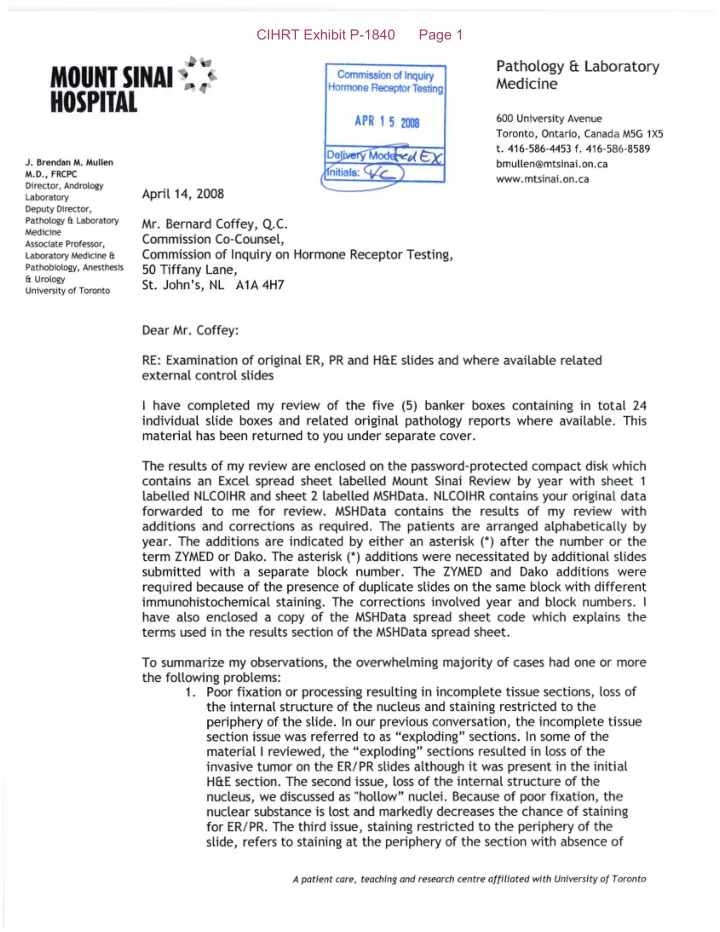
RE: Examination of original ER, PR and H&E slides and where available related
external control slides I have completed my review of the five (5) banker boxes containing in total 24 individual slide boxes and related original pathology reports where available. This material has been returned to you under separate cover. The results of my review are enclosed on the password-protected compact disk which contains an Excel spread sheet labelled Mount Sinai Review by year with sheet 1 labelled NLCOIHR and sheet 2 labelled MSHData. NLCOIHR contains your original data forwarded to me for review. MSHData contains the results of my review with additions and corrections as required. The patients are arranged alphabetically by
- year. The additions are indicated by either an asterisk (') after the number or the
term ZYMED or Dako. The asterisk (') additions were necessitated by additional slides submitted with a separate block number. The ZYMED and Dako additions were required because of the presence of duplicate slides on the same block with different immunohistochemical staining. The corrections involved year and block numbers. I have also enclosed a copy of the MSHData spread sheet code which explains the terms used in the results section of the MSHData spread sheet. To summarize my observations, the overwhelming majority of cases had one or more the following problems: 1. Poor fixation or processing resulting in incomplete tissue sections, loss of the internal structure of the nucleus and staining restricted to the periphery of the slide. In our previous conversation, the incomplete tissue section issue was referred to as "exploding" sections. In some of the material I reviewed, the "exploding" sections resulted in loss of the invasive tumor on the ER/PR slides although it was present in the initial H&E section. The second issue, loss of the internal structure of the nucleus, we discussed as "hollow" nuclei. Because of poor fixation, the nuclear substance is lost and markedly decreases the chance of staining for ER/PR. The third issue, staining restricted to the periphery of the slide, refers to staining at the periphery of the section with absence of
A patient care, teaching and research centre affiliated with University of Toronto