Lhaptel This fast You're will I into be review a - for - - PowerPoint PPT Presentation

lhaptel
SMART_READER_LITE
LIVE PREVIEW

Lhaptel This fast You're will I into be review a - for - - PowerPoint PPT Presentation

- Fly through Lhaptel This fast You're will I into be review a - for reading Chapter 2) ( and responsible 1 and if something talking to there's me you don't follow . : big ideas / terms " set ( Think like " the


slide-1
SLIDE 1

Lhaptel

  • Flythrough
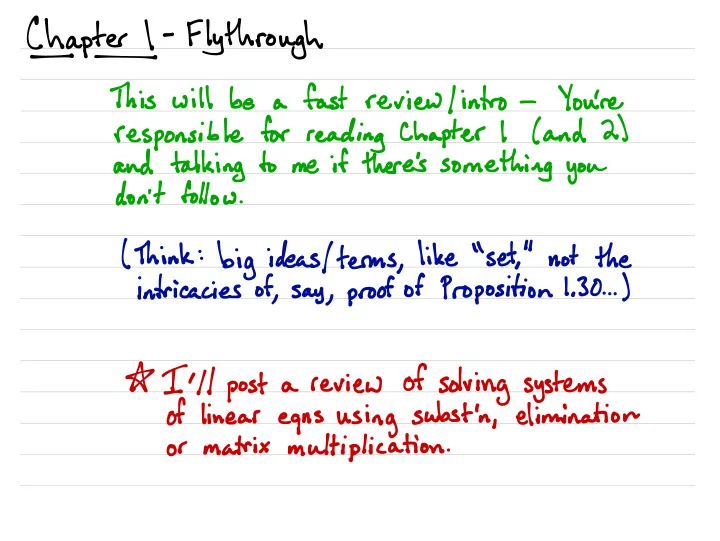
This will be a fast review I into
  • You're
responsible for reading Chapter 1 ( and 2) and talking to me if there's something you don't follow . ( Think : big ideas / terms , like " set , " not the intricacies
  • f
, say , proof of Proposition 1.30 . . . ) * I'll post a review
  • f solving systems
  • f
linear eqns using swbst 'n , elimination
  • r
matrix multiplication .
slide-2
SLIDE 2 Fundamentals / Very f : for every , for all F : there exists

( F !

: there exisb antique ) iff : iff and only if , ( ⇒ We won't use sets in much depth . Mostly : R = ieal numbers fx : XHR}

1122¥

( x. g) :
  • x. YER}
and esp . subsets
  • f those
slide-3
SLIDE 3 RecaH"Abstat"FunctionNotal= f : A B A : domain xtsftx ) B : co domain ( image , range ) × ~ fan target ( space ) T " maps to " f : R
  • > IR
  • r
{ XEIR : xzo } X ~ > ×2 Det injective
  • r
  • ne-to-one
( l :L) : two elb in domain sent to different outputs . swjective
  • r
  • nto :
every ett
  • f
co domain is hit . we
slide-4
SLIDE 4 Functions Injective Sejdiu Notate

:

. 3 . 4 . (bisection) 5 . 6 . fal=u ,HtH,H=fti ) 7 . 8.

:

.
slide-5
SLIDE 5 Vectors , Points and Lines

÷

2D) Vector is an
  • rdered
pair of real # ' s , ( a , b) . =) Common notations : ( a ,b ) , ( a , b) Our book : U = ( ui , ua )

µ

, in Graphically , U is an arrow : .
  • .
. ui ( here Ui , Ua ) 0)

Virtually

every vector concept has an algebraic defy

interpretation

and a geometric / axiomatic
  • ne
. Vi int
slide-6
SLIDE 6
  • dg
geo Addition Utkfuuytuuattthfu

:b

¥4

(scalar) mwlth cU=du , ,ud

¥

=L cu , ,cuI Eu Subtraction U . V=UtHW =L u ,
  • v , ,Usy)
linearly U=cVwV=cU dependent Ia ,b such that

#

(parallel) aUtbV= 01=10,0 )) a ,b not both .
slide-7
SLIDE 7
  • dg
gee dot product : U .V=lu , ,uD•(v , ,v ,) ( inner product , = Hiv , + Uava scalar product) I ( u ,v , , Usb ) . UnV=( u ,v ) length th magnitude Hull .in#g

#

"
slide-8
SLIDE 8 If you learned vectors from Stewart's book . . . Stewart make huge distinctions between points and vectors : n

/¥f

  • P
= ( 3,2 )

#

( 3 , 2) = OF =) We won't For us , Vector and point are synonyms .
  • .
It's clear from context , and it makes life easier to do it this way . To wit :
slide-9
SLIDE 9 Det Given a point P and non . zero vector U , the set l={P+sU : se R }
  • is
a line U
  • Post'sU••
  • ptrou
P
  • 2U
P Ptu P•t2U A is a direction indicator ( dir vector ) . Points
  • n
l are " incident " with line . R , Ps , ... , Pn are collinear if F line incident w/ all
  • f them
. EI H , 2) + sl 3 ,
  • 4)
(k , 0) is
  • n
line ( s= I )
  • 1+35=5
( 5,6 ) is not . 2 . ys=6 } no sotn
slide-10
SLIDE 10 Pts ( Q ' P) a- p=U

t.fi

µ

  • .
µ FQ=QI P
  • than
gp+s(

¥

,} " { Qtslpal }

/

5.0 so ' pot ' = 'QF ' Hxlkfax PI ' # OF ' length of PI is HQ . pH=HP . QH

=(Q-P,Q#

= FIAT
slide-11
SLIDE 11 Does this def " cover everything we expect?
  • Can get segments,
rays using restricted values
  • f
s .
  • Two points
farm a line ? Yes ( wksheett PIOPII two non
  • zero
vectors are DI 's of same line if± they 're scalar Mutt 's of each
  • ther
. Let Pt Q . Then F unique line # incident with both , U = Q
  • P
is a DI
  • f
' POT , and every DI
  • f
' POT is difference
  • f
two pts
  • n
the line .
  • slope
  • f
Pts U is ¥ , if u , to . P %% : " 2
  • U
,
slide-12
SLIDE 12
  • ther forms :
eliminate parameter E± ( -1,2 )+s( 3 ,
  • 4)
  • (
  • 1+3
, 2- 4s) IF It X=3s
  • 1
5=51×+1) y=
  • 45+2
s =
  • fly
  • 2)
f- ( x + D=
  • t.ly
  • 2)
4×+4=-3+6 solve for y . . . 3y=
  • 4×+2
y=
  • 31×+3
slide-13
SLIDE 13 Det Two lines l , m are parallel , l//m if DI 's are H . Pap # Lines l= { Pts U } , m= { QTTV}
  • A
in
  • ne point if
U , V tin . indep ( not 11 ) . empty Ah if UHV and

UHQP

p

y

,
  • are
same line if u||✓ ¥
  • OF
and UHQ
  • P
K;←Q± .

slide-14
SLIDE 14 Warm-up Pkn ( 4131171 Red : UaV= ( u , ,u2 ) . ( v , , b) = U , v. + Uzva Proves : The dot product is commutative : U . V=
  • V. U
U ' V = U ,v , + uzvz = V , U , + Valls =
  • V. U
Proves : The dot product is distributive : U . ( Vtw )=U.V+U . W U . ( ✓ t W) = ( u , , Ua )
  • ( v ,
+ w , , Vatwa ) =
  • x. ( v.
+ w ,)
  • ualvatwa )
= U , V , + U , wit U2V2 + Uaw 2 = ( U , v , + uava ) t ( u , W , tuzws ) = U . V + U . W
slide-15
SLIDE 15

Quickstatuscheck

: which
  • f
Euclid 's Axioms work so far ? 1 Given two pts, F line containing them 2 Lines can be extended indefinitely 3 Given A ,B, F circle cent 'd at A r= HD
  • All
with radius AI . C={ X : HX
  • AH=r}
A.
  • B
4 Right angles are all equal X 5 || postulate ( ✓ Hw )
slide-16
SLIDE 16

Pe_repend@ty1o_thogma_ityDefU1VifU.V

= U , v , + uava =
  • .
Two lines l , m are perpendicular if they have 1- Direction Indicators . |/ and -1 play important roles . . . Wry # If l is a line and P is a point, 7 exactly
  • ne
line incident with P and H to l . Prep # If l is a line and P is a point, 7 exactly
  • ne
line incident with P and 1- to l .
slide-17
SLIDE 17 Pap # If l is a line and P is a point, F exactly
  • ne
line incident with P and
  • 1
to l . Pf Suppose l : Q + SU , Ufo
  • ¥#
Claim : U=lu , .ua ) V= (
  • us
, u.lt U l now show any veutw I U is Cased U= ( u , .ua ) , u ,=o V= tua ,
  • )
scalar mull .
  • f
this . UT U . V= ( o , uol.L.ua , D= 0+0=0 (ase2_ Uz=O (ase3_ in gen 'l , U . ✓ = @ , , UD . tus , 4) =
  • Aiustu
,ua=o m : P + SV incident wlp , 1 l .
slide-18
SLIDE 18 NormalFoI Given lined , choose Yet and All a g ( i.e. ALU , U any DI
  • fl )
. Then

\f%×

th :

Aceto

} (
  • nleqn
  • f
line + Remember A , Y fixed ; X= ( x . ,xa ) ( = L x. yi ) is variable . If HAH =L , this Is " special " nlegn . EI Y=( 3. D , A =L
  • 1,2)
(-1,21
  • ( X
  • y) =L
  • I. 2)
. ( lx , ,xn
  • 13,1))
= ( -1,21 . ( x , -3 , Xa
  • l )
=
  • × , +3
+2×2
  • 2=0

¥t¥

,

III. tartan

's
slide-19
SLIDE 19 F alternate version
  • f normal
farm : l A
  • A. lx
. yko

\•f

't t
  • A. X
  • AaY=O
  • A. ( x ,y )
  • C
=0 An X=c

[ A- ( x

.,xd=c] EI A=H,2) , 4=13,1)
  • A. 1 x
  • y )=o
A X
  • Ito
A

.x+i=o

=
  • 1
A .X=
  • 1
slide-20
SLIDE 20 Between

IEHEOP

Let fcs) be egn of line , fun =P , fcsI=Q . Then R is between P , Q if F sz , s , ( s ] < 52 , f-CSs ) = R .

the

p . . fo ,
  • Q: fcsas
Corollary 1.21 Given 3 pts
  • n
a line , ' One must be blw
  • ther
two .
  • <
  • See book
for further corollaries with 4+ points
slide-21
SLIDE 21 A line separates 1122 into two " half planes . " 7 L Clever Def P , Qctl
  • n
  • pposite sides of l
if F Rtl
  • between
them . Otherwise , they 're
  • n
the same side . l p l
  • R

¥0

, l

  • \•Q
.
slide-22
SLIDE 22 Prep # let l :
  • A. l x
  • YKO
l Ytl , Atl ) and P ,

Qttl

. then P and Q are
  • n
same / opposite side of l if A • ( P
  • Y) ,
  • A. ( Q
  • Y)
have same signs .

D.

Book uses A . X = C , compares AP
  • c
,
  • A. Q
  • c
. D. Would be " simple " 1 well , simpler) if we had
  • E. I
= HEH . HBH cos A > for Oeco , Mad < for Otltla , it ]
  • Hafts
. P
  • l
Y
slide-23
SLIDE 23 Prep # let l :
  • A. ( x
  • YKO
( Ytl , Atl ) and P , Qtl . Then P and Q are
  • n
same / opposite side of l if Aa(P
  • Y)
, Aol Q
  • Y)
have same 1opposite sign . PI Let go ) = A. (

Cpi

)]
  • Y
) for
  • esel
line segment PI glsko for some s iff PI intersects l at pt R ( P , Q
  • pposite
sides ) Now gcst.to#ED+sA.l+Q-PT=b+ms=ms+b That 's linear , so minlmax values

Af

  • P
@ endpts , gcsko only if# glol , ga) have diff . signs . Y
  • a
glo ) =
  • A. ( P
  • y )
, g (1) =
  • A. ( Q
  • YI
.
slide-24
SLIDE 24 . Second Warmup Question : Prove : (CU ) .V= c ( U .V) PI : EU)
= ( ( u , ,c uol.lv , ,v , ) = ( UN , t C U2V2 = C ( au , t uzva ) = c ( uv )
slide-25
SLIDE 25

Moving

# kapter2= You read § 2.1
  • n
" Matrix Concepts . Other than
  • matrix
multiplication . all we 'll need for now : Lemmond Let U ,VeR2 be linearly independent . Then
  • V. XE R3
F unique a , be IR such that X = add " cards ( a. b) " linear combination
  • f
U , V . ( See lemma for formulas for a ,b . in particular . . . )
slide-26
SLIDE 26 Lemma2= Let U , Vto in IN , with ULV . Let XEIR? Then x= Yiutrutiftfzv Corollary
  • 2.5
( same conditions) 11×11 ? l×juh÷ + Ynys
slide-27
SLIDE 27 Distance qualities We defined Hxlkxfx = ( x. x 7 " 2 Also , HQ
  • PH
= dist ton P to Q = H P
  • QH
= IPII = / OF /

V¥kltu

Def FQ a RJ are qngment_ if IPFI = IRJI . Det Congruence of line segments is equivalence relation .
slide-28
SLIDE 28 Quick#d : Equivalence Relations Examples of Relations 2 , < : 3<4 , 541 R , aRb if a2=b2 IR , = : 3=3 , 3=14 A relh is an equivalence rekn if it is ... 1 reflexive : tfx , × Rx 2 symmetric : V × , y , if × Ry then yRx . 3 transitive : Vx ,y,z , if xRy and yRz, then xRz
slide-29
SLIDE 29 You try ( I didn't type this up ... )
  • :
Which
  • f
the following are equivalence relations ? people, " have same birthday " yes lines , H yes integers , E X not Symm lines , 1 X not reflexive
  • r
trans . IR , aRb if a2=b? yes R , a ( ? ) lappx equal to .
slide-30
SLIDE 30 Cauchy
  • Schwarz (
  • Bunyakovsky) Inequality
( Lemma 2.11) / U . V / I Hull . HVH with equality iff UHV . 1 Standard Pf 2 Quicker Pf using tin . alg . concepts from Chapter 2 . (These were done
  • n
board ) end day 2 .
slide-31
SLIDE 31 ten

( 0

inequality) : ( done
  • n
board ) ( Restated in Prop 2.13 4 line segments)
slide-32
SLIDE 32 thm.SI (Pythagorean) Let A , B , CEIR 2 be distinct points .

( done

  • n
board )
  • 13
A
  • C