Green Bag Lunch: Composting Opportunities at Home What the Office of - - PowerPoint PPT Presentation

green bag lunch composting opportunities at home what the
SMART_READER_LITE
LIVE PREVIEW

Green Bag Lunch: Composting Opportunities at Home What the Office of - - PowerPoint PPT Presentation

Green Bag Lunch: Composting Opportunities at Home What the Office of Energy & Sustainability Works On Climate Action Plan Management Energy Efficiency Projects/Campus Energy Metering Recycling & Waste Education


slide-1
SLIDE 1

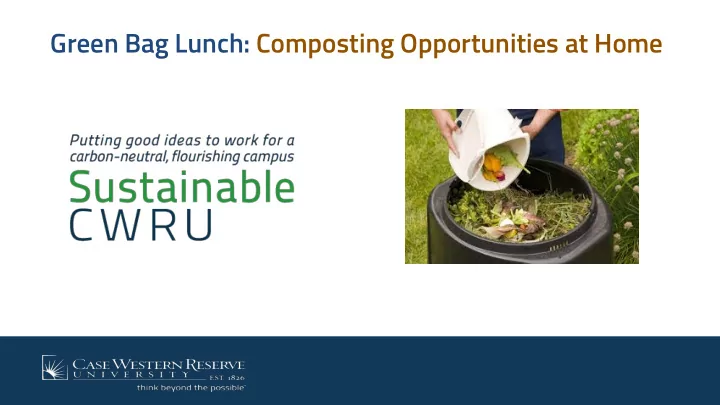
Green Bag Lunch: Composting Opportunities at Home

slide-2
SLIDE 2

What the Office of Energy & Sustainability Works On

  • Climate Action Plan Management
  • Energy Efficiency Projects/Campus Energy Metering
  • Recycling & Waste Education
  • Sustainable Transportation Education
  • Energy & Sustainability Data Collection & Reporting
  • Green Building & Green Grounds Advising
  • Working to Create a Culture of Energy and Sustainability Awareness
  • Community Engagement in Energy & Sustainability
  • Sustainability House program, Student Sustainability Ambassadors, Green Bag Lunches
  • Bike committee, Scooter Committee, Recycling Committee, CAP Committee, Tree Committee
slide-3
SLIDE 3

TODAY’S SPEAKERS: Carin Miller, Education Specialist, Cuyahoga County Solid Waste District Zoe Apisdorf, Director of Residential Services, Rust Belt Riders Laura Klingler, Assistant Director University Events, CWRU

slide-4
SLIDE 4

Carin Miller Education Specialist Cuyahoga County Solid Waste District

slide-5
SLIDE 5

CUYAHOGA COUNTY SOLID WASTE DISTRICT

We are the public agency helping the people of Cuyahoga County to reduce, reuse and recycle at home, at work and in our communities. We serve the 59 communities within Cuyahoga County. Learn more at CuyahogaRecycles.org

1

slide-6
SLIDE 6

2

Why Compost?

It is an easy waste reduction strategy for households

  • Food scraps & yard waste = 25% municipal solid waste
  • Improves your ecological footprint (carbon sequestration)
  • Organics in landfills produce methane gas
slide-7
SLIDE 7

3

Why Add Compost

Good quality compost supplies organic matter, nutrients, and beneficial microorganisms

  • Improves workability of soil and resists compaction for better

aeration and water holding capacity

  • Stimulates healthy root development
  • Adds nutrients back into the soil to improve soil fertility
  • Results in healthier food
slide-8
SLIDE 8

4

Composting is

Aerobic biological decomposition of

  • rganic material

under controlled conditions

A mixture of stable organic matter, minerals and microorganisms

slide-9
SLIDE 9

5

A Healthy Pile

  • Create a healthy environment that

supports micro-organisms (bacteria and fungi) and macro-organisms (worms, insects, slugs)

  • Physical and chemical decomposers

break down organic waste

  • Happy, healthy creatures reproduce,

consuming your organic scraps more efficiently

  • All living things need shelter, food

and water

slide-10
SLIDE 10

6

  • Level, well drained

area

  • Build over soil or lawn
  • Discreet & accessible
  • Sunny spot

Location

slide-11
SLIDE 11

7

  • Keep volume

around 3 feet cubed

  • Center of pile 90–

120 degrees F

  • 50% moisture
  • Oxygen – turn/stir
slide-12
SLIDE 12

8

A Healthy Pile

Balanced diet

slide-13
SLIDE 13

9

30-40% Green, nitrogen containing

  • rganic matter

supplies protein

Vegetables, fruits, flowers, plant clippings, grass clippings, coffee grounds, manure, etc…

A Balanced Mixture

Affects quality and speed of decomposition

slide-14
SLIDE 14

10

60-70% Brown, carbon based organic matter supplies energy in carbohydrates

Dead leaves, straw, sawdust, wood chips, shredded newspaper, corn stalks, cotton rags, nut shells, pine needles, etc…

A Balanced Mixture

slide-15
SLIDE 15

11

Compost Dos

Grass clippings Plants Fruits, vegetables and grains Egg shells Coffee grounds Hair (pet, human) Leaves Nuts Straw, hay Tea bags (not plastic) Sawdust Lint (natural fibers) Shredded paper

slide-16
SLIDE 16

12

Compost Don’ts

Meats Dairy Products Oils and Fats Bones Cat and dog droppings Cat litter Diseased plants Weed seeds Branches or limbs Glossy paper Plastic tea bags

slide-17
SLIDE 17

13

Lay down base material (chopped brush or other coarse materials) on soil to allow air circulation around base of pile Alternate layers of greens (nitrogen) and browns (carbon) around 3”- 6” After each green/brown layer, add garden soil or compost

How to Start the Composter

slide-18
SLIDE 18

14

  • The pile will heat

up

  • Materials no

longer look like the original stuff you put in the pile

  • Little to no odor
  • ther than an

earthy one

Is it working?

slide-19
SLIDE 19

15

Pile Too Wet?

  • add sawdust, straw or

wood chips, and aerate Pile Too Dry?

  • Turn pile, and add water, or

leave top off Pile Damp & Sweet Smelling? Won’t heat up?

  • It needs nitrogen so add

fresh grass clippings, manure, blood meal or urea fertilizer Pile Smells Like Ammonia?

  • add brown leaves,

sawdust, straw or wood chips.

Problem Solving

Refer to section in Composting Brochure or online sources

slide-20
SLIDE 20

16

Bins Available

Ultimate Dirt Machine (Digester bin) = $55 Go Plastics, Georgia Retail value over $100 Wishing Well Composter = $50 Covered Bridge Organics, Ohio Retail value $74 or more

slide-21
SLIDE 21

17

Other Equipment

Yard Butler - Compost Aeration Tool $20 Compost Thermometer $10 Sure-Close Pail = $5

Retail value $20 Add a pail to hold your food scraps in the kitchen until you’re ready for a trip to the compost bin

slide-22
SLIDE 22

18

Digester Model

  • 70 gallons, 29”X39”
  • 100% recycled plastic
  • Good for passive composting
  • r someone who does not

need the soil amendment

  • Takes all food scraps and

yard waste

  • Minimal maintenance
  • Good second bin, especially

with large lawn, lots of trees and/or eat mostly vegetarian meals

Ultimate Dirt Machine

slide-23
SLIDE 23

19

  • Select a sunny location with good

drainage

  • Dig a pit 3” wider than digester
  • Position composter and backfill

with dirt to cover 3” over flange

  • Clean out and spread material

after a year and start again or move bin

How to Start the Digester

*Instructions are on a sticker on the bin. It could even be placed in a raised bed

slide-24
SLIDE 24

20

  • 135 gallons, 30”X36”
  • 100% recycled plastic
  • Ease of access to top, good for

active composting to turn pile

  • Follow dos and don’ts of food scraps

and yard waste composting

  • Requires a bit more maintenance
  • Good bin for households with large

lawn, lots of trees and willingness to maintain carbon to nitrogen ratio

Wishing Well Composter

* Instruction booklet comes with each composter in a plastic bag.

slide-25
SLIDE 25

Resources

The PDF of our Composting Guide is attached. If someone wants to request a hard copy they can do so via this link: https://cuyahogarecycles.org/PublicationRequest.aspx Backyard composting Webinars: https://cuyahogarecycles.org/compost_workshops_and_bins Info on composting equipment sold by the district: https://cuyahogarecycles.org/buy_a_compost_bin Equipment order form: https://cuyahogarecycles.org/Documents/PageContent/Composting/Composting_Equipment_Order_Fo rm.pdf

slide-26
SLIDE 26

Zoe Apisdorf Director of Residential Services Rust Belt Riders

slide-27
SLIDE 27

Rust Belt Riders

slide-28
SLIDE 28

Laura Klingler Home Composter & Assistant Director University Events at CWRU

slide-29
SLIDE 29

Laura’s Compost Bin

slide-30
SLIDE 30

CWRU Sustainability Team

sustainability@case.edu & energymanager@case.edu

  • Stephanie Corbett, Director of Energy & Sustainability
  • Erin Kollar, Assistant Director Sustainability
  • Erika Weliczko, Energy Manager