f zyxwvutsrqponmlkjihgfedcbaZYXWVUTSRQPONMLKJIHGFEDCBA A Petri - - PDF document

f zyxwvutsrqponmlkjihgfedcbazyxwvutsrqponmlkjihgfedcba
SMART_READER_LITE
LIVE PREVIEW

f zyxwvutsrqponmlkjihgfedcbaZYXWVUTSRQPONMLKJIHGFEDCBA A Petri - - PDF document

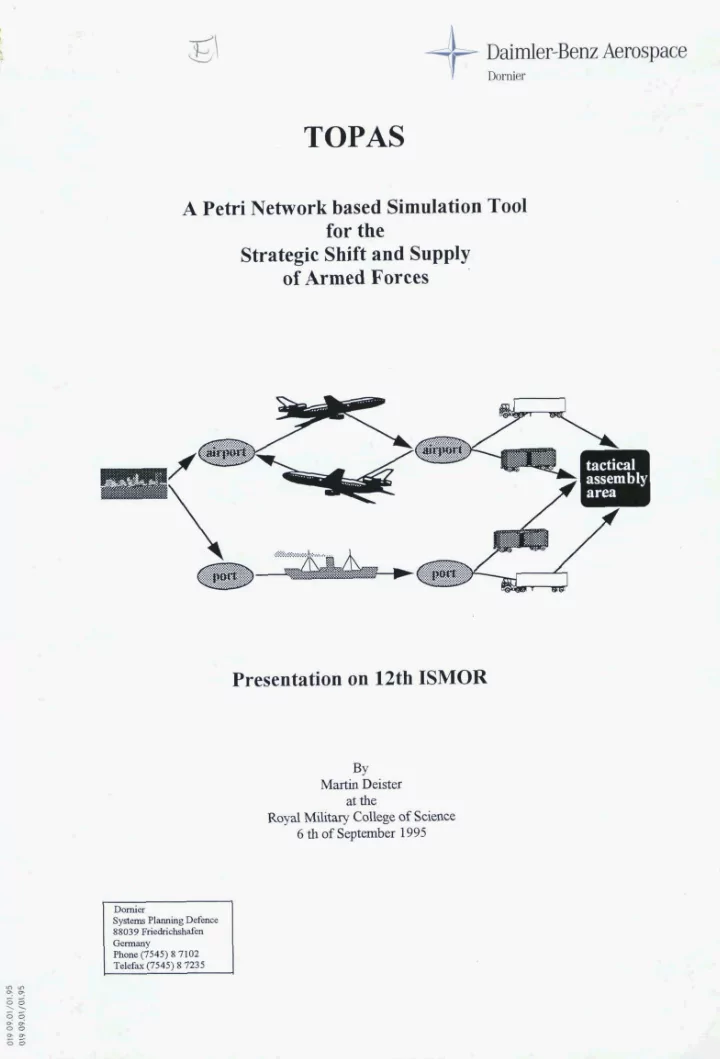
TOPAS zyxwvutsrqponmlkjihgfedcbaZYXWVUTSRQPONMLKJIHGFEDCBA ; F - B e n z Aerospace of Armed Forces zyxwvutsrqponmlkjihgfedcbaZYXWVUTSRQPONMLKJIHGFEDCBA f zyxwvutsrqponmlkjihgfedcbaZYXWVUTSRQPONMLKJIHGFEDCBA A Petri Network based Simulation Tool for


slide-1
SLIDE 1

TOPAS zyxwvutsrqponmlkjihgfedcbaZYXWVUTSRQPONMLKJIHGFEDCBA

; F - B e n z Aerospace

A Petri Network based Simulation Tool

for the Strategic Shift and Supply

  • f Armed Forces zyxwvutsrqponmlkjihgfedcbaZYXWVUTSRQPONMLKJIHGFEDCBA

f zyxwvutsrqponmlkjihgfedcbaZYXWVUTSRQPONMLKJIHGFEDCBA

\

area

Presentation

  • n 12th ISMOR zyxwvutsrqponmlkjihgfedcbaZYXWVUTSRQPONMLKJIHGFEDCBA

BY

MartinDeister

a t the Royal zyxwvutsrqponmlkjihgfedcbaZYXWVUTSRQPONMLKJIHGFEDCBA Military College o

f Science zyxwvutsrqponmlkjihgfedcbaZYXWVUTSRQPONMLKJIHGFEDCBA

6 th

  • f

September zyxwvutsrqponmlkjihgfedcbaZYXWVUTSRQPONMLKJIHGFEDCBA

1995

SysttmPlmuiegDeferm

phon (7545) 8 7102

T e l a

(7545) 8 723s

slide-2
SLIDE 2

Eh&der-Benz zyxwvutsrqponmlkjihgfedcbaZYXWVUTSRQPONMLKJIHGFEDCBA

Aerospace zyxwvutsrqponmlkjihgfedcbaZYXWVUTSRQPONMLKJIHGFEDCBA

1 zyxwvutsrqponmlkjihgfedcbaZYXWVUTSRQPONMLKJIHGFEDCBA

Introduction zyxwvutsrqponmlkjihgfedcbaZYXWVUTSRQPONMLKJIHGFEDCBA

M y name

is Martin Deister a

n d I a

m responsible for zyxwvutsrqponmlkjihgfedcbaZYXWVUTSRQPONMLKJIHGFEDCBA marketing in

the zyxwvutsrqponmlkjihgfedcbaZYXWVUTSRQPONMLKJIHGFEDCBA

defence planning division of DORNIERGmbHin Friedrichsbafq zyxwvutsrqponmlkjihgfedcbaZYXWVUTSRQPONMLKJIHGFEDCBA

  • Gfmnany. I wouidliketo give yona short zyxwvutsrqponmlkjihgfedcbaZYXWVUTSRQPONMLKJIHGFEDCBA
  • verview
  • f a “ p o r t

simnlation model we have developed,

nsing a special

commercial simulation language to represent the

flow oft ran sport good sand the deployment^.

The name

  • f

this model is TOPAS.

The a b b r e v i a t i

  • n

stands for: transport,

  • ptimhtio& planning,

analym, s

i m n l a t i

  • n

(Figure 1). zyxwvutsrqponmlkjihgfedcbaZYXWVUTSRQPONMLKJIHGFEDCBA

I

F..

$:&$

xG>::E:$

: . : . : * : . : ! . : . . . . . .

.

. . . . . . .

L

....

:~.:

: . . . :

simulation model for the for the strategic shift and final supply of armed forces

Figure zyxwvutsrqponmlkjihgfedcbaZYXWVUTSRQPONMLKJIHGFEDCBA

1

2 TheModel

2.1 General TOPAS

i s a model based on

commercial WINDOWS-softwue. TOPAS was developed for modelling, amdyzkg evaluating

and optimizing complex flows aftranspoaation The

tool combmes the function

  • f a database with a s

i m n l a t i

  • n

module w

h i c h

models the typical opcration sequenca for the transcer

and provisioning of troops. The model repmdnces the complete work flow from t

h e home base

to the

assembly

area,

t a k i n g

into acwunt the altemahve possibilities

  • f

land-, a u

  • ,

and sea-transportation.

The model breaks up into t

h e . single

vehicle a n d

the single transportation element

  • 2 -
slide-3
SLIDE 3

Daimler-Benz zyxwvutsrqponmlkjihgfedcbaZYXWVUTSRQPONMLKJIHGFEDCBA

Aerospace

Domier

As zyxwvutsrqponmlkjihgfedcbaZYXWVUTSRQPONMLKJIHGFEDCBA results, the tool delivers detailed protocols of zyxwvutsrqponmlkjihgfedcbaZYXWVUTSRQPONMLKJIHGFEDCBA

time and quantities

concerning

the means and goods zyxwvutsrqponmlkjihgfedcbaZYXWVUTSRQPONMLKJIHGFEDCBA

  • f

branspoaaton and the stations

(e.g. r a i l r

  • a

d zyxwvutsrqponmlkjihgfedcbaZYXWVUTSRQPONMLKJIHGFEDCBA

stations, zyxwvutsrqponmlkjihgfedcbaZYXWVUTSRQPONMLKJIHGFEDCBA harbours,

akprt.5, d i s t a n c e s ) , based on which the

f l

  • w
  • f transportation will be analyzed

and optimized according to different criteria zyxwvutsrqponmlkjihgfedcbaZYXWVUTSRQPONMLKJIHGFEDCBA

such as zyxwvutsrqponmlkjihgfedcbaZYXWVUTSRQPONMLKJIHGFEDCBA

cost, t

i m e

and means.

Figure 2 shows the main application of TOPAS; the Oot

  • f Area

mission planning using land, air and s e a

aansport.

The picture r e p r e s e n t s the overall scenario of

an intend study of DASA @aimla Benz

Aerospace) where TOPAS

was used for the simulation of the shift of an airborne brigade from zyxwvutsrqponmlkjihgfedcbaZYXWVUTSRQPONMLKJIHGFEDCBA

Germany

into southern

T u r k e y

and the supply of these.

forces

dnring the employment. zyxwvutsrqponmlkjihgfedcbaZYXWVUTSRQPONMLKJIHGFEDCBA

Figure 2

2.2 The Simulation System, Overview

A s

already mentioM TOPAS IS c

  • m

p

  • s

e d

  • ut of four zyxwvutsrqponmlkjihgfedcbaZYXWVUTSRQPONMLKJIHGFEDCBA

different

modules: (Figure 3)

TAFOS

(Task Force Struaure)

that is used for the development a n d input ofthe " n o and

m l n d e s the

development of the st"

  • f the

forces t

h a t have to be shifted,

managment of the

data base

  • f the equipment and transpoIt

assets

a n d matchmg of transpart

goods to the assets.

The Loading

Module that is used for a 3 dimensional check of the transpoaabity. The Simulation Module

that simulates all

proceedings for the

  • n

the level of the single vehicle or transport

good, and the

level of the single asset. It IS based on a commerd P

e t r i

Network software and

1s an event oriented,

  • 3
slide-4
SLIDE 4

I I * zyxwvutsrqponmlkjihgfedcbaZYXWVUTSRQPONMLKJIHGFEDCBA

b zyxwvutsrqponmlkjihgfedcbaZYXWVUTSRQPONMLKJIHGFEDCBA

El-Benz

Aerospace

I I zyxwvutsrqponmlkjihgfedcbaZYXWVUTSRQPONMLKJIHGFEDCBA

T

I zyxwvutsrqponmlkjihgfedcbaZYXWVUTSRQPONMLKJIHGFEDCBA

LoadingModule 1 zyxwvutsrqponmlkjihgfedcbaZYXWVUTSRQPONMLKJIHGFEDCBA

Figure 3

2.3 TheModules

Task Force zyxwvutsrqponmlkjihgfedcbaZYXWVUTSRQPONMLKJIHGFEDCBA

Structure

Module (Figure 4)

Figure zyxwvutsrqponmlkjihgfedcbaZYXWVUTSRQPONMLKJIHGFEDCBA

4

  • 4 -

II

slide-5
SLIDE 5

EI-Benz zyxwvutsrqponmlkjihgfedcbaZYXWVUTSRQPONMLKJIHGFEDCBA

Aerospace

TAFOS

is zyxwvutsrqponmlkjihgfedcbaZYXWVUTSRQPONMLKJIHGFEDCBA

a MS-ACCESS applicatior~

B a s i s

is a Data Base

that includes zyxwvutsrqponmlkjihgfedcbaZYXWVUTSRQPONMLKJIHGFEDCBA all zyxwvutsrqponmlkjihgfedcbaZYXWVUTSRQPONMLKJIHGFEDCBA relwant Data mnceming

the

aanspon

gwds, e.g. "es,

w e i g h ! , tmspombility, identification zyxwvutsrqponmlkjihgfedcbaZYXWVUTSRQPONMLKJIHGFEDCBA rmmbar. Also,

the zyxwvutsrqponmlkjihgfedcbaZYXWVUTSRQPONMLKJIHGFEDCBA

asset related

data

are stored in

ttus data b a s e . The main cqability of TAFOS

i s developing the zyxwvutsrqponmlkjihgfedcbaZYXWVUTSRQPONMLKJIHGFEDCBA stmctllre offorceis, including the assigMlent of

equipmto t

h e forces, using the

transport

goodDataBase F

i g u r e 5

) . Thesc scmctnres can be

s t

  • r

e d

in

the database, and

completely orparINybeused f

  • r

zyxwvutsrqponmlkjihgfedcbaZYXWVUTSRQPONMLKJIHGFEDCBA

  • ther zyxwvutsrqponmlkjihgfedcbaZYXWVUTSRQPONMLKJIHGFEDCBA
  • Scenarios. TOPAS is only one

m a t i o n for which w

e .

need

TAFOS. TAFOS

as

a sperate module is also u s e d

within

  • ther

simulation models. Figure zyxwvutsrqponmlkjihgfedcbaZYXWVUTSRQPONMLKJIHGFEDCBA

5

Another

function

  • f TAFOS

is the

automatic matching of transport g

  • d

s to

assets using the data in

the

the

database (Firmre 6). The results are listsinMC1 11 format for the airtranspoaable g

  • d

s and

goods

U

....

~

Figure 6

  • 5 -
slide-6
SLIDE 6

1 . zyxwvutsrqponmlkjihgfedcbaZYXWVUTSRQPONMLKJIHGFEDCBA

E F - B e n z zyxwvutsrqponmlkjihgfedcbaZYXWVUTSRQPONMLKJIHGFEDCBA Aerospace zyxwvutsrqponmlkjihgfedcbaZYXWVUTSRQPONMLKJIHGFEDCBA

After zyxwvutsrqponmlkjihgfedcbaZYXWVUTSRQPONMLKJIHGFEDCBA

this

the zyxwvutsrqponmlkjihgfedcbaZYXWVUTSRQPONMLKJIHGFEDCBA creation zyxwvutsrqponmlkjihgfedcbaZYXWVUTSRQPONMLKJIHGFEDCBA

  • f zyxwvutsrqponmlkjihgfedcbaZYXWVUTSRQPONMLKJIHGFEDCBA

Sorties for air transpoxtation

an

seatransportatirm can be

made (Figure 7).

FM this, the

f 0 E d g k takeninto zyxwvutsrqponmlkjihgfedcbaZYXWVUTSRQPONMLKJIHGFEDCBA

accOrmt:

resbictionsoftheunitslike

+-&Pm

+

seqnence

  • f the units

+

r e l a t e d

equipment that has to be

tramprted together

st"eoff0rCes listofairandseatransportablegoodsand capacityoftheaircraft

The results are zyxwvutsrqponmlkjihgfedcbaZYXWVUTSRQPONMLKJIHGFEDCBA t h e dif€erent

sorties,

and these sortie l

i s t s

a x e zyxwvutsrqponmlkjihgfedcbaZYXWVUTSRQPONMLKJIHGFEDCBA

"sferred into the s i m u l a t i

  • n

model.

TAFOS, creating Sortie Lib figure 8

Loading Module (Figure 7) This module was a requirement f

"

Daimler Benz Aerospace (DASA), the sponsor for TOPAS. DASA was intexested in using TOPAS for iwestigationS concerning the Future Large Aircraft. For this there was a need for a capability to check the loading m

e a s u r e s

  • f t

h e aircraft against the measures of the Pmvidedthat the data are available, the Loading Module can be nsed for w

e r y type

  • f

aircraft and every

type

  • f nanspon good. This

checkis madeby athree dimensional portrayal of each ofthe airnaft and the loading goods. The precision of this assignment aepends strongly on the precision of the available d a t a . With corresponding CAD-models in AUTOCAD-format the program is able to show, whether aggregates

M

  • w

the chassis will collide if the angle of the ramp is tw steep. If no

CADdata are available, the

program

calculates with t h e

  • ver-all dimensions of the vehicle. The results of t

h i s check are loading

lists which are

s t

  • r

e d in the database. transpofigoods.

e",

9 9 6 6 x, 6 6

d o

0 0

D D

6 6

  • 6 -
slide-7
SLIDE 7
slide-8
SLIDE 8
slide-9
SLIDE 9

;)-Benz

Aerospace zyxwvutsrqponmlkjihgfedcbaZYXWVUTSRQPONMLKJIHGFEDCBA

With the

use zyxwvutsrqponmlkjihgfedcbaZYXWVUTSRQPONMLKJIHGFEDCBA

  • f this, zyxwvutsrqponmlkjihgfedcbaZYXWVUTSRQPONMLKJIHGFEDCBA

different procedures, "portation cycles, zyxwvutsrqponmlkjihgfedcbaZYXWVUTSRQPONMLKJIHGFEDCBA

setzing of mources and ' as w

e l l as controlling zyxwvutsrqponmlkjihgfedcbaZYXWVUTSRQPONMLKJIHGFEDCBA

functions of the. transportation f

l

  • w

, zyxwvutsrqponmlkjihgfedcbaZYXWVUTSRQPONMLKJIHGFEDCBA can be designed in zyxwvutsrqponmlkjihgfedcbaZYXWVUTSRQPONMLKJIHGFEDCBA

  • a

hierarchical Models. Figure 1

zyxwvutsrqponmlkjihgfedcbaZYXWVUTSRQPONMLKJIHGFEDCBA

gives an

example o

f how the

loading and start of an

aircraft can be

modelled.

march t a airport

air baffle control zyxwvutsrqponmlkjihgfedcbaZYXWVUTSRQPONMLKJIHGFEDCBA

Figure zyxwvutsrqponmlkjihgfedcbaZYXWVUTSRQPONMLKJIHGFEDCBA

10

.- An mcraftwillbe

loaded, i

f tbeFe

are

vehicles waiting to be loaded (vehicles are waiting when the

process marcb t

  • airport has

been linished) and

.

an aircraft

is available (

a i r c r a f t

is

available whenpmcess fight back has been finished)

and

theaircrafthasfreecapacity.

The process of dosing the hatch can

be executed, i f

.

theairaafthasbeenfnp

I

The process

start

canbe execlded i

f the

hatch

is closed and

clearance for take off is

given (clearance for take off is given when process air tratic control has been

f i n i s h e d ) and the crew is ready for take

  • ff (crew is

ready for take o f f when process lunch has & f i n i s h e d ) .

It is

also possible t

  • define wnnectedpmcesses as

a subnet i n

  • rder

t

  • decrease

the

number ofsJlmbols

  • n the

screen.

I n

this

way, the

very complex p

r

  • c

e e d i n g s

  • f parallel or wncnrrent flows

can

be

figu~ed

  • ut wthn a process- and

event-oriented simnlaton. The degree of details may be changed with low effort, e.g. critical points can be d&uled subsequently, uncritical may be designea warser. Using tins method, the very complex process of the strategc shiff can be modelled m

every detail Figure 11 shows

the

tughest level net

  • The units proceed f

r

  • m

their

homebases to Wilhelmshafen

(sea-wort) and Stuttgarl (anaansport) by land march. From there,

s e a

  • l

i f t

and

air-lift are

nsed for transport.

The model a n t o d d y

plots the number of executed f

l i g h t s and

nnmber of s

e a

  • l

i f t s . After the unloading, the

single vehicles

stay i

n

an assembly a r e a d t h e units are wmpl&. Then the units proceed towards the deployment area by land march S e a

  • l

i f t , h-lift, Hombares, Unloading and March are defined

as

  • subnels. These can be opened

by a

mouse dck. F

i g u r e

12 shows the

contents of the mbn& Air-U?. Served processes w

i t b i n

this subnet

arede.tinedbysubnetsthe.mselves.

m u 3 D D

< ,

D e

0 0 0 0

6 6

5 - 6 $ 2
  • 8 -
slide-10
SLIDE 10

4

Daimler-Benz Aerospace zyxwvutsrqponmlkjihgfedcbaZYXWVUTSRQPONMLKJIHGFEDCBA

~

v

Dornier zyxwvutsrqponmlkjihgfedcbaZYXWVUTSRQPONMLKJIHGFEDCBA

Unloading zyxwvutsrqponmlkjihgfedcbaZYXWVUTSRQPONMLKJIHGFEDCBA

A zyxwvutsrqponmlkjihgfedcbaZYXWVUTSRQPONMLKJIHGFEDCBA

Narc

h zyxwvutsrqponmlkjihgfedcbaZYXWVUTSRQPONMLKJIHGFEDCBA

P d e f C

1ect 1

1

f i x e d zyxwvutsrqponmlkjihgfedcbaZYXWVUTSRQPONMLKJIHGFEDCBA

Figure 1 I

+ c l i t

I>rinulate I >deselect I 1 f i x c d

Figure I2

  • 9 -
slide-11
SLIDE 11

Daimler-Benz Aerospace

Dornier According to the above, in our object oriented simulation the single transport objects were sent continuously through the defined stations in which they seize certain recources (e.g. airport, aircraft) for

a defined time. Using the petri network technique, the problems occurring with slacks will be registered

automatically and recorded in the chosen specification. zyxwvutsrqponmlkjihgfedcbaZYXWVUTSRQPONMLKJIHGFEDCBA

Figure zyxwvutsrqponmlkjihgfedcbaZYXWVUTSRQPONMLKJIHGFEDCBA

13

Figure 13 shows a user caused break during the executed simulation, where an aircraft on its flight has been stopped to view the load of the aircraft. This can be seen out of the protocol. Two aircraft are on flight from zyxwvutsrqponmlkjihgfedcbaZYXWVUTSRQPONMLKJIHGFEDCBA

S t u t t g a r t :

an Ilussin 76 (JL769) and a Transall C160 (~16039). The loading list of the IL 76 No. zyxwvutsrqponmlkjihgfedcbaZYXWVUTSRQPONMLKJIHGFEDCBA

9 is shown, beginning with a trailer 1 t (Anhaenger 2 Rad It). The starting

time of this aircraft at Stuttgart was 13.452 hours after the start of the operation.

Output Processor

The data produced by the simulation will be processed statistically during the simulation. Figure 14 gives an overview of the data that can be produced by the simulation. After the simulation ends, the results may be evaluated using the TOPAS-Outputprocessor. They can also be presented as dynamic graphics during he running simulation using the integrated graphic software of the simulation language

  • PACE. zyxwvutsrqponmlkjihgfedcbaZYXWVUTSRQPONMLKJIHGFEDCBA
  • 10 -
slide-12
SLIDE 12

t

' I zyxwvutsrqponmlkjihgfedcbaZYXWVUTSRQPONMLKJIHGFEDCBA

i zyxwvutsrqponmlkjihgfedcbaZYXWVUTSRQPONMLKJIHGFEDCBA

Daimler-Benz zyxwvutsrqponmlkjihgfedcbaZYXWVUTSRQPONMLKJIHGFEDCBA Aerospace

Domier zyxwvutsrqponmlkjihgfedcbaZYXWVUTSRQPONMLKJIHGFEDCBA

Figure 14

3 Conclusion

Using a simulation language like PACE for zyxwvutsrqponmlkjihgfedcbaZYXWVUTSRQPONMLKJIHGFEDCBA

  • the. simulation of complex networks gave zyxwvutsrqponmlkjihgfedcbaZYXWVUTSRQPONMLKJIHGFEDCBA

1 1 s the flexiiil~ty

and t

h e zyxwvutsrqponmlkjihgfedcbaZYXWVUTSRQPONMLKJIHGFEDCBA advantage we needed to lepresent strategc sluft ofarmed

forces in s

u f f i c i e n t

  • detail. T

h m

advantages are Figure zyxwvutsrqponmlkjihgfedcbaZYXWVUTSRQPONMLKJIHGFEDCBA I5

  • 11 -