American Foray Into Soft OR - - PDF document

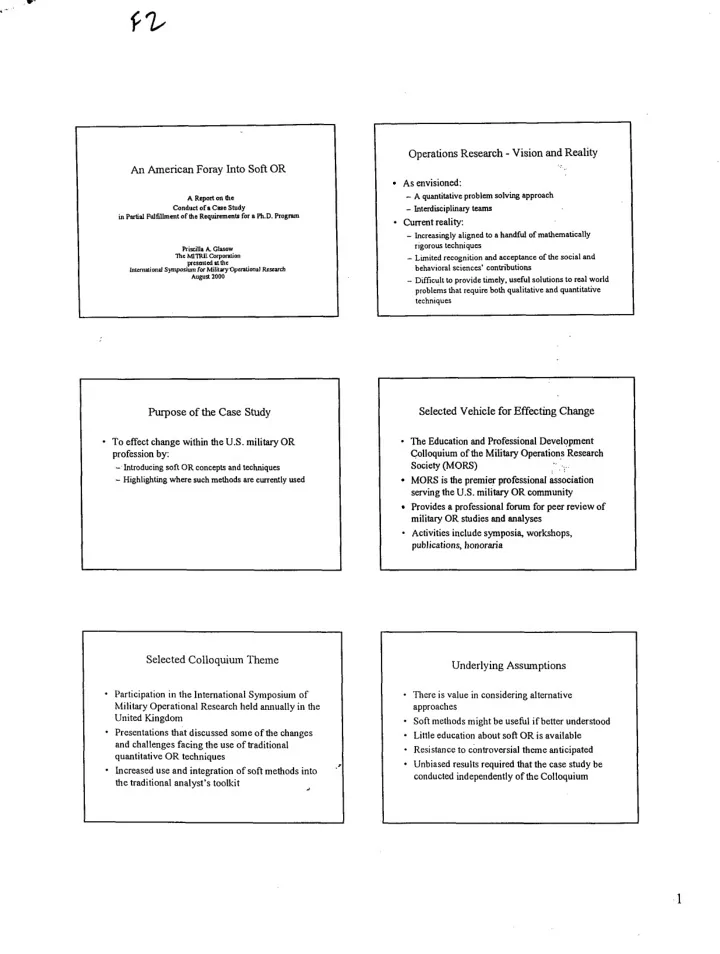
american foray into soft or
SMART_READER_LITE
LIVE PREVIEW

American Foray Into Soft OR - - PDF document

American Foray Into Soft OR zyxwvutsrqponmlkjihgfedcbaZYXWVUTSRQPONMLKJIHGFEDCBA An zyxwvutsrqponmlkjihgfedcbaZYXWVUTSRQPONMLKJIHGFEDCBA Report zyxwvutsrqponmlkjihgfedcbaZYXWVUTSRQPONMLKJIHGFEDCBA A


slide-1
SLIDE 1

An zyxwvutsrqponmlkjihgfedcbaZYXWVUTSRQPONMLKJIHGFEDCBA

American Foray Into Soft OR zyxwvutsrqponmlkjihgfedcbaZYXWVUTSRQPONMLKJIHGFEDCBA

A zyxwvutsrqponmlkjihgfedcbaZYXWVUTSRQPONMLKJIHGFEDCBA Report zyxwvutsrqponmlkjihgfedcbaZYXWVUTSRQPONMLKJIHGFEDCBA

  • n

L e

Canduct

  • f a Cape Study

i n Partial Fulfillment ofthe Requirements for a P

h . D . F’rogram

Priscilla A Clasow

nlc

M I m E carpodon

prcrmlcd d(hc zyxwvutsrqponmlkjihgfedcbaZYXWVUTSRQPONMLKJIHGFEDCBA

~nlcmPlionnl S)mpozium fwh4ilitryOpMljonil Research Auguri 2000

Purpose of the Case Study zyxwvutsrqponmlkjihgfedcbaZYXWVUTSRQPONMLKJIHGFEDCBA

* To effect change within the U.S. military OR

profession by:

  • Introducing soft OR concepts and techniques
  • Highlighting where such methods are currently used

Operations Research - Vision and Reality

As envisioned:

  • A quantitative problem solving

approach

  • Interdisciplinary teams

Current reality:

  • Increasingly aligned to a handful of mathematically

rigorous techniques

  • Limited recognition and acceptance of the social and

behavioral sciences’ contributions

  • Difficult to provide timely, useful solutions to real world

problems that require both qualitative and quantitative techniques

Selected Vehicle for Effecting Change

The Education and Professional Development Colloquium of the Military Operations Research

. ‘

Society (MORS)

. .

MORS is the premier professional association

serving

the U.S. military OR community Provides a professional forum for peer review of military OR studies and analyses Activities include symposia, workshops, publications, honoraria

Selected Colloquium Theine

* Participation in the International Symposium of

Military Operational Research held annually in the United Kingdom Presentations that discussed some of the changes and challenges facing the use of traditional quantitative OR techniques

* Increased use and integration of soft methods into

the traditional analyst’s toolkit

a

Underlying Assumptions

  • There is value in considering alternative

approaches

* Soft methods might be useful if better understood * Little education about soft OR is available

Resistance to controversial theme anticipated Unbiased results required that the case study be conducted independently of the Colloquium

slide-2
SLIDE 2

Literature Review zyxwvutsrqponmlkjihgfedcbaZYXWVUTSRQPONMLKJIHGFEDCBA

SofiOR quantitative methods Teaching approaches Complementary integration of qualitative and

Historical Foundations of Soft OR

in the Literature zyxwvutsrqponmlkjihgfedcbaZYXWVUTSRQPONMLKJIHGFEDCBA

* Analysis is only useful zyxwvutsrqponmlkjihgfedcbaZYXWVUTSRQPONMLKJIHGFEDCBA if

it provides insight and possible solutions to problems that are of interest to the decision

  • maker. (Ackoff. zyxwvutsrqponmlkjihgfedcbaZYXWVUTSRQPONMLKJIHGFEDCBA

1979)

Technology must incorporate nontraditional inputs. such as "subjective preferences, ethical positions, and aesthetic judgements". (Boland Tenkasi. and Te'eni. 1996)

* It is a responsibility of the OR analyst to address in the

analysis "nonquantitative aspects that may need consideration" by the decision maker. (Morse and

  • Kimball. 1970)

Broadening the Analyst's Toolkit

The OR community needs to redefme itselfin light of a changing reality. (Ormerod, 1998)

* The current trend of defming OR in terms of its models

[and its use of technology] has sacrificed both relevance and breadth. (Abbott, as cited in Ormerod. 1998)

* Nonquantitative methods may be used in OR to augment

traditional quantitative methods. (Keys,

1989)

* Soft OR offas methods that aid in resolving social

conflicts and structuring complex problems. (Rosenhead

1986)

Definitions

  • "Non-classical formal approaches for the support of

managerial problem-management activities" that seek relevance of its theories. tools. and lechniquq to real world

  • problems. (Ledington and Donaldson. 1997)
  • Methods that help understand, clarify. and communicate

the problem where individuals hold different views on what the problem may be. (Matthews and Benne% 1986)

  • Soft OR methods allow "small groups of people working

together to structure issues and explore different ways of improving the situation". (Ormerod. 1996)

* Soft OR emphasizes problem structuring to understand the

  • situation. (Jackson, 1991)

The Nature of OR as a Discipline

* Lack of involvement of OR in social problems and the

absence of a working relationship with the social sciences @ando and Bennett, 1981)

* Divergence of theoretical research and teaching from the

needs of practical application (Checkland. 1983)

Rationale Supporting Complementary Integration of Qualitative and Quantitative Methods

Rorman and Wilson (as cited i n Mil- and H u b " , 1994)

  • Conobomlc findings
  • Elaborate qunntitntive analyscs
  • Examine uncxpstcd rmdings
  • To achicvc convergence ofresulk
  • To identify ovnlnpping f a c e that

emerge upon clorn inspection

  • Tosugmmltheinformation~ained

h a m lheuscofaninitial

  • To

identify and a m i n e conhadictions obtained from multiple

  • T
  • add scope and breadth to a rtudy
  • Creme. Cmcclli. and Graham (as cited in Crswdl. 1994)

using multiple methods approach wurces zyxwvutsrqponmlkjihgfedcbaZYXWVUTSRQPONMLKJIHGFEDCBA

2

slide-3
SLIDE 3

Guidance for Integrating Qualitative and Quantitative Methods zyxwvutsrqponmlkjihgfedcbaZYXWVUTSRQPONMLKJIHGFEDCBA

*

Complementary integration recognizes that sharing and zyxwvutsrqponmlkjihgfedcbaZYXWVUTSRQPONMLKJIHGFEDCBA

O V R ~ P

between qualitative and quantitative approachn zyxwvutsrqponmlkjihgfedcbaZYXWVUTSRQPONMLKJIHGFEDCBA c a n and do exist (Firealone, 1987) “Each approach zyxwvutsrqponmlkjihgfedcbaZYXWVUTSRQPONMLKJIHGFEDCBA adds

to OUT body ofhowledge

by zyxwvutsrqponmlkjihgfedcbaZYXWVUTSRQPONMLKJIHGFEDCBA building on the information derived from the other approach” (Newman and Ben% zyxwvutsrqponmlkjihgfedcbaZYXWVUTSRQPONMLKJIHGFEDCBA

An appropriale mix of

both methods can be used for problem solving

so that approaches and solutions are comprehensive and support a

wider variely ofproblems (Jackson, 1991) ThinL creatively about the problem context before selecting

a

mehodology lo use zyxwvutsrqponmlkjihgfedcbaZYXWVUTSRQPONMLKJIHGFEDCBA in

ib solution.

(Bmcklesby. 1995) Operations research practiboners must be flexible in how analytic

rfmltp are provided 10 their decision maken and “se whalever methods

bestsuit hose decision makers. (O’Keefe. 1989)

  • 1998)
  • Focus of Colloquiuin 2000

The Colloquium was held on 4-5 April 2000;

44 participants representing all sectors of the U.S.

military OR community

* The theme was: zyxwvutsrqponmlkjihgfedcbaZYXWVUTSRQPONMLKJIHGFEDCBA

Expanding the Sciencer - The Interdisciplinarity o

f OR * The interdisciplinarity of interest was the

application of soft OR methods to military OR The Colloquium addressed many of the soft OR methods that figured largely in Uie British OR literature

Colloquium Objectives

  • Provide tutorials to enhance participants’

knowledge of soft OR methods. Demonstrate opportunities for use of soft OR methods through Application presentations.

* Examine the potential for inclusion of soft OR

methods in current military OR curricula.

  • Hidden agenda - Conduct a case study to meet the

program requirements

  • f the Waldetl University

Ph.D. program in Applied Management and Decision Science (Operations Research).

Teaching Literature

, ,

* Methods to conduct and assess Ihe Colloquium

  • Critical thinking
  • Peer learning
  • Socratic discussion
  • Methods for eliciting

balanced participation

  • Graphic representations
  • Kolb Learning

Style Inventory

Colloquium Emphases

Soft OR methods can be used to AUGMENT traditional quantitative methods, butPO NOT REPLACE our traditional tools and.tethniques.

  • The purpose of the Colloquium was to EXPLORE

the applicability of soft OR methods for the practice of military OR, not to advocufe their use.

The Importance of the Hidden Case Study

  • Strong objections from one member of the
  • rganizing committee
  • Vehement opposition to the Colloquium theme

* Reported volatile interactions with soft OR

proponents in the past

  • Would not be p‘arty to any event that effectively

“diminished the heritage” of traditional OR

  • Refused to participate in the Colloquium

3

slide-4
SLIDE 4

Summary of Colloquium Presentations zyxwvutsrqponmlkjihgfedcbaZYXWVUTSRQPONMLKJIHGFEDCBA

  • zyxwvutsrqponmlkjihgfedcbaZYXWVUTSRQPONMLKJIHGFEDCBA

h zyxwvutsrqponmlkjihgfedcbaZYXWVUTSRQPONMLKJIHGFEDCBA

Brim zyxwvutsrqponmlkjihgfedcbaZYXWVUTSRQPONMLKJIHGFEDCBA 0.

  • McCw. USMC. Tmdy

Nhe Fdmq CA T

  • p

i c :

Son

OR

U.r 0 zyxwvutsrqponmlkjihgfedcbaZYXWVUTSRQPONMLKJIHGFEDCBA

  • Muh. Fsp.p.rimd.Lim

Key Colloquium Findings and Products

* Many real world problems require the use of soft

ORmethods to structure the problem, provide insights, and suggest solutions. The use of soft OR methods may require the involvement

  • f multiple disciplines, which

supports the historical interdisciplinarity of our profession.

I

Limitations of Soft OR Methods

* Inability to replicate results where human decisions and

actions are involved.

  • Ability of a single strong personality to influence the
  • verall group's decisions.

* Difficulty in understanding and modeling human behavior. * Variability in interpretations of soft OR resultdqualitative

responses.

* Dependence on the abilities of the facilitator. * Tendency of subjects to think in terms of alternatives

instead of values.

Summary

  • f Colloquium Presentations (cont.)

'..

Lessons Leamed

. son

OR methods u

c

mort uabl during lhe early arga

  • f p

m b l m Mmition

and analyds. lhc anilysishouldvansition to morcrigmYbdORmahods

IS thc problm domain md mlai become m m

mnagnble md &tined. Casc nudies like olhu m&o& OfMdyliC l m s

lamcd

should bc mcwngcd IS pm

  • f a pofcnional litcrohlrr rcvim f w a + r

apaicncc Applications inaudngly rely m Ihe obscrmion

  • f md didWion ofhuman

pcrccp(ionandpafmmccinrgivcn mntut. lhaed~allagarrquuc&ills i n ~uwcy

  • design. inkmiming sdmiqucs md aganizalionll

dcsign.

I n

mort son OR

  • aunples. !he utility to

lhe &cision makuwu

lmibnjblc to

lhirponion

  • flhcdTmknownas WndCmMdinglheRoblem..

In mod son OR

  • kchniqucs. a comprchcnsvc a

p

  • m

to lhe ledmiqua and

possible limitations in & l a md m p l j m r musl

bs zyxwvutsrqponmlkjihgfedcbaZYXWVUTSRQPONMLKJIHGFEDCBA a p o o d

10 the decision

makuupulofthcpramlation ofrssullr lhiispmvidulhedccision maka with insghl into he risk or confidmcc levcl mociakd wilh using lhal dccidon upp port information.

*

within agivcn problcm h i i n .

: .'

* *

I

4

slide-5
SLIDE 5

. zyxwvutsrqponmlkjihgfedcbaZYXWVUTSRQPONMLKJIHGFEDCBA

Kolb Leadug zyxwvutsrqponmlkjihgfedcbaZYXWVUTSRQPONMLKJIHGFEDCBA

Style Inventory

  • zyxwvutsrqponmlkjihgfedcbaZYXWVUTSRQPONMLKJIHGFEDCBA

Usod zyxwvutsrqponmlkjihgfedcbaZYXWVUTSRQPONMLKJIHGFEDCBA t

  • wseu whethar the Colloquium

participanh acquired new learning about aoff OR mehods as a result

  • f attonding

the Colloquium

Sent via emdl immediately zyxwvutsrqponmlkjihgfedcbaZYXWVUTSRQPONMLKJIHGFEDCBA after tho went

  • Responses allowed

via email, E.x in p e m

* 59% response rate (26 responses)

Openness to Sofl OR Methods During the Colloquium

I

Willingness t

  • U

s e Sot? OR Methods as a Result of the Colloquium Respondents’ Reported Practical Experience U s i n g Sofl OR Methods Ease with which Respondents

Imagined

Using Soft OR Methods Evaluahon ofthe Chenge Strategy U

s e d

* MORS

Colloquium presented an ideal opporhuity

+ Change WBJ suoccadully

eected due to the for conducting the requied zyxwvutsrqponmlkjihgfedcbaZYXWVUTSRQPONMLKJIHGFEDCBA

w e

study skong support and participation of the MORS Sponsors,

the MORS President. and t

h e

ettendoas

* New laming about =&OR was achieved et

both the Colloquium and at the outbrief

Change was direotly effected

as

npwtDd

by mc

pu2icipantofthc CoUoquum outbnef

I

5

slide-6
SLIDE 6

Reference List (cont.) zyxwvutsrqponmlkjihgfedcbaZYXWVUTSRQPONMLKJIHGFEDCBA

6