and 611 + for small : Integer factorization Sieving 1 612 2 2 - - PowerPoint PPT Presentation

and 611 for small integer factorization sieving
SMART_READER_LITE
LIVE PREVIEW

and 611 + for small : Integer factorization Sieving 1 612 2 2 - - PowerPoint PPT Presentation

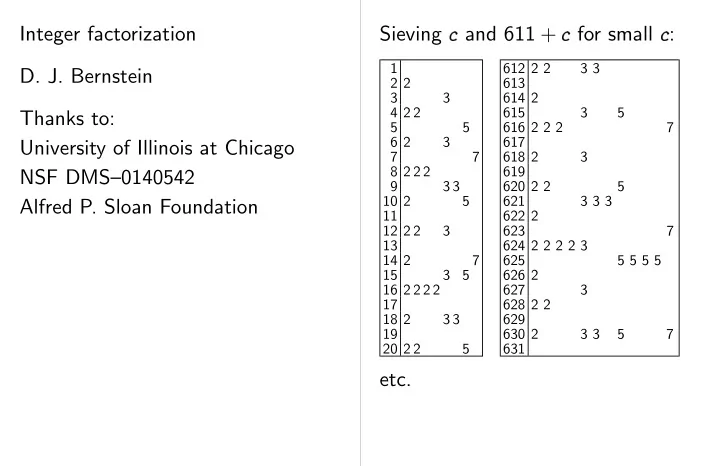
and 611 + for small : Integer factorization Sieving 1 612 2 2 3 3 D. J. Bernstein 2 2 613 3 3 614 2 4 2 2 615 3 5 Thanks to: 5 5 616 2 2 2 7 6 2 3 617 University of Illinois at Chicago 7 7 618 2 3 8 2 2 2


slide-1
SLIDE 1

Integer factorization

  • D. J. Bernstein

Thanks to: University of Illinois at Chicago NSF DMS–0140542 Alfred P. Sloan Foundation Sieving

and 611 + for small :

1 2 2 3 3 4 2 2 5 5 6 2 3 7 7 8 2 2 2 9 3 3 10 2 5 11 12 2 2 3 13 14 2 7 15 3 5 16 2 2 2 2 17 18 2 3 3 19 20 2 2 5 612 2 2 3 3 613 614 2 615 3 5 616 2 2 2 7 617 618 2 3 619 620 2 2 5 621 3 3 3 622 2 623 7 624 2 2 2 2 3 625 5 5 5 5 626 2 627 3 628 2 2 629 630 2 3 3 5 7 631

etc.

slide-2
SLIDE 2

rization Illinois at Chicago DMS–0140542 Foundation Sieving

and 611 + for small :

1 2 2 3 3 4 2 2 5 5 6 2 3 7 7 8 2 2 2 9 3 3 10 2 5 11 12 2 2 3 13 14 2 7 15 3 5 16 2 2 2 2 17 18 2 3 3 19 20 2 2 5 612 2 2 3 3 613 614 2 615 3 5 616 2 2 2 7 617 618 2 3 619 620 2 2 5 621 3 3 3 622 2 623 7 624 2 2 2 2 3 625 5 5 5 5 626 2 627 3 628 2 2 629 630 2 3 3 5 7 631

etc. Have complete facto

(611 + ) for some
  • 14
625 = 2130547

64

675 = 2633527

75

686 = 2131527

14

64 75 625 675
  • = 28345874 = (243

gcd 14

64 75 ✁ ✂

= 47. 611 = 47

13.
slide-3
SLIDE 3

Sieving

and 611 + for small :

1 2 2 3 3 4 2 2 5 5 6 2 3 7 7 8 2 2 2 9 3 3 10 2 5 11 12 2 2 3 13 14 2 7 15 3 5 16 2 2 2 2 17 18 2 3 3 19 20 2 2 5 612 2 2 3 3 613 614 2 615 3 5 616 2 2 2 7 617 618 2 3 619 620 2 2 5 621 3 3 3 622 2 623 7 624 2 2 2 2 3 625 5 5 5 5 626 2 627 3 628 2 2 629 630 2 3 3 5 7 631

etc. Have complete factorization of

(611 + ) for some ’s.

14

625 = 21305471.

64

675 = 26335270.

75

686 = 21315273.

14

64 75 625 675 686

= 28345874 = (24325472)2. gcd 14

64 75 ✁

24325472

✂ 611

= 47. 611 = 47

13.
slide-4
SLIDE 4
  • 611 +
for small :

2 2 3 3 2 3 5 2 2 2 7 2 3 2 2 5 3 3 3 2 7 2 2 2 2 3 5 5 5 5 2 3 2 2 2 3 3 5 7

Have complete factorization of

(611 + ) for some ’s.

14

625 = 21305471.

64

675 = 26335270.

75

686 = 21315273.

14

64 75 625 675 686

= 28345874 = (24325472)2. gcd 14

64 75 ✁

24325472

✂ 611

= 47. 611 = 47

13.

Given

  • and parameter
  • 1. Use powers of p

sieve

and
  • +
fo
  • 2. Look for nonempt
  • with
(
  • +
) completely

and with

✁ (
  • +
  • 3. Compute gcd
✂ ✂
  • where

=

slide-5
SLIDE 5

Have complete factorization of

(611 + ) for some ’s.

14

625 = 21305471.

64

675 = 26335270.

75

686 = 21315273.

14

64 75 625 675 686

= 28345874 = (24325472)2. gcd 14

64 75 ✁

24325472

✂ 611

= 47. 611 = 47

13.

Given

  • and parameter

:

  • 1. Use powers of primes

to sieve

and
  • +
for 1
  • 2.
  • 2. Look for nonempty set of
’s

with

(
  • +
) completely factored

and with

✁ (
  • +
) square.
  • 3. Compute gcd
✂ ✂
  • where

=

✁ (
  • +
).
slide-6
SLIDE 6

factorization of

  • some
’s.
  • 471.
  • 270.
  • 273.
  • 675
686

4325472)2.

24325472

✂ 611
  • Given
  • and parameter

:

  • 1. Use powers of primes

to sieve

and
  • +
for 1
  • 2.
  • 2. Look for nonempty set of
’s

with

(
  • +
) completely factored

and with

✁ (
  • +
) square.
  • 3. Compute gcd
✂ ✂
  • where

=

✁ (
  • +
).

This is the Q sieve Same principles: Continued-fraction (Lehmer, Powers, Brillhart, Morrison). Linear sieve (Schro Quadratic sieve (P Number-field sieve (Pollard, Buhler, Lenstra, Pomerance, Adleman).

slide-7
SLIDE 7

Given

  • and parameter

:

  • 1. Use powers of primes

to sieve

and
  • +
for 1
  • 2.
  • 2. Look for nonempty set of
’s

with

(
  • +
) completely factored

and with

✁ (
  • +
) square.
  • 3. Compute gcd
✂ ✂
  • where

=

✁ (
  • +
).

This is the Q sieve. Same principles: Continued-fraction method (Lehmer, Powers, Brillhart, Morrison). Linear sieve (Schroeppel). Quadratic sieve (Pomerance). Number-field sieve (Pollard, Buhler, Lenstra, Pomerance, Adleman).

slide-8
SLIDE 8
  • rameter

:

  • f primes

to

  • for 1
  • 2.

nonempty set of

’s
  • completely factored
  • +
) square. ✂ ✂
✁ (
  • +
).

This is the Q sieve. Same principles: Continued-fraction method (Lehmer, Powers, Brillhart, Morrison). Linear sieve (Schroeppel). Quadratic sieve (Pomerance). Number-field sieve (Pollard, Buhler, Lenstra, Pomerance, Adleman). Sieving speed Handle sieving in sieve

  • + 1
  • sieve
  • +

+ 1

  • sieve
  • + 2 + 1
  • etc.

Sieving

  • + 1
  • +
  • using primes

means finding, for

  • + 1
  • + 2
  • which

’s divide

slide-9
SLIDE 9

This is the Q sieve. Same principles: Continued-fraction method (Lehmer, Powers, Brillhart, Morrison). Linear sieve (Schroeppel). Quadratic sieve (Pomerance). Number-field sieve (Pollard, Buhler, Lenstra, Pomerance, Adleman). Sieving speed Handle sieving in pieces: sieve

  • + 1
  • +

; sieve

  • +

+ 1

  • + 2

; sieve

  • + 2 + 1
  • + 3

; etc. Sieving

  • + 1
  • + 2
  • +

using primes means finding, for each

  • + 1
  • + 2
  • +

, which ’s divide

  • +
.
slide-10
SLIDE 10

sieve. Continued-fraction method ers, rrison). (Schroeppel). (Pomerance). sieve Buhler, Lenstra, Adleman). Sieving speed Handle sieving in pieces: sieve

  • + 1
  • +

; sieve

  • +

+ 1

  • + 2

; sieve

  • + 2 + 1
  • + 3

; etc. Sieving

  • + 1
  • + 2
  • +

using primes means finding, for each

  • + 1
  • + 2
  • +

, which ’s divide

  • +
.

Consider all pairs (

where

  • +
is a multiple

Easy to generate pairs sorted by second comp (612

✂ 2), (614 ✂ 2), (616 ✂ ✂

(620

✂ 2), (612 ✂ 3), (615 ✂ ✂

(615

✂ 5), (620 ✂ 5), (616 ✂

Sieving means listing sorted by first comp (612

✂ 2), (612 ✂ 3), (614 ✂

(615

✂ 3), (615 ✂ 5), (616 ✂ ✂

(618

✂ 2), (618 ✂ 3), (620 ✂ ✂
slide-11
SLIDE 11

Sieving speed Handle sieving in pieces: sieve

  • + 1
  • +

; sieve

  • +

+ 1

  • + 2

; sieve

  • + 2 + 1
  • + 3

; etc. Sieving

  • + 1
  • + 2
  • +

using primes means finding, for each

  • + 1
  • + 2
  • +

, which ’s divide

  • +
.

Consider all pairs (

  • +

) where

  • +
is a multiple of

. Easy to generate pairs sorted by second component: (612

✂ 2), (614 ✂ 2), (616 ✂ 2), (618 ✂ 2),

(620

✂ 2), (612 ✂ 3), (615 ✂ 3), (618 ✂ 3),

(615

✂ 5), (620 ✂ 5), (616 ✂ 7).

Sieving means listing pairs sorted by first component: (612

✂ 2), (612 ✂ 3), (614 ✂ 2),

(615

✂ 3), (615 ✂ 5), (616 ✂ 2), (616 ✂ 7),

(618

✂ 2), (618 ✂ 3), (620 ✂ 2), (620 ✂ 5).
slide-12
SLIDE 12

pieces:

  • +

;

  • + 2

;

  • 1
  • + 3

;

  • + 2
  • +

for each

  • 2
  • +

,

  • +
.

Consider all pairs (

  • +

) where

  • +
is a multiple of

. Easy to generate pairs sorted by second component: (612

✂ 2), (614 ✂ 2), (616 ✂ 2), (618 ✂ 2),

(620

✂ 2), (612 ✂ 3), (615 ✂ 3), (618 ✂ 3),

(615

✂ 5), (620 ✂ 5), (616 ✂ 7).

Sieving means listing pairs sorted by first component: (612

✂ 2), (612 ✂ 3), (614 ✂ 2),

(615

✂ 3), (615 ✂ 5), (616 ✂ 2), (616 ✂ 7),

(618

✂ 2), (618 ✂ 3), (620 ✂ 2), (620 ✂ 5).

There are

1+

(1)

involving

  • + 1
  • Sieving
  • + 1
  • +
  • takes

1+

(1) seconds
  • n RAM costing
  • 2-dimensional mesh

is much faster:

  • n machine costing
  • Can do even better:
  • n machine costing
  • using “elliptic-curve
slide-13
SLIDE 13

Consider all pairs (

  • +

) where

  • +
is a multiple of

. Easy to generate pairs sorted by second component: (612

✂ 2), (614 ✂ 2), (616 ✂ 2), (618 ✂ 2),

(620

✂ 2), (612 ✂ 3), (615 ✂ 3), (618 ✂ 3),

(615

✂ 5), (620 ✂ 5), (616 ✂ 7).

Sieving means listing pairs sorted by first component: (612

✂ 2), (612 ✂ 3), (614 ✂ 2),

(615

✂ 3), (615 ✂ 5), (616 ✂ 2), (616 ✂ 7),

(618

✂ 2), (618 ✂ 3), (620 ✂ 2), (620 ✂ 5).

There are

1+

(1) pairs

involving

  • + 1
  • + 2
  • +

. Sieving

  • + 1
  • + 2
  • +

takes

1+

(1) seconds
  • n RAM costing

1+

(1) dollars.

2-dimensional mesh computer is much faster:

✁ 5+ (1) seconds
  • n machine costing

1+

(1) dollars.

Can do even better:

(1) seconds
  • n machine costing

1+

(1) dollars,

using “elliptic-curve method.”

slide-14
SLIDE 14

pairs (

  • +

)

  • multiple of

. pairs component:

✂ ✂ 2), (616 ✂ 2), (618 ✂ 2), ✂ ✂ 3), (615 ✂ 3), (618 ✂ 3), ✂ ✂ 5), (616 ✂ 7).

listing pairs component:

✂ ✂ 3), (614 ✂ 2), ✂ ✂ 5), (616 ✂ 2), (616 ✂ 7), ✂ ✂ 3), (620 ✂ 2), (620 ✂ 5).

There are

1+

(1) pairs

involving

  • + 1
  • + 2
  • +

. Sieving

  • + 1
  • + 2
  • +

takes

1+

(1) seconds
  • n RAM costing

1+

(1) dollars.

2-dimensional mesh computer is much faster:

✁ 5+ (1) seconds
  • n machine costing

1+

(1) dollars.

Can do even better:

(1) seconds
  • n machine costing

1+

(1) dollars,

using “elliptic-curve method.” Square-finding speed Start from factored

  • 1(
  • +
1) =
  • 2(
  • +
2) =
  • etc.

Want to find

1

2

  • such that

(

1(
  • +
1)) 1( 2(
  • is a square.

In other words:

  • 1
✁ 1( )+ 2 ✁ 2(
  • ✂✄✂☎✂

has even exponents.

slide-15
SLIDE 15

There are

1+

(1) pairs

involving

  • + 1
  • + 2
  • +

. Sieving

  • + 1
  • + 2
  • +

takes

1+

(1) seconds
  • n RAM costing

1+

(1) dollars.

2-dimensional mesh computer is much faster:

✁ 5+ (1) seconds
  • n machine costing

1+

(1) dollars.

Can do even better:

(1) seconds
  • n machine costing

1+

(1) dollars,

using “elliptic-curve method.” Square-finding speed Start from factored

(
  • +
)’s: 1(
  • +
1) =
  • ✁ 1(
), 2(
  • +
2) =
  • ✁ 2(
),

etc. Want to find

1

2

  • such that

(

1(
  • +
1)) 1( 2(
  • +
2)) 2
  • is a square.

In other words:

  • 1
✁ 1( )+ 2 ✁ 2( )+ ✂✄✂☎✂

has even exponents.

slide-16
SLIDE 16 (1) pairs
  • + 2
  • +

.

  • + 2
  • +
  • seconds

1+

(1) dollars.

mesh computer

✁ 5+ (1) seconds

costing

1+

(1) dollars.

etter:

(1) seconds

costing

1+

(1) dollars,

“elliptic-curve method.” Square-finding speed Start from factored

(
  • +
)’s: 1(
  • +
1) =
  • ✁ 1(
), 2(
  • +
2) =
  • ✁ 2(
),

etc. Want to find

1

2

  • such that

(

1(
  • +
1)) 1( 2(
  • +
2)) 2
  • is a square.

In other words:

  • 1
✁ 1( )+ 2 ✁ 2( )+ ✂✄✂☎✂

has even exponents. In other words:

1(

1(2) ✂ 1(3) ✂ 1(5) ✂
  • +

2(

2(2) ✂ 2(3) ✂
  • +
  • is even.

e.g. given 14

625 = 2130547

64

675 = 2633527

75

686 = 2131527

find

1

2

3 such 1(1

✂ 0 ✂ 4 ✂ 1) +

2(6

✂ ✂ ✂

+

3(1

✂ 1 ✂ 2 ✂ 3) is even.
slide-17
SLIDE 17

Square-finding speed Start from factored

(
  • +
)’s: 1(
  • +
1) =
  • ✁ 1(
), 2(
  • +
2) =
  • ✁ 2(
),

etc. Want to find

1

2

  • such that

(

1(
  • +
1)) 1( 2(
  • +
2)) 2
  • is a square.

In other words:

  • 1
✁ 1( )+ 2 ✁ 2( )+ ✂✄✂☎✂

has even exponents. In other words:

1(

1(2) ✂ 1(3) ✂ 1(5) ✂
  • )

+

2(

2(2) ✂ 2(3) ✂ 2(5) ✂
  • )

+

  • is even.

e.g. given 14

625 = 21305471,

64

675 = 26335270,

75

686 = 21315273:

find

1

2

3 such that 1(1

✂ 0 ✂ 4 ✂ 1) +

2(6

✂ 3 ✂ 2 ✂ 0)

+

3(1

✂ 1 ✂ 2 ✂ 3) is even.
slide-18
SLIDE 18

speed red

(
  • +
)’s:
  • ✁ 1(
),
  • ✁ 2(
), ✂

2

  • (
  • +
2)) 2

(

)+ ✂✄✂☎✂
  • nents.

In other words:

1(

1(2) ✂ 1(3) ✂ 1(5) ✂
  • )

+

2(

2(2) ✂ 2(3) ✂ 2(5) ✂
  • )

+

  • is even.

e.g. given 14

625 = 21305471,

64

675 = 26335270,

75

686 = 21315273:

find

1

2

3 such that 1(1

✂ 0 ✂ 4 ✂ 1) +

2(6

✂ 3 ✂ 2 ✂ 0)

+

3(1

✂ 1 ✂ 2 ✂ 3) is even.

This is linear algeb finding kernel of a

3+

(1) seconds

using Gaussian elimination.

2+

(1) seconds

using Wiedemann’s Again exploit parallelism:

1

✁ 5+ (1) seconds
  • n a 2-dimensional

costing

1+

(1) dolla
slide-19
SLIDE 19

In other words:

1(

1(2) ✂ 1(3) ✂ 1(5) ✂
  • )

+

2(

2(2) ✂ 2(3) ✂ 2(5) ✂
  • )

+

  • is even.

e.g. given 14

625 = 21305471,

64

675 = 26335270,

75

686 = 21315273:

find

1

2

3 such that 1(1

✂ 0 ✂ 4 ✂ 1) +

2(6

✂ 3 ✂ 2 ✂ 0)

+

3(1

✂ 1 ✂ 2 ✂ 3) is even.

This is linear algebra mod 2: finding kernel of a matrix.

3+

(1) seconds

using Gaussian elimination.

2+

(1) seconds

using Wiedemann’s method. Again exploit parallelism:

1

✁ 5+ (1) seconds
  • n a 2-dimensional mesh

costing

1+

(1) dollars.
slide-20
SLIDE 20
1(5) ✂
  • )
  • (3)
✂ 2(5) ✂
  • )
  • 471,
  • 270,
  • 273:
✂ ✂

such that

✂ ✂ ✂

(6

✂ 3 ✂ 2 ✂ 0) ✂ ✂ ✂

is even. This is linear algebra mod 2: finding kernel of a matrix.

3+

(1) seconds

using Gaussian elimination.

2+

(1) seconds

using Wiedemann’s method. Again exploit parallelism:

1

✁ 5+ (1) seconds
  • n a 2-dimensional mesh

costing

1+

(1) dollars.

How big is ? Positive integers

have

chance

  • f completely facto

into primes , where

  • = (log
✂ )

Very crude approximation but in right ballpark. (Try numerical exp count products of use fancy analytic

slide-21
SLIDE 21

This is linear algebra mod 2: finding kernel of a matrix.

3+

(1) seconds

using Gaussian elimination.

2+

(1) seconds

using Wiedemann’s method. Again exploit parallelism:

1

✁ 5+ (1) seconds
  • n a 2-dimensional mesh

costing

1+

(1) dollars.

How big is ? Positive integers

have

chance

  • f completely factoring

into primes , where

  • = (log
✂ ) log .

Very crude approximation but in right ballpark. (Try numerical experiments; count products of primes; use fancy analytic theorems.)

slide-22
SLIDE 22

algebra mod 2: a matrix.

  • elimination.
  • Wiedemann’s method.

rallelism:

  • seconds

2-dimensional mesh

  • dollars.

How big is ? Positive integers

have

chance

  • f completely factoring

into primes , where

  • = (log
✂ ) log .

Very crude approximation but in right ballpark. (Try numerical experiments; count products of primes; use fancy analytic theorems.) For log (1 2)

  • Positive integers
  • have

1 chance

  • f completely facto

into primes . Presumably the integers 1(

  • + 1)
✂ 2(
  • + 2)
  • have

complete thus produce a squa

  • ften factor
.
slide-23
SLIDE 23

How big is ? Positive integers

have

chance

  • f completely factoring

into primes , where

  • = (log
✂ ) log .

Very crude approximation but in right ballpark. (Try numerical experiments; count products of primes; use fancy analytic theorems.) For log (1 2) log

log log :

Positive integers

2(

  • +

2)

have 1 chance

  • f completely factoring

into primes . Presumably the integers 1(

  • + 1)
✂ 2(
  • + 2)

2(

  • +

2)

have complete factorizations; thus produce a square;

  • ften factor
.
slide-24
SLIDE 24

chance factoring

  • ✂ ) log .

roximation ballpark. experiments;

  • f primes;

analytic theorems.) For log (1 2) log

log log :

Positive integers

2(

  • +

2)

have 1 chance

  • f completely factoring

into primes . Presumably the integers 1(

  • + 1)
✂ 2(
  • + 2)

2(

  • +

2)

have complete factorizations; thus produce a square;

  • ften factor
.

So we believe that Q-sieve price-perfo is

+ (1) power of

exp( log

log log
  • for some constant
  • Continued-fraction

linear sieve, quadratic smaller power. Use integers around

  • Number-field sieve:

exp( 3 (log

)(log log
  • Use even smaller integers.
slide-25
SLIDE 25

For log (1 2) log

log log :

Positive integers

2(

  • +

2)

have 1 chance

  • f completely factoring

into primes . Presumably the integers 1(

  • + 1)
✂ 2(
  • + 2)

2(

  • +

2)

have complete factorizations; thus produce a square;

  • ften factor
.

So we believe that Q-sieve price-performance ratio is

+ (1) power of

exp( log

log log ),

for some constant

.

Continued-fraction method, linear sieve, quadratic sieve: smaller power. Use integers around

.

Number-field sieve: power of exp( 3 (log

)(log log )2).

Use even smaller integers.

slide-26
SLIDE 26

2) log

log log :

2(

  • +

2)

chance factoring integers

  • 2)

2(

  • +

2)

complete factorizations; square;

  • So we believe that

Q-sieve price-performance ratio is

+ (1) power of

exp( log

log log ),

for some constant

.

Continued-fraction method, linear sieve, quadratic sieve: smaller power. Use integers around

.

Number-field sieve: power of exp( 3 (log

)(log log )2).

Use even smaller integers. Discrete logarithms Can use the same to compute given

  • “Index-calculus metho

Exponential in log

  • to compute discrete

by collisions, kanga Subexponential in

  • to use index calculus.

Can cryptanalyze la

slide-27
SLIDE 27

So we believe that Q-sieve price-performance ratio is

+ (1) power of

exp( log

log log ),

for some constant

.

Continued-fraction method, linear sieve, quadratic sieve: smaller power. Use integers around

.

Number-field sieve: power of exp( 3 (log

)(log log )2).

Use even smaller integers. Discrete logarithms Can use the same techniques to compute given 3

  • mod
.

“Index-calculus methods.” Exponential in log

  • to compute discrete logarithm

by collisions, kangaroos, etc. Subexponential in log

  • to use index calculus.

Can cryptanalyze larger

.
slide-28
SLIDE 28

that erformance ratio

  • er of
  • log
),

constant

.

Continued-fraction method, quadratic sieve: round

.

sieve: power of

)(log log )2).

smaller integers. Discrete logarithms Can use the same techniques to compute given 3

  • mod
.

“Index-calculus methods.” Exponential in log

  • to compute discrete logarithm

by collisions, kangaroos, etc. Subexponential in log

  • to use index calculus.

Can cryptanalyze larger

.

Collisions, kangaro work for elliptic curves, so we can cryptanalyze small elliptic curves. We don’t know anything Index calculus doesn’t work for elliptic curves. Diffie-Hellman speed use elliptic curves. Signature-verification still use RSA/Rabin

slide-29
SLIDE 29

Discrete logarithms Can use the same techniques to compute given 3

  • mod
.

“Index-calculus methods.” Exponential in log

  • to compute discrete logarithm

by collisions, kangaroos, etc. Subexponential in log

  • to use index calculus.

Can cryptanalyze larger

.

Collisions, kangaroos, etc. work for elliptic curves, so we can cryptanalyze small elliptic curves. We don’t know anything better. Index calculus doesn’t work for elliptic curves. Diffie-Hellman speed records use elliptic curves. Signature-verification speed records still use RSA/Rabin variants.