UMBC A B M A L T F O U M B C I M Y O R T 1 - - PowerPoint PPT Presentation

umbc
SMART_READER_LITE
LIVE PREVIEW

UMBC A B M A L T F O U M B C I M Y O R T 1 - - PowerPoint PPT Presentation

VLSI Design Verification and Test Faults I CMPE 646 Defects, Errors and Faults Models bridge the gap between physical reality and a mathematical abstraction and allow for development of analytical tools. Definitions: Defect : An untended


slide-1
SLIDE 1

VLSI Design Verification and Test Faults I CMPE 646 1 (10/16/06)

UMBC

U M B C U N I V E R S I T Y O F M A R Y L A N D B A L T I M O R E C O U N T Y 1 9 6 6

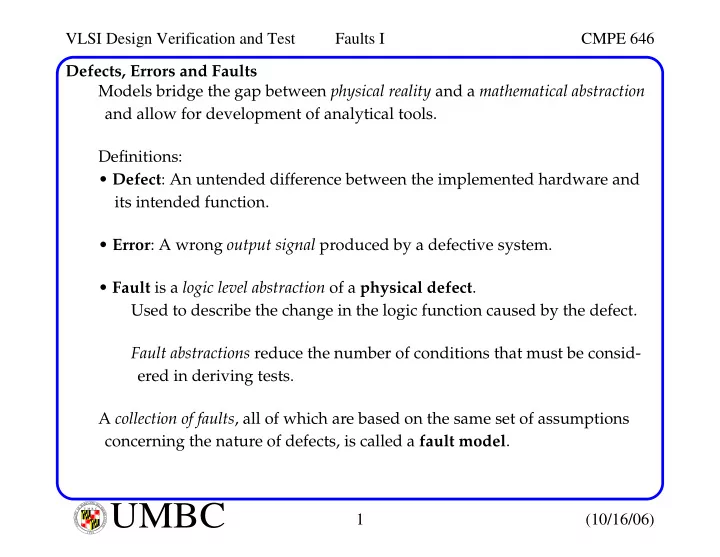
Defects, Errors and Faults Models bridge the gap between physical reality and a mathematical abstraction and allow for development of analytical tools. Definitions:

  • Defect: An untended difference between the implemented hardware and

its intended function.

  • Error: A wrong output signal produced by a defective system.
  • Fault is a logic level abstraction of a physical defect.

Used to describe the change in the logic function caused by the defect. Fault abstractions reduce the number of conditions that must be consid- ered in deriving tests. A collection of faults, all of which are based on the same set of assumptions concerning the nature of defects, is called a fault model.

slide-2
SLIDE 2

VLSI Design Verification and Test Faults I CMPE 646 2 (10/16/06)

UMBC

U M B C U N I V E R S I T Y O F M A R Y L A N D B A L T I M O R E C O U N T Y 1 9 6 6

Defects, Errors and Faults For example:

  • Defect: A shorted to GND.
  • Fault: A Stuck-at logic 0.
  • Error: A=1, B=1 => C=1

Correct output is C=0. Note that the error is not permanent For example, no error occurs if at least one input is 0. A B Out A B Out A B Out 1 1 1 1 1 1 1 1Ω

slide-3
SLIDE 3

VLSI Design Verification and Test Faults I CMPE 646 3 (10/16/06)

UMBC

U M B C U N I V E R S I T Y O F M A R Y L A N D B A L T I M O R E C O U N T Y 1 9 6 6

Functional Vs. Structural Testing For a 10-input AND gate, we can apply the test 0101010101. If Out = 0, what can we conclude?

  • (A) it’s an AND gate.
  • (B) it’s not a NAND gate.
  • (C) it’s a NOR gate.
  • (D) it’s not an OR gate.

There are Boolean functions possible. To be absolutely sure, we need to apply all 210 patterns. Clearly, functional test is not feasible. Out=0 1 1 1 1 1 2210

slide-4
SLIDE 4

VLSI Design Verification and Test Faults I CMPE 646 4 (10/16/06)

UMBC

U M B C U N I V E R S I T Y O F M A R Y L A N D B A L T I M O R E C O U N T Y 1 9 6 6

Functional Vs. Structural Testing Design verification may need to use exhaustive functional tests. Fortunately, for hardware testing, we can assume the function is correct. The focus on structure makes it possible to develop algorithms that are independent of the design. The algorithms are based on fault models. Fault models can be formulated at the various levels of design abstraction.

  • Behavioral level: Faults may not have any obvious correlation to defects.
  • RTL and Logic level: Stuck-at faults most popular, followed by bridging and

delay fault models.

  • Transistor (switch) level: Technology-dependent faults.

IDDX: Defect-based methods Adv: can represent defects not represented by other fault models.

slide-5
SLIDE 5

VLSI Design Verification and Test Faults I CMPE 646 5 (10/16/06)

UMBC

U M B C U N I V E R S I T Y O F M A R Y L A N D B A L T I M O R E C O U N T Y 1 9 6 6

Design Levels from Testability Perspective: Behavioral Description Behavioral DFT RTL Description Logic DFT Synthesis Gate Description Test Pattern Generation Gate Technology Mapping Layout Parameter Extraction Product Test Application Synthesis Libraries Fault Coverage? low high Manufacturing Good Product Libraries (fault simulation)

slide-6
SLIDE 6

VLSI Design Verification and Test Faults I CMPE 646 6 (10/16/06)

UMBC

U M B C U N I V E R S I T Y O F M A R Y L A N D B A L T I M O R E C O U N T Y 1 9 6 6

Fault Models The text describes these and other fault models:

  • Bridging fault
  • Defect-oriented fault (e.g. bridging, stuck-open, IDDQ).
  • Delay fault (transition, gate-delay, line-delay, segment-delay, path-delay).
  • Intermittent fault
  • Logical fault (often stuck-at)
  • Memory fault (single cell SA0/1, pattern sensitive, cell coupling faults).
  • Non-classical fault (stuck-open or stuck-on, transistor faults for CMOS).
  • Pattern sensitive fault
  • Pin fault (SA faults on the signal pins of all modules in the circuit).
  • Redundant fault
  • Stuck-at fault
slide-7
SLIDE 7

VLSI Design Verification and Test Faults I CMPE 646 7 (10/16/06)

UMBC

U M B C U N I V E R S I T Y O F M A R Y L A N D B A L T I M O R E C O U N T Y 1 9 6 6

Single stuck-at faults (SSF) Assumes defects cause the signal net or line to remain at a fixed voltage level. Model includes stuck-at-0 (SA0) or stuck-at-1 (SA1) faults and assumes

  • nly one fault exists.

For example, how many SSF faults can occur on an n-input NAND gate? What fault(s) does the pattern AB = 01 detect? What is the minimum number of tests needed to "detect" all of them? What are the tests? A B Z Inputs Fault-Free Faulty Response AB Response A/0 B/0 Z/0 A/1 B/1 Z/1 00 1 1 1 1 1 1 01 1 1 1 1 1 10 1 1 1 1 1 11 1 1 1

slide-8
SLIDE 8

VLSI Design Verification and Test Faults I CMPE 646 8 (10/16/06)

UMBC

U M B C U N I V E R S I T Y O F M A R Y L A N D B A L T I M O R E C O U N T Y 1 9 6 6

SSF A dominant input value is defined as the value that determines the state of the

  • utput independent of the other values of the inputs.

What is the dominant input value for the NAND? How many tests do you need to diagnosis the fault? Can you distinguish between all of the faults? A B Z Inputs Fault-Free Faulty Response AB Response A/0 B/0 Z/0 A/1 B/1 Z/1 00 1 1 1 1 1 1 01 1 1 1 1 1 10 1 1 1 1 1 11 1 1 1

slide-9
SLIDE 9

VLSI Design Verification and Test Faults I CMPE 646 9 (10/16/06)

UMBC

U M B C U N I V E R S I T Y O F M A R Y L A N D B A L T I M O R E C O U N T Y 1 9 6 6

SSF An n-line circuit can have at most 2n SSF faults. This number can be further reduced through fault collapsing. Fault detection requires:

  • A test t activates or provokes the fault f.
  • t propagates the error to observation point (primary output (PO)/scan latch).

A line that changes with f is said to be sensitized to the fault site. Fault propagation requires off-path inputs be set to non-dominant values. AND1 AND2 OR 1 1 SA1 1 0(1) 0(1) True response Faulty response 14 faults possible here. 01, 10, and 11 do not provoke the fault

slide-10
SLIDE 10

VLSI Design Verification and Test Faults I CMPE 646 10 (10/16/06)

UMBC

U M B C U N I V E R S I T Y O F M A R Y L A N D B A L T I M O R E C O U N T Y 1 9 6 6

SSF Let Z(t) represent the response of a circuit N under input vector t. Fault f transforms the circuit to Nf and its response to Zf(t). In this example, any test in which x1 = 0 and x4 = 1 is a test for f. The expression x1x4 represents 4 tests (0001, 0011, 0101, 0111). x1 Z1 0(1) Z2 x2 x3 OR bridging defect 1 1 0(1) 1 Z1 = x1x2 Z1f = x1 + x2 Z2 = x2x3 Z2f = (x1 + x2)x3

011 defects f because Z(011) = 01 and Zf(011) = 11.

The set of all tests x that detect f is given by Z x ( ) Z f x ( ) ⊕ 1 = x2 x3 G1 x4 x1 G2 G3 G4 G5 Z = (x2 + x3)x1 + x1x4 SA0 x2 x3 x1 Zf Zf = (x2 + x3)x1 Z x ( ) Z f x ( ) ⊕ x1x4 = G1 G3 x x 1 1 1(0) 1(0)

slide-11
SLIDE 11

VLSI Design Verification and Test Faults I CMPE 646 11 (10/16/06)

UMBC

U M B C U N I V E R S I T Y O F M A R Y L A N D B A L T I M O R E C O U N T Y 1 9 6 6

SSF Note that faults on fanout stems and fanout branches are not the same. Signal line g, h and i carry the same signal value. Input ab = (10) activates h SA0 and is detectable at z. This input also activates SA0 faults on g and i However, i SA0 is not detectable since it is blocked by f = 0. Stem g is the output of the NAND and lines h and i are inputs to downstream NANDs. To consider all possible faults, we model faults on all nodes g, h and i. a b z SA0 1 1 0(1) 1 1(0) d e c f g h i j k

slide-12
SLIDE 12

VLSI Design Verification and Test Faults I CMPE 646 12 (10/16/06)

UMBC

U M B C U N I V E R S I T Y O F M A R Y L A N D B A L T I M O R E C O U N T Y 1 9 6 6

Fault Equivalence Two faults f and g are considered functionally equivalent iff Zf(x) = Zg(x). There is no test that can distinguish between f and g. i.e., all tests that detect f also detect g. For large circuits, determining this is computationally intensive. However, equivalence can be determined for simple gates and applied to large circuits. Any n-input gate has 2(n+1) SA faults. For the NAND gate, the SA0 on the inputs are equivalent to SA1 on the

  • utput and all three are detected by the same test pattern AB=(11).

For any n-input primitive gate with n>1, only n+2 single SA faults need to be considered. SA1 SA0 SA1 SA0

slide-13
SLIDE 13

VLSI Design Verification and Test Faults I CMPE 646 13 (10/16/06)

UMBC

U M B C U N I V E R S I T Y O F M A R Y L A N D B A L T I M O R E C O U N T Y 1 9 6 6

Fault Equivalence Equivalence fault collapsing is performed from inputs to output. Reduction is between 50-60% and is larger, in general, for fanout free circuits. 10/20 = 0.5 remain 20/32 = 0.625 remain {A/0, B/0, H/0} {C/1, D/1, F/1, G/0} {E/0, G/0, V/0} {H/1, V/1, Z/1} {F/0, G/1} A B C D E F G H V Z merge

slide-14
SLIDE 14

VLSI Design Verification and Test Faults I CMPE 646 14 (10/16/06)

UMBC

U M B C U N I V E R S I T Y O F M A R Y L A N D B A L T I M O R E C O U N T Y 1 9 6 6

Fault Equivalence Functional equivalence partitions the set of all faults into functional equiva- lence classes, from each of which only one fault needs to be considered. This property is useful for test generation programs. Fault equivalence reduces the size of the fault list. Fault equivalence is important for fault location analysis as well. A complete location test set can diagnose a fault to within a functional equivalence class. This represents the maximal diagnostic resolution achievable. Fault collapsing using this simple method cannot find all equivalencies. G1 G2 G3 G4 G5 c d f1 f2 f3 f4 Equivalence of SA1 faults: f1 = f4 and f2 = f3 Method indicates need to model all 6 faults

slide-15
SLIDE 15

VLSI Design Verification and Test Faults I CMPE 646 15 (10/16/06)

UMBC

U M B C U N I V E R S I T Y O F M A R Y L A N D B A L T I M O R E C O U N T Y 1 9 6 6

Fault Equivalence Therefore, the equivalence classes derived are not maximal. Our method will not identify faults b SA0 and f SA0 as equivalent Algorithms are available to solve the more general case of functional equiva- lence based on: The benefit of identifying these additional fault equivalences is usually not worth the effort, however. See text for ISCAS’85 benchmark circuit results. b f SA0 SA0 Z f x ( ) Zg x ( ) ⊕ =

slide-16
SLIDE 16

VLSI Design Verification and Test Faults I CMPE 646 16 (10/16/06)

UMBC

U M B C U N I V E R S I T Y O F M A R Y L A N D B A L T I M O R E C O U N T Y 1 9 6 6

Fault Dominance If fault detection is the objective (not diagnosis), then fault dominance can be used to further reduce the fault list. A fault f dominates another fault g if the set of all tests that detect g, Tg, is a subset of the test set of Tf. Therefore, any test that detects g will also detect f. Since g implies f, it is sufficient to include g in the fault list. For example, the SA1 test (g) for input A of the NAND gate also detects SA0 (f) on the output (the same is true for input B.) Therefore, Z-SA0 can be dropped from the list. Tg T f ⊆ Tg Tf f and g are functionally equivalent under Tg. Def: f dominates g iff

  • r
slide-17
SLIDE 17

VLSI Design Verification and Test Faults I CMPE 646 17 (10/16/06)

UMBC

U M B C U N I V E R S I T Y O F M A R Y L A N D B A L T I M O R E C O U N T Y 1 9 6 6

Fault Dominance For larger input gates. Dominance fault collapsing is performed from outputs to inputs. Here, the x indicates the collapsing of the fault via dominance. We can also, optionally, choose to move the output fault preserved in the equivalence fault collapsing to an arbitrary input. One such fault list may be: {A/0, A/1, B/1, C/0, C/1, D/0, E/1} Or another may be: {B/0, A/1, B/1, C/0, D/1, D/0, E/1} 001 110 000 101 100 010 011 SA1 SA1 7/20 = 0.3 remain A B C D E F G H V Z

slide-18
SLIDE 18

VLSI Design Verification and Test Faults I CMPE 646 18 (10/16/06)

UMBC

U M B C U N I V E R S I T Y O F M A R Y L A N D B A L T I M O R E C O U N T Y 1 9 6 6

Fault Dominance Note that these lists contains only faults on the PIs. Any test set that detects all SSFs on the PIs of a fanout free combina- tional circuit C detects all SSFs in C. What happens in the presence of fanout? SAB = (010) detects C SA1, SAB = (001) detects D SA1 => both detect S SA1. SAB = (110) detects C SA0, SAB = (101) detects D SA0 => both detect S SA0. Therefore, SA faults on stem dominate SA faults on the fanout branches. More generally, any test set that detects all SSF on the PIs and fanout branches of C detects all SSF in C. The PIs and fanout branches are called checkpoints. A S B C D E F G Z Eliminating S, reduces the circuit to a fanout free circuit.

slide-19
SLIDE 19

VLSI Design Verification and Test Faults I CMPE 646 19 (10/16/06)

UMBC

U M B C U N I V E R S I T Y O F M A R Y L A N D B A L T I M O R E C O U N T Y 1 9 6 6

Fault Dominance Therefore, it is sufficient to target faults only at the checkpoints. Equivalence and dominance relations can then be used to further collapse the list of faults. For example, this circuit has 24 SSFs. But it only has 14 checkpoint faults (the 5 PIs) + g and h. This leaves 8 faults from the original list of 14 checkpoint faults. a b c d e f g h i j k m Equivalent Dominates

slide-20
SLIDE 20

VLSI Design Verification and Test Faults I CMPE 646 20 (10/16/06)

UMBC

U M B C U N I V E R S I T Y O F M A R Y L A N D B A L T I M O R E C O U N T Y 1 9 6 6

Undetectable Faults A fault is detectable if there exists a test t that defects f. It is undetectable, if no test simultaneously activates f and creates a sensitized path to a PO. Undetectable faults may appear to be harmless. However, a complete test set may not be sufficient if one is present in a chip with multiple faults. The fault b SA0 is no longer detectable by the test t = (1101) if the undetect- able fault a SA1 is present. B C A 1 1 SA1 a SA0 0(1) 1 D 1 1 0(1) 1(0) 1(0) 0(1) 1(0)

slide-21
SLIDE 21

VLSI Design Verification and Test Faults I CMPE 646 21 (10/16/06)

UMBC

U M B C U N I V E R S I T Y O F M A R Y L A N D B A L T I M O R E C O U N T Y 1 9 6 6

Undetectable Faults If test t is the only test in the complete test set T that detects b SA0, then T is no longer complete in the presence of a SA1. Redundancy: A combinational circuit that contains an undetectable fault is said to be redundant. Redundant faults cause ATPG algorithms to exhibit worst-case behavior. Redundancy is not always undesirable. A S B C D E F G Z Describe the transition that causes a static hazard without Can not detect SA0 -- why? F(A,B,S) = AS + BS F(A,B,S) = AS + BS + AB redundant product term. the ’shaded’ AND.