
SLIDE 1
TIMBER TECTONICS IN THE DIGITAL AGE - WINTER 2017 Final PresentaAon
The 5-Point Canopy, a #mber gridshell TIMBER TECTONICS IN THE - - PowerPoint PPT Presentation
The 5-Point Canopy, a #mber gridshell TIMBER TECTONICS IN THE DIGITAL AGE - WINTER 2017 Final PresentaAon Date: March 20 2017 Topic: Precedents Precedent Studies The Trondheim Pavilion The Trondheim pavilion is a gridshell structure erected
TIMBER TECTONICS IN THE DIGITAL AGE - WINTER 2017 Final PresentaAon
Valen&na Leoni TIMBER TECTONICS IN THE DIGITAL AGE - WINTER 2017
Date: March 20 2017 Topic: Precedents
WEEK # 10
The Trondheim pavilion is a gridshell structure erected in May 2015 at the Krigsseilerplassen in Trondheim,
master thesis at the Norwegian University of Science and Technology (NTNU), by John Haddal Mork and Steinar Hillersøy Dyvik. Lessons learned: The module – allows for the approximaAon of long members using reasonably sized pieces. Advantageous for us as the material we had were short segments of solid wood. Form – gives a general idea of a feasible bending radius and overall shape Connec&on to base and bracing – The gridshell’s support connecAon shows substanAal width at the connecAon to the base and bracing that helps to sAffen the form and reduce displacement and thrust. Grid vs diagrid – the regular grid allows for simpler connecAons to the ground
Valen&na Leoni TIMBER TECTONICS IN THE DIGITAL AGE - WINTER 2017
Date: March 18 2017 Topic: Precedents
WEEK # 10
Completed by the Melbourne School of Design and Gridshell.it, during a student workshop in Melbourne, Australia in Autumn 2014 Lessons learned: Construc&on Process–The Tackle – and ancient Greek machine is used to pull the gridshell into shape Connec&on to base and bracing: The base is connecAon in this precedent
Date: 3/20/17 Topic: Final Project
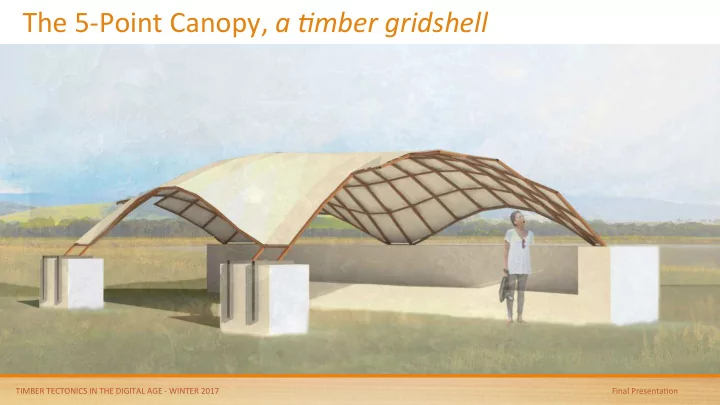
The 5-Point canopy as stated in the name touches the ground at 5 points. These points, which rest on a concrete base wall, form the base of a swooping diagrid gridshell. A rain protecAon canopy protects the wood and the interior from the rain and produces interesAng spaAal effects. This canopy has the potenAal to be translucent, which can produce an interesAng lighAng effect on the interior. >>Josh Rosenthal
TIMBER TECTONICS IN THE DIGITAL AGE - WINTER 2017
Date: 3/20/17 Topic: Final Project
The canopy is 33’x16’. Through the use of a base retaining wall, the canopy reaches a maximum height of 9’, a comfortable height to walk
various ways in which the canopy can accommodate 20 people. The main support wall contains a bench and the two piers allow for flexible entry. >>Josh Rosenthal
TIMBER TECTONICS IN THE DIGITAL AGE - WINTER 2017
Date: 20 March 2017 Topic: Canopy Final
The building shape is using hanging chain model method, formed by gravity load pushed up the grid and five supporAng points are pulling back to the ground. Because the shape is formed by the gravity, the shape itself have a resistance to the load. Karamba and Kangaroo bboth can simulate the hanging chain model, but Karamba is remaining the straight line
why we decide to find the form with Karamba instead of Kangaroo.
TIMBER TECTONICS IN THE DIGITAL AGE - WINTER 2017
Kangaroo Karamba Hanging Chain Diagram
Date: 3/20/17 Topic: Final Project
The definiAon pictured at right was used for form finding. It consists of a grid on which two supports were added at each of the five points. The grid was then deformed using Karamba to achieve the characterisAcs
points were placed on one side while two were placed on the other. >>Josh Rosenthal
TIMBER TECTONICS IN THE DIGITAL AGE - WINTER 2017
Date: 3/20/17 Topic: Final Project
The definiAon at right is for re- analyzing the form-found output. Downward forces are applied at each intersecAon for the purpose of realisAc
right is a rendered structural output. >>Josh Rosenthal
TIMBER TECTONICS IN THE DIGITAL AGE - WINTER 2017
Valen&na Leoni TIMBER TECTONICS IN THE DIGITAL AGE - WINTER 2017 9
Date: March 20 2017 Topic: Canopy Final
WEEK #
Maximum beam displacement: .57 inches
Valen&na Leoni TIMBER TECTONICS IN THE DIGITAL AGE - WINTER 2017 9
Date: March 18 2017 Topic: Canopy Final
WEEK #
Maximum beam displacement: 1.6 inches
Valen&na Leoni TIMBER TECTONICS IN THE DIGITAL AGE - WINTER 2017 9
Date: March 18 2017 Topic: Canopy Final
WEEK #
Max Compression: 1.17 kips Max Tension: .15 kips
Valen&na Leoni TIMBER TECTONICS IN THE DIGITAL AGE - WINTER 2017 9
Date: March 18 2017 Topic: Canopy Final
WEEK #
Max Shear: .236 kips Shear Y Shear Z
Valen&na Leoni TIMBER TECTONICS IN THE DIGITAL AGE - WINTER 2017 9
Date: March 18 2017 Topic: Canopy Final
WEEK #
Max moment: .277 kip-l node 36 Moment Combined Moment Y Moment X Moment Z
Date: 3/20/17 Topic: Final Project
The Trondheim Gridshell uAlizes cross bracing in order to keep the form in place as it does not have a rigid connecAon to the ground. The 5-Point Canopy does not require bracing due to the fact that the form is firmly held in place by the concrete base. Bracing is also not necessary due to the fact that lateral loads do not cause enough deflecAon on the structure to require extra bracing. >>Josh Rosenthal
TIMBER TECTONICS IN THE DIGITAL AGE - WINTER 2017
Date: March 20 Topic: Final PresentaAon
Valen&na Leoni TIMBER TECTONICS IN THE DIGITAL AGE - WINTER 2017 WEEK # 6
1x2 Western Hemlock is the material we would choose from the list of available materials for this structure. The 1x2 secAon is the most appropriate material choice (in comparison to the the 4x4 or plywood panels) for a laoce shell. Western Hemlock usually has a straight grain, which will be helpful to transfer bending and lateral forces. It is not a very durable wood, and is vulnerable to insect aiack, so it will need to be off the ground and covered. The species is grown in Oregon and Washington and commonly used in construcAon, so it hypotheAcally it could be sourced locally. Our canopy will be made from some water resistant fabric, ideally translucent. That exact type of fabric is currently being researched as water resistance and light transmission seem to be at odds. We may try shower curtain fabric.
hips:// www.commerce.alaska.gov /web/portals/6/Images/ commercial_forest_species _04.jpg hip:// www.coniferousforest.com /wp-content/uploads/ 2017/01/Western- Hemlock-Tree.jpg hip:// www.greatnorthernlumber. com/gnl/wp-content/ uploads/westhemlock2.jpg hip:// www.kalesnikoff.com/wp- content/uploads/2013/12/ album- hemlock-2-1024x787.png
Parr TIMBER TECTONICS IN THE DIGITAL AGE - WINTER 2017 9
Date: 3/20/17 Topic: Final PresentaAon
WEEK #
Date: 20 March Topic: Final PresentaAon
Since the second iteraAon, we decided to focus on grid shell system. We switched from karamba form finding to kangaroo form finding, and developed construcAon sequence based on Trondheim gridshell research.
TIMBER TECTONICS IN THE DIGITAL AGE - WINTER 2017
Date: 20 Mar 2017 Topic: Final PresentaAon
LEARNING OBJECTIVE Canopy Project The Trondheim gridshell research paper is our main reference for construcAon sequence and connecAon detail. The basic module is four laths intercrossed in the center of the wide
modules is creaAng conAnuous grid system. << Screenshot from Trondheim Gridshell Research Paper
ZHENGXIAN JIN TIMBER TECTONICS IN THE DIGITAL AGE - WINTER 2017 18 WEEK 9
Date: 6 Mar 2017 Topic: Canopy Second InteraAon
LEARNING OBJECTIVE Canopy Project Each module is made with four ¼ inch thick 4 l 1*3 wood interconnect in the center of wide surface.Each lath have five wholes for connecAon, and spaced in certain distances as hand sketch on the upper right. Two out of four lathes with five wholes are having same diameter for each whole, and the other two out of four lathes have four 1 inch wide slots and a center whole for interconnect. These slots allow the module have beier bending. << Screenshot from Trondheim Gridshell Research Paper
ZHENGXIAN JIN TIMBER TECTONICS IN THE DIGITAL AGE - WINTER 2017 19 WEEK 9
Date: 20 Mar 2017 Topic: Final PresentaAon
Each of the two pieces is made out of
One piece is drilled with all pin holes for connecAons. The other piece has
are sloied to allow for extra bending in the connecAon.
WILL SEARCY TIMBER TECTONICS IN THE DIGITAL AGE - WINTER 2017 20 WEEK 6
Date: 3/20/17 Topic: Final PresentaAon
The wooden members of the grid shell will be connected with 3/8-16 x3.5” and 1/2-13x3.5” stainless steel
The 1/2” fasteners will be used at the center of each module for the pivot
short thread style of fastener to provide a smooth shank for the Amber to rotate on. The 3/8” fasteners will be used at all
with fender washers and nylocks >>Images by Tygh Parr
TIMBER TECTONICS IN THE DIGITAL AGE - WINTER 2017
2.50 20.00 6.50 6.50 0.50 0.50 0.55 2.50 20.00 0.55 6.50 1.00 R0.25 0.50 0.50 0.55 0.65 2.50 0.55 0.65
A A B B 2 2 1 1
Grid Shell Wood Lathe Union
DO NOT SCALE DRAWING
Week 9
SHEET 1 OF 1
3-7-17 PARR UNLESS OTHERWISE SPECIFIED:
SCALE 1:5 WEIGHT: REV
A
SIZE TITLE:
NAME DATE COMMENTS: Q.A. MFG APPR. ENG APPR. CHECKED DRAWN FINISH MATERIAL INTERPRET GEOMETRIC TOLERANCING PER: DIMENSIONS ARE IN INCHES TOLERANCES: FRACTIONAL ANGULAR: MACH BEND TWO PLACE DECIMAL THREE PLACE DECIMAL APPLICATION USED ON NEXT ASSY PROPRIETARY AND CONFIDENTIAL THE INFORMATION CONTAINED IN THIS DRAWING IS THE SOLE PROPERTY OF OSU WSE 499. ANY REPRODUCTION IN PART OR AS A WHOLE WITHOUT THE WRITTEN PERMISSION OF OSU WSE 499 IS PROHIBITED.
Date: 20 Mar 2017 Topic: Final PresentaAon
LEARNING OBJECTIVE Canopy Project A singular module consists of four pieces, two of each type. The two sloied pieces sandwich the two pin connecAon pieces. This way, each arm has a connecAon with a pin and a slot to allow the bolt connector to move and allow for extra bending.
WILL SEARCY TIMBER TECTONICS IN THE DIGITAL AGE - WINTER 2017 22 WEEK 6
Date: 20 Mar 2017 Topic: Final PresentaAon
LEARNING OBJECTIVE Canopy Project A system of four creates the beginning of the grid shell. As the grid shell moves away from the pin connecAon, each piece aiaches on the lower side of the last piece. This automaAcally sets the bend for the grid shell. The connecAon to the ground is a pin connecAon to allow for rotaAon when bending the grid shell to shape.
WILL SEARCY TIMBER TECTONICS IN THE DIGITAL AGE - WINTER 2017 23 WEEK 6
Date: 3/20/17 Topic: Timber Tectonics Final
The 5-point canopy will be connected to its foundaAon piers by 10 pined steel plates. Each connecAon point of the canopy will be comprised of the laoce of the gridshell clamped by the use of through bolAng to the connecAons plate. The pin will resist the outward thrust force of the canopy while allowing the bent geometry of the canopy some posiAon tolerance. >>Image by Tygh Parr
TIMBER TECTONICS IN THE DIGITAL AGE - WINTER 2017
Date: 3/20/17 Topic: Timber Tectonics Final
1.25 2.75 1.63 4.00 0.50 1.00 0.38 45° 0.38 45° 4 . 0.75 0.10 45° 0.50 1.25 3.00 0.88 0.25 0.25 2.20 2.20 0.40 0.40 0.44 0.44
A A B B 2 2 1 1
WEIGHT:57
PARR 3-20-17
WSE 499 GRIDSHELL FOUNDATION CONNECTION
PROPRIETARY AND CONFIDENTIAL THE INFORMATION CONTAINED IN THIS DRAWING IS THE SOLE PROPERTY OF OSU COURSE WSE 499. ANY REPRODUCTION IN PART OR AS A WHOLE WITHOUT THE WRITTEN PERMISSION OF OSU CoF IS PROHIBITED. COMMENTS: SHEET 1 OF 1 Q.A. MFG APPR. ENG APPR. CHECKED DRAWN DATE NAMEDIMENSIONS ARE IN INCHES TOLERANCES: FRACTIONAL ANGULAR: MACH BEND TWO PLACE DECIMAL THREE PLACE DECIMAL NEXT ASSY USED ON APPLICATION DO NOT SCALE DRAWING
FINISH MATERIAL REV.A
The pined connecAons will be cast into the foundaAon piers when they are
secured onto the plate with the same 3/8”-16 stainless fasteners as the modules are constructed with. >>Images by Tygh Parr
TIMBER TECTONICS IN THE DIGITAL AGE - WINTER 2017
Date: 3/20/17 Topic: Final PresentaAon
1. The concrete base is constructed 2. The canopy is laid out flat on top
3. The canopy is pushed/pulled into place 4. A finalized form is produced and secured to the base 5. The rain protecAon canopy is added >>Josh Rosenthal
TIMBER TECTONICS IN THE DIGITAL AGE - WINTER 2017
Date: 20 Mar 2017 Topic: Final PresentaAon
TIMBER TECTONICS IN THE DIGITAL AGE - WINTER 2017
TIMBER TECTONICS IN THE DIGITAL AGE - WINTER 2017
Date: March 20 2017 Topic: Final PresentaAon
A square shouldered carriage bolt is used to connect the four laths and fabric enclosure. The bolt is inserted from the boiom of the assembly and fixed with a hex nut on top. Once the final form is achieved, the grommeied fabric enclosure is draped over the top of the structured and secured with acorn nuts.
Valen&na Leoni TIMBER TECTONICS IN THE DIGITAL AGE - WINTER 2017 9
Date: March 19 2017 Topic: Canopy Final
WEEK #
TIMBER TECTONICS IN THE DIGITAL AGE - WINTER 2017
Date: March 19 2017 Topic: Canopy Final
TIMBER TECTONICS IN THE DIGITAL AGE - WINTER 2017
Date: March 19 2017 Topic: Canopy Final Single Unit
Valen&na Leoni TIMBER TECTONICS IN THE DIGITAL AGE - WINTER 2017 9
Date: March 19 2017 Topic: Canopy Final
WEEK #
Two Units
(REPLACE THIS WITH YOUR OWN IMAGE OR A CITED CREATIVE COMMONS IMAGE] Final ReflecAon: This class was among the best I have taken at UO. Though I did not have as much Ame as I would have liked to experiment in depth with karamba models for each system, the design build process was very rewarding. I thought the alternaAng digital design and structural design lecture format was great. The assigned readings were also excellent. It’s always Ame consuming and tedious to have to demonstrate what you have learned but I appreciate that you tried to make it as painless as possible by providing the porvolio template and outline. It’s obvious that webex wasn’t the greatest tool – are we required to use it by the universiAes? If not – I know a lot of us relied on simple, accessible tools like faceAme, skype, and facebook chat. There were a lot of complaints about webex but I would argue that many of the people complaining have not had to work on projects in the real world yet, which olen require collaboraAon of this nature. I work part Ame as a GE at the UO office of design and construcAon and I am on a “go to meeAng” at least once a week. For all its faults, webex allowed for guest speakers and connected our two universiAes. Shop access was a huge part in the success of our projects. If Tygh didn’t have unrestricted access to the cral center shop at OSU this full scale model would not have been as successful. The mulAple reviews also pushed us to make progress. I think the course descripAon should just make it clear that the course is for people who are willing to put in Ame and are interested in collaboraAon. Having some background in structures is also very helpful. If the opportunity ever arose to build an installaAon on one of our campuses I would love to parAcipate. Please keep me in the loop – I enjoyed working with you both very much! Thank you for all your effort – ValenAna