Sample size calculations How many individuals do we need??? It - - PowerPoint PPT Presentation

sample size calculations
SMART_READER_LITE
LIVE PREVIEW

Sample size calculations How many individuals do we need??? It - - PowerPoint PPT Presentation

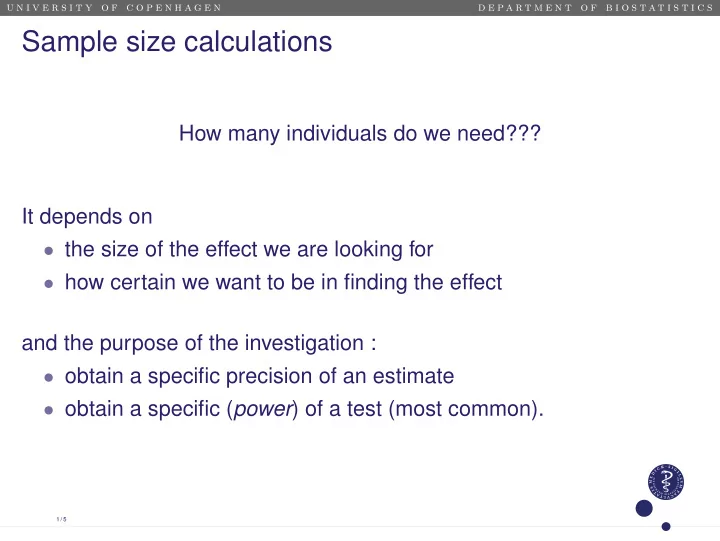
u n i v e r s i t y o f c o p e n h a g e n d e p a r t m e n t o f b i o s t a t i s t i c s Sample size calculations How many individuals do we need??? It depends on the size of the effect we are looking for how certain we want to be


slide-1
SLIDE 1

u n i v e r s i t y o f c o p e n h a g e n d e p a r t m e n t o f b i o s t a t i s t i c s

Sample size calculations

How many individuals do we need??? It depends on

  • the size of the effect we are looking for
  • how certain we want to be in finding the effect

and the purpose of the investigation :

  • obtain a specific precision of an estimate
  • obtain a specific (power) of a test (most common).

1 / 5

slide-2
SLIDE 2

u n i v e r s i t y o f c o p e n h a g e n d e p a r t m e n t o f b i o s t a t i s t i c s

Precision

We want to estimate the mean SBP level µ for females with a precision

  • f

µ ± a. 95% confidence interval (95%) : µ ± 1.96 SD

√n.

Thus a = 1.96 SD

√n

i.e. n = 3.84 × SD2 a2 . We need to come up with a guess of SD. In the Framingham data we find SD=25. Example : a = 3 and SD=25 gives n = 3.84 × 252 32 = 266.67 → 267.

2 / 5

slide-3
SLIDE 3

u n i v e r s i t y o f c o p e n h a g e n d e p a r t m e n t o f b i o s t a t i s t i c s

Test of hypotheses

A test of a hypothesis H0 can give two types of error : Type I: Reject the hypothesis even though it is true. Type II: Accept the hypothesis even though it is wrong. Probability of type I error : α = level of significance. Probability of type II error : β. 1 − β = power.

Truth Conclusion Hypothesis true Hypothesis wrong Accept Correkt conclusion Type II error 1 − α β Reject Type I fejl Correkt conclusion α 1 − β

3 / 5

slide-4
SLIDE 4

u n i v e r s i t y o f c o p e n h a g e n d e p a r t m e n t o f b i o s t a t i s t i c s

Comparison of means in two groups

We determine the number of individuals in each group. Determine µ1, µ2, SD, α an β. n = 2 SD2 (µ1 − µ2)2 × (z1−α/2 + z1−β)2. We need ∆ = µ1 − µ2 and SD. The needed samples size depends on :

  • the level of significance (α)
  • the power (1 − β)

and

  • the difference between the groups : the larger difference the

smaller the needed sample size

  • the variation (SD) : the larger, the larger the sample size

4 / 5

slide-5
SLIDE 5

u n i v e r s i t y o f c o p e n h a g e n d e p a r t m e n t o f b i o s t a t i s t i c s

Example

Assume that we want to detect af difference in SBP of ∆=10mmHg for women randomized to placebo / treatment. We want to be 90% sure to detect the difference (1 − β = 0.90) when testing on the 5% significance level (α = 0.05). In the Framingham data we find (SD=25). I.e. n = 2(SD ∆ )2(z1−0.05/2 + z0.90)2 = 2(SD ∆ )2(1.96 + 1.28)2 = 2 × (25 10)2 × 10.5 = 131.25. We need 132 women in each group.

5 / 5