protoDUNE-SP Cold Electronics Calibration Two in situ DAC available - - PowerPoint PPT Presentation

protodune sp cold electronics calibration
SMART_READER_LITE
LIVE PREVIEW

protoDUNE-SP Cold Electronics Calibration Two in situ DAC available - - PowerPoint PPT Presentation

protoDUNE-SP Cold Electronics Calibration Two in situ DAC available on the FEMB external generated by the FPGA internal generated by the FE ASIC Configure: FPGA controls clock to generate all pulses: Set FPGA to


slide-1
SLIDE 1

protoDUNE-SP Cold Electronics Calibration

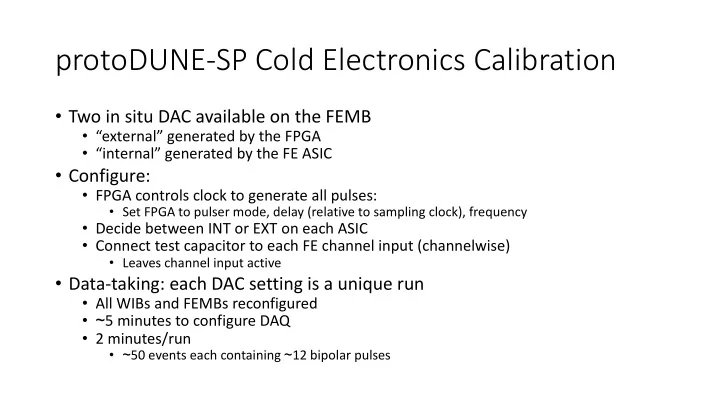
  • Two in situ DAC available on the FEMB
  • “external” generated by the FPGA
  • “internal” generated by the FE ASIC
  • Configure:
  • FPGA controls clock to generate all pulses:
  • Set FPGA to pulser mode, delay (relative to sampling clock), frequency
  • Decide between INT or EXT on each ASIC
  • Connect test capacitor to each FE channel input (channelwise)
  • Leaves channel input active
  • Data-taking: each DAC setting is a unique run
  • All WIBs and FEMBs reconfigured
  • ~5 minutes to configure DAQ
  • 2 minutes/run
  • ~50 events each containing ~12 bipolar pulses
slide-2
SLIDE 2

Analysis

  • Area of interest for calibration:
  • DAC 1-7
  • At each DAC setting:
  • Average area under the pulse is

plotted as a function of DAC value

  • Known DAC step size:
  • From fit and DAC size extract

gain in e-/ADC

30

  • 20
  • 10
  • 10

20 30 Pulser DAC setting 10000

  • 5000
  • 5000

10000 15000 20000 25000 tick] ´ Area [(ADC count)

0.14 ± Slope: 909.41

ProtoDUNE-SP

ROI area channel 2080

slide-3
SLIDE 3

Gain and Issues

  • Every channel was included in

every DAC value run

  • Only several times did we take

DAC values well into saturation

  • After that only DAC values 1-10

for the default detector gain and shaping time (14 mV/fC, 2 usec) were taken

  • Slow and lots of deadtime!
  • Solution (not implemented):
  • Use EXT pulser, 1 DAQ run
  • Configure all FEMBs 1 time
  • During run, raise the trigger

inhibit every 5 minutes, change the DAC setting in the FPGA, lower inhibit, continue taking data