New Tax and Licensing Revenue Opportunities Navigating Emerging - - PowerPoint PPT Presentation

new tax and licensing revenue opportunities
SMART_READER_LITE
LIVE PREVIEW

New Tax and Licensing Revenue Opportunities Navigating Emerging - - PowerPoint PPT Presentation

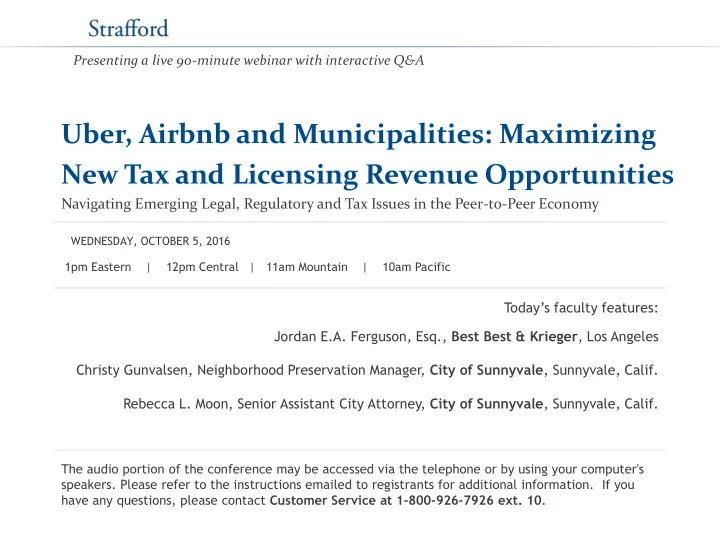
Presenting a live 90-minute webinar with interactive Q&A Uber, Airbnb and Municipalities: Maximizing New Tax and Licensing Revenue Opportunities Navigating Emerging Legal, Regulatory and Tax Issues in the Peer-to-Peer Economy WEDNESDAY,


slide-1
SLIDE 1

The audio portion of the conference may be accessed via the telephone or by using your computer's

  • speakers. Please refer to the instructions emailed to registrants for additional information. If you

have any questions, please contact Customer Service at 1-800-926-7926 ext. 10.

Presenting a live 90-minute webinar with interactive Q&A

Uber, Airbnb and Municipalities: Maximizing New Tax and Licensing Revenue Opportunities

Navigating Emerging Legal, Regulatory and Tax Issues in the Peer-to-Peer Economy

Today’s faculty features:

1pm Eastern | 12pm Central | 11am Mountain | 10am Pacific WEDNESDAY, OCTOBER 5, 2016

Jordan E.A. Ferguson, Esq., Best Best & Krieger, Los Angeles Christy Gunvalsen, Neighborhood Preservation Manager , City of Sunnyvale, Sunnyvale, Calif. Rebecca L. Moon, Senior Assistant City Attorney, City of Sunnyvale, Sunnyvale, Calif.

slide-2
SLIDE 2

Tips for Optimal Quality

Sound Quality If you are listening via your computer speakers, please note that the quality

  • f your sound will vary depending on the speed and quality of your internet

connection. If the sound quality is not satisfactory, you may listen via the phone: dial 1-866-871-8924 and enter your PIN when prompted. Otherwise, please send us a chat or e-mail sound@straffordpub.com immediately so we can address the problem. If you dialed in and have any difficulties during the call, press *0 for assistance. Viewing Quality To maximize your screen, press the F11 key on your keyboard. To exit full screen, press the F11 key again.

FOR LIVE EVENT ONLY

slide-3
SLIDE 3

Continuing Education Credits

In order for us to process your continuing education credit, you must confirm your participation in this webinar by completing and submitting the Attendance Affirmation/Evaluation after the webinar. A link to the Attendance Affirmation/Evaluation will be in the thank you email that you will receive immediately following the program. For additional information about continuing education, call us at 1-800-926-7926

  • ext. 35.

FOR LIVE EVENT ONLY

slide-4
SLIDE 4

Program Materials

If you have not printed the conference materials for this program, please complete the following steps:

  • Click on the ^ symbol next to “Conference Materials” in the middle of the left-

hand column on your screen.

  • Click on the tab labeled “Handouts” that appears, and there you will see a

PDF of the slides for today's program.

  • Double click on the PDF and a separate page will open.
  • Print the slides by clicking on the printer icon.

FOR LIVE EVENT ONLY

slide-5
SLIDE 5

Agenda

  • The Sharing Economy
  • Online Vacation Rental Marketplaces
  • Transportation Network Companies
  • What issues are posed by Ridesharing

Technologies?

  • What Issues are posed by Home-Sharing

Technologies?

  • Recent Developments
  • Drafting and Enforcing Regulations and

Ordinances

  • Strategies for Recovering and Maximizing Revenue

5

slide-6
SLIDE 6

The Sharing Economy

6

slide-7
SLIDE 7

“Innovative Disruption”

  • Use of technology to create new markets and

displace existing industries

  • Key to understanding the mindset of companies

like Uber and Airbnb

  • Tech has moved into highly regulated areas of the

economy like transportation, housing, and employment relationships

  • Not afraid to “disrupt” existing laws

7

slide-8
SLIDE 8

The Sharing Economy

  • Refers to businesses that provide consumers

the ability to share resources, like housing, vehicles, home-cooked meals, and more, generally through apps or websites that connect users with potential customers.

  • Examples: Uber, Lyft, Sidecar, Airbnb, VRBO,

Mealsharing

8

slide-9
SLIDE 9

The Sharing Economy

  • The basic principle of the

sharing economy is simple: One person has resources, another person wants to rent/borrow/use them temporarily.

  • Businesses in the sharing

economy claim that they are merely facilitators: they connect those with resources with those who want to utilize them, for a fee.

9

slide-10
SLIDE 10

Short Term Rentals

  • Websites that enable homeowners, tenants, or
  • ccupants to rent out their living space.
  • May rent entire home or just a couch or spare

bedroom.

  • Typically lasts less than 30 days.
  • Major players: Airbnb, Homeaway (VRBO)

10

slide-11
SLIDE 11

Transportation Network Companies

  • Web-based applications that connect users and

drivers through smartphone apps.

  • Allow prospective passengers to view and

select from nearby available drivers, who are guided to them using the smartphone’s GPS.

  • Major players: Uber, Lyft

11

slide-12
SLIDE 12

Exponential Growth

  • Uber (valued at $50B) is world’s most valuable

private start-up. Worth more than FedEX ($48B) and Nissan ($47B).

  • Airbnb (valued at $10B) worth more than

Wyndam Hotels ($9.4B) and Hyatt ($8.4B)

12

slide-13
SLIDE 13

Airbnb: Exponential Growth

Source: Airbnb.com

13

slide-14
SLIDE 14

What Issues Are Posed By Ride-Sharing Technologies?

14

slide-15
SLIDE 15

Objectives

  • Ensure Safety of Both Drivers and Customers.
  • Encourage Competition in the Market.
  • Ensure Fairness of Employment Practices.

15

slide-16
SLIDE 16

Issues

  • Competition with Taxi Industry
  • Lack of regulations
  • Employee Classification

16

slide-17
SLIDE 17

Issues: Competition with Taxi Industry

  • Controversy surrounding

Uber’s effect on the taxi industry.

  • Taxi medallions de-

valued by unregulated competitors like Uber and Lyft.

  • Taxis pay higher fees,

must abide by more stringent regulations.

17

slide-18
SLIDE 18

Why Protect the Taxi Industry?

  • TNC success fueled by dissatisfaction with taxi

service as well as changing values/preferences

  • f consumers
  • However, taxis still provide valuable service to

many in the community (e.g. elderly, disabled)

  • Taxi ordinances require vehicle inspections,

insurance, driver background checks, posting/regulation of fares and universal service/non-discrimination

18

slide-19
SLIDE 19

How To Help Taxis Compete

  • Lobby state for appropriate laws/regulations to

ensure public safety and protect consumers

  • Modernize taxi ordinances to make taxis more

competitive

  • If state law limits local enforcement options of

TNC’s, consider what other laws may apply (e.g., unfair competition, labor laws)

  • Impose business license tax on TNC drivers

19

slide-20
SLIDE 20

Issues: Lack of Regulation

  • TNCs enter a market without

permission, presume legality until told otherwise.

  • Uber in particular has

displayed willingness to flout local laws and operate despite bans.

  • Lack of regulation has led to

deaths, injuries, and crimes by drivers who passed less

  • nerous background checks.

20

slide-21
SLIDE 21

Issues: Employee Classification

  • Two ongoing lawsuits by drivers of Uber and Lyft,

who allege that the companies have misclassified them as independent contractors instead of employees.

  • Independent contractor:
  • Drivers set hours
  • Drivers choose to accept or reject fares
  • Employee:
  • Right to terminate drivers if customer ratings fall

below threshold

  • Uber’s “Driver Handbook” governing conduct

21

slide-22
SLIDE 22

What Issues Are Posed By Home-Sharing Technologies?

22

slide-23
SLIDE 23

23

slide-24
SLIDE 24

Objectives of Regulation

  • Preserve the Community’s Residential Character
  • Prevent Nuisances in Single-Family Neighborhoods
  • Limit Conversion of Housing to Full-Time Short

Term Rental.

  • Generate Taxes/Fees to Cover the Cost of Short

Term Rental Occupancies and offset lost hotel taxes.

  • Ensure that Short Term Rental Users are

Adequately Protected Against Fire, Hazards, Health Risks.

24

slide-25
SLIDE 25

Issues

  • Housing Market Issues
  • Taxing Issues
  • Code Enforcement Issues
  • Policy Enforcement Issues

25

slide-26
SLIDE 26

Issues: Housing Markets

  • Short-Term Rental Marketplaces can create

major problems for housing markets in pricing and availability.

  • Owners may use Airbnb and HomeAway full-

time to generate greater revenue than simply renting or selling the property.

  • As this practice becomes more prevalent,

housing availability for residents will likely decrease, with the price likely to increase.

26

slide-27
SLIDE 27

Who rents on Airbnb?

Source: triplepundit.com

27

slide-28
SLIDE 28

Issues: Housing Markets

  • In New York City, the number of

short-term private rentals has increased from 2,652 in 2010 to 16,483 in the first half of 2014, including instances of people permanently renting out second bedrooms through Airbnb, people renting out their whole property, or landlords renting out multiple apartments in the same building.

  • One commercial host

generated $6.84 million from renting out their properties through Airbnb between 2010 and 2014.

Source: Statista.com, http://www.statista.com/statistics/339766/private- short-term-rentals-booked-through-airbnb-in-new-york- city/

28

slide-29
SLIDE 29

Not Just Vacation Rentals!

Techie dorms Hacker homes Intern houses Not your grandma’s youth hostel! (These come with WiFi)

29

slide-30
SLIDE 30

“Highly Distributed” Luxury Hotels

“Geekhut’s” rentals include high-end work stations, a fridge full of groceries, 500 Mbps WiFi and free Netflix, Hulu, and HBOGo.

30

slide-31
SLIDE 31

Do the Math

  • $3,000 per month (median rent in Silicon

Valley) = $100 per day

  • That same apartment for $270 a day on Airbnb

= $8,100 per month

  • 3 bedroom home = 7 bed “hacker dorm” at

$35/night = $7,350 per month

31

slide-32
SLIDE 32

Issues: Taxes

  • Most local governments

tax hotel stays (usually called “Transient Occupancy Taxes”).

  • Tax collected from guest

through hotel bill.

  • Hotels responsible for

remitting these taxes to local governments on a monthly or quarterly basis.

32

slide-33
SLIDE 33

Issues: Taxes

  • Airbnb and HomeAway leave the obligation to

comply with local laws (including paying TOT) to the host and guest.

  • Hotels must typically register with local

governments; Airbnb properties often have no such

  • requirement. How to track and audit?
  • Communities are often forced to search websites

themselves then send letters to collect taxes.

  • This has inefficiencies, with lost tax revenue as a

result.

33

slide-34
SLIDE 34

Issues: Code Enforcement

  • Large numbers of

temporary occupants linked to several code enforcement problems, including:

  • Excessive noise complaints
  • Parking Problems
  • Trash problems
  • Smokers congregating
  • utside home/in backyards
  • Degradation of

neighborhood’s residential character

34

slide-35
SLIDE 35

Issues: How to Regulate?

  • Whatever policies a city adopts, you have to make

sure they are enforceable as a practical matter.

  • Harsh regulations are only effective if you can

identify violators.

  • Burdensome permitting/licensing schemes tend to

deter compliance.

  • Random compliance inspections of home businesses

not allowed in 9th Circuit without a warrant

35

slide-36
SLIDE 36

Recent Developments in Ride- Sharing and Home-Sharing

36

slide-37
SLIDE 37

Ride-Sharing Developments

  • As of October 2016, 34

states and more than 69 cities have passed legislation governing TNCs.

  • Most commonly impose

insurance and background check requirements

37

slide-38
SLIDE 38

Ride-Sharing Developments

  • Finger-print based

background checks

  • Local governments argue

they are a necessary security measure

  • Uber and Lyft have argued

they act as a disincentive for drivers to sign up

  • Uber has threatened to

leave Houston over current fingerprint requirements

38

slide-39
SLIDE 39

Ride-Sharing Developments

  • New Massachusetts law requires two-part background

check, but no finger-printing

  • Requires cars to be fitted with decals
  • Requires commercial insurance while trips are in

progress

  • Imposes a fee of $0.20 a ride for transportation funding

at state and local levels.

39

slide-40
SLIDE 40

Ride-Sharing Developments

  • Google launching a ride-

sharing service in San Francisco this fall.

  • Powered by Waze
  • Focuses on shared-rides
  • Accessible to any Waze

user in San Francisco

40

slide-41
SLIDE 41

Ride-Sharing Developments

  • Uber and Lyft have both expressed

interest in developing fleets of driverless cars

  • Uber has teamed with GM to

develop a fleet—began testing deployment in Pittsburgh in September

  • Ford announced 2021 deployment

date for driverless fleet and ride- sharing service—not just a carmaker, but a “mobility company”

  • BMW and Mercedes Benz have

also announced ride-sharing services

  • The ride-sharing market is about

to get much more crowded…

41

slide-42
SLIDE 42

Home-Sharing Developments

  • Airbnb struggling to curb

discrimination by landlords

  • Rampant reports of users

being turned away based

  • n race, later approved

when using a white photo and fake name

  • Airbnb increasing instant-

booking and posting anti- discrimination policy

42

slide-43
SLIDE 43

Home-sharing Developments

  • Recent New York City

investigation found over 100 listings allowing more than 13 guests using bunk beds or beds shoved into bathrooms or kitchens

  • State of New York is

contemplating legislation prohibiting the advertising

  • f short-term rentals on

Airbnb and similar sites

43

slide-44
SLIDE 44

Home-Sharing Developments

  • Airbnb is negotiating

agreements to collect and remit Transient Occupancy Taxes for an increasing number of municipalities

  • Will not share customer

data, but will provide the amount each user owes directly to the City

  • Increases City revenue but

decreases transparency of local home-sharing market

44

slide-45
SLIDE 45

Home-Sharing Developments

  • CA Supreme Court heard arguments on September 29

in In Re Transient Occupancy Tax Cases

  • Focused on internet-based online travel companies

(“OTCs,” more like Expedia than Airbnb)

  • Cities claim OTCs have failed to remit TOT collected on

the sites

  • May result in CA SC decision on who constitutes an

“operator” and is responsible for TOT compliance

45

slide-46
SLIDE 46

Drafting Regulations and Ordinances

46

slide-47
SLIDE 47

Short Term Rentals

47

slide-48
SLIDE 48

Housing 2.0

  • Many cities in California prohibit or regulate

short term rentals in residential zones

  • Short term rentals through may be considered

unlawful hotels/motels under many city

  • rdinances
  • Popularity of short-term rental services caught

many cities off-guard and overwhelmed local code enforcement resources

48

slide-49
SLIDE 49

Regulation Rundown

  • Require all Short Term Rentals to Register and pay

fees.

  • Establish Minimum Stay Requirements (NYC).
  • Establish Maximum Total Number of Days Property

Can Be Used as Short Term Rental (SF).

  • Establish Maximum Number of Short Term Rentals

(Austin).

  • Establish Maximum Density of Short Term Rentals

(San Luis Obispo).

  • Require Safety Inspections (Deep Creek Lake, MD).
  • Require Payment of TOT (SF, DC, Portland, Chicago…)

49

slide-50
SLIDE 50

New York City: Outright Ban

  • NYC enforces its law making

it illegal for property owners to rent out homes for fewer than 30 days (Ewing v. Carmel-by-the-Sea).

  • City has been granted

preliminary injunctions against owners of two residential buildings being run as “illegal hotels.”

  • Ongoing fight over release of

“host” information to State Attorney General.

50

slide-51
SLIDE 51

Sunnyvale, CA

  • Suburban community in heart of Silicon Valley
  • Median home price around $1 million
  • Average rent approx. $3,000 per month
  • Not a tourist destination, but critical shortage
  • f housing for expanding workforce

51

slide-52
SLIDE 52

Sunnyvale’s Ordinance

  • Requires host be present on

site

  • Requires registration and

City approval

  • Maximum of 4 short-term

renters (not incl. minors)

  • Prohibits rental of non-

habitable space for sleeping

  • Requires payment of TOT
  • Must be approved by

HOA/Landlords

52

slide-53
SLIDE 53

Sunnyvale: Considered But Not Adopted

  • Allow “unhosted” rentals up to “X” days per

year? (tried in many cities but difficult to enforce)

  • Random compliance inspections? (likely

unconstitutional – City of LA v. Patel)

  • Pre-approval inspections, minimum parking

requirements, neighbor notification, annual renewals etc. (burdensome permit process will deter compliance with ordinance; compliance in other cities has been extremely low)

53

slide-54
SLIDE 54

Santa Monica: Tight Regulations

  • New Ordinance prohibits

property owners from renting their homes unless they are present in the unit throughout the rental period.

  • Mandates platforms collect

and remit TOT, disclose names and addresses of all hosts.

  • City intends to create an

enforcement department exclusively dedicated to home-sharing.

54

slide-55
SLIDE 55

San Francisco: Regulation

  • Legalized short-term rentals,

but requires “hosts” to be permanent residents of the City (must live in their unit for at least 275 days per year).

  • Rentals where host is not

present limited to 90-days-per- year.

  • Aim to keep housing market
  • pen to residents.
  • City has run into serious

enforcement problems

  • Airbnb won’t give booking data,

no way to tell when people are present in their homes.

55

slide-56
SLIDE 56

San Francisco: Regulation

  • San Francisco also has several other requirements

that are becoming commonplace, including:

  • Registry and Permits.
  • Insurance requirement ($500,000 in coverage).
  • TOT must be paid (San Francisco has contract with Airbnb

to remit).

  • Airbnb required to notify hosts of the City’s laws.
  • Tenants must notify landlords, new law does not affect

lease restrictions against subletting.

  • Airbnb recently agreed to pay the City roughly $25 million

in past-due TOT.

56

slide-57
SLIDE 57

San Francisco: Opposition

  • HomeAway filed suit against San Francisco to block

the new law.

  • Argued the rule unfairly limits rentals on its site, which

caters to vacation rentals and second homes.

  • 1,200 properties in San Francisco listed on HomeAway

as of November 2014, many of which will be forced off the site entirely.

  • Lawsuit was dismissed for lack of standing

(HomeAway does not own property in San Francisco). The law took effect February 1, 2015.

57

slide-58
SLIDE 58

Austin: Maximum Number

  • Austin ordinance passed

in 2013 allows annual determination of maximum number of licenses for short-term rentals that may be issued.

58

slide-59
SLIDE 59

Rancho Mirage Ordinance

  • Rancho Mirage, California

passed an ordinance requiring every short-term rental agreement to be signed by someone older than 30.

  • Lawsuit challenging that
  • rdinance has since been

dismissed on grounds that the Unruh Civil Rights Act does not apply to a City acting in its legislative capacity.

59

slide-60
SLIDE 60

Transportation Network Companies

60

slide-61
SLIDE 61

Regulation Rundown

  • California requires baseline levels of insurance for

every stage of TNC operation.

  • Houston requires background checks, permits, and a

minimum level of ADA compliant vehicles.

  • Portland allowing cabs to set their own fares during

Uber/Lyft pilot program.

61

slide-62
SLIDE 62

Playing Hardball

  • If Airbnb has shown a

willingness to negotiate, Uber is close to the

  • pposite, refusing to

engage and flouting regulations it disagrees with to force court challenges.

62

slide-63
SLIDE 63

Regulatory Complications

  • Efforts to regulate are

complicated by questions of who has authority.

  • In California, the CPUC

has preempted local regs.

  • Elsewhere, cities are

fending for themselves, illegalizing or regulating Uber.

63

slide-64
SLIDE 64

California Regulations

  • Insurance:
  • Law requires drivers of

the services to maintain insurance coverage.

  • Three tiers:
  • App is on, no customer
  • Customer hails through

app, en route to pick up

  • Customer in car

64

slide-65
SLIDE 65

Houston, Texas

  • City Council ordinance

allowing TNCs to

  • perate.
  • Establishes a minimum

requirement for ADA compliant vehicles.

  • Requires permit to
  • perate.
  • Eliminates minimum

limousine fare.

  • Requires full background

checks.

65

slide-66
SLIDE 66

But…

  • Houston has experienced

issues with enforcement.

  • Drivers not registering

with City.

  • Alleged rape by driver

revealed in April 2015. Driver continued to work for Uber for months after.

  • City has threatened to

revoke Uber’s permits.

  • Uber sued City to block

release of public records

  • n drivers.

66

slide-67
SLIDE 67

Changes of Heart: Nevada

  • Banned TNCs entirely in

2014.

  • Uber lobbied hard for

legislation to legalize ridesharing in the state.

  • Uber contends it is a

technology company, not a transportation provider.

  • May 2015, Legislature

passes bill authorizing ride-sharing.

67

slide-68
SLIDE 68

Changes of Heart: Portland

  • Banned Uber and Lyft.
  • City approved a four-

month pilot program in April 2015.

  • Business Licenses and

Vehicle inspections required.

  • Cabs able to set their
  • wn prices during pilot

program.

68

slide-69
SLIDE 69

Enforcing Regulations and Ordinances

69

slide-70
SLIDE 70

Enforcement Tips: Short Term Rentals

  • Rely on neighbors to alert authorities
  • Subpoena Short Term Rental company records

(legislative subpoenas)

  • Track individual online Short Term Rental activities
  • Require Short Term Rental companies to collect TOT

as a condition of operation

  • Establish strict penalties for noncompliance
  • Consider nuisance actions against problem hosts
  • Increase enforcement staff if possible

70

slide-71
SLIDE 71

Enforcement Tips: TNC’s

  • Rely on cab companies to alert authorities
  • Subpoena TNC company records to determine

drivers

  • Require (where authorized) minimum level of

insurance/background checks

  • Establish strict penalties for noncompliance
  • Increase enforcement staff if possible

71

slide-72
SLIDE 72

Strategies for Recovering and Maximizing Revenue

72

slide-73
SLIDE 73

Ride-Sharing

  • Local governments can

work to make taxis more competitive by reassessing local taxi regulations

  • If drivers are independent

contractors, may be able to collect business license tax (depending on state law/local ordinances)

73

slide-74
SLIDE 74

Ride-Sharing

  • Background Checks
  • Help to recover costs

spent enforcing against unsafe or criminal drivers

  • Cities can impose fees for

registration of drivers and for conducting background checks

74

slide-75
SLIDE 75

Home-Sharing

  • Require registration,

including registration fee

  • Collect and remit TOT—

enter Agreement with Airbnb, pass ordinance requiring collect and remit, make it part of registration process

  • Airbnb generally won’t

cooperate unless you work with them to adopt an

  • rdinance they like

75

slide-76
SLIDE 76

Home-Sharing

  • Registration

requirements can include inspections to reduce code- enforcement costs

  • Balance between

interests in strong regulation and interests in revenue maximization

76

slide-77
SLIDE 77

Questions?

Jordan E. A. Ferguson Jordan.Ferguson@bbklaw.com Best Best & Krieger 300 South Grand Avenue 25th Floor Los Angeles, CA 90071 Tel: (213) 787-2564 Website: www.bbklaw.com Christy Gunvalsen cgunvalsen@sunnyvale.ca.gov Neighborhood Preservation Manager, Sunnyvale, California 456 W. Olive Ave Sunnyvale, CA 94068 Tel: (408) 730-7255 Rebecca L. Moon rmoon@sunnyvale.ca.gov

  • Sr. Assistant City Attorney,

Sunnyvale, California 456 W. Olive Ave Sunnyvale, CA 94068 Tel: (408) 730-2705

77