CSE 341 : Programming Languages For larger programs, one top-level - - PowerPoint PPT Presentation

cse 341 programming languages
SMART_READER_LITE
LIVE PREVIEW

CSE 341 : Programming Languages For larger programs, one top-level - - PowerPoint PPT Presentation

Modules CSE 341 : Programming Languages For larger programs, one top-level sequence of bindings is poor Especially because a binding can use all earlier (non- Lecture 12 shadowed) bindings ML Modules So ML has structures to define


slide-1
SLIDE 1

CSE 341 : Programming Languages

Lecture 12 ML Modules Zach Tatlock Spring 2014 Modules

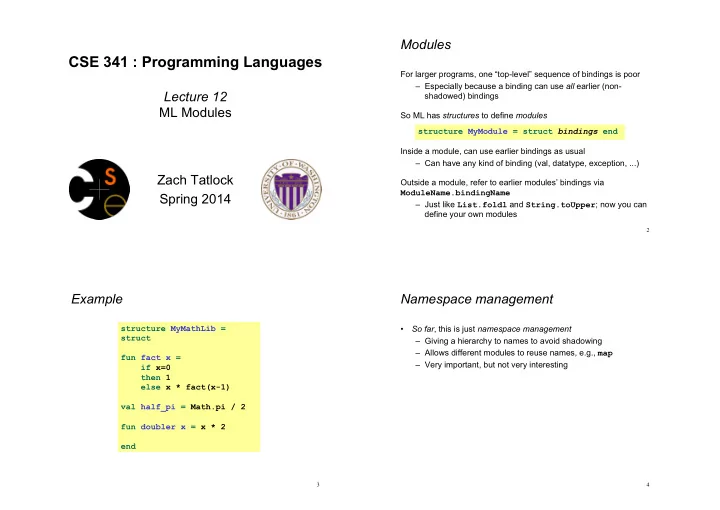
For larger programs, one “top-level” sequence of bindings is poor – Especially because a binding can use all earlier (non- shadowed) bindings So ML has structures to define modules Inside a module, can use earlier bindings as usual – Can have any kind of binding (val, datatype, exception, ...) Outside a module, refer to earlier modules’ bindings via ModuleName.bindingName – Just like List.foldl and String.toUpper; now you can define your own modules

2

structure MyModule = struct bindings end

Example

3

structure MyMathLib = struct fun fact x = if x=0 then 1 else x * fact(x-1) val half_pi = Math.pi / 2 fun doubler x = x * 2 end

Namespace management

  • So far, this is just namespace management

– Giving a hierarchy to names to avoid shadowing – Allows different modules to reuse names, e.g., map – Very important, but not very interesting

4

slide-2
SLIDE 2

Optional: Open

  • Can use open ModuleName to get “direct” access to a

module’s bindings – Never necessary; just a convenience; often bad style – Often better to create local val-bindings for just the bindings you use a lot, e.g., val map = List.map

  • But doesn’t work for patterns
  • And open can be useful, e.g., for testing code

5

Signatures

  • A signature is a type for a module

– What bindings does it have and what are their types

  • Can define a signature and ascribe it to modules – example:

6

signature MATHLIB = sig val fact : int -> int val half_pi : real val doubler : int -> int end structure MyMathLib :> MATHLIB = struct fun fact x = … val half_pi = Math.pi / 2.0 fun doubler x = x * 2 end

In general

  • Signatures

– Can include variables, types, datatypes, and exceptions defined in module

  • Ascribing a signature to a module

– Module will not type-check unless it matches the signature, meaning it has all the bindings at the right types

– Note: SML has other forms of ascription; we will stick with these [opaque signatures]

7

structure MyModule :> SIGNAME = struct bindings end signature SIGNAME = sig types-for-bindings end

Hiding things

Real value of signatures is to to hide bindings and type definitions – So far, just documenting and checking the types Hiding implementation details is the most important strategy for writing correct, robust, reusable software So first remind ourselves that functions already do well for some forms of hiding…

8

slide-3
SLIDE 3

Hiding with functions

These three functions are totally equivalent: no client can tell which we are using (so we can change our choice later): Defining helper functions locally is also powerful – Can change/remove functions later and know it affects no

  • ther code

Would be convenient to have “private” top-level functions too – So two functions could easily share a helper function – ML does this via signatures that omit bindings…

9

fun double x = x*2 fun double x = x+x val y = 2 fun double x = x*y

Example

Outside the module, MyMathLib.doubler is simply unbound – So cannot be used [directly] – Fairly powerful, very simple idea

10

signature MATHLIB = sig val fact : int -> int val half_pi : real end structure MyMathLib :> MATHLIB = struct fun fact x = … val half_pi = Math.pi / 2.0 fun doubler x = x * 2 end

A larger example [mostly see the code]

Now consider a module that defines an Abstract Data Type (ADT) – A type of data and operations on it Our example: rational numbers supporting add and toString

11

structure Rational1 = struct datatype rational = Whole of int | Frac of int*int exception BadFrac (*internal functions gcd and reduce not on slide*) fun make_frac (x,y) = … fun add (r1,r2) = … fun toString r = … end

Library spec and invariants

Properties [externally visible guarantees, up to library writer] – Disallow denominators of 0 – Return strings in reduced form (“4” not “4/1”, “3/2” not “9/6”) – No infinite loops or exceptions Invariants [part of the implementation, not the module’s spec] – All denominators are greater than 0 – All rational values returned from functions are reduced

12

slide-4
SLIDE 4

More on invariants

Our code maintains the invariants and relies on them Maintain: – make_frac disallows 0 denominator, removes negative denominator, and reduces result – add assumes invariants on inputs, calls reduce if needed Rely: – gcd does not work with negative arguments, but no denominator can be negative – add uses math properties to avoid calling reduce – toString assumes its argument is already reduced

13

A first signature

With what we know so far, this signature makes sense: – gcd and reduce not visible outside the module

14

signature RATIONAL_A = sig datatype rational = Whole of int | Frac of int*int exception BadFrac val make_frac : int * int -> rational val add : rational * rational -> rational val toString : rational -> string end structure Rational1 :> RATIONAL_A = …

The problem

By revealing the datatype definition, we let clients violate our invariants by directly creating values of type Rational1.rational – At best a comment saying “must use Rational1.make_frac” Any of these would lead to exceptions, infinite loops, or wrong results, which is why the module’s code would never return them – Rational1.Frac(1,0) – Rational1.Frac(3,~2) – Rational1.Frac(9,6)

15

signature RATIONAL_A = sig datatype rational = Whole of int | Frac of int*int …

So hide more

Key idea: An ADT must hide the concrete type definition so clients cannot create invariant-violating values of the type directly Alas, this attempt doesn’t work because the signature now uses a type rational that is not known to exist:

16

signature RATIONAL_WRONG = sig exception BadFrac val make_frac : int * int -> rational val add : rational * rational -> rational val toString : rational -> string end structure Rational1 :> RATIONAL_WRONG = …

slide-5
SLIDE 5

Abstract types

So ML has a feature for exactly this situation: In a signature: type foo means the type exists, but clients do not know its definition

17

signature RATIONAL_B = sig type rational exception BadFrac val make_frac : int * int -> rational val add : rational * rational -> rational val toString : rational -> string end structure Rational1 :> RATIONAL_B = …

This works! (And is a Really Big Deal)

Nothing a client can do to violate invariants and properties: – Only way to make first rational is Rational1.make_frac – After that can use only Rational1.make_frac, Rational1.add, and Rational1.toString – Hides constructors and patterns – don’t even know whether

  • r not Rational1.rational is a datatype

– But clients can still pass around fractions in any way

18

signature RATIONAL_B = sig type rational exception BadFrac val make_frac : int * int -> rational val add : rational * rational -> rational val toString : rational -> string end

Two key restrictions

So we have two powerful ways to use signatures for hiding: 1. Deny bindings exist (val-bindings, fun-bindings, constructors) 2. Make types abstract (so clients cannot create values of them or access their pieces directly) (Later we will see a signature can also make a binding’s type more specific than it is within the module, but this is less important)

19

A cute twist

In our example, exposing the Whole constructor is no problem In SML we can expose it as a function since the datatype binding in the module does create such a function – Still hiding the rest of the datatype – Still does not allow using Whole as a pattern

20

signature RATIONAL_C = sig type rational exception BadFrac val Whole : int -> rational val make_frac : int * int -> rational val add : rational * rational -> rational val toString : rational -> string end

slide-6
SLIDE 6

Signature matching

Have so far relied on an informal notion of, “does a module type- check given a signature?” As usual, there are precise rules… structure Foo :> BAR is allowed if:

  • Every non-abstract type in BAR is provided in Foo, as specified
  • Every abstract type in BAR is provided in Foo in some way

– Can be a datatype or a type synonym

  • Every val-binding in BAR is provided in Foo, possibly with a

more general and/or less abstract internal type – Discussed “more general types” earlier in course – Will see example soon

  • Every exception in BAR is provided in Foo

Of course Foo can have more bindings (implicit in above rules)

21

Equivalent implementations

A key purpose of abstraction is to allow different implementations to be equivalent – No client can tell which you are using – So can improve/replace/choose implementations later – Easier to do if you start with more abstract signatures (reveal

  • nly what you must)

Now: Another structure that can also have signature RATIONAL_A, RATIONAL_B, or RATIONAL_C – But only equivalent under RATIONAL_B or RATIONAL_C

(ignoring overflow)

Next: A third equivalent structure implemented very differently

22

Equivalent implementations

Example (see code file):

  • structure Rational2 does not keep rationals in reduced form,

instead reducing them “at last moment” in toString – Also make gcd and reduce local functions

  • Not equivalent under RATIONAL_A

– Rational1.toString(Rational1.Frac(9,6)) = "9/6" – Rational2.toString(Rational2.Frac(9,6)) = "3/2"

  • Equivalent under RATIONAL_B or RATIONAL_C

– Different invariants, but same properties – Essential that type rational is abstract

23

More interesting example

24

Given a signature with an abstract type, different structures can: – Have that signature – But implement the abstract type differently Such structures might or might not be equivalent Example (see code): – type rational = int * int – Does not have signature RATIONAL_A – Equivalent to both previous examples under RATIONAL_B or RATIONAL_C

slide-7
SLIDE 7

More interesting example

25

structure Rational3 = struct type rational = int * int exception BadFrac fun make_frac (x,y) = … fun Whole i = (i,1) (* needed for RATIONAL_C *) fun add ((a,b)(c,d)) = (a*d+b*c,b*d) fun toString r = … (* reduce at last minute *) end

Some interesting details

  • Internally make_frac has type int * int -> int * int,

but externally int * int -> rational – Client cannot tell if we return argument unchanged – Could give type rational -> rational in signature, but this is awful: makes entire module unusable – why?

  • Internally Whole has type 'a -> 'a * int but externally

int -> rational – This matches because we can specialize 'a to int and then abstract int * int to rational – Whole cannot have types 'a -> int * int

  • r 'a -> rational (must specialize all 'a uses)

– Type-checker figures all this out for us

26

Can’t mix-and-match module bindings

Modules with the same signatures still define different types So things like this do not type-check: – Rational1.toString(Rational2.make_frac(9,6)) – Rational3.toString(Rational2.make_frac(9,6)) This is a crucial feature for type system and module properties: – Different modules have different internal invariants! – In fact, they have different type definitions

  • Rational1.rational looks like Rational2.rational,

but clients and the type-checker do not know that

  • Rational3.rational is int*int not a datatype!

27