
SLIDE 1
1 Analysis 2 Argumentation References
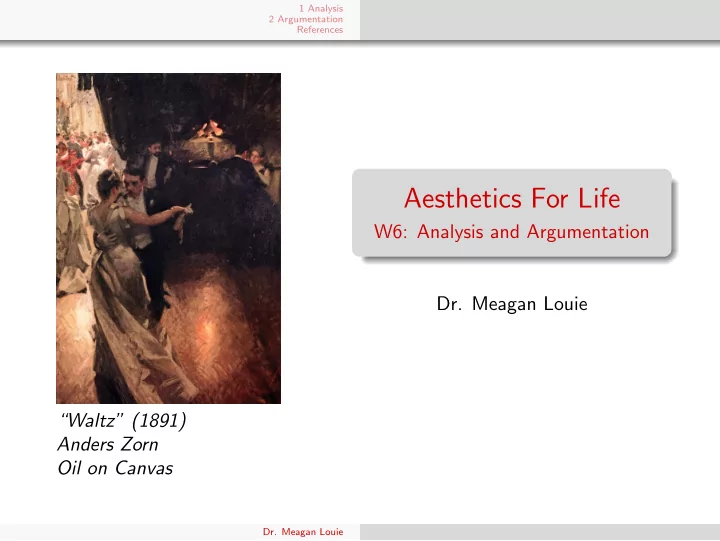
“Waltz” (1891) Anders Zorn Oil on Canvas
Aesthetics For Life
W6: Analysis and Argumentation
- Dr. Meagan Louie
- Dr. Meagan Louie
Aesthetics For Life W6: Analysis and Argumentation Dr. Meagan Louie - - PowerPoint PPT Presentation
1 Analysis 2 Argumentation References Aesthetics For Life W6: Analysis and Argumentation Dr. Meagan Louie Waltz (1891) Anders Zorn Oil on Canvas Dr. Meagan Louie 1 Analysis 1.1 What is an analysis? 2 Argumentation 1.2 FORM
1 Analysis 2 Argumentation References
“Waltz” (1891) Anders Zorn Oil on Canvas
W6: Analysis and Argumentation
1 Analysis 2 Argumentation References 1.1 What is an analysis? 1.2 FORM 1.3 CONTENT
An analysis takes something complex, and breaks it down
by identifying its component parts, and by identifying relationships between the parts
Q: What types of components does a piece of art have? Q: What sort of relationships can hold between these parts?
1 Analysis 2 Argumentation References 1.1 What is an analysis? 1.2 FORM 1.3 CONTENT
Stokstad & Cothren 2010: . A work of art is a material object that has both
1 form, and 2 content
So, to analyze an art object, you should
(i) identify components of its FORM and CONTENT, and (ii) identify relationships between those elements
1 Analysis 2 Argumentation References 1.1 What is an analysis? 1.2 FORM 1.3 CONTENT
Stokstad & Cothren 2010: . FORM is the purely visual aspects of the object, eg.,
1 lines, shapes 2 colour, texture 3 space, mass, volume 4 composition
So, to analyze an art object’s FORM, you should ask
Are the lines straight? curved? parallel? perpendicular? visible or implied? Long? Short? Are the shapes open? Closed? Sharp? Rounded?
1 Analysis 2 Argumentation References 1.1 What is an analysis? 1.2 FORM 1.3 CONTENT
Stokstad & Cothren 2010: . FORM is the purely visual aspects of the object, eg.,
1 lines, shapes 2 colour, texture 3 space, mass, volume 4 composition
So, to analyze an art object’s FORM, you should ask
Which hues are present? R, O, Y, G, B, P? What values are present? Low-values? mid-values? high-values How chromatic/saturated are the colours? High-chroma? Mid-chroma? low-chroma?
1 Analysis 2 Argumentation References 1.1 What is an analysis? 1.2 FORM 1.3 CONTENT
Stokstad & Cothren 2010: . FORM is the purely visual aspects of the object, eg.,
1 lines, shapes 2 colour, texture 3 space, mass, volume 4 composition
So, to analyze an art object’s FORM, you should ask
Do the elements look smooth? polished? rough? sharp? bumpy?
What type of perspective is used? How close together are the shapes/lines/how much space is there?
1 Analysis 2 Argumentation References 1.1 What is an analysis? 1.2 FORM 1.3 CONTENT
Stokstad & Cothren 2010: . FORM is the purely visual aspects of the object, eg.,
1 lines, shapes 2 colour, texture 3 space, mass, volume 4 composition
So, to analyze an art object’s FORM, you should ask
. arranged in a composition?
Is the composition balanced? symmetrical? Is there repetition of elements? What is in the foreground? middle ground? background?
1 Analysis 2 Argumentation References 1.1 What is an analysis? 1.2 FORM 1.3 CONTENT
“Muddy Alligators” (1917) John Singer Sargent Watercolour and graphite lines, shapes colour, texture space, mass, volume composition
1 Analysis 2 Argumentation References 1.1 What is an analysis? 1.2 FORM 1.3 CONTENT
“Muddy Alligators” (1917) John Singer Sargent Watercolour and graphite lines, shapes
Straight or curved, visible or implied lines? Open or closed shapes? Angled or rounded?
colour, texture space, mass, volume composition
1 Analysis 2 Argumentation References 1.1 What is an analysis? 1.2 FORM 1.3 CONTENT
“Muddy Alligators” (1917) John Singer Sargent Watercolour and graphite lines, shapes colour, texture
Hues? R, O, Y, G, B, P? Values? High, mid, low? Chroma? High, mid, low?
space, mass, volume composition
1 Analysis 2 Argumentation References 1.1 What is an analysis? 1.2 FORM 1.3 CONTENT
“Muddy Alligators” (1917) John Singer Sargent Watercolour and graphite lines, shapes colour, texture (and interaction with light)
smooth? rough? oily? bubbly? sharp? shiny? dull? matte? glossy? glowing?
space, mass, volume composition
1 Analysis 2 Argumentation References 1.1 What is an analysis? 1.2 FORM 1.3 CONTENT
“Muddy Alligators” (1917) John Singer Sargent Watercolour and graphite lines, shapes colour, texture space, mass, volume
Perspective? Shape/size
Solid, hollow? large, small?
composition
1 Analysis 2 Argumentation References 1.1 What is an analysis? 1.2 FORM 1.3 CONTENT
“Muddy Alligators” (1917) John Singer Sargent Watercolour and graphite lines, shapes colour, texture space, mass, volume composition
symmetrical? repetition of elements? Foreground? Middle ground? Background?
1 Analysis 2 Argumentation References 1.1 What is an analysis? 1.2 FORM 1.3 CONTENT
“Waltz” (1891) Anders Zorn Oil on Canvas lines, shapes colour, texture space, mass, volume composition
1 Analysis 2 Argumentation References 1.1 What is an analysis? 1.2 FORM 1.3 CONTENT
“Waltz” (1891) Anders Zorn Oil on Canvas lines, shapes
Straight or curved, visible or implied lines? Open or closed shapes? Angled or rounded?
colour, texture space, mass, volume composition
1 Analysis 2 Argumentation References 1.1 What is an analysis? 1.2 FORM 1.3 CONTENT
“Waltz” (1891) Anders Zorn Oil on Canvas lines, shapes colour, texture
Hues? R, O, Y, G, B, P? Values? High, mid, low? Chroma? High, mid, low?
space, mass, volume composition
1 Analysis 2 Argumentation References 1.1 What is an analysis? 1.2 FORM 1.3 CONTENT
“Waltz” (1891) Anders Zorn Oil on Canvas lines, shapes colour, texture (and interaction with light)
smooth? rough? oily? bubbly? sharp? shiny? dull? matte? glossy? glowing?
space, mass, volume composition
1 Analysis 2 Argumentation References 1.1 What is an analysis? 1.2 FORM 1.3 CONTENT
“Waltz” (1891) Anders Zorn Oil on Canvas lines, shapes colour, texture space, mass, volume
Perspective? Shape/size of space? Solid, hollow? large, small?
composition
1 Analysis 2 Argumentation References 1.1 What is an analysis? 1.2 FORM 1.3 CONTENT
“Waltz” (1891) Anders Zorn Oil on Canvas lines, shapes colour, texture space, mass, volume composition
symmetrical? repetition of elements? Foreground? Middle ground? Background?
1 Analysis 2 Argumentation References 1.1 What is an analysis? 1.2 FORM 1.3 CONTENT
Stokstad & Cothren 2010: . A work of art is a material object that has both
1 form, and 2 content
1 Analysis 2 Argumentation References 1.1 What is an analysis? 1.2 FORM 1.3 CONTENT
Stokstad & Cothren 2010: . CONTENT is the meaning associated with the object .
Irwin Panofsky identified three steps for deriving meaning:
1 Identifying Natural subject matter . Does it depict humans? animals? situations? . Things we recognize from our life experience? 2 Identifying Iconography . Are the forms and figures symbolic of something else? . Were/are these subjects associated with conventional meanings?
1 Analysis 2 Argumentation References 1.1 What is an analysis? 1.2 FORM 1.3 CONTENT
Stokstad & Cothren 2010: . CONTENT is the meaning associated with the object .
Irwin Panofsky identified three steps for deriving meaning:
3 ICONOLOGY How can the art object be understood as an . “embodiment of its cultural situation”? . i.e., what relationships does it have to its social, . political, religious, intellectual context?
1 Analysis 2 Argumentation References 1.1 What is an analysis? 1.2 FORM 1.3 CONTENT
Panofsky took a Contextualist approach to art . the context of creation is crucial component for . understanding the content of the art object
1 Analysis 2 Argumentation References 1.1 What is an analysis? 1.2 FORM 1.3 CONTENT
(i) identify components of its FORM and CONTENT, and (ii) identify relationships between those elements, . and elements of the context
Elements of context:
The artist’s
external situation - eg., place, time inner reality - eg., desires, emotions, moods, beliefs
Events, situations, objects, people, ideas, beliefs, value-systems
Contemporary to the piece of art Historical/prior to the piece of art
1 Analysis 2 Argumentation References 1.1 What is an analysis? 1.2 FORM 1.3 CONTENT
Let R(x,y) indicate an relationship between x and y. R could be
parallel(x,y) or mirror(x,y) or analagous-to(x,y)
part-of(x,y) or example-of(x,y), depict(x,y) or represent(x,y), symbolize(x,y) or refer-to(x,y) highlight(x,y), or conceal(x,y), idealize(x,y), deprecate(x,y) dependent-on(x,y), or sufficient-for(x,y) ...
Don’t just say “is related to” - explain HOW it is related
1 Analysis 2 Argumentation References 1.1 What is an analysis? 1.2 FORM 1.3 CONTENT
1 Identify relevant Formal aspects 2 Identify natural subject matter 3 Identify symbolic elements 4 Identify relevant elements of the Context1 5 Identify relationships between these components An analysis is necessary for a good argument You need to clearly identify components and relationships
1Context-of-creation (and/or the perciever’s context)
1 Analysis 2 Argumentation References 1.1 What is an analysis? 1.2 FORM 1.3 CONTENT
1 Identify relevant Formal aspects 2 Identify natural subject matter 3 Identify symbolic elements 4 Identify relevant elements of the Context2 5 Identify relationships between these components 6 Organize these to reason for, and support, your MAIN CLAIM
2Context-of-creation (and/or the perciever’s context)
1 Analysis 2 Argumentation References
. → establish the validity of your argument
. → establish the soundness of your argument
1 Analysis 2 Argumentation References
1 Consider this piece of art; . is it’s artistic value compatible with a . approach to art? . is a judgement of it compatible with Kant’s . ‘s criterion? 2 Consider this analysis of art; . is the analysis compatible with a . approach to art? . does the analysis require a . approach to art? . does the assessment of value satisfy Kant’s . criterion?
1 Analysis 2 Argumentation References
1 Your reasoning should identify a relationship between
, and
2 Your reasoning should identify a relationship between
, and
→ Providing the definition of the concept in your premises is a good way to show your recall, if nothing else
1 Analysis 2 Argumentation References
1 Your evidence should refer to specific components of the . form and content of the piece of art 2 Your evidence should refer to specific components of the . discussion of form and content in the analysis
1 Analysis 2 Argumentation References
Emanuelle Moureaux’s installation “Forest of Numbers,” consists of more than 60 000 rainbow-coloured numbers suspended from the ceiling.
1 Analysis 2 Argumentation References
The numbers are arranged by hue in 10 layers, each layer representing a year within the decade from 2017-2026 – eg., the layer for 2017 consists
2026 consists of the digits 2, 0, 2, and 6 in a random arrangement.
1 Analysis 2 Argumentation References
A section of these suspended numbers was removed, creating a path for the perceiver to walk through, as if they were time-travelling from 2017 to 2026.
1 Analysis 2 Argumentation References
Two Basic Types of Questions:
1 Consider this piece of art; . is it’s artistic value compatible with a . approach to art? . is a judgement of it compatible with Kant’s . ‘s criterion? 2 Consider this analysis of art; . is the analysis compatible with a . approach to art? . does the analysis use/require a . approach to art? . does the assessment of value satisfy Kant’s . criterion? → https://www.instagram.com/swu_lci_afl/
1 Analysis 2 Argumentation References
The first image provided is “Medusas Raft” by Joran Roukes (2015, oil
eodore G´ ericault (1818/1819, oil on canvas).
1 Analysis 2 Argumentation References
The first image provided is “Medusas Raft” by Joran Roukes (2015, oil
eodore G´ ericault (1818/1819, oil on canvas).
1 Analysis 2 Argumentation References
The first image provided is “Medusas Raft” by Joran Roukes (2015, oil
eodore G´ ericault (1818/1819, oil on canvas).
1 Analysis 2 Argumentation References
Stokstad, Marilyn & Michael Cothren. 2010. Art history, vol. 2.