Advanced Nanoscale Metrology with AFM Sang-il Park PSIA Corp. PSIA - - PDF document

advanced nanoscale metrology with afm
SMART_READER_LITE
LIVE PREVIEW

Advanced Nanoscale Metrology with AFM Sang-il Park PSIA Corp. PSIA - - PDF document

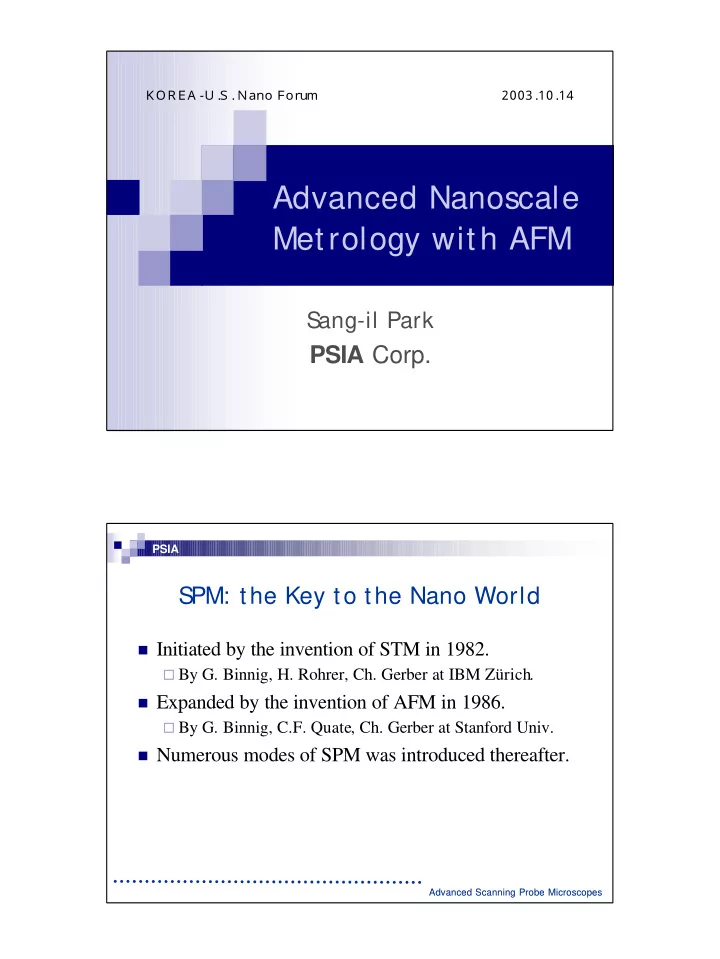
KOR E A - U . S . N a n o F o r u m 2 0 0 3 . 1 0 . 1 4 Advanced Nanoscale Metrology with AFM Sang-il Park PSIA Corp. PSIA SPM: the Key to the Nano World Initiated by the invention of STM in 1982. By G. Binnig,


slide-1
SLIDE 1

Advanced Nanoscale Metrology with AFM

Sang-il Park

PSIA Corp.

KOR E A

  • U

. S . N a n

  • F
  • r

u m 2 3 . 1 . 1 4

Advanced Scanning Probe Microscopes Advanced Scanning Probe Microscopes

PSIA

SPM: the Key to the Nano World

Initiated by the invention of STM in 1982.

By G. Binnig, H. Rohrer, Ch. Gerber at IBM Zürich.

Expanded by the invention of AFM in 1986.

By G. Binnig, C.F. Quate, Ch. Gerber at Stanford Univ.

Numerous modes of SPM was introduced thereafter.

slide-2
SLIDE 2

Advanced Scanning Probe Microscopes Advanced Scanning Probe Microscopes

PSIA

Schemat ics of AFM

Deflection of

cantilever is measured by baser beam bounce system.

Laser PSPD x-y-z piezo tube scanner sample mirror cantilever x y

  • x
  • Laser interferometer
  • Piezo resistance
  • Quartz tuning fork

Advanced Scanning Probe Microscopes Advanced Scanning Probe Microscopes

PSIA

100µm

Typical AFM Cantilever and Tip

5µm

slide-3
SLIDE 3

Advanced Scanning Probe Microscopes Advanced Scanning Probe Microscopes

PSIA

Inter-At omic Force

Total interaction Attractive Distance, z Repulsive z U

Advanced Scanning Probe Microscopes Advanced Scanning Probe Microscopes

PSIA

Resonance Frequency Change Due to Tip-Sample Interaction

0.50 0.75 1.00 1.25 1.50 5 10 15

Maximum slope position Operating frequency Applying interaction No interaction

∆A

∆ω/ω 0

Amplitude[ Arb]

ω/ω0

slide-4
SLIDE 4

Advanced Scanning Probe Microscopes Advanced Scanning Probe Microscopes

PSIA

NC-AFM: Mono At omic Steps on LAO

Scan size: 5 x 5 µm, 1 x 1 µm, z range: 0.5 nm [LaAlO3 ]

Advanced Scanning Probe Microscopes Advanced Scanning Probe Microscopes

PSIA

UHV NC-AFM: Si(111) 7x7

F.J. Giessibl et. al. Science 289, 422 (2000).

FM Detection Tuning fork W tip f0=16.7kHz k=1800N/m A=0.8nm

slide-5
SLIDE 5

Advanced Scanning Probe Microscopes Advanced Scanning Probe Microscopes

PSIA

Advant ages of SPM

High Resolution : ~ 1nm lateral, < 0.1nm vertical. Quantitative 3-D information. Non-conductors as well as conductors and

semiconductors.

Operates in air, liquid, and vacuum. Can measure electrical, magnetic, optical, and

mechanical properties.

Atomic scale manipulations and lithography.

Advanced Scanning Probe Microscopes Advanced Scanning Probe Microscopes

PSIA

SPM Family Tree

NSOM SCM SThM LFM

STM

STS PFM FMM MFM

NC-AFM (DFM) C-AFM

EFM Primary modes Additional modes

slide-6
SLIDE 6

Advanced Scanning Probe Microscopes Advanced Scanning Probe Microscopes

PSIA

SPM Wish List

Speed

z-scanner response NC detection time constant

Accuracy

Scan accuracy Tip convolution

Resolution

Acoustic and vibration noise Preserving sharp tip

Convenience

Easy operation Optical vision

Advanced Scanning Probe Microscopes Advanced Scanning Probe Microscopes

PSIA

Common Problems in Conventional AFM

Piezo tube is not an

  • rthogonal 3-D actuator.

Non-linearity. x-y and z cross talk and

background curvatures in z.

Low resonance frequency

( f0 < 1kHz) and low force.

slide-7
SLIDE 7

Advanced Scanning Probe Microscopes Advanced Scanning Probe Microscopes

PSIA

New XE Scan Syst em

Separated z scanner from x-y

scanner; x-y scanner scans

  • nly the sample, z scanner

scans only the probe.

x-y flexure scanner has

minimal out-of-plane motion.

Rigid and high force z

scanner can scan much faster ( f0 > 10kHz).

Single module parallel- kinematics x-y scanner stacked piezo

z-scanner x-y flexure scanner sample cantilever

Advanced Scanning Probe Microscopes Advanced Scanning Probe Microscopes

PSIA

Cantilever Deflection Measurement

z scanner moves the

cantilever and PSPD.

With a second mirror, the

bounced laser beam hits the same point on PSPD regardless of the z scanner motion.

slide-8
SLIDE 8

Advanced Scanning Probe Microscopes Advanced Scanning Probe Microscopes

PSIA

XE Scan Syst em

Z scanner moves only the

cantilever and the detector (PSPD).

Laser, steering mirror

and aligning mechanisms are fixed on the head frame.

x-y scanner moves only

the sample.

x-y scanner z scanner

Advanced Scanning Probe Microscopes Advanced Scanning Probe Microscopes

PSIA

On-Axis Optical Microscope

CCD Camera cantilever sample mirror Objective lens x-y -z piezo tube scanner

x y

  • x

In conventional large sample AFM, an oblique mirror had to be used. XE scan system allows direct on-axis optical view.

CCD Camera Objective lens x-y scanner z scanner

slide-9
SLIDE 9

Advanced Scanning Probe Microscopes Advanced Scanning Probe Microscopes

PSIA

Improved Optical Vision

All optical elements –

  • bjective lens, tube lens, and

CCD camera – are rigidly fixed on a single body.

The whole optical microscope

move together for focusing and panning to keep the highest quality intact.

1 µm resolution (0.28 N.A.)

Advanced Scanning Probe Microscopes Advanced Scanning Probe Microscopes

PSIA

x-y Flexure S canner

Single module parallel-

kinematics stage has low inertia and minimal runout.

Provides the best

  • rthogonality, high

responsiveness, and axis- independent performance.

slide-10
SLIDE 10

Advanced Scanning Probe Microscopes Advanced Scanning Probe Microscopes

PSIA

Improved Scan Accuracy

  • 60
  • 40
  • 20

20 40 60 3 6 9 12 15 X (㎛) Height (㎚) DI XE

Advanced Scanning Probe Microscopes Advanced Scanning Probe Microscopes

PSIA

Improved S can S peed

Contact mode, 10Hz scan, 10 x 10 µm (256 x 256 pixel)

slide-11
SLIDE 11

Advanced Scanning Probe Microscopes Advanced Scanning Probe Microscopes

PSIA

Improved z-servo Performance

Scan size: 6 x 6 µm, z range: 6 µm NC-AFM [Styrene and Divinyl-Benzen] 1 µm 1 µm 1 µm

Advanced Scanning Probe Microscopes Advanced Scanning Probe Microscopes

PSIA

1 µm 1 µm 1 µm Scan size: 9 x 9 µm, z range: 1.4 µm NC-AFM [Silicon Pattern 0.8 µm width ]

Improved z-servo Performance

0.8 µm wide, 1 µm deep trenches

slide-12
SLIDE 12

Advanced Scanning Probe Microscopes Advanced Scanning Probe Microscopes

PSIA

Improved Resolution

XE non-contact mode Conventional AFM tapping mode

Scan size: 500 x 500 nm, z range: 10nm [Anodically generated textured aluminum]

Advanced Scanning Probe Microscopes Advanced Scanning Probe Microscopes

PSIA

Advanced Metrology with XE: PTR

Pole Tip Recession (PTR) of MR head has been an important subject of nano-metrology, but conventional AFM had difficulty.

slide-13
SLIDE 13

Advanced Scanning Probe Microscopes Advanced Scanning Probe Microscopes

PSIA

Conventional AFM Tapping Mode

Advanced Scanning Probe Microscopes Advanced Scanning Probe Microscopes

PSIA

Force Modulat ion Image

slide-14
SLIDE 14

Advanced Scanning Probe Microscopes Advanced Scanning Probe Microscopes

PSIA

Cont act Mode AFM

Small Setpoint Large Setpoint

Tapping force makes indentation on soft pole tip!

Advanced Scanning Probe Microscopes Advanced Scanning Probe Microscopes

PSIA

CD Metrology

Scan size: 1.5 x 1.5 µm, z range: 0.6 µm NC-AFM 0.16 µm wide 0.55 µm deep trenches

slide-15
SLIDE 15

Advanced Scanning Probe Microscopes Advanced Scanning Probe Microscopes

PSIA

Conventional conical Si tip FIB tip (Park Scientific Instruments) High Density Carbon tip (Nano Tools) Carbon Nanotube tips (PiezoMax)

Improved AFM Probe Tips

Advanced Scanning Probe Microscopes Advanced Scanning Probe Microscopes

PSIA

Tip Convolution and Deconvolut ion

Forming AFM image by dilation Geometrical interpretation of erosion: Reconstructed image is equivalent to the minimum of tip ’s envelop

I P= - T

( I ) (Sr )

( S )

by JS Villarrubia, NIST

I = S ⊕ T Sr = I P

slide-16
SLIDE 16

Advanced Scanning Probe Microscopes Advanced Scanning Probe Microscopes

PSIA

Tip De-convolut ion

Raw data Raw data Deconvoluted Deconvoluted data data

Advanced Scanning Probe Microscopes Advanced Scanning Probe Microscopes

PSIA

Conclusions

The performance of AFM has been greatly improved

with the new XE design.

2D flexure scanner vs. tube scanner NC-AFM vs. tapping mode AFM

The new XE AFM can provide nanoscale metrology

solutions, which were not possible with conventional AFM.