Addicted to Self-Esteem? Self-Evaluation Overcoming Shame and - - PDF document

addicted to self esteem self evaluation
SMART_READER_LITE
LIVE PREVIEW

Addicted to Self-Esteem? Self-Evaluation Overcoming Shame and - - PDF document

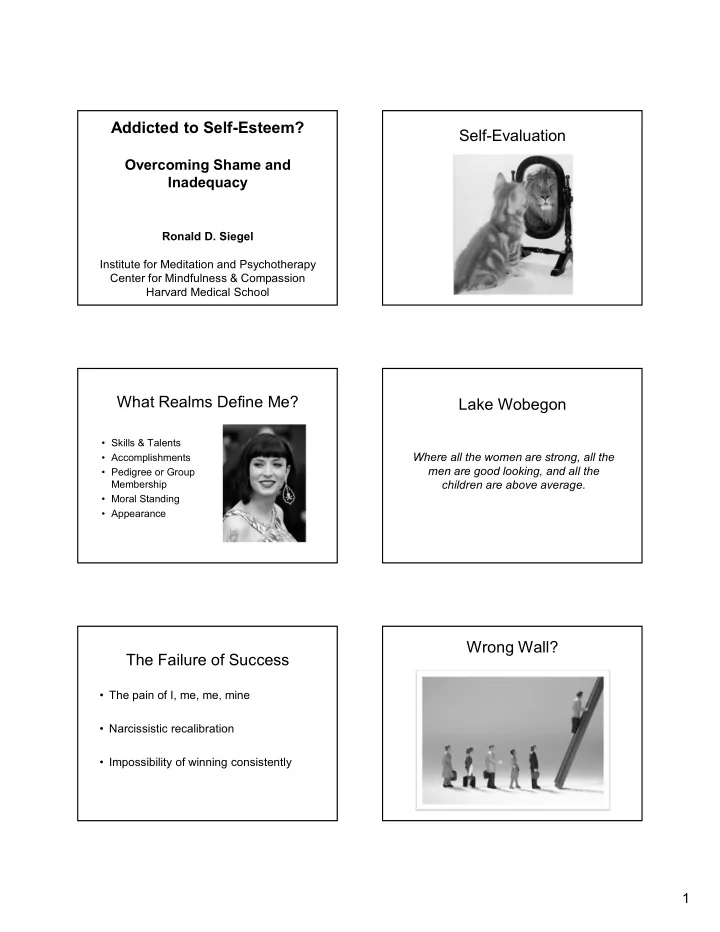
Addicted to Self-Esteem? Self-Evaluation Overcoming Shame and Inadequacy Ronald D. Siegel Institute for Meditation and Psychotherapy Center for Mindfulness & Compassion Harvard Medical School What Realms Define Me? Lake Wobegon


slide-1
SLIDE 1

1

Addicted to Self-Esteem?

Overcoming Shame and Inadequacy

Ronald D. Siegel Institute for Meditation and Psychotherapy Center for Mindfulness & Compassion Harvard Medical School

Self-Evaluation What Realms Define Me?

  • Skills & Talents
  • Accomplishments
  • Pedigree or Group

Membership

  • Moral Standing
  • Appearance

Lake Wobegon

Where all the women are strong, all the men are good looking, and all the children are above average.

The Failure of Success

  • The pain of I, me, me, mine
  • Narcissistic recalibration
  • Impossibility of winning consistently

Wrong Wall?

slide-2
SLIDE 2

2

Suffering in Isolation

  • If we’re not happy, it’s our fault
  • Failure to buy the right consumer product
  • Inherent weakness
  • Psychiatric diagnostic system can

exacerbate problem

  • Only sick people experience pain

It’s Getting Worse Narcissistic Personality Inventory

  • I just want to be reasonably happy
  • I want to amount to something in the eyes of the world
  • If I ruled the world it would be a better place
  • The thought of ruling the world scares the hell out of me
  • I am much like everybody else
  • I am an extraordinary person
  • I always know what I’m doing
  • Sometimes I’m not sure of what I’m doing

Egos Inflating Over Time: A Cross‐Temporal Meta‐Analysis of the Narcissistic Personality Inventory

Journal of Personality, Volume 76, Issue 4

Pathways to Freedom

Three Marks of Existence

  • Anicca

(impermanence)

  • Dukkha

(unsatisfactoriness)

  • Anatta (no enduring,

separate self)

slide-3
SLIDE 3

3

Anatta

Therapeutic Benefits of Glimpsing Anatta

  • 1. Increased affect tolerance
  • 2. Radical acceptance of parts
  • 3. Freedom from self-esteem concerns
  • 4. Deeper connection to others

Thinking Homunculus? Default Mode Network Who Am I?

  • Two types of self-reference
  • Narrative focus (NF)
  • Enduring traits
  • Talking to ourselves about ourselves
  • Experiential focus (EF)
  • Moment-to-moment

experience

  • The mind-body in action
slide-4
SLIDE 4

4

Medial Prefrontal Cortex (mPFC)

  • Links subjective

experiences across time

  • Holds memory of
  • Self traits
  • Traits of similar
  • thers
  • Reflected self-

knowledge

  • Future aspirations

The Study

  • Half of subjects engaged in 8 week MBSR

course, half on wait list

  • All trained in narrative focus (NF) and

experiential focus (EF) modes of responding to adjectives

  • All asked to do each approach while in fMRI

scanner

The Results

  • In novices, experiential focus (EF) reduced

self-referential activity in medial prefrontal cortex (mPFC)

  • In MBSR participants, EF resulted in more

marked and pervasive reduced activity in mPFC, along with increased engagement in several other areas

The Conclusion

  • There is a fundamental neural dissociation

between two forms of self-awareness:

  • The self across time
  • The unfolding of moment-to-moment experience in

the present moment

  • Mindfulness practice enables us to see these

as separate

  • To see how the separate “self” is created out of a

narrative

To study Buddhism is to study the self. To study the self is to forget the self. To forget the self is to be enlightened by all things. To be enlightened by all things is to be free from attachment to the body and mind of

  • ne's self and of others.
  • - Dogen 13th Century

No one Home

  • Continuous flow of

moment-to-moment experience

  • New “self” born and

dies each moment

  • Not even a stable

witness

  • Just impersonal

experience unfolding

slide-5
SLIDE 5

5

Copernicus of the Mind

  • Identity is recreated

moment by moment

  • Continuity of self is

illusory

  • Like frames of a

movie

A human being is part of the whole called by us universe ... We experience ourselves, our thoughts and feelings as something separate from the rest. A kind of optical delusion of

  • consciousness. This delusion is a kind of prison

for us, restricting us to our personal desires and to affection for a few persons nearest to us. Our task must be to free ourselves from the prison by widening our circle of compassion to embrace all living creatures and the whole of nature in its

  • beauty. The true value of a human being is

determined by the measure and the sense in which they have obtained liberation from the self.

1) Affect Tolerance

And I, Sir, Can Be Run Through with a Sword Selfing & Affect Tolerance

  • Not “my,” but “the”
  • Anger
  • Sadness
  • Fear
  • Joy
  • Lust

2) Acceptance of Parts

slide-6
SLIDE 6

6

Our Polytheistic Mind How Was Your Meditation?

  • Part trying to attend to

the breath

  • Part fantasizing about

the future

  • Part judging myself
  • Ask the committee!

Jung’s Shadow

  • We identify with some

parts while rejecting

  • thers
  • We become defensive

when shadow is illuminated

We’re all Bozos on this Bus

  • Dandelions in a field
  • Not a path to perfection, but a path to

wholeness

  • Boundary of what we can accept in
  • urselves is the boundary of our

freedom

– Zen Patriarch

Celebrating Ordinariness

He’s just an ordinary kid.

  • - Barry Magid (Ordinary Mind)
slide-7
SLIDE 7

7

Self-Esteem Autobiography

I get my money from Mommy.

Safe Social Connection

Love Self-Esteem “Do unto others as you would have them do unto you”

It’s not just a commandment, but a law of nature.

slide-8
SLIDE 8

8

Judgments

Make a connection, not an impression.

It’s About Other People Service Relational-Cultural Theory

  • Grew out of feminist critique of conventional

psychology

  • Benefits of mutual connection
  • Energy and vitality
  • Greater capacity to act
  • Increased clarity
  • Enhanced self-worth (efficacy)
  • Desire and capacity for more connection
slide-9
SLIDE 9

9

Three Objects of Awareness

  • Mindfulness of sensations, thoughts,

feelings in “me”

  • Mindfulness of the words, body

language, mood of the other

  • Mindfulness of the flow of relationship

Life in a Space Suit

  • Defenses against

pain insulate us from one another

  • We imagine they

keep us safe, but they leave us more vulnerable

Embracing Insignificance

Poor Prognosis

slide-10
SLIDE 10

10 Wat Tham Sua

Tiger Cave Temple Krabi, Thailand

King of England, 1387 Narcissistic Threats

  • Anxiety often involves threats to us or
  • ur loved ones
  • Self-esteem
  • Health
  • Wealth
  • Fantasized loss of pleasure
  • Anticipated disappointment
slide-11
SLIDE 11

11

Cultivating Compassion

Looking Through Another’s Eyes

How Mindfulness Develops Compassion

  • Compassion for ourselves arises as we
  • pen to our own suffering
  • Compassion for others arises as we see

that everyone else also suffers

  • Compassion arises naturally as we see
  • ur interconnectedness

Condon, Desbordes, & Miller (2013)

Loving-kindness for the Competition When Things Go Wrong

Unholy trinity of

  • Self-criticism
  • Self-isolation
  • Self-absorption
slide-12
SLIDE 12

12

Self-Compassion

  • Self-kindness
  • Common Humanity
  • Mindfulness

Self-Compassionate Letter

  • Describe something that makes you feel

badly about yourself

  • Think of loving, accepting, imaginary

friend

  • Write a letter to yourself from your

friend’s perspective

  • --Kristen Neff

Therapeutic Progress

“mine” about me Not about me “mine” about me Not about me

  • - Adapted from Engler & Fulton

Why Are You Unhappy? Because 99.9% of everything you think, and everything you do, is for yourself. And there isn’t one.

  • - Wei Wu Wei

To Receive Free Chapter & Tailored Meditations

Send a blank email to:

handouts@yahoo.com

Subject line: IMP

For recorded meditations, visit: www.mindfulness-solution.com www.sittingtogether.com email: rsiegel@hms.harvard.edu