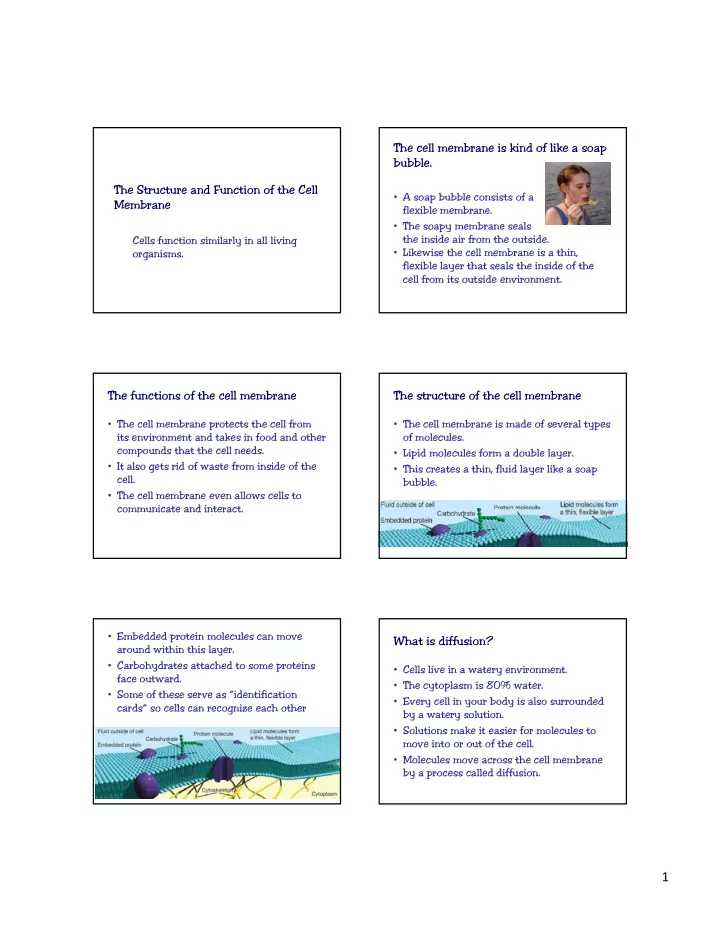
1 How diffusion works in a cell Diffusion is the movement of In - - PDF document

1
SMART_READER_LITE
LIVE PREVIEW

1 How diffusion works in a cell Diffusion is the movement of In - - PDF document

The cell membrane is kind of like a soap bubble. The Structure and Function of the Cell A soap bubble consists of a thin, Membrane flexible membrane. The soapy membrane seals the inside air from the outside. Cells function similarly


slide-1
SLIDE 1

1

The Structure and Function of the Cell Membrane

Cells function similarly in all living

  • rganisms.

The cell membrane is kind of like a soap bubble.

  • A soap bubble consists of a

thin, flexible membrane.

  • The soapy membrane seals

the inside air from the outside.

  • Likewise the cell membrane is a thin,

flexible layer that seals the inside of the cell from its outside environment.

The functions of the cell membrane

  • The cell membrane protects the cell from

its environment and takes in food and other compounds that the cell needs.

  • It also gets rid of waste from inside of the

cell.

  • The cell membrane even allows cells to

communicate and interact.

The structure of the cell membrane

  • The cell membrane is made of several types
  • f molecules.
  • Lipid molecules form a double layer.
  • This creates a thin, fluid layer like a soap

bubble.

  • Embedded protein molecules can move

around within this layer.

  • Carbohydrates attached to some proteins

face outward.

  • Some of these serve as “identification

cards” so cells can recognize each other

What is diffusion?

  • Cells live in a watery environment.
  • The cytoplasm is 80% water.
  • Every cell in your body is also surrounded

by a watery solution.

  • Solutions make it easier for molecules to

move into or out of the cell.

  • Molecules move across the cell membrane

by a process called diffusion.

slide-2
SLIDE 2

2

Diffusion is the movement of molecules from areas of greater concentration to areas of lesser concentration. How diffusion works in a cell

  • In order for diffusion to occur, there must

be an unequal number of molecules on each side of the cell membrane.

If there are more molecules on the outside

  • f the membrane

compared to the inside, the molecules will move to the inside of the cell until there are an equal number of molecules on both sides.

Can you predict what will happen if there are more molecules on the inside of the cell?

Not all molecules can move across the cell membrane by diffusion.

  • You can compare the cell

membrane to a tea bag.

  • Only smaller particles can pass

through the tea bag; larger particles are left inside of the bag.

  • The same is true of the cell membrane.
  • Small molecules like oxygen and carbon

dioxide can pass through.

  • Water molecules are small enough to pass

through the cell membrane by diffusion.

  • Osmosis is the diffusion of water across

the cell membrane.

  • Like other molecules,

water moves from areas

  • f greater concentration
  • f water molecules to

areas of lesser concentration.

slide-3
SLIDE 3

3

Cells take in water by osmosis

  • When you put a cell into a solution, it will

take in water, stay the same, or lose water.

  • What happens depends on the amount of

water in the solution.

  • If the solution outside the cell has more

water molecules than inside the cell, the cell gains water.

  • Water molecules are free to pass across the

cell membrane in both directions, but more water comes into the cell than leaves.

  • The cell swells up.
  • If the solution outside the cell has the same

amount of water molecules as inside the cell, the amount of water inside the cell stays the same.

  • Water crosses the membrane in both

directions, but the amount going in is the same as the amount going out.

  • Thus, the cell stays the same size.
  • If the solution outside the cell has fewer

water molecules than inside the cell, the cell loses water.

  • Again, water crosses the cell membrane in

both directions, but this time more water leaves the cell than enters it.

  • The cell shrinks.

Animal and plant cells

  • If animal cells take in too much water they

can burst.

  • That’s why your cells are surrounded by a

solution that has the same amount of water as inside the cell membrane.

  • Plant cells can take in more water than

animal cells because of their strong cell walls.