1 Management and Restoration of California's Coastal Prairie - - PDF document

1
SMART_READER_LITE
LIVE PREVIEW

1 Management and Restoration of California's Coastal Prairie - - PDF document

Management and Restoration of California's Coastal Prairie Project Objectives To Study the Effects of Rangeland Management Practices on Water Quality and Grassland Diversity, Health, and Productivity. Impacts of Livestock Management


slide-1
SLIDE 1

1

Impacts of Livestock Management Practices on Water Quality and Grasslands in the Morro Bay Watershed

Project Objectives

  • To Study the Effects of Rangeland

Management Practices on Water Quality and Grassland Diversity, Health, and Productivity.

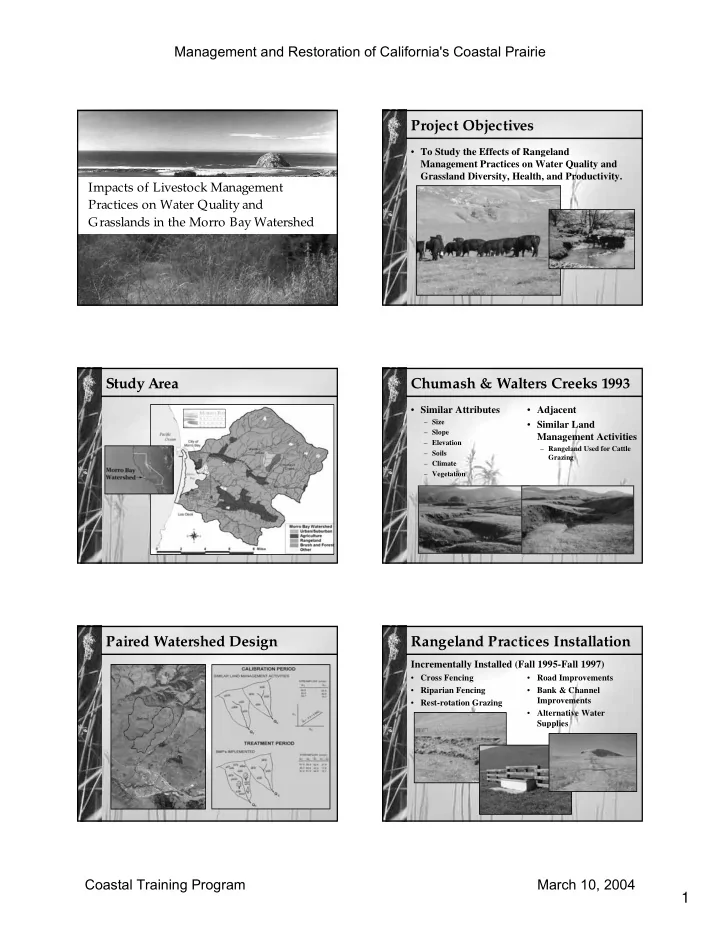
Study Area Chumash & Walters Creeks 1993

  • Similar Attributes

– Size – Slope – Elevation – Soils – Climate – Vegetation

  • Adjacent
  • Similar Land

Management Activities

– Rangeland Used for Cattle Grazing

Paired Watershed Design Rangeland Practices Installation

  • Cross Fencing
  • Riparian Fencing
  • Rest-rotation Grazing
  • Road Improvements
  • Bank & Channel

Improvements

  • Alternative Water

Supplies

Incrementally Installed (Fall 1995-Fall 1997)

Management and Restoration of California's Coastal Prairie Coastal Training Program March 10, 2004
slide-2
SLIDE 2

2 Monitoring

  • Stream Response

– Event-based & Even- Interval Water Quality Samples – Streamflow

  • Grassland Response

– Transects – Residual Dry Matter – Photo Documentation

  • Calibration Period
  • Treatment Period

Project Findings

Findings Introduction

Findings were developed as a guide to interpret statistical results and trends in the data. These findings address both water quality and vegetation:

  • Stream Flow
  • Sediment and Turbidity
  • Vegetation Species Composition
  • Surface Cover
  • Vegetation Type
  • Vegetation Life Cycle/Duration
  • Specific Species
  • Residual Dry Matter

Findings – Water Quality

Chumash Peak Storm Flow Lagged Behind Walters

Especially in Fall/Early Winter Due to Increase in Vegetation

Stream Flow

Findings – Water Quality

Turbidity and Suspended Sediment Were Reduced as a Result of BMP Implementation in Chumash

2000 1000 1

  • 1

day dlogsed

Turbidity & Sediment dlogsed=differences between log sediment means for Chumash and Walters

Findings Water Quality

  • Chumash was more resilient to high

rainfall, producing a later response to significant events.

  • Temperature was decreased in Chumash.
  • Rangeland practices decreased sediment

load and turbidity.

Overall Findings

Findings – Vegetation

Composition of Ecologically Desirable and Undesirable Vegetation Chumash and Walters Subwatersheds

50 100 150 200 250 300 1994 1995 1996 1997 1998 1999 2000 2001 2002

Year Total Count

5 10 15 20 25 30 35 40 45

Precipitation in Inches

Desirable Chumash Desirable Walters Undesirable Chumash Undesirable Walters Precipitation Linear (Undesirable Walters) Linear (Undesirable Chumash) Linear (Desirable Chumash) Linear (Desirable Walters)

Undesirables Decreased in Both Desirables Increased at a Faster Rate in Chumash Species Composition

Management and Restoration of California's Coastal Prairie Coastal Training Program March 10, 2004

slide-3
SLIDE 3

3 Findings - Vegetation

Surface Cover Chumash and Walters Subwatersheds

50 100 150 200 250 300 1994 1995 1996 1997 1998 1999 2000 2001 2002

Year Total Count

5 10 15 20 25 30 35 40 45

Precipitation in Inches

Bare Ground Chumsh Bare Ground Walters Vegetation Chumash Vegetation Walters Precipitation Linear (Bare Ground Chumsh) Linear (Bare Ground Walters) Linear (Vegetation Chumash) Linear (Vegetation Walters)

Bare Ground Increased In Walters Bare Ground Trends Have Remained Relatively Steady for Chumash Surface Cover

Findings – Vegetation

5 10 15 20 25 1994 1995 1996 1997 1998 1999 2000 Spring % Bare ground, Walters % Bare ground, Chumash

Another Way to Look at Bare Ground

Surface Cover

Pasture in Walters

Surface Cover

Findings – Vegetation Findings – Vegetation

Riparian Pasture in Chumash Following Installation

Surface Cover

Findings – Vegetation

Growth Habit of Vegetation Chumash and Walters Subwatersheds

50 100 150 200 250 300 1994 1995 1996 1997 1998 1999 2000 2001 2002

Year Total Count

5 10 15 20 25 30 35 40 45

Precipitation in Inches

Forb Chumash Forb Walters Grass Chumash Grass Walters Precipitation Linear (Grass Walters) Linear (Grass Chumash) Linear (Forb Walters) Linear (Forb Chumash)

Forbs Increased at a Faster Rate in Chumash Annual Grasses Decreased at a Faster Rate in Chumash Vegetation Type

Findings – Vegetation

Life Cycle Vegetation Types Chumash and Walters Subwatersheds

50 100 150 200 250 300 1994 1995 1996 1997 1998 1999 2000 2001 2002

Year Total Count

5 10 15 20 25 30 35 40 45

Precipitation in Inches

Annual Chumash Annual Walters Perennial Chumash Perennial Walters Precipitation Linear (Perennial Chumash) Linear (Perennial Walters) Linear (Annual Chumash) Linear (Annual Walters)

Perennials Increased at a Faster Rate in Chumash Annuals Decreased for Both Life Cycle/Duration

Management and Restoration of California's Coastal Prairie Coastal Training Program March 10, 2004

slide-4
SLIDE 4

4 Findings – Vegetation

Italian Rye Grass Cover Chumash and Walters Subwatersheds

20 40 60 80 100 120 140 160 1994 1995 1996 1997 1998 1999 2000 2001 2002

Year Total Count

5 10 15 20 25 30 35 40 45

Precipitation in Inches

Annual Italian Rye Grass Chumash Annual Italian Rye Grass Walters Precipitation Linear (Annual Italian Rye Grass Walters) Linear (Annual Italian Rye Grass Chumash)

Italian Rye Grass Increased in Walters Italian Rye Grass Decreased in Chumash Specific Species

Findings – Vegetation

Residual Dry Matter Chumash and Walters Subwatersheds

500 1000 1500 2000 2500 3000 3500 4000 1994 1995 1996 1997 1998 1999 2000 2001 2002

Year Lbs/ Acre

5 10 15 20 25 30 35 40 45

Precipitation in Inches

Residual Dry Matter Chumash Resudual Dry Matter Walters Precipitation Linear (Precipitation) Linear (Residual Dry Matter Chumash) Linear (Resudual Dry Matter Walters)

Residual Dry Matter Decreased at a Faster Rate in Walters Residual Dry Matter

Findings – Vegetation

Overall Findings

Dominate Dominate Grasses Decreased Slight Decrease Residual Dry Matter Increased Decreased Rye Grass Decreased Slight Decrease Annual Species Slight Increase Increase Perennial Species Slight Increase Increased Species Diversity Increased Slight Decrease Bare Ground Slight Increase Increased Desirable Species Walters Chumash

Riparian Zone

Walters Chumash

Conclusion

This System of Rangeland Management Practices Improved Water Quality and Enhanced Grassland Health, Diversity, and Productivity.

Rest-rotation Grazing Road Improvements Riparian Pastures Cross Fencing Alternative Water Supplies Bank & Channel Improvements

Questions?

Management and Restoration of California's Coastal Prairie Coastal Training Program March 10, 2004