Wigner Measures and Effective Mass Theorems Victor Chabu 1 , Clotilde - - PowerPoint PPT Presentation

wigner measures and effective mass theorems
SMART_READER_LITE
LIVE PREVIEW

Wigner Measures and Effective Mass Theorems Victor Chabu 1 , Clotilde - - PowerPoint PPT Presentation

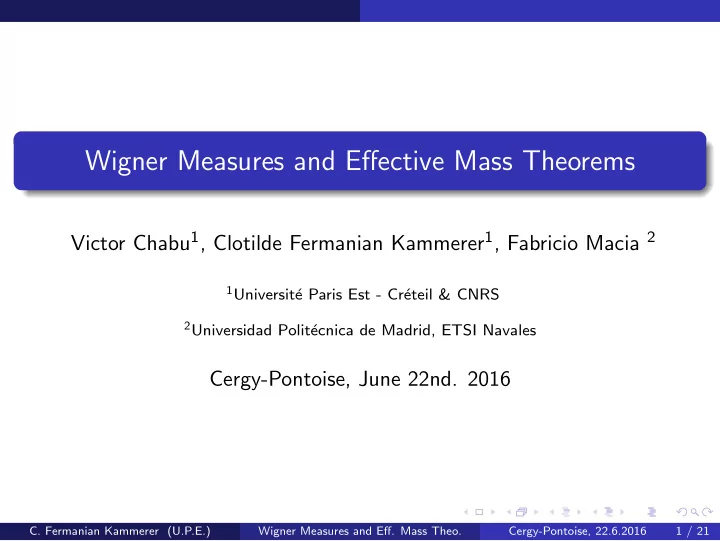
Wigner Measures and Effective Mass Theorems Victor Chabu 1 , Clotilde Fermanian Kammerer 1 , Fabricio Macia 2 1 Universit e Paris Est - Cr eteil & CNRS 2 Universidad Polit ecnica de Madrid, ETSI Navales Cergy-Pontoise, June 22nd. 2016


slide-1
SLIDE 1

Wigner Measures and Effective Mass Theorems

Victor Chabu1, Clotilde Fermanian Kammerer1, Fabricio Macia 2

1Universit´

e Paris Est - Cr´ eteil & CNRS

2Universidad Polit´

ecnica de Madrid, ETSI Navales

Cergy-Pontoise, June 22nd. 2016

  • C. Fermanian Kammerer (U.P.E.)

Wigner Measures and Eff. Mass Theo. Cergy-Pontoise, 22.6.2016 1 / 21

slide-2
SLIDE 2

Content:

1 Schr¨

  • dinger Equation in a Lattice

2 Floquet-Bloch theory 3 Quantifying the lack of dispersion 4 Strategy of the proof 5 Back to Effective Mass Theory

  • C. Fermanian Kammerer (U.P.E.)

Wigner Measures and Eff. Mass Theo. Cergy-Pontoise, 22.6.2016 2 / 21

slide-3
SLIDE 3

Schr¨

  • dinger Equation in a Lattice : The equation

The equation: i∂tΨ + 2 2m∆xΨ − Qper (x) Ψ − Qext(x)Ψ = 0, (t, x) ∈ R × Rd, Ψ|t=0 = Ψ0 ∈ L2(Rd), where Qper is a potential periodic with respect to a lattice Γ = Zd. Let ε be the ratio between the mean spacing of the lattice and the characteristic length scale of variation of Qext. ε ≪ 1. = ⇒ Change of units and rescaling the external potential and the wave function ! (see [Poupaud & Ringhofer 96]).

  • C. Fermanian Kammerer (U.P.E.)

Wigner Measures and Eff. Mass Theo. Cergy-Pontoise, 22.6.2016 3 / 21

slide-4
SLIDE 4

Schr¨

  • dinger Equation in a Lattice : The equation

The equation: i∂tΨ + 2 2m∆xΨ − Qper (x) Ψ − Qext(x)Ψ = 0, (t, x) ∈ R × Rd, Ψ|t=0 = Ψ0 ∈ L2(Rd), where Qper is a potential periodic with respect to a lattice Γ = Zd. Let ε be the ratio between the mean spacing of the lattice and the characteristic length scale of variation of Qext. ε ≪ 1. = ⇒ Change of units and rescaling the external potential and the wave function ! (see [Poupaud & Ringhofer 96]).

  • C. Fermanian Kammerer (U.P.E.)

Wigner Measures and Eff. Mass Theo. Cergy-Pontoise, 22.6.2016 3 / 21

slide-5
SLIDE 5

Schr¨

  • dinger Equation in a Lattice : The scaled equation

The equation: i∂tψε + 1 2∆xψε − 1 ε2 Vper x ε

  • ψε − V (x)ψε = 0, (t, x) ∈ R × Rd,

ψε

|t=0 = ψε 0 ∈ L2(Rd),

where Vper is a potential periodic with respect to Zd. Question: Effective Mass Theory consists in showing situations where ψε(t) can be approximated by the solution of a Effective Mass Equation: i∂tφ(t, x) + 1 2M Dx, Dxφ(t, x) − V (x)φ(t, x) = 0. M is a d × d matrix called the effective mass tensor.

  • C. Fermanian Kammerer (U.P.E.)

Wigner Measures and Eff. Mass Theo. Cergy-Pontoise, 22.6.2016 4 / 21

slide-6
SLIDE 6

Schr¨

  • dinger Equation in a Lattice : The scaled equation

The equation: i∂tψε + 1 2∆xψε − 1 ε2 Vper x ε

  • ψε − V (x)ψε = 0, (t, x) ∈ R × Rd,

ψε

|t=0 = ψε 0 ∈ L2(Rd),

where Vper is a potential periodic with respect to Zd. Question: Effective Mass Theory consists in showing situations where ψε(t) can be approximated by the solution of a Effective Mass Equation: i∂tφ(t, x) + 1 2M Dx, Dxφ(t, x) − V (x)φ(t, x) = 0. M is a d × d matrix called the effective mass tensor.

  • C. Fermanian Kammerer (U.P.E.)

Wigner Measures and Eff. Mass Theo. Cergy-Pontoise, 22.6.2016 4 / 21

slide-7
SLIDE 7

Schr¨

  • dinger Equation in a Lattice : Our purpose

The two main questions of the literature : Finding initial conditions for which the previous analysis holds, Finding the corresponding M.

[Bensoussan, Lions & Papanicolaou 78], [Poupaud & Ringhofer 96], [Allaire & Piatniski 05], [Hoefer &Weinstein 11], [Barletti & Ben Abdallah 11].

= ⇒ Our purpose : Getting rid of assumptions on the initial conditions, Clarifying the dependence of M on the parameter of the equation.

  • C. Fermanian Kammerer (U.P.E.)

Wigner Measures and Eff. Mass Theo. Cergy-Pontoise, 22.6.2016 5 / 21

slide-8
SLIDE 8

Schr¨

  • dinger Equation in a Lattice : Our purpose

The two main questions of the literature : Finding initial conditions for which the previous analysis holds, Finding the corresponding M.

[Bensoussan, Lions & Papanicolaou 78], [Poupaud & Ringhofer 96], [Allaire & Piatniski 05], [Hoefer &Weinstein 11], [Barletti & Ben Abdallah 11].

= ⇒ Our purpose : Getting rid of assumptions on the initial conditions, Clarifying the dependence of M on the parameter of the equation.

  • C. Fermanian Kammerer (U.P.E.)

Wigner Measures and Eff. Mass Theo. Cergy-Pontoise, 22.6.2016 5 / 21

slide-9
SLIDE 9

Schr¨

  • dinger Equation in a Lattice : our strategy

Remark If v ε solves the semiclassical Schr¨

  • dinger equation

iε∂tv ε + ε2 2 ∆xv ε − Vper x ε

  • v ε − ε2V (x)v ε = 0, v ε|t=0 = ψε

0.

Then, ψε(t, x) = v ε t ε, x

  • .

[G´ erard], [GMMP] [Poupaud & Ringhofer], [Bechouche, Mauser & Poupaud], [Spohn & Teufel] [Panati, Spohn &Teufel], [Dimassi, Guillot & Ralston] [Allaire &Palombaro] [Carles &Sparber]

= ⇒ Perform simultaneously the s.c. limit ε → 0 with the limit t/ε → +∞.

[Macia and his collaborators Anantharaman, L´ eautaud, Rivi` ere & C.F.K.] (without periodic potential).

Our goal : apply this viewpoint to effective mass theory. = ⇒ a generalized effective mass equation of Heisenberg type.

  • C. Fermanian Kammerer (U.P.E.)

Wigner Measures and Eff. Mass Theo. Cergy-Pontoise, 22.6.2016 6 / 21

slide-10
SLIDE 10

Schr¨

  • dinger Equation in a Lattice : our strategy

Remark If v ε solves the semiclassical Schr¨

  • dinger equation

iε∂tv ε + ε2 2 ∆xv ε − Vper x ε

  • v ε − ε2V (x)v ε = 0, v ε|t=0 = ψε

0.

Then, ψε(t, x) = v ε t ε, x

  • .

[G´ erard], [GMMP] [Poupaud & Ringhofer], [Bechouche, Mauser & Poupaud], [Spohn & Teufel] [Panati, Spohn &Teufel], [Dimassi, Guillot & Ralston] [Allaire &Palombaro] [Carles &Sparber]

= ⇒ Perform simultaneously the s.c. limit ε → 0 with the limit t/ε → +∞.

[Macia and his collaborators Anantharaman, L´ eautaud, Rivi` ere & C.F.K.] (without periodic potential).

Our goal : apply this viewpoint to effective mass theory. = ⇒ a generalized effective mass equation of Heisenberg type.

  • C. Fermanian Kammerer (U.P.E.)

Wigner Measures and Eff. Mass Theo. Cergy-Pontoise, 22.6.2016 6 / 21

slide-11
SLIDE 11

Schr¨

  • dinger Equation in a Lattice : our strategy

Remark If v ε solves the semiclassical Schr¨

  • dinger equation

iε∂tv ε + ε2 2 ∆xv ε − Vper x ε

  • v ε − ε2V (x)v ε = 0, v ε|t=0 = ψε

0.

Then, ψε(t, x) = v ε t ε, x

  • .

[G´ erard], [GMMP] [Poupaud & Ringhofer], [Bechouche, Mauser & Poupaud], [Spohn & Teufel] [Panati, Spohn &Teufel], [Dimassi, Guillot & Ralston] [Allaire &Palombaro] [Carles &Sparber]

= ⇒ Perform simultaneously the s.c. limit ε → 0 with the limit t/ε → +∞.

[Macia and his collaborators Anantharaman, L´ eautaud, Rivi` ere & C.F.K.] (without periodic potential).

Our goal : apply this viewpoint to effective mass theory. = ⇒ a generalized effective mass equation of Heisenberg type.

  • C. Fermanian Kammerer (U.P.E.)

Wigner Measures and Eff. Mass Theo. Cergy-Pontoise, 22.6.2016 6 / 21

slide-12
SLIDE 12

Floquet-Bloch theory : Bloch waves and energies

We use the Ansatz : ψε(t, x) = Uε t, x, x ε

  • , where Uε(t, x, y) is assumed

to be Zd-periodic in y and solves iε2∂tUε(t, x, y) = P(εD)Uε(t, x, y) + ε2V (x)Uε(t, x, y), Uε|t=0 = ψε where P(ξ) = 1 2 (ξ + Dy)2 + VΓ(y), y ∈ Td := Rd\Zd. The Bloch energies are the eigenvalues of the self-adjoint operator on the torus P(ξ) : λ1(ξ) ≤ λ2(ξ) ≤ · · · ≤ λn(ξ) → +∞. They are 2πZd periodic and smooth in domain where they are of constant multiplicity. The Bloch waves are the orthonormal eigenfunctions of P(ξ) P(ξ)ϕn(ξ, y) = λn(ξ)ϕn(ξ, y), n ∈ N, y ∈ T2, ∀ξ ∈ Rd.

  • C. Fermanian Kammerer (U.P.E.)

Wigner Measures and Eff. Mass Theo. Cergy-Pontoise, 22.6.2016 7 / 21

slide-13
SLIDE 13

Floquet-Bloch theory : Bloch waves and energies

We use the Ansatz : ψε(t, x) = Uε t, x, x ε

  • , where Uε(t, x, y) is assumed

to be Zd-periodic in y and solves iε2∂tUε(t, x, y) = P(εD)Uε(t, x, y) + ε2V (x)Uε(t, x, y), Uε|t=0 = ψε where P(ξ) = 1 2 (ξ + Dy)2 + VΓ(y), y ∈ Td := Rd\Zd. The Bloch energies are the eigenvalues of the self-adjoint operator on the torus P(ξ) : λ1(ξ) ≤ λ2(ξ) ≤ · · · ≤ λn(ξ) → +∞. They are 2πZd periodic and smooth in domain where they are of constant multiplicity. The Bloch waves are the orthonormal eigenfunctions of P(ξ) P(ξ)ϕn(ξ, y) = λn(ξ)ϕn(ξ, y), n ∈ N, y ∈ T2, ∀ξ ∈ Rd.

  • C. Fermanian Kammerer (U.P.E.)

Wigner Measures and Eff. Mass Theo. Cergy-Pontoise, 22.6.2016 7 / 21

slide-14
SLIDE 14

Floquet-Bloch theory : Bloch waves and energies

We use the Ansatz : ψε(t, x) = Uε t, x, x ε

  • , where Uε(t, x, y) is assumed

to be Zd-periodic in y and solves iε2∂tUε(t, x, y) = P(εD)Uε(t, x, y) + ε2V (x)Uε(t, x, y), Uε|t=0 = ψε where P(ξ) = 1 2 (ξ + Dy)2 + VΓ(y), y ∈ Td := Rd\Zd. The Bloch energies are the eigenvalues of the self-adjoint operator on the torus P(ξ) : λ1(ξ) ≤ λ2(ξ) ≤ · · · ≤ λn(ξ) → +∞. They are 2πZd periodic and smooth in domain where they are of constant multiplicity. The Bloch waves are the orthonormal eigenfunctions of P(ξ) P(ξ)ϕn(ξ, y) = λn(ξ)ϕn(ξ, y), n ∈ N, y ∈ T2, ∀ξ ∈ Rd.

  • C. Fermanian Kammerer (U.P.E.)

Wigner Measures and Eff. Mass Theo. Cergy-Pontoise, 22.6.2016 7 / 21

slide-15
SLIDE 15

Floquet Bloch theory : Bloch decomposition

Consider (Πn(ξ))n∈N a family of projectors on separated Bloch bands and Uε

n(t, x, y) := Πn(εDx)Uε(t, x, y) =

  • Rd×Rd Πn(εξ)Uε(t, w, y)eiξ·(x−w) dwdξ

(2π)d dy so that Uε(t, x, y) =

  • n∈N

n(t, x, y).

This construction leads to the following representation formula for the solution of the Schr¨

  • dinger equation

ψε(t, x) =

  • n∈N

n

  • t, x, x

ε

  • .

If Rk Πn(ξ) = 1, Range Πn(ξ) = Vect ϕn(ξ, ·), P(ξ)ϕn(ξ) = λn(ξ)ϕn(ξ), Uε

n(t, x, y) = ϕn(εD, y)uε n(t, x) + O(ε|t|),

where uε

n solves

iε2∂tuε

n = λn(εDx)uε n + ε2V (x)uε n, uε n|t=0 = uε n,0.

  • C. Fermanian Kammerer (U.P.E.)

Wigner Measures and Eff. Mass Theo. Cergy-Pontoise, 22.6.2016 8 / 21

slide-16
SLIDE 16

Floquet Bloch theory : Bloch decomposition

Consider (Πn(ξ))n∈N a family of projectors on separated Bloch bands and Uε

n(t, x, y) := Πn(εDx)Uε(t, x, y) =

  • Rd×Rd Πn(εξ)Uε(t, w, y)eiξ·(x−w) dwdξ

(2π)d dy so that Uε(t, x, y) =

  • n∈N

n(t, x, y).

This construction leads to the following representation formula for the solution of the Schr¨

  • dinger equation

ψε(t, x) =

  • n∈N

n

  • t, x, x

ε

  • .

If Rk Πn(ξ) = 1, Range Πn(ξ) = Vect ϕn(ξ, ·), P(ξ)ϕn(ξ) = λn(ξ)ϕn(ξ), Uε

n(t, x, y) = ϕn(εD, y)uε n(t, x) + O(ε|t|),

where uε

n solves

iε2∂tuε

n = λn(εDx)uε n + ε2V (x)uε n, uε n|t=0 = uε n,0.

  • C. Fermanian Kammerer (U.P.E.)

Wigner Measures and Eff. Mass Theo. Cergy-Pontoise, 22.6.2016 8 / 21

slide-17
SLIDE 17

Floquet Bloch theory : Bloch decomposition

Consider (Πn(ξ))n∈N a family of projectors on separated Bloch bands and Uε

n(t, x, y) := Πn(εDx)Uε(t, x, y) =

  • Rd×Rd Πn(εξ)Uε(t, w, y)eiξ·(x−w) dwdξ

(2π)d dy so that Uε(t, x, y) =

  • n∈N

n(t, x, y).

This construction leads to the following representation formula for the solution of the Schr¨

  • dinger equation

ψε(t, x) =

  • n∈N

n

  • t, x, x

ε

  • .

If Rk Πn(ξ) = 1, Range Πn(ξ) = Vect ϕn(ξ, ·), P(ξ)ϕn(ξ) = λn(ξ)ϕn(ξ), Uε

n(t, x, y) = ϕn(εD, y)uε n(t, x) + O(ε|t|),

where uε

n solves

iε2∂tuε

n = λn(εDx)uε n + ε2V (x)uε n, uε n|t=0 = uε n,0.

  • C. Fermanian Kammerer (U.P.E.)

Wigner Measures and Eff. Mass Theo. Cergy-Pontoise, 22.6.2016 8 / 21

slide-18
SLIDE 18

Quantifying the lack of dispersion : a more general question

Consider equations of the form

  • iε2∂tuε(t, x) = λ(εDx)uε(t, x) + ε2V (x)uε(t, x),

(t, x) ∈ R × Rd, uε|t=0 = uε

0.

(1) This equation ceases to be dispersive as soon as λ(ξ) has critical points ξ = 0, and this is always the case if λ is a Bloch energy. Heuristically, dispersive time-evolution = ⇒ smoothing effect i.e. regularization of the high-frequency effects developed by the initial data.

[Kato 83], [Sj¨

  • lin 87], [Vega 88], [Constantin & Saut 88], [Kenig, Ponce & Vega 91], [Ben Artzi & Devinatz 91].

We show that, in the presence of critical points of λ, some of the high-frequency effects developed by the sequence of initial data persist after applying the time evolution.

  • C. Fermanian Kammerer (U.P.E.)

Wigner Measures and Eff. Mass Theo. Cergy-Pontoise, 22.6.2016 9 / 21

slide-19
SLIDE 19

Quantifying the lack of dispersion : a more general question

Consider equations of the form

  • iε2∂tuε(t, x) = λ(εDx)uε(t, x) + ε2V (x)uε(t, x),

(t, x) ∈ R × Rd, uε|t=0 = uε

0.

(1) This equation ceases to be dispersive as soon as λ(ξ) has critical points ξ = 0, and this is always the case if λ is a Bloch energy. Heuristically, dispersive time-evolution = ⇒ smoothing effect i.e. regularization of the high-frequency effects developed by the initial data.

[Kato 83], [Sj¨

  • lin 87], [Vega 88], [Constantin & Saut 88], [Kenig, Ponce & Vega 91], [Ben Artzi & Devinatz 91].

We show that, in the presence of critical points of λ, some of the high-frequency effects developed by the sequence of initial data persist after applying the time evolution.

  • C. Fermanian Kammerer (U.P.E.)

Wigner Measures and Eff. Mass Theo. Cergy-Pontoise, 22.6.2016 9 / 21

slide-20
SLIDE 20

Quantifying the lack of dispersion : The assumptions

Assumptions: H0 The sequence (uε

0) is uniformly bounded in L2(Rd) and ε-oscillating :

lim sup

ε→0+

  • |ξ|>R/ε

| uε

0(ξ)|2dξ −

R→+∞ 0.

H1 V ∈ C∞(Rd) and λ ∈ C∞(Rd) grows at most polynomially; i.e. there exist C, N > 0 such that: |λ(ξ)| ≤ C(1 + |ξ|)N, ∀ξ ∈ Rd. H2 The set Λ :=

  • ξ ∈ Rd : ∇λ(ξ) = 0
  • is a submanifold of Rd of codimension

0 < p ≤ d and the Hessian ∇2λ is of maximal rank over Λ. Moreover, each connected component of Λ is compact. Remark If all critical points of λ are non-degenerate, then Λ is a discrete set in Rd. If moreover one has that λ is Zd-periodic, this set is finite modulo Zd.

  • C. Fermanian Kammerer (U.P.E.)

Wigner Measures and Eff. Mass Theo. Cergy-Pontoise, 22.6.2016 10 / 21

slide-21
SLIDE 21

Quantifying the lack of dispersion : The assumptions

Assumptions: H0 The sequence (uε

0) is uniformly bounded in L2(Rd) and ε-oscillating :

lim sup

ε→0+

  • |ξ|>R/ε

| uε

0(ξ)|2dξ −

R→+∞ 0.

H1 V ∈ C∞(Rd) and λ ∈ C∞(Rd) grows at most polynomially; i.e. there exist C, N > 0 such that: |λ(ξ)| ≤ C(1 + |ξ|)N, ∀ξ ∈ Rd. H2 The set Λ :=

  • ξ ∈ Rd : ∇λ(ξ) = 0
  • is a submanifold of Rd of codimension

0 < p ≤ d and the Hessian ∇2λ is of maximal rank over Λ. Moreover, each connected component of Λ is compact. Remark If all critical points of λ are non-degenerate, then Λ is a discrete set in Rd. If moreover one has that λ is Zd-periodic, this set is finite modulo Zd.

  • C. Fermanian Kammerer (U.P.E.)

Wigner Measures and Eff. Mass Theo. Cergy-Pontoise, 22.6.2016 10 / 21

slide-22
SLIDE 22

Quantifying the lack of dispersion : non-degenerate case

Theorem (Obstruction to smoothing effects in presence of critical points) Assume H0 & H1 and that all critical points of λ are non-degenerate. Then there exists a subsequence (uεk

0 ) such that ∀a < b and ∀φ ∈ Cc(Rd) :

lim

k→∞

b

a

  • Rd φ(x)|uεk(t, x)|2dxdt =
  • ξ∈Λ

b

a

  • Rd φ(x)|uξ(t, x)|2dxdt,

where uξ solves the Schr¨

  • dinger equation:

i∂tuξ(t, x) = ∇2λ(ξ)Dx · Dxuξ(t, x) + V (x)uξ(t, x), with initial data uξ|t=0 which is the weak limit in L2(Rd) of

  • e−iξ/εk·xuεk
  • .

If Λ = ∅ then the right-hand side above is equal to zero. Example : If uε

0(x) =

1 εd/4 ρ x − x0 √ε

  • eiξ0/ε·x, then uξ = 0 for all ξ and the

Theorem yields that (uε) converge to zero in L2

loc(R × Rd).

Related work : [Ruzhanski & Sugimoto 16]

  • C. Fermanian Kammerer (U.P.E.)

Wigner Measures and Eff. Mass Theo. Cergy-Pontoise, 22.6.2016 11 / 21

slide-23
SLIDE 23

Quantifying the lack of dispersion : non-degenerate case

Theorem (Obstruction to smoothing effects in presence of critical points) Assume H0 & H1 and that all critical points of λ are non-degenerate. Then there exists a subsequence (uεk

0 ) such that ∀a < b and ∀φ ∈ Cc(Rd) :

lim

k→∞

b

a

  • Rd φ(x)|uεk(t, x)|2dxdt =
  • ξ∈Λ

b

a

  • Rd φ(x)|uξ(t, x)|2dxdt,

where uξ solves the Schr¨

  • dinger equation:

i∂tuξ(t, x) = ∇2λ(ξ)Dx · Dxuξ(t, x) + V (x)uξ(t, x), with initial data uξ|t=0 which is the weak limit in L2(Rd) of

  • e−iξ/εk·xuεk
  • .

If Λ = ∅ then the right-hand side above is equal to zero. Example : If uε

0(x) =

1 εd/4 ρ x − x0 √ε

  • eiξ0/ε·x, then uξ = 0 for all ξ and the

Theorem yields that (uε) converge to zero in L2

loc(R × Rd).

Related work : [Ruzhanski & Sugimoto 16]

  • C. Fermanian Kammerer (U.P.E.)

Wigner Measures and Eff. Mass Theo. Cergy-Pontoise, 22.6.2016 11 / 21

slide-24
SLIDE 24

Quantifying the lack of dispersion : degenerate case

When the non-degeneracy of the critical points is replaced by H2, we obtain a similar result which requires some geometric preliminaries. Define the tangent bundle of Λ as the union of all tangent spaces to Λ, TΛ := {(x, ξ) ∈ Rd × Λ : x ∈ TξΛ}. The normal bundle of Λ is the union of linear subspaces normal to Λ: NΛ := {(y, ξ) ∈ Rd × Λ : y ∈ NξΛ = (TξΛ)⊥}. Every point x ∈ Rd can be uniquely written as x = z + y, where z ∈ TξΛ and y ∈ NξΛ. Given a function φ ∈ L∞(Rd), we write mφ(z, ξ), where z ∈ TξΛ, to denote the operator acting on L2(NξΛ) by multiplication by φ(z + ·). We use the notation ∆E to denote the Laplacian acting on functions defined

  • n a linear subspace E ⊂ Rd.
  • C. Fermanian Kammerer (U.P.E.)

Wigner Measures and Eff. Mass Theo. Cergy-Pontoise, 22.6.2016 12 / 21

slide-25
SLIDE 25

Quantifying the lack of dispersion : degenerate case

When the non-degeneracy of the critical points is replaced by H2, we obtain a similar result which requires some geometric preliminaries. Define the tangent bundle of Λ as the union of all tangent spaces to Λ, TΛ := {(x, ξ) ∈ Rd × Λ : x ∈ TξΛ}. The normal bundle of Λ is the union of linear subspaces normal to Λ: NΛ := {(y, ξ) ∈ Rd × Λ : y ∈ NξΛ = (TξΛ)⊥}. Every point x ∈ Rd can be uniquely written as x = z + y, where z ∈ TξΛ and y ∈ NξΛ. Given a function φ ∈ L∞(Rd), we write mφ(z, ξ), where z ∈ TξΛ, to denote the operator acting on L2(NξΛ) by multiplication by φ(z + ·). We use the notation ∆E to denote the Laplacian acting on functions defined

  • n a linear subspace E ⊂ Rd.
  • C. Fermanian Kammerer (U.P.E.)

Wigner Measures and Eff. Mass Theo. Cergy-Pontoise, 22.6.2016 12 / 21

slide-26
SLIDE 26

Quantifying the lack of dispersion : degenerate case

When the non-degeneracy of the critical points is replaced by H2, we obtain a similar result which requires some geometric preliminaries. Define the tangent bundle of Λ as the union of all tangent spaces to Λ, TΛ := {(x, ξ) ∈ Rd × Λ : x ∈ TξΛ}. The normal bundle of Λ is the union of linear subspaces normal to Λ: NΛ := {(y, ξ) ∈ Rd × Λ : y ∈ NξΛ = (TξΛ)⊥}. Every point x ∈ Rd can be uniquely written as x = z + y, where z ∈ TξΛ and y ∈ NξΛ. Given a function φ ∈ L∞(Rd), we write mφ(z, ξ), where z ∈ TξΛ, to denote the operator acting on L2(NξΛ) by multiplication by φ(z + ·). We use the notation ∆E to denote the Laplacian acting on functions defined

  • n a linear subspace E ⊂ Rd.
  • C. Fermanian Kammerer (U.P.E.)

Wigner Measures and Eff. Mass Theo. Cergy-Pontoise, 22.6.2016 12 / 21

slide-27
SLIDE 27

Quantifying the lack of dispersion : degenerate case

When the non-degeneracy of the critical points is replaced by H2, we obtain a similar result which requires some geometric preliminaries. Define the tangent bundle of Λ as the union of all tangent spaces to Λ, TΛ := {(x, ξ) ∈ Rd × Λ : x ∈ TξΛ}. The normal bundle of Λ is the union of linear subspaces normal to Λ: NΛ := {(y, ξ) ∈ Rd × Λ : y ∈ NξΛ = (TξΛ)⊥}. Every point x ∈ Rd can be uniquely written as x = z + y, where z ∈ TξΛ and y ∈ NξΛ. Given a function φ ∈ L∞(Rd), we write mφ(z, ξ), where z ∈ TξΛ, to denote the operator acting on L2(NξΛ) by multiplication by φ(z + ·). We use the notation ∆E to denote the Laplacian acting on functions defined

  • n a linear subspace E ⊂ Rd.
  • C. Fermanian Kammerer (U.P.E.)

Wigner Measures and Eff. Mass Theo. Cergy-Pontoise, 22.6.2016 12 / 21

slide-28
SLIDE 28

Quantifying the lack of dispersion : degenerate case

When the non-degeneracy of the critical points is replaced by H2, we obtain a similar result which requires some geometric preliminaries. Define the tangent bundle of Λ as the union of all tangent spaces to Λ, TΛ := {(x, ξ) ∈ Rd × Λ : x ∈ TξΛ}. The normal bundle of Λ is the union of linear subspaces normal to Λ: NΛ := {(y, ξ) ∈ Rd × Λ : y ∈ NξΛ = (TξΛ)⊥}. Every point x ∈ Rd can be uniquely written as x = z + y, where z ∈ TξΛ and y ∈ NξΛ. Given a function φ ∈ L∞(Rd), we write mφ(z, ξ), where z ∈ TξΛ, to denote the operator acting on L2(NξΛ) by multiplication by φ(z + ·). We use the notation ∆E to denote the Laplacian acting on functions defined

  • n a linear subspace E ⊂ Rd.
  • C. Fermanian Kammerer (U.P.E.)

Wigner Measures and Eff. Mass Theo. Cergy-Pontoise, 22.6.2016 12 / 21

slide-29
SLIDE 29

Quantifying the lack of dispersion : degenerate case

Theorem Assume H0, H1 & H2. Then there exist a subsequence (uεk

0 ), a positive measure

γ ∈ M+(TΛ) and a measurable fami. of s.-adj., positive, trace-class operators M0 : TξΛ ∋ (z, ξ) − → M0(z, ξ) ∈ L1

+(L2(NξΛ)),

TrL2(NξΛ)M0(z, ξ) = 1, such that for every a < b and every φ ∈ Cc(Rd) one has: lim

k→∞

b

a

  • Rd φ(x)|uεk(t, x)|2dxdt

= b

a

TrL2(NξΛ) [mφ(z, ξ)M(t, z, ξ)] γ(dz, dξ)dt, where M(·, z, ξ) ∈ C(R; L1

+(L2(NξΛ)) solves the following Heisenberg equation:

i∂tM(t, z, ξ) + 1 2∆NξΛ + mV (z, ξ), M(t, z, ξ)

  • = 0,

M|t=0 = M0.

  • C. Fermanian Kammerer (U.P.E.)

Wigner Measures and Eff. Mass Theo. Cergy-Pontoise, 22.6.2016 13 / 21

slide-30
SLIDE 30

Quantifying the lack of dispersions : comments

The measure γ and the family of operators M0(z, ξ), for z ∈ TξΛ, only depend on the subsequence of initial data (uεk

0 ).

When Λ is a set of isolated critical points, both Theorems are equivalent : TΛ = {0} × Λ and γ =

  • ξ∈Λ

γξδξ, where γξ = ||uξ|t=0||2

L2(Rd).

In addition, NξΛ = Rd and M(t, ξ) is the orth. proj. onto uξ(t, ·). A consequence of this Theorem is that the weak-⋆ limit of the densities |uεk|2 is absolutely continuous with respect to the Lebesgue measure dxdt and can be expressed as a superposition of position densities associated to solutions to the family of p-dimensional Schr¨

  • dinger evolutions:

i∂tvz,ξ(t, y) + 1 2∆yvz,ξ(t, y) + V (z + y)vz,ξ(t, y) = 0, (t, y) ∈ R × NξΛ.

  • C. Fermanian Kammerer (U.P.E.)

Wigner Measures and Eff. Mass Theo. Cergy-Pontoise, 22.6.2016 14 / 21

slide-31
SLIDE 31

Quantifying the lack of dispersions : comments

The measure γ and the family of operators M0(z, ξ), for z ∈ TξΛ, only depend on the subsequence of initial data (uεk

0 ).

When Λ is a set of isolated critical points, both Theorems are equivalent : TΛ = {0} × Λ and γ =

  • ξ∈Λ

γξδξ, where γξ = ||uξ|t=0||2

L2(Rd).

In addition, NξΛ = Rd and M(t, ξ) is the orth. proj. onto uξ(t, ·). A consequence of this Theorem is that the weak-⋆ limit of the densities |uεk|2 is absolutely continuous with respect to the Lebesgue measure dxdt and can be expressed as a superposition of position densities associated to solutions to the family of p-dimensional Schr¨

  • dinger evolutions:

i∂tvz,ξ(t, y) + 1 2∆yvz,ξ(t, y) + V (z + y)vz,ξ(t, y) = 0, (t, y) ∈ R × NξΛ.

  • C. Fermanian Kammerer (U.P.E.)

Wigner Measures and Eff. Mass Theo. Cergy-Pontoise, 22.6.2016 14 / 21

slide-32
SLIDE 32

Quantifying the lack of dispersions : comments

The measure γ and the family of operators M0(z, ξ), for z ∈ TξΛ, only depend on the subsequence of initial data (uεk

0 ).

When Λ is a set of isolated critical points, both Theorems are equivalent : TΛ = {0} × Λ and γ =

  • ξ∈Λ

γξδξ, where γξ = ||uξ|t=0||2

L2(Rd).

In addition, NξΛ = Rd and M(t, ξ) is the orth. proj. onto uξ(t, ·). A consequence of this Theorem is that the weak-⋆ limit of the densities |uεk|2 is absolutely continuous with respect to the Lebesgue measure dxdt and can be expressed as a superposition of position densities associated to solutions to the family of p-dimensional Schr¨

  • dinger evolutions:

i∂tvz,ξ(t, y) + 1 2∆yvz,ξ(t, y) + V (z + y)vz,ξ(t, y) = 0, (t, y) ∈ R × NξΛ.

  • C. Fermanian Kammerer (U.P.E.)

Wigner Measures and Eff. Mass Theo. Cergy-Pontoise, 22.6.2016 14 / 21

slide-33
SLIDE 33

Strategy of the proof : phase space analysis

Phase space analysis: Let W (uε) be the Wigner transform of (uε), W ε(t, x, ξ) = (2π)−d

  • Rd uε

t, x + εv 2

t, x − εv 2

  • eiv·ξdv.

The Wigner transform plays the role of a generalised energy density since |uε(t, x)|2 =

  • Rd W ε(t, x, ξ)dξ.

Wigner measures of (uε) are positive measures µ(t) satisfying for some subsequence εk and for all a < b, c ∈ C∞

0 (R2d) ,

lim

k→∞

b

a

  • R2d c(x, ξ)W εk(t, x, ξ)dxdξdt =

b

a

  • R2d c(x, ξ)µ(t, dx, dξ)dt.

Besides, ε-oscillation = ⇒ lim

k→∞

b

a

  • Rd φ(x)|uεk(t, x)|2dxdt =

b

a

  • R2d φ(x)µ(t, dx, dξ)dt.
  • C. Fermanian Kammerer (U.P.E.)

Wigner Measures and Eff. Mass Theo. Cergy-Pontoise, 22.6.2016 15 / 21

slide-34
SLIDE 34

Strategy of the proof : phase space analysis

Phase space analysis: Let W (uε) be the Wigner transform of (uε), W ε(t, x, ξ) = (2π)−d

  • Rd uε

t, x + εv 2

t, x − εv 2

  • eiv·ξdv.

The Wigner transform plays the role of a generalised energy density since |uε(t, x)|2 =

  • Rd W ε(t, x, ξ)dξ.

Wigner measures of (uε) are positive measures µ(t) satisfying for some subsequence εk and for all a < b, c ∈ C∞

0 (R2d) ,

lim

k→∞

b

a

  • R2d c(x, ξ)W εk(t, x, ξ)dxdξdt =

b

a

  • R2d c(x, ξ)µ(t, dx, dξ)dt.

Besides, ε-oscillation = ⇒ lim

k→∞

b

a

  • Rd φ(x)|uεk(t, x)|2dxdt =

b

a

  • R2d φ(x)µ(t, dx, dξ)dt.
  • C. Fermanian Kammerer (U.P.E.)

Wigner Measures and Eff. Mass Theo. Cergy-Pontoise, 22.6.2016 15 / 21

slide-35
SLIDE 35

Strategy of the proof : phase space analysis

Phase space analysis: Let W (uε) be the Wigner transform of (uε), W ε(t, x, ξ) = (2π)−d

  • Rd uε

t, x + εv 2

t, x − εv 2

  • eiv·ξdv.

The Wigner transform plays the role of a generalised energy density since |uε(t, x)|2 =

  • Rd W ε(t, x, ξ)dξ.

Wigner measures of (uε) are positive measures µ(t) satisfying for some subsequence εk and for all a < b, c ∈ C∞

0 (R2d) ,

lim

k→∞

b

a

  • R2d c(x, ξ)W εk(t, x, ξ)dxdξdt =

b

a

  • R2d c(x, ξ)µ(t, dx, dξ)dt.

Besides, ε-oscillation = ⇒ lim

k→∞

b

a

  • Rd φ(x)|uεk(t, x)|2dxdt =

b

a

  • R2d φ(x)µ(t, dx, dξ)dt.
  • C. Fermanian Kammerer (U.P.E.)

Wigner Measures and Eff. Mass Theo. Cergy-Pontoise, 22.6.2016 15 / 21

slide-36
SLIDE 36

Strategy of the proof : phase space analysis

Phase space analysis: Let W (uε) be the Wigner transform of (uε), W ε(t, x, ξ) = (2π)−d

  • Rd uε

t, x + εv 2

t, x − εv 2

  • eiv·ξdv.

The Wigner transform plays the role of a generalised energy density since |uε(t, x)|2 =

  • Rd W ε(t, x, ξ)dξ.

Wigner measures of (uε) are positive measures µ(t) satisfying for some subsequence εk and for all a < b, c ∈ C∞

0 (R2d) ,

lim

k→∞

b

a

  • R2d c(x, ξ)W εk(t, x, ξ)dxdξdt =

b

a

  • R2d c(x, ξ)µ(t, dx, dξ)dt.

Besides, ε-oscillation = ⇒ lim

k→∞

b

a

  • Rd φ(x)|uεk(t, x)|2dxdt =

b

a

  • R2d φ(x)µ(t, dx, dξ)dt.
  • C. Fermanian Kammerer (U.P.E.)

Wigner Measures and Eff. Mass Theo. Cergy-Pontoise, 22.6.2016 15 / 21

slide-37
SLIDE 37

Strategy of the proof : localisation of Wigner measures

Set for χ ∈ C0(R) and c ∈ C∞

0 (R2d) ,

I ε(χ, c) =

  • R
  • R2d χ(t)c(x, ξ)W εk(t, x, ξ)dxdξdt.

Invariance of Wigner measure : Egorov’s theorem = ⇒ Proposition Any µt is invariant by the flow φ1

s : s → (x + s∇λ(ξ), ξ).

Localization of Wigner measures Corollary Supp(µt) ⊂ {(x, ξ) ∈ R2d, ∇λ(ξ) = 0}.

  • C. Fermanian Kammerer (U.P.E.)

Wigner Measures and Eff. Mass Theo. Cergy-Pontoise, 22.6.2016 16 / 21

slide-38
SLIDE 38

Strategy of the proof : localisation of Wigner measures

Set for χ ∈ C0(R) and c ∈ C∞

0 (R2d) ,

I ε(χ, c) =

  • R
  • R2d χ(t)c(x, ξ)W εk(t, x, ξ)dxdξdt.

Invariance of Wigner measure : Egorov’s theorem = ⇒ Proposition Any µt is invariant by the flow φ1

s : s → (x + s∇λ(ξ), ξ).

Localization of Wigner measures Corollary Supp(µt) ⊂ {(x, ξ) ∈ R2d, ∇λ(ξ) = 0}.

  • C. Fermanian Kammerer (U.P.E.)

Wigner Measures and Eff. Mass Theo. Cergy-Pontoise, 22.6.2016 16 / 21

slide-39
SLIDE 39

Strategy of the proof : localisation of Wigner measures

Set for χ ∈ C0(R) and c ∈ C∞

0 (R2d) ,

I ε(χ, c) =

  • R
  • R2d χ(t)c(x, ξ)W εk(t, x, ξ)dxdξdt.

Invariance of Wigner measure : Egorov’s theorem = ⇒ Proposition Any µt is invariant by the flow φ1

s : s → (x + s∇λ(ξ), ξ).

Localization of Wigner measures Corollary Supp(µt) ⊂ {(x, ξ) ∈ R2d, ∇λ(ξ) = 0}.

  • C. Fermanian Kammerer (U.P.E.)

Wigner Measures and Eff. Mass Theo. Cergy-Pontoise, 22.6.2016 16 / 21

slide-40
SLIDE 40

Strategy of the proof : Two scale observables

We add to the phase space R2d a new variable η ∈ Rd.

[CK], [Nier], [Miller], [FFK &G´ erard], [Laser & Teufel], [Harris, Lukkarinen, Teufel& Theil], [Macia], [Anantharaman & Macia]

With c = c(x, ξ, η) ∈ C∞(R3d) satisfying additional properties, which satisfy :

1

there exists a compact K such that for all η ∈ Rd, (x, ξ) → c(x, ξ, η) is a smooth function compactly supported in K;

2

there exists a function c∞(x, ξ, ω) defined on R2d × Sd−1 and R0 > 0 such that if |η| > R0, then c(x, ξ, η) =c∞(x, ξ, η/|η|). Assume Λ = ξ0 + 2πZd. We associate with such c, the two-scale observable c♯

ε(x, ξ) = c

  • x, ξ, ξ − ξ0

ε

  • .

Remarks : 1) If c ∈ C∞

0 (R2d), c is admissible.

2) Wigner transform acts on two-scale observables.

  • C. Fermanian Kammerer (U.P.E.)

Wigner Measures and Eff. Mass Theo. Cergy-Pontoise, 22.6.2016 17 / 21

slide-41
SLIDE 41

Strategy of the proof : Two scale observables

We add to the phase space R2d a new variable η ∈ Rd.

[CK], [Nier], [Miller], [FFK &G´ erard], [Laser & Teufel], [Harris, Lukkarinen, Teufel& Theil], [Macia], [Anantharaman & Macia]

With c = c(x, ξ, η) ∈ C∞(R3d) satisfying additional properties, which satisfy :

1

there exists a compact K such that for all η ∈ Rd, (x, ξ) → c(x, ξ, η) is a smooth function compactly supported in K;

2

there exists a function c∞(x, ξ, ω) defined on R2d × Sd−1 and R0 > 0 such that if |η| > R0, then c(x, ξ, η) =c∞(x, ξ, η/|η|). Assume Λ = ξ0 + 2πZd. We associate with such c, the two-scale observable c♯

ε(x, ξ) = c

  • x, ξ, ξ − ξ0

ε

  • .

Remarks : 1) If c ∈ C∞

0 (R2d), c is admissible.

2) Wigner transform acts on two-scale observables.

  • C. Fermanian Kammerer (U.P.E.)

Wigner Measures and Eff. Mass Theo. Cergy-Pontoise, 22.6.2016 17 / 21

slide-42
SLIDE 42

Strategy of the proof : Two scale observables

We add to the phase space R2d a new variable η ∈ Rd.

[CK], [Nier], [Miller], [FFK &G´ erard], [Laser & Teufel], [Harris, Lukkarinen, Teufel& Theil], [Macia], [Anantharaman & Macia]

With c = c(x, ξ, η) ∈ C∞(R3d) satisfying additional properties, which satisfy :

1

there exists a compact K such that for all η ∈ Rd, (x, ξ) → c(x, ξ, η) is a smooth function compactly supported in K;

2

there exists a function c∞(x, ξ, ω) defined on R2d × Sd−1 and R0 > 0 such that if |η| > R0, then c(x, ξ, η) =c∞(x, ξ, η/|η|). Assume Λ = ξ0 + 2πZd. We associate with such c, the two-scale observable c♯

ε(x, ξ) = c

  • x, ξ, ξ − ξ0

ε

  • .

Remarks : 1) If c ∈ C∞

0 (R2d), c is admissible.

2) Wigner transform acts on two-scale observables.

  • C. Fermanian Kammerer (U.P.E.)

Wigner Measures and Eff. Mass Theo. Cergy-Pontoise, 22.6.2016 17 / 21

slide-43
SLIDE 43

Strategy of the proof : Two scale observables

We add to the phase space R2d a new variable η ∈ Rd.

[CK], [Nier], [Miller], [FFK &G´ erard], [Laser & Teufel], [Harris, Lukkarinen, Teufel& Theil], [Macia], [Anantharaman & Macia]

With c = c(x, ξ, η) ∈ C∞(R3d) satisfying additional properties, which satisfy :

1

there exists a compact K such that for all η ∈ Rd, (x, ξ) → c(x, ξ, η) is a smooth function compactly supported in K;

2

there exists a function c∞(x, ξ, ω) defined on R2d × Sd−1 and R0 > 0 such that if |η| > R0, then c(x, ξ, η) =c∞(x, ξ, η/|η|). Assume Λ = ξ0 + 2πZd. We associate with such c, the two-scale observable c♯

ε(x, ξ) = c

  • x, ξ, ξ − ξ0

ε

  • .

Remarks : 1) If c ∈ C∞

0 (R2d), c is admissible.

2) Wigner transform acts on two-scale observables.

  • C. Fermanian Kammerer (U.P.E.)

Wigner Measures and Eff. Mass Theo. Cergy-Pontoise, 22.6.2016 17 / 21

slide-44
SLIDE 44

Strategy of the proof : Two scale Wigner measures

Theorem There exist, εn − →

n→+∞ 0, ν ∈ L∞(R, M+(Rd × Sd−1)), Φ ∈ C0(R, L2(Rd)) such

that I εn(χ, c♯

εn) −

n→+∞

  • R

χ(t) (a(x, ξ0, D)Φ(t), Φ(t)) dt+

  • R

χ(t)a∞(·, ξ0, ·), νtdt.

1

Φ solves the effective mass equation i∂tΦ = Hess λ(ξ0)D · D Φ + Vext(x)Φ, Φ(0) = Φ0, where Φ0 is a weak limit in L2(Rd) of the sequence x → e

i ε ξ0·xuε

0(x).

2

νt is invariant by the flow φ2

s : (x, ω) → (x + sHess λ(ξ0)ω, ω).

Corollary If Hess λ(ξ0) is non degenerated, then νt = 0 and µt(x, ξ)1ξ=ξ0 = |Φ(t, x)|2dx.

  • C. Fermanian Kammerer (U.P.E.)

Wigner Measures and Eff. Mass Theo. Cergy-Pontoise, 22.6.2016 18 / 21

slide-45
SLIDE 45

Strategy of the proof : Two scale Wigner measures

Theorem There exist, εn − →

n→+∞ 0, ν ∈ L∞(R, M+(Rd × Sd−1)), Φ ∈ C0(R, L2(Rd)) such

that I εn(χ, c♯

εn) −

n→+∞

  • R

χ(t) (a(x, ξ0, D)Φ(t), Φ(t)) dt+

  • R

χ(t)a∞(·, ξ0, ·), νtdt.

1

Φ solves the effective mass equation i∂tΦ = Hess λ(ξ0)D · D Φ + Vext(x)Φ, Φ(0) = Φ0, where Φ0 is a weak limit in L2(Rd) of the sequence x → e

i ε ξ0·xuε

0(x).

2

νt is invariant by the flow φ2

s : (x, ω) → (x + sHess λ(ξ0)ω, ω).

Corollary If Hess λ(ξ0) is non degenerated, then νt = 0 and µt(x, ξ)1ξ=ξ0 = |Φ(t, x)|2dx.

  • C. Fermanian Kammerer (U.P.E.)

Wigner Measures and Eff. Mass Theo. Cergy-Pontoise, 22.6.2016 18 / 21

slide-46
SLIDE 46

Back to effective mass theory : assumptions on the initial data

Let I ⊂ N, a set of indices n such that the multiplicity of the Bloch energy λn(ξ) is constant for every ξ ∈ Rd Assume that H2 holds for any λn, n ∈ I Assume that ψε

0 is ε-oscillating and

ψε

0 =

  • n∈I

ψε

n,0, ψε n,0 = Uε n

  • 0, x, x

ε

  • ,

where Uε

n(0, ξ) is in the eigenspace of λn(ξ).

  • C. Fermanian Kammerer (U.P.E.)

Wigner Measures and Eff. Mass Theo. Cergy-Pontoise, 22.6.2016 19 / 21

slide-47
SLIDE 47

Back to effective mass theory : application of the Theorem

Then, if (ψε) is the solution to the Schr¨

  • dinger equation issued for data (ψε

0),

For every φ ∈ C∞

0 (Rd), the family (φψε(t)) is ε-oscillating.

ψε(t, x) =

  • n∈I

ψε

n(t, x) with ψε n(t, x) = Uε n

  • t, x, x

ε

  • , For each n ∈ N,

iε2∂tψε

n(t, x) = λn(εDx)ψε n(t, x) + ε2V (x)ψε n(t, x) + ε2f ε n (t, x),

||f ε

n (t, ·)||L2(Rd) ≤ Cε,

t ∈ R, . There exist a subsequence εk such that, for every a < b, φ ∈ C∞

0 (Rd),

lim

k→∞

b

a

  • Rd φ(x)|ψε(t, x)|2dxdt =
  • n∈I

b

a

  • Rd |φ(x)|2µn

t (dx)dt,

where, for each n ∈ N, the measures µn

t ∈ M+(Rd × Rd) are Wigner

measures of (ψε

n).

  • C. Fermanian Kammerer (U.P.E.)

Wigner Measures and Eff. Mass Theo. Cergy-Pontoise, 22.6.2016 20 / 21

slide-48
SLIDE 48

Conclusion

Second microlocalisation along Λ has led to a complete description of the mechanism for any (ε-oscillating) initial data. In non standard cases (when Λ is a submanifold with H2), we have introduced a generalized effective mass equation with an operator-valued macroscopic item satisfying a Heisenberg equation (instead of a function satisfying a Schr¨

  • dinger equation).

In those non standard cases, the second microlocalisation does not concern “all the variable ξ” and the remaining part is responsible of the quantum feature at macroscopic level in the derived effective mass equation which becomes a Heisenberg equation. The next step should consist in treating a Bloch band containing two eigenvalues presenting a conical intersection (work in progress).

Thank you for your attention !

  • C. Fermanian Kammerer (U.P.E.)

Wigner Measures and Eff. Mass Theo. Cergy-Pontoise, 22.6.2016 21 / 21

slide-49
SLIDE 49

Conclusion

Second microlocalisation along Λ has led to a complete description of the mechanism for any (ε-oscillating) initial data. In non standard cases (when Λ is a submanifold with H2), we have introduced a generalized effective mass equation with an operator-valued macroscopic item satisfying a Heisenberg equation (instead of a function satisfying a Schr¨

  • dinger equation).

In those non standard cases, the second microlocalisation does not concern “all the variable ξ” and the remaining part is responsible of the quantum feature at macroscopic level in the derived effective mass equation which becomes a Heisenberg equation. The next step should consist in treating a Bloch band containing two eigenvalues presenting a conical intersection (work in progress).

Thank you for your attention !

  • C. Fermanian Kammerer (U.P.E.)

Wigner Measures and Eff. Mass Theo. Cergy-Pontoise, 22.6.2016 21 / 21

slide-50
SLIDE 50

Conclusion

Second microlocalisation along Λ has led to a complete description of the mechanism for any (ε-oscillating) initial data. In non standard cases (when Λ is a submanifold with H2), we have introduced a generalized effective mass equation with an operator-valued macroscopic item satisfying a Heisenberg equation (instead of a function satisfying a Schr¨

  • dinger equation).

In those non standard cases, the second microlocalisation does not concern “all the variable ξ” and the remaining part is responsible of the quantum feature at macroscopic level in the derived effective mass equation which becomes a Heisenberg equation. The next step should consist in treating a Bloch band containing two eigenvalues presenting a conical intersection (work in progress).

Thank you for your attention !

  • C. Fermanian Kammerer (U.P.E.)

Wigner Measures and Eff. Mass Theo. Cergy-Pontoise, 22.6.2016 21 / 21

slide-51
SLIDE 51

Conclusion

Second microlocalisation along Λ has led to a complete description of the mechanism for any (ε-oscillating) initial data. In non standard cases (when Λ is a submanifold with H2), we have introduced a generalized effective mass equation with an operator-valued macroscopic item satisfying a Heisenberg equation (instead of a function satisfying a Schr¨

  • dinger equation).

In those non standard cases, the second microlocalisation does not concern “all the variable ξ” and the remaining part is responsible of the quantum feature at macroscopic level in the derived effective mass equation which becomes a Heisenberg equation. The next step should consist in treating a Bloch band containing two eigenvalues presenting a conical intersection (work in progress).

Thank you for your attention !

  • C. Fermanian Kammerer (U.P.E.)

Wigner Measures and Eff. Mass Theo. Cergy-Pontoise, 22.6.2016 21 / 21

slide-52
SLIDE 52

Conclusion

Second microlocalisation along Λ has led to a complete description of the mechanism for any (ε-oscillating) initial data. In non standard cases (when Λ is a submanifold with H2), we have introduced a generalized effective mass equation with an operator-valued macroscopic item satisfying a Heisenberg equation (instead of a function satisfying a Schr¨

  • dinger equation).

In those non standard cases, the second microlocalisation does not concern “all the variable ξ” and the remaining part is responsible of the quantum feature at macroscopic level in the derived effective mass equation which becomes a Heisenberg equation. The next step should consist in treating a Bloch band containing two eigenvalues presenting a conical intersection (work in progress).

Thank you for your attention !

  • C. Fermanian Kammerer (U.P.E.)

Wigner Measures and Eff. Mass Theo. Cergy-Pontoise, 22.6.2016 21 / 21