The genus Anthurium in Central America morphology, ecology, and - - PowerPoint PPT Presentation

the genus anthurium in central america morphology ecology
SMART_READER_LITE
LIVE PREVIEW

The genus Anthurium in Central America morphology, ecology, and - - PowerPoint PPT Presentation

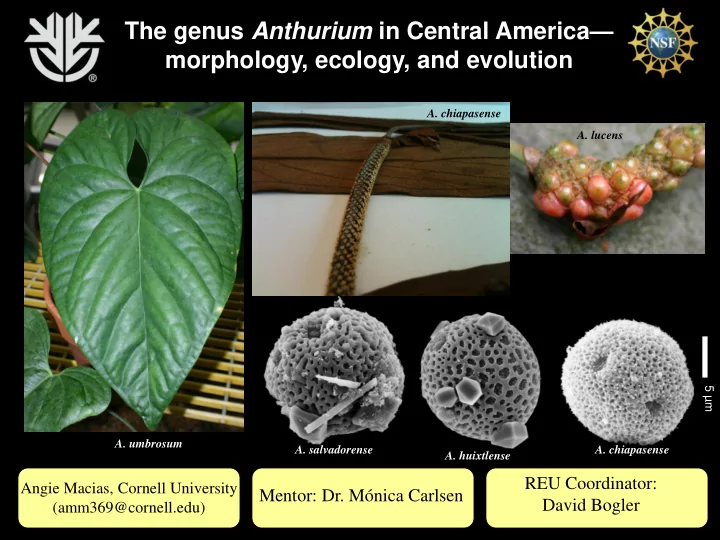
The genus Anthurium in Central America morphology, ecology, and evolution A. chiapasense A. lucens 5 m A. umbrosum A. salvadorense A. chiapasense A. huixtlense REU Coordinator: Angie Macias, Cornell University Mentor: Dr. Mnica


slide-1
SLIDE 1

The genus Anthurium in Central America— morphology, ecology, and evolution

Angie Macias, Cornell University (amm369@cornell.edu)

  • A. chiapasense
  • A. chiapasense
  • A. huixtlense
  • A. salvadorense
  • A. umbrosum

Mentor: Dr. Mónica Carlsen REU Coordinator: David Bogler

5 µm

  • A. lucens
slide-2
SLIDE 2

Outline

Introduction

  • Pollen
  • Lucid Key
  • Species Distribution Models
  • Conclusion
  • A. verapazense
  • A. pedatoradiatum
slide-3
SLIDE 3

Introduction

  • Neotropical genus in

family Araceae

  • Est. 1000 species,

912 currently described

  • Morphology extremely

variable

http://www.geoware-online.com/maps.html

slide-4
SLIDE 4

Introduction

  • Anthurium was

divided into 18 sections (Croat & Sheffer 1983)

  • Molecular phylogeny

sampling ~11% of species (Carlsen & Croat 2013)

  • Three clades are

restricted to Central America, others are more widespread

Clade A Clade 4 Clade 16

slide-5
SLIDE 5

Introduction

  • A. clidemioides
  • A. chiapasense
  • A. berriozabalense
  • A. chiapasense
  • A. guatemalense
  • A. verapazense
  • A. huixtlense
  • A. podophyllum
  • A. clarinervium
slide-6
SLIDE 6

Objectives

  • 1. Examine pollen to look for characters

that provide morphological evidence for the molecular phylogeny.

  • 2. Produce a Lucid Key for the group of

Anthurium species endemic to Central America.

  • 3. Identify differences in ecological

preferences between species and/or clades.

slide-7
SLIDE 7

Outline

  • Introduction

Pollen

  • Lucid Key
  • Species Distribution Models
  • Conclusion
  • A. lezamae

5 µm

slide-8
SLIDE 8

Methods

1. Collect pollen from 16 species in the Missouri Botanical Garden greenhouses 2. Prepare samples for and view in SEM 3. Describe pollen characters for each species

The Missouri Botanical Garden SEM

slide-9
SLIDE 9

Results

S

  • Strange crystals!
  • Some are certainly

calcium oxalate because of their crystal structure

  • Most are unknown

Some are attached to pollen… Others are embedded in the outer layer…

  • A. huixtlense
  • A. berriozabalense

5 µm 5 µm 20 µm

And more are “free”…

1 µm 5 µm

slide-10
SLIDE 10

Results

  • Gemmate exine
  • rnamentation occurs in

Clade A

  • Spiny, reticulate “criss-

cross” ornamentation

  • ccurs in Clade 4
  • Fine reticulation with

smooth walls and apparent apertures occur in Clade 16 (most similar to outgroups)

  • Other Anthurium species

have reticulation, but holes are usually larger.

  • A. clidemioides, Clade A

(Grayum 1992)

  • A. podophyllum, Clade 16
  • A. verapazense, Clade 4
  • A. salvadorense, Clade 9

(outgroup) 5 µm

slide-11
SLIDE 11

Outline

  • Introduction
  • Pollen

Lucid Key

  • Species Distribution Models
  • Conclusion
  • A. salvadorense
slide-12
SLIDE 12

Methods

  • Revise Lucid Key

developed originally by Tom Croat

  • Scored 92 characters for

47 species (184 herbarium specimens) from Central America

  • Also scored 16 living

species, but data still incomplete

  • Look through literature to

find detailed taxonomic descriptions of the species

Herbarium specimen of Anthurium yetlense

slide-13
SLIDE 13

But what is a Lucid Key?

  • Digital keys that aid in

species identification

  • Allow users to select the

characters they want to use instead of following those chosen in a dichotomous key

  • Good for plant groups with

many species and many important characters

slide-14
SLIDE 14

Raw Data

slide-15
SLIDE 15

Lucid

slide-16
SLIDE 16

Lucid

slide-17
SLIDE 17

Outline

  • Introduction
  • Pollen
  • Lucid Key

Species Distribution Models

  • Conclusion

www.maps.google.com

slide-18
SLIDE 18

Methods

  • Collect localities and

coordinates for 56 species (~5800 specimens) through TROPICOS and georeferencing

  • Clean data
  • Use MaxEnt &

DivaGIS to produce distribution models

  • A. andicola

Absent Low probability Medium probability High probability

Key

Observed specimens Model: Probability of Occurrence

slide-19
SLIDE 19

Results

Clade A Clade 4 Clade 16 S E W Absent Low richness Medium richness High richness Key

slide-20
SLIDE 20

Outline

  • Introduction
  • Pollen
  • Lucid Key
  • Species Distribution Models

Conclusion

  • A. verapazense
slide-21
SLIDE 21

Conclusion

  • In general, the three clades restricted to

Central America (Clade A-section Polyphyllium, Clade 4, and Clade 16- Anthurium andicola alliance) (Carlsen & Croat 2013) are very distinct from each

  • ther, and from other more widespread

groups, in their overall morphology and ecological needs.

slide-22
SLIDE 22

Conclusion

  • All the programs used (Lucid, DivaGIS,

MaxEnt) are freely available online

  • All the results will be freely available
  • nline!
  • Pollen images: PalDat
  • Lucid Key: Kew eMonocots webpage
  • Species Distribution Models:

Smithsonian

slide-23
SLIDE 23

Acknowledgements

  • MBG
  • NSF
  • Mónica Carlsen
  • David Bogler
  • Tom Croat
  • Justin Zweck
  • Erika Belmont
  • MBG Library
  • CCSD

(esp. Adam Smith)

  • A. clarinervium

Flickr, CC license

slide-24
SLIDE 24

Thanks for listening!

  • My email address is amm369@cornell.edu

if you have any questions!

Missouri Botanical Garden, Araceae greenhouse