Structure History of Semantic Roles 1. Contemporary Frameworks 2. - - PDF document

structure
SMART_READER_LITE
LIVE PREVIEW

Structure History of Semantic Roles 1. Contemporary Frameworks 2. - - PDF document

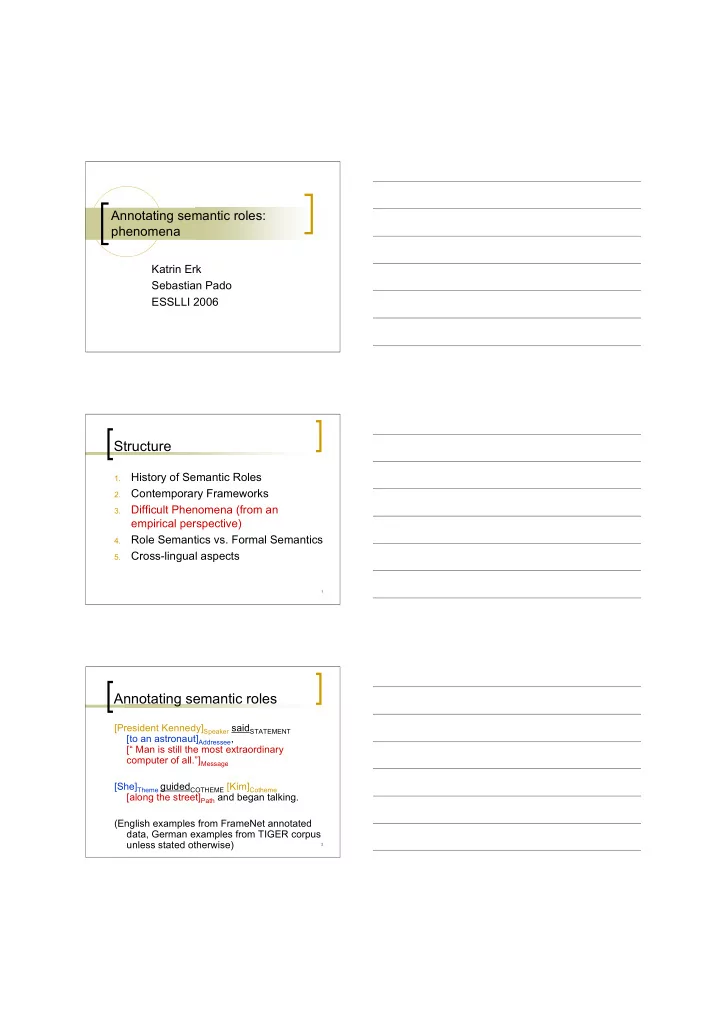
Annotating semantic roles: phenomena Katrin Erk Sebastian Pado ESSLLI 2006 Structure History of Semantic Roles 1. Contemporary Frameworks 2. Difficult Phenomena (from an 3. empirical perspective) Role Semantics vs. Formal Semantics 4.


slide-1
SLIDE 1

Annotating semantic roles: phenomena

Katrin Erk Sebastian Pado ESSLLI 2006

1

Structure

1.

History of Semantic Roles

2.

Contemporary Frameworks

3.

Difficult Phenomena (from an empirical perspective)

4.

Role Semantics vs. Formal Semantics

5.

Cross-lingual aspects

2

Annotating semantic roles

[President Kennedy]Speaker saidSTATEMENT [to an astronaut]Addressee, [“ Man is still the most extraordinary computer of all.”]Message [She]Theme guidedCOTHEME [Kim]Cotheme [along the street]Path and began talking. (English examples from FrameNet annotated data, German examples from TIGER corpus unless stated otherwise)

slide-2
SLIDE 2

3

Annotating semantic roles

 The meaning of the predicate is

relevant for determining the semantic roles available

 I heard him ask [her]Donor to passGIVING

[the salt]Theme.

 [The children]Theme passedTRAVERSING

[the neighbor’s yard]Area.

4

Annotating semantic roles: idioms

 [Kerry]Evader gave [them]Pursuer

the slipEVADING and was found Sunday night in Kota Bahru.

 “Give the slip” as a whole is a

  • predicate. “the slip” does not fill any

semantic role.

5

Annotating semantic roles: support

 Noun (or PP) as semantic head of a clause

rather than the verb.

 Noun = predicate, verb = support:

Syntactic dependents of the verb are annotated as semantic roles of the noun.

 Examples:

[Someone]Speaker [made] a statementSTATEMENT [about my need two kerrect my shpelling]Topic.

[Frances Patterson]Patient [underwent] an

  • perationTREATMENT.
slide-3
SLIDE 3

6

Annotating semantic roles: metaphors

 Example: “boil” in literal, non-literal use

[Water]Entity boilsABSORB_HEAT [at 100ºC]Temperature at one atmosphere pressure.

Just now work seemed the best antidote to the frustration [that]Emotion was boilingEMOTION_HEAT [inside her]Seat_of_emotion.

 Design choice for metaphors:

annotate literal meaning vs. understood meaning. Results in different semantic roles.

7

Annotating semantic roles: metaphors

 Roles in literal and nonliteral readings:

[She]Agent threwCAUSE_MOTION [her pencil]Theme [across the room]Path

[Danny’s corner]Agent refused to throwCAUSE_MOTION [in]Goal [the towel]Theme.

[Danny’s corner]Capitulator refused to throw in the towelGIVING_IN.

 Roles of the literal reading may form part of

the target in the nonliteral reading.

8

A problem of boundaries

 Next:

 problems of defining hard boundaries

between phenomena in manual Frame-semantic annotation

 illustrated on examples

slide-4
SLIDE 4

9

Boundary problems at a glance

Role semantics Pragmatics Markables of predicate-argument structure Non-markables semantic class A semantic class B metaphor idiom support literal reading role A role B

10

Unclear boundaries between semantic classes of predicates

Role semantics Pragmatics Markables of predicate-argument structure Non-markables semantic class A semantic class B metaphor idiom support literal reading role A role B

11

Unclear boundaries between semantic classes of predicates

to surprise/überraschen:

 

to take unawares



to cause emotion of surprise

But:

Die Wurzeln mancher unguter Erscheinungen, die in unseren Gesellschaften auftreten und uns immer wieder überraschen, liegen in dem eben beschriebenen Zustand eines frustrierten postkommunistischen Gemüts. (The roots of some unfortunate events that occur in our societies and surprise us again and again lie in the state

  • f a frustrated post-communist mind that we’ve just

described.)

Unexpectedness or emotion? Or some of both?

slide-5
SLIDE 5

12

Unclear boundaries between semantic classes of predicates

to remark, notice/feststellen, bemerken:

  to become aware  to make a statement

But:

Zudem gibt es, so stellte die Prüfungskommission “Gläserne LPG” jüngst fest, viele Unregelmäßigkeiten. (In addition, as the examination board “LPG of glass” recently remarked/noticed, there are many irregularities.)

Becoming aware, or statement? Or some of both?

13

Unclear boundaries between semantic classes of predicates

Slam the door/Tür zuschlagen: contains aspects of both Closure and Impact

14

Unclear boundaries between role labels

Role semantics Pragmatics Markables of predicate-argument structure Non-markables semantic class A semantic class B metaphor idiom support literal reading role A role B

slide-6
SLIDE 6

15

Unclear boundaries between role labels: granularity

 Frame Hostile_encounter:

Issue: something over which the two sides in a hostile encounter are in disagreement

Goal: the desired result of the outcome of the hostile encounter

struggle for control: goal. struggle over familiar territory: issue

 Machtkampf / power struggle: Issue or

Goal?

16

Unclear boundaries between role labels: granularity

Frame Assistance: help, assist, aid, …

Goal: the desirable state of affairs that the Benefitted_party is involved in and which is enabled by the Helper. Jack helped Jill [in the development of the game].

Focal_entity: This role identifies a Focal_entity involved in achieving the Goal. Whoever didn’t cook has to help [with the dishes].

But: Can you help me [do the dishes]? Neither Goal nor Focal_entity, rather some kind of Activity.

Granularity problem remains, even with fine-grained FrameNet roles.

Goal, Focal_entity and Activity differ syntactically and in the inferences they afford

But they all relate to the activity in which the Helper helps.

17

Unclear boundaries between role labels: metonymy

Frame Statement:

Speaker: the person who produces the message

Medium: the physical entity or channel used by the Speaker to transmit the statement

Problem with Metonymy: Die nachhaltigste Korrektur forderte [ein Antrag]… (The most extensive corrections are being demanded by [a motion]…)

2 strategies:

Ignore metonymy in general (because otherwise it interferes with very many role assignments). Then this should probably be Speaker.

Treat metonymy separately in all cases, and assign Medium here

slide-7
SLIDE 7

18

Unclear boundaries between role labels: metonymy

 Frame Destroying:

Destroyer: conscious entity

Cause: an event, or an entity involved in such an event

 Inmitten des aufgeklärten Europas wurde

[von Deutschland] die Zivilisation radikal zerstört. (In the middle of enlightened Europe, civilization was radically destroyed [by Germany].)

 Again, problem of metonymy.

19

Unclear boundaries between role labels: core/noncore

 FrameNet distinguishes core, peripheral,

extrathematic roles.

Core: conceptually necessary component of a frame; also: distinguishes this frame from others

Revenge frame: Avenger, Punishment, Offender, Injury, Injured_party

Peripheral: can be instantiated in any appropriate event frame

Time, Place, Manner, Means, Degree  Similar: classical distinction

  • bligatory/optional

20

Unclear boundaries between role labels: core/noncore

 J. P. Koenig (2003): semantic arguments

characterized by

  • bligatoriness (or at least frequency)

specificity

 Problematic: PPs

live in Berlin

stumble over the table (“quasi-valency” in PTB, Lopatkova & Panevova 2005)

win by two goals (“quasi-valency” in PTB)

 FrameNet: Addressee not core in Statement

slide-8
SLIDE 8

21

Unclear boundaries between limited compositionality phenomena

Role semantics Pragmatics Markables of predicate-argument structure Non-markables semantic class A semantic class B metaphor idiom support literal reading role A role B

22

Unclear boundaries between limited compositionality phenomena

Metaphor versus idiom, metaphor versus separate but nonmetaphoric reading of the lexeme: How strongly is the literal reading still perceived?

“Kick the bucket”: The bucket was a bar used by butchers to tie dead pigs to – by their back legs. So these pigs “kicked the bucket”.

23

Unclear boundaries between limited compositionality phenomena

Metaphor versus separate but nonmetaphoric sense:

Der “Pluralismus von Erklärungen” aus der CDU/CSU-FDP-Koalition zeige, dass die Einigkeit über die Pflegeversicherung nur “vorgetäuscht” worden sei, “um über die Sommerpause zu kommen”, sagte Klose. (The “multiplicity of explanations” given by the CDU/CSU-FDP coalition showed that they only “pretended” to agree on nursing care insurance “in

  • rder to get through the summer break”, Klose

said.)

Get through (a difficult time):

metaphor with Motion source?

Or lexicalized and separate sense of “get”?

slide-9
SLIDE 9

24

Unclear boundaries between limited compositionality phenomena

Metaphor vs. support vs. separate word sense:

Zwar liege die Verantwortung allein bei der Bundesregierung… (While responsibility lies solely with the federal government…)

Support, similar to undergo/perform an

  • peration

Metaphor, with a Location source

Separate word sense of lie: being located, even for abstract objects

25

Unclear boundaries between (role) semantics and pragmatics

Role semantics Pragmatics Markables of predicate-argument structure Non-markables semantic class A semantic class B metaphor idiom support literal reading role A role B

26

Unclear boundaries between (role) semantics and pragmatics

 “What is X doing Y” (Kay & Fillmore 97)

What is this scratch doing on the table?

I wonder what the salesman will say this house is doing without a kitchen.

What are your children doing playing in my garden?

 Is this a special construction, as

Kay&Fillmore argue, or a pragmatic phenomenon?

slide-10
SLIDE 10

27

What is X doing Y: semantics or pragmatics?

Possible analyses of “What’s X doing Y”:

Special construction with its own reading (markable in role semantics)

Pragmatics: additional reading derived by conversational implicature

“Waiter, what is this fly doing in my soup?” – “Madam, I believe that’s the backstroke”

“How come there is a fly in my soup?”

“What is the fly in my soup doing?”

28

What is X doing Y: semantics or pragmatics?

Arguments in favor of the “WXDY” construction:

Context does not change the meaning of the construction:

Look what the children are doing in my garden! [Isn’t that cute?]

But: What are your children doing playing in my garden? [Isn’t that cute?]

Answer to the literal question often included in the expression:

What’s your dog doing peeing on my doorstep?

Uses progressive even to express events or states that usually do not go with the progressive:

What is he doing knowing the answer?

29

Unclear boundaries between (role) semantics and pragmatics

 [We]Agent immediately rushed to the ladies,

washed Jessica carefully in the sink and driedCAUSE_TO_BE_DRY [her]Dryee [under the hand dryer]Place/Instrument

 under the hand dryer:

Place

Instrument can be inferred because hand dryers usually blow hot air downward?

 Instrument is defeasible, can be overwritten

by continuing the sentence by “… using lots of paper towels”

slide-11
SLIDE 11

30

Unclear boundaries between (role) semantics and pragmatics

 [Drei Pötte per annum]Theme

verließenDEPARTING während der achtziger Jahre [die Trockendocks]Source. ([Three ships a year]Theme leftDEPARTING [the dry docks]Source in the eighties.)

 Leaving dry docks = being manufactured?  [Three ships a year]Product leftMANUFACTURING

[the dry docks]Factory in the eighties.

31

Unclear boundaries between (role) semantics and pragmatics

Frame Statement, role Addressee: the person to whom the Message is communicated

“vor dem Parlament” (before the parliament), “vor Journalisten” (in front of journalists/in a press conference), “vor den Delegierten” (in front of the delegates):

Place?

Inferred Addressee?

Addressee-reading is defeasible, can be changed by context: Er sagte vor Journalisten zu seinem Ministerkollegen… (In a press conference, he said to his co-minister…)

32

Unclear boundaries between markables and non-markables

Role semantics Pragmatics Markables of predicate-argument structure Non-markables semantic class A semantic class B metaphor idiom support literal reading role A role B

slide-12
SLIDE 12

33

What is a predicate?

 Seen so far:

single lemma as frame-evoking: verb, noun, adjective

multiword expressions (even, maybe, something like “What’s X doing Y”)

 Also: parts of a word (German compounds)

Machtkampf: struggle for power

34

What is a predicate?

“Colon construction”:

 “Das ist eines der weltbesten Teams”, zeigte

Klinsmann Respekt. (“This is one of the world’s best teams”, Klinsmann showed respect.)

 In English much more restricted than in

  • German. Although:

And don’t expect many complete games by pitchers – perhaps three out of 288, laughs Mr. Fingers, the former Oakland reliever. (wsj_0214)

35

What are potential semantic role fillers?

Local assignment:

Constituents within the maximal projection of the predicate

Arguments of the supporting verb in support constructions

Subjects of control verbs

Nonlocal assignment of semantic roles:

Communication: message running longer than one sentence.

Rare: possible nonlocal roles for verbs

Besitzer von [Zweifamilienhäusern]Goods?, [die]Buyer vor 1987 gebaut oder gekauftCOMMERCE_BUY haben (TIGER s975) (Owners of [two-family homes]Goods? [who]Buyer have built or purchasedCOMMERCE_BUY before 1987…) Note defeasibility!

slide-13
SLIDE 13

36

What are potential semantic role fillers?

 Nonlocal assignment of semantic roles:

Not so rare: possible nonlocal roles for frame- evoking nouns

Vor Jahren, als [Helmut Kohl]Addressee?? erstmals ganz unten war[…], machte […] [Günter Oettinger]Speaker? bundesweit mit einer [Rücktritts]MessageforderungRequest von sich reden. (TIGER s1862) (Years ago, when [Helmut Kohl]Addressee?? was on the rocks for the first time, [Günter Oettinger]Speaker? brought himself into public awareness with a demandREQUEST [for resignation]Message.)

37

What are potential semantic role fillers?

 Comparatives: content of a semantic

role not overtly realized

 The flooding was worse than

expectedEXPECTATION. What is the Phenomenon here?

38

Unclear boundaries: summing up

Role semantics Pragmatics Markables of predicate-argument structure Non-markables semantic class A semantic class B metaphor idiom support literal reading role A role B

slide-14
SLIDE 14

39

Unclear boundaries: What do we make of this?

 Focus on

unclear boundaries between predicate senses (frames)

unclear boundaries between semantic roles

 Unclear boundaries in sense and role

assignment:

Just a result of not defining classes clearly enough?

Inherent feature of the phenomena?

40

Unclear boundaries: bug or feature?

 Word Sense Disambiguation:

School A: just a problem of bad definitions. More coarse-grained definitions will do the trick. e.g. Hovy et al (2006)

School B: vagueness inherent to the phenomenon. Remains persistent with all sense inventories.

41

Unclear boundaries: bug or feature?

 Semantic role assignment:

Granularity problem with small set of abstract roles (see earlier class),

Granularity problem also with FrameNet roles: the case of Assistance above

 Following “School B”, we’ll pursue the idea

that vagueness may be inherent in the phenomenon

 Next: prototype theory

slide-15
SLIDE 15

42

Concepts: The classical theory

 Goes back to Aristotle  A concept is defined by a set of necessary

and sufficient conditions

Acquiring concepts: Conditions are empirically

  • discoverable. We consider instances of a

concept and extract distinguishing conditions.

Classifying items: by checking whether they fulfil conditions.

 Examples:

BACHELOR: unmarried male human

HUMAN: featherless biped

43

Problems with the “necessary and sufficient conditions” theory of concepts

 Do all concepts have a definition?

Wittgenstein (1953): GAME as a concept without a definition

Same problem with BACHELOR:

children? divorced or widowed men? priests?  Psychological corroboration?

People rarely able to provide definitions

Definitions differ between people, differ over time

Reaction time should depend on complexity of definition

Reaction to MALE should be faster than to BACHELOR. This is not the case.

44

Prototype theory

 Eleanor Rosch and others, 1970s  Typicality effects in members of a common

category

 Experiments:

Rating inhowfar items are good examples of the category FURNITURE, scale 1-7: “chair” and “sofa” on top, “telephone” and “refrigerator” at the bottom (Rosch 1975)

Response time: “Is a robin a bird?”

Naming examples

slide-16
SLIDE 16

45

Prototype theory

Concepts organized by family resemblances

Fuzzy boundaries: some borderline items may “more or less” belong to a category

Concepts represented by a set of weighted features

BIRD: has features, can fly, …

Need not be present in all members of a category

Features are weighted: Theories name either some notion

  • f salience, or the relative frequency of category members

exhibiting a feature

46

Prototypes in lexical semantics

Linda Coleman and Paul Kay (1981): the verb “lie”

Participants were asked to rate situations on whether they represent a lie

Participants did not seem to use necessary and sufficient conditions

Participants seemed to use cluster of features, none of them necessary, varied in importance:

untruth (least important)

speaker knows that the statement is not true (most important)

intention to deceive (medium important)

Participants easily use “more-or-less” ratings, good agreement

Prototype for rather abstract concept

47

Prototypes in lexical semantics

Patrick Hanks (2000): Do word meanings exist?

“bank”: “financial institution” vs “riverside” reading

1000 random occurrences of the noun “bank” in the BNC:

No ambiguity between “finance” and “river” reading

But cases where a reading is only partially activated

“Financial” reading: Blood bank, data bank, seed bank?

“Riverside” reading: Sloping land? Water? One slope or two?

Again: features, none of them necessary, may be “more-or-less” activated. Usually a combination of features is activated.

slide-17
SLIDE 17

48

Prototypes and FrameNet

 Fillmore (1975): Alternatives to checklist

theories of meaning Proposes prototypes instead of necessary and sufficient conditions

 FrameNet: a prototype-based theory of

meaning

49

Sense and role assignment: Consequences of adopting prototype theory?

 Senses (frames):

not assumed disjoint

assignment of more than one frame label to signal similar distance to several classes

 Roles:

Each role bears properties/inferences, in virtue

  • f being a certain participant in the given frame

Properties as prototype features: a given instance may fulfil more or less of the properties

  • f a given role

50

Sense and role assignment: Consequences of adopting prototype theory?

 Frame/role described by features which

need not be present in all cases

Defeasible features (as in “birds can fly”)

More-or-less features (as in color terms: more or less green)

 Consequences for doing reasoning over

semantic representations: Handle non- certain knowledge?

slide-18
SLIDE 18

51

Summary

Annotation of normal cases, also involving metaphor, idioms, support

Boundary problems concerning:

semantic classes (senses)

semantic roles

different kinds of Limited Compositionality phenomena

markables vs. non-markables

semantics vs. pragmatics

Attempting to explain boundary problems concerning senses and roles: Prototype theory

52

References

Collin Baker, Charles Fillmore, John Lowe (1998): The Berkeley Framenet

  • project. In: Proceedings of the COLING-ACL, Montreal.

Aljoscha Burchardt, Katrin Erk, Anette Frank, Andrea Kowalski, Sebastian Pado and Manfred Pinkal (2006): The SALSA corpus: a German corpus resource for lexical semantics. In: Proceedings of LREC 2006, Genova.

Linda Coleman and Paul Kay (1981): Prototype semantics: the English verb “lie”. Language 57/1:26-44

Michael Ellsworth, Katrin Erk, Paul Kingsbury, and Sebastian Pado (2004): PropBank, SALSA, and FrameNet: how design determines product. In: Proceedings of the LREC 2004 workshop on building lexical resources from semantically annotated corpora, Lisbon.

Katrin Erk, Andrea Kowalski, Sebastian Pado and Manfred Pinkal (2003): Towards a resource for lexical semantics: a large German corpus with extensive semantic annotation. In: Proceedings of ACL 2003, Sapporo.

Patrick Hanks (1994): Linguistic norms and pragmatic exploitations, or Why lexicographers need prototype theory, and vice versa. In: F. Kiefer, G. Kiss and J. Pajzs (eds.) Papers in Computational Lexicography: Complex ‘94. Hungarian Academy of Sciences, Budapest.

53

References

Patrick Hanks (2000): Do word meanings exist? Computers and the Humanities 34

Ed Hovy, Mitchell Marcus, Martha Palmer, Lance Ramshaw and Ralph Weischedel (2006): OntoNotes - the 90% solution. In Proceedings of HLT- NAACL 2006, New York.

Jean-Pierre Koenig, Gail Mauner, and Breton Bienvenue (2003): Arguments for Adjuncts. Cognition. 89:67-103

Marketa Lopatkova and Jamila Panevova (2005): Recent developments in the theory of valency in the light of the Prague Dependency Treebank. In Insights into Slovak and Czech Corpus Linguistics, 83-92. Veda Bratislava, Slovakia

Eleanor Rosch (1975): Cognitive representation of semantic categories. J Experimental Psychology 104:192-233

Josef Ruppenhofer, Michael Ellsworth, Miriam Petruck, and Christopher Johnson (2005): FrameNet: Theory and Practice. http://framenet.icsi.berkeley.edu

Ludwig Wittgenstein, Philosophical investigations. Prentice Hall, 1999. (Originally appeared 1953)