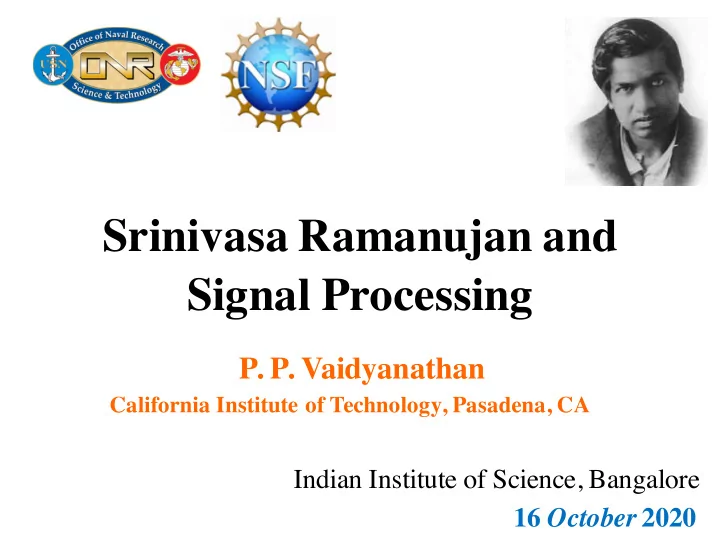
Srinivasa Ramanujan and Signal Processing P. P. Vaidyanathan - PowerPoint PPT Presentation
Srinivasa Ramanujan and Signal Processing P. P. Vaidyanathan California Institute of Technology, Pasadena, CA Indian Institute of Science, Bangalore 16 October 2020 1887 - 1920 Self-educated Indian mathematician Grew up in poverty (Kumbakonam,
Srinivasa Ramanujan and Signal Processing P. P. Vaidyanathan California Institute of Technology, Pasadena, CA Indian Institute of Science, Bangalore 16 October 2020
1887 - 1920 Self-educated Indian mathematician Grew up in poverty (Kumbakonam, Tamil Nadu) His genius discovered by Prof. G. H. Hardy Worked with Hardy in 1914 - 1919 1877 - 1947 (Cambridge)
1887 -- 1920 Ramanujan created history in mathematics Became a Fellow of the Royal Society at 32 Passed away at 33
Ramanujan’s slate
Ramanujan’s handwriting
Talk Outline • Ramanujan sums (RS): 1918 • Representing periodic signals • From RS to Subspaces • From Subspaces to Dictionaries • From Dictionaries to Filter Banks • iMUSIC • Conclusions, Acknowledgements, …
P Periodic x ( n ) data size N x ( n ) = x(n + P ) Smallest such integer P is called the period
period Periodic x ( n ) data size N DFT representation: period = a divisor of N Let N = 6, look at these period 1 periods 4 and 5 missing! period 2 period 3 period 6
period Periodic x ( n ) data size N DFT representation: period = N or a divisor of N N = 32; divisors = 1, 2, 4, 8, 16, 32 Very few periods in basis Ramanujan-sum representation: Every period q is in basis! period q
Limitations of DFT: Example (Re part) (Re part) 32 point 32 point DFT DFT
Period 8 (Re part) Period 9 (Re part) 32 point 32 point DFT DFT non- sparse sparse
Identifying periods vs spectrum est. harmonic arbitrary periodic case structure line spectrum ω ω fundamental DFT, MUSIC, H MUSIC, H MP, etc., are not the best … Ramanujan offers something new
Hidden periodic period = 16 components period = 12 Does not “look” periodic Ramanujan offers sparse representation …
Importance of periodicity • Pitch identification acoustics (music, speech, … ) • Time delay estimation in sensor arrays • Medical applications • Genomics and proteomics • Radar • Astronomy • Physics
Ramanujan sum (1918) q = positive integer k and q coprime # of terms = φ ( q ) = Euler totient period q 6 9 C [ k ] 9 1 2 0 3 4 5 6 7 8
primitive frequencies with same period q Theorem: Ramanujan sum is integer valued! Examples: Orthogonal:
What did Ramanujan do with these? He expanded arithmetic functions (1918): Number-of-divisors: Sum-of-divisors: Euler-totient: von Mangoldt function:
Our goal • Use this to represent periodic signals efficiently • Significant advantages over traditional …
Representation for periodic signals? x ( n ) = x ( n ) = not sparse sparse representation Planat, et al., 2002-09 Not a good representation Mainardi, et al., 2008 Sugavaneswaran, et al., 2008
What do we do about it? Replace each Ramanujan-sum with a subspace: Ramanujan subspace Leads to a nice representation!
Ramanujan subspace [Vaidyanathan 2014, IEEE SP Trans.] Space of signals of the form: complex basis real integer basis
Ramanujan subspace: look at the DFT 9 DFT of c ( n ) 9 0 1 2 4 5 3 6 7 8 DFT of a signal in 5 1 2 0 3 4 6 7 8
Think of the q x q DFT matrix k 1 2 4 5 7 8 q = 9 : sum of dark cols. Ramanujan sum : space spanned by dark cols. Ramanujan subspace
Periodicity Theorems [PPV 2014, IEEE SP Trans]. 1. Nonzero signals in have period q. (can’t be smaller). 2. Any period- P signal can be written as where q are divisors of P. m
Periodicity Theorems [PPV 2014, IEEE SP Trans]. 3. Consider the sum where . This has period (can’t be smaller).
Farey dictionary (PPV and Piya Pal, 2014) 2 π Farey frequency grid
Farey Frequency Grids q = 6 q = 8 q = 10 Non-uniform frequency grids for period estimation Farey series, in Number Theory [Hardy and Wright 1938, 2008 ]
Ramanujan dictionary [Srikanth Tenneti, PPV 2015, 2016, IEEE SP Trans]. N Frame, rather than basis
Finding period using Ramanujan dictionary φ (1) φ (2) φ (3) φ (4) φ (5) N Given x, find a sparse representation: Then period P
Example Hidden periods: 3, 7, 11 3 7 DFT does not Ramanujan reveal much dictionary periods are clear! 11 S. Tenneti, P. P. Vaidyanathan
Example Hidden periods: 7, 10 10 10 Farey Ramanujan 7 7 complex computations 5 5 integer more errors computations 2 2
Ramanujan vs other methods Ramanujan works much better when: • periods are integers ( DNA, proteins, … ) • datalength is short • multiple hidden periods should be found
On the lighter side …
The Taxicab number 3 3 = 1 + 12 1729 3 3 = 9 + 10 Smallest integer that can be written as a sum of two cubes in two ways!
Prof. George Andrews Prof. Bruce Brendt Penn State UIUC
Tracking periodicity as it changes … Time-Period plane plot is needed
Ramanujan Filter-Banks
Ramanujan Filter-Banks x ( n ) ( l ) C ( z ) 1 period P ( l ) C ( z ) 2 . . . ( l ) C ( z ) N Suppose the filters with nonzero outputs Theorem: are Then
FIR Ramanujan filters Can show: : d is a divisor (or factor) of q PPV and Tenneti, ICASSP 2017
Multiplierless FIR Ramanujan FB elements In practice:
Protein molecules (amino acid sequences) The HetL protein • Has strong period 5 component • Contains insertion loops • Kyte-Doolittle scale, EIIP scale
Time-period plane from RFB period 5 amino acid domain
More proteins ... Comparison with other methods … RFB always works Tenneti and PPV 2016
i MUSIC Traditional MUSIC spectrum
x ( n ) periodic: spectrum is harmonic ω β 2 β 3 β Modified MUSIC: H MP, Gribonval and Bacry, 2003 . H MUSIC, Christensen, Jacobsson and Jensen, 2006 + More accurate than MUSIC; but complex, time consuming
iMUSIC [Tenneti and PPV, 2017, 2019] I nteger MUSIC (i.e., when period = integer) Instead of this, uses vectors from: • Ramanujan dictionary or • Farey dictionary or • Natural basis dictionary More accurate, much faster …
ω 3 3 13 10 Farey MUSIC is similar 13 10
Ongoing and future …. • Denoising periodic signals • Non-integer periods • CNN and Ramanujan • 2D case
Our Website on this … Srikanth Tenneti
References for this talk http://systems.caltech.edu/dsp/students/srikanth/Ramanujan/
From A mathematician’s apology, 1940 G. H. Hardy 1877 - 1947 The ‘real’ mathematics of the ‘real’ mathematicians is almost wholly ‘useless’. (So) the ‘real mathematician’ has a clear conscience. Applied mathematics is ‘useful’, yes. But it is trivial. Perhaps, Hardy was wrong?
Thank you!
Recommend


More recommend
Explore More Topics
Stay informed with curated content and fresh updates.
 Sambuz