
SLIDE 1
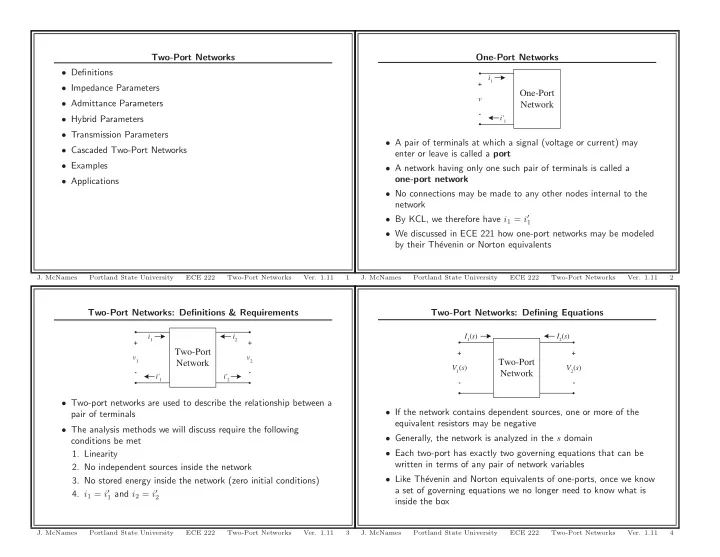
Two-Port Networks: Definitions & Requirements Two-Port Network
v1
- +
i1 i'1
- +
i2 i'2 v2
- Two-port networks are used to describe the relationship between a
pair of terminals
- The analysis methods we will discuss require the following
conditions be met
- 1. Linearity
- 2. No independent sources inside the network
- 3. No stored energy inside the network (zero initial conditions)
- 4. i1 = i′
1 and i2 = i′ 2
- J. McNames
Portland State University ECE 222 Two-Port Networks
- Ver. 1.11
3
Two-Port Networks
- Definitions
- Impedance Parameters
- Admittance Parameters
- Hybrid Parameters
- Transmission Parameters
- Cascaded Two-Port Networks
- Examples
- Applications
- J. McNames
Portland State University ECE 222 Two-Port Networks
- Ver. 1.11
1
Two-Port Networks: Defining Equations Two-Port Network
V1(s)
- +
- +
V2(s) I1(s) I2(s)
- If the network contains dependent sources, one or more of the
equivalent resistors may be negative
- Generally, the network is analyzed in the s domain
- Each two-port has exactly two governing equations that can be
written in terms of any pair of network variables
- Like Th´
evenin and Norton equivalents of one-ports, once we know a set of governing equations we no longer need to know what is inside the box
- J. McNames
Portland State University ECE 222 Two-Port Networks
- Ver. 1.11
4
One-Port Networks One-Port Network
v
- +
i1 i'1
- A pair of terminals at which a signal (voltage or current) may
enter or leave is called a port
- A network having only one such pair of terminals is called a
- ne-port network
- No connections may be made to any other nodes internal to the
network
- By KCL, we therefore have i1 = i′
1
- We discussed in ECE 221 how one-port networks may be modeled
by their Th´ evenin or Norton equivalents
- J. McNames
Portland State University ECE 222 Two-Port Networks
- Ver. 1.11