Newtown Creek Superfund Site Modeling Overview CAG Technical - - PowerPoint PPT Presentation

newtown creek superfund site modeling overview cag
SMART_READER_LITE
LIVE PREVIEW

Newtown Creek Superfund Site Modeling Overview CAG Technical - - PowerPoint PPT Presentation

Region 2 serving the people of New Jersey, New York, Puerto Rico and the U.S. Virgin Islands Newtown Creek Superfund Site Modeling Overview CAG Technical Meeting March 20, 2019 1 Region 2 serving the people of New Jersey, New York, Puerto


slide-1
SLIDE 1

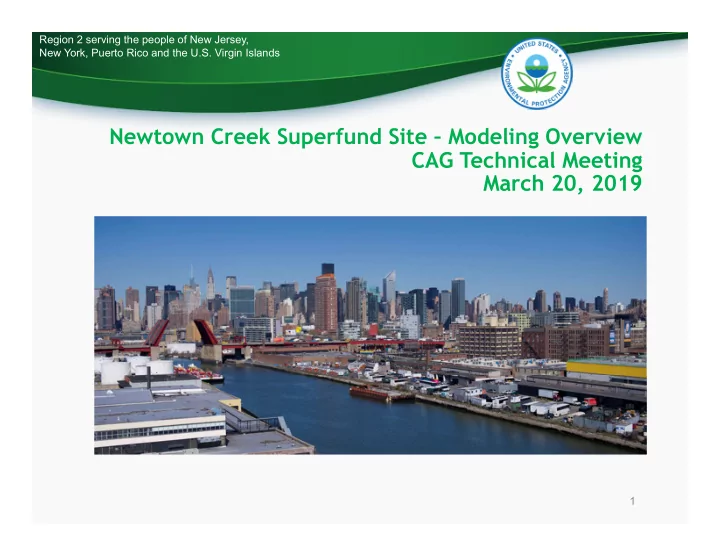
Newtown Creek Superfund Site – Modeling Overview CAG Technical Meeting March 20, 2019

Region 2 serving the people of New Jersey, New York, Puerto Rico and the U.S. Virgin Islands 1
slide-2
SLIDE 2

Presentation Overview

  • Role of models in decision‐making
  • Scope of modeling study
  • Overview of modeling framework
  • Review of individual sub‐models
  • Model application for feasibility study
  • Status of modeling study

2 Region 2 serving the people of New Jersey, New York, Puerto Rico and the U.S. Virgin Islands

slide-3
SLIDE 3

Role of Models in Decision‐Making

3 Region 2 serving the people of New Jersey, New York, Puerto Rico and the U.S. Virgin Islands

  • What are models?
  • Computational or

numerical models

  • A simplification of

reality…formal representation in mathematical terms (USEPA, 2009)

  • Implementation in

software algorithms

  • Flexible applications
  • 0D, 1D, 2D, 3D
  • Time‐variable
slide-4
SLIDE 4

Role of Models (Contd.)

4 Region 2 serving the people of New Jersey, New York, Puerto Rico and the U.S. Virgin Islands

  • Modeling in the

Superfund process

  • Remedial

investigation

  • Feasibility study
  • Remedy design

General Overview of the Newtown Creek Superfund Process

slide-5
SLIDE 5

Role of Models (Contd.)

  • Why use models?
  • Issues related to site characterization
  • Identify data gaps
  • Quantitative assessment of contaminant fate and transport – sources, sinks, etc.
  • Develop conceptual site model
  • Issues related to site management
  • Develop site management options
  • Predictive tool for comparison of remedial alternatives
  • Provides another line of evidence in addition to empirical observations in

developing a remedy

  • Support remedy design
  • Engineering design of remedial elements, environmental and flood impacts

assessments, etc.

5 Region 2 serving the people of New Jersey, New York, Puerto Rico and the U.S. Virgin Islands

slide-6
SLIDE 6

Role of Models (Contd.)

  • Constraints – computational limitations, assumptions and knowledge gaps
  • Tools to help inform decisions rather than machines to generate truth or

make decisions

  • Consideration of model assumptions and uncertainties in site

decision‐making

  • Use of model results as one of several lines of evidence to inform

site decision‐making

6 Region 2 serving the people of New Jersey, New York, Puerto Rico and the U.S. Virgin Islands

  • Interaction between modeling and data
  • Identify fate and transport processes
  • Model inputs, calibration & validation
  • Model limitations and constraints (USEPA,

2002; 2005; 2009a; 2017)

  • Simplification of reality
slide-7
SLIDE 7

Scope of Modeling Study

  • Primary objective of the Newtown Creek modeling

study (Anchor QEA, 2012; 2014) is to develop a reliable management tool that can be used to

  • Inform the conceptual site model
  • Evaluate the efficacy of remedial alternatives

7 Region 2 serving the people of New Jersey, New York, Puerto Rico and the U.S. Virgin Islands

slide-8
SLIDE 8

Scope of Modeling Study (Contd.)

  • Specific questions that may be answered by the Newtown

Creek modeling study

  • Site characterization
  • What effects do chemical concentrations in the sediment bed have on total

chemical concentrations in the water column and in biota?

  • What is the effect of chemical loads from the East River on chemical

concentrations in the sediment bed and in biota?

  • What is the annual load of chemicals from Newtown Creek to the East River

under current conditions?

  • What are the effects of ongoing sources on chemical concentrations in the

sediment bed and in biota?

  • What are the effects of high‐flow events or storms on chemical

concentrations in the sediment bed, in the water column, and in biota?

  • What is the potential for erosion, transport, and re‐deposition of particle‐

associated chemicals in the sediment bed during high‐flow events or storms at different locations within Newtown Creek?

8 Region 2 serving the people of New Jersey, New York, Puerto Rico and the U.S. Virgin Islands

slide-9
SLIDE 9

Scope of Modeling Study (Contd.)

  • Specific questions that may be answered by the Newtown

Creek modeling study

  • Feasibility study
  • What is the rate of natural attenuation of chemical concentrations in the

sediment bed and in biota under future conditions?

  • How would various remedial alternatives affect the rate of attenuation
  • f chemical concentrations in the sediment bed and in biota?
  • How would various remedial alternatives affect the annual load of

chemicals from Newtown Creek to the East River?

  • What is the potential for recontamination of remediated areas due to

inputs from the East River and/or ongoing sources?

  • What is the potential effect of ship traffic (i.e., propwash) on the

effectiveness of various remedial alternatives?

9 Region 2 serving the people of New Jersey, New York, Puerto Rico and the U.S. Virgin Islands

slide-10
SLIDE 10

Conceptual Site Model – Physical

  • Draft version
  • Food chain

shown subsequently

10 Region 2 serving the people of New Jersey, New York, Puerto Rico and the U.S. Virgin Islands

Adapted from Anchor QEA, 2016b

Groundwater Flow NAPL Seeps

slide-11
SLIDE 11

Modeling Framework

  • Contaminant fate and transport in Newtown Creek

proposed to be modeled by a suite of sub‐models

  • Watershed or point‐source model
  • Groundwater model
  • Surface water hydrodynamic model
  • Surface water sediment transport model
  • Surface water contaminant fate and transport model
  • Foodchain or bioaccumulation model

11 Region 2 serving the people of New Jersey, New York, Puerto Rico and the U.S. Virgin Islands

slide-12
SLIDE 12

Modeling Framework (Contd.)

  • Draft version

12 Region 2 serving the people of New Jersey, New York, Puerto Rico and the U.S. Virgin Islands

Anchor QEA, 2016b

slide-13
SLIDE 13

Model Review – Watershed

13 Region 2 serving the people of New Jersey, New York, Puerto Rico and the U.S. Virgin Islands

slide-14
SLIDE 14

Model Review – Watershed (Contd.)

  • Processes

simulated

  • Rainfall runoff
  • Transport through

collection system

  • Release to

Newtown Creek via combined sewer overflow (CSO) and storm drains

14 Region 2 serving the people of New Jersey, New York, Puerto Rico and the U.S. Virgin Islands

Note: General schematic of urban wet weather flows. Not intended to be a conceptual schematic of the Newtown Creek watershed

slide-15
SLIDE 15

Model Review – Watershed (Contd.)

  • Model framework
  • InfoWorks hydrologic

and hydraulic model

  • Developed by NYC

for the LTCP

  • Model domain
  • Newtown Creek and

Bowery Bay WWTP sewersheds

  • Model inputs
  • Model calibration

15 Region 2 serving the people of New Jersey, New York, Puerto Rico and the U.S. Virgin Islands

Anchor QEA, 2016b

slide-16
SLIDE 16

Model Review – Watershed (Contd.)

  • Model outputs and

linkages with other models

  • Outputs
  • Flow rates
  • Model linkages
  • Hydrodynamic
  • Sediment

transport

  • Contaminant fate

and transport

16 Region 2 serving the people of New Jersey, New York, Puerto Rico and the U.S. Virgin Islands

Anchor QEA, 2014

slide-17
SLIDE 17

Model Review – Groundwater

17 Region 2 serving the people of New Jersey, New York, Puerto Rico and the U.S. Virgin Islands

slide-18
SLIDE 18

Model Review – Groundwater (Contd.)

  • Processes simulated
  • Rainfall infiltration and

groundwater recharge

  • Subsurface groundwater

flow

  • Release to Newtown

Creek (exfiltration), loss to sewer and subway system, withdrawal

18 Region 2 serving the people of New Jersey, New York, Puerto Rico and the U.S. Virgin Islands

Anchor QEA, 2016b

slide-19
SLIDE 19

Model Review – Groundwater (Contd.)

  • Steady‐state model
  • Model domain
  • Defined using

groundwater elevation contours

  • Model inputs
  • USGS data and modeling
  • RI data
  • Secondary data sources

19 Region 2 serving the people of New Jersey, New York, Puerto Rico and the U.S. Virgin Islands

Anchor QEA, 2016b

slide-20
SLIDE 20

Model Review – Groundwater (Contd.)

  • Tiered approach for

modeling

  • Tier 1
  • Develop regional water

balance

  • Tier 2 and Tier 3
  • Estimate flow rates for

groundwater discharge into Newtown Creek

  • Calibrated to measured

seepage data

20 Region 2 serving the people of New Jersey, New York, Puerto Rico and the U.S. Virgin Islands

Anchor QEA, 2016b

slide-21
SLIDE 21

Model Review – Groundwater (Contd.)

  • Model outputs and

linkages with other models

  • Outputs
  • Flow rates
  • Model linkages
  • Hydrodynamic
  • Contaminant fate

and transport

  • Loadings based on

RI contaminant concentrations in native sediments

21 Region 2 serving the people of New Jersey, New York, Puerto Rico and the U.S. Virgin Islands

Anchor QEA, 2014

slide-22
SLIDE 22

Model Review – Hydrodynamic

22 Region 2 serving the people of New Jersey, New York, Puerto Rico and the U.S. Virgin Islands

slide-23
SLIDE 23

Model Review – Hydrodynamic (Contd.)

  • Parameters simulated
  • Currents (advection)
  • Dispersion
  • Water depths/levels
  • Salinity
  • Temperature
  • Processes simulated
  • Freshwater inflow from CSOs, SW outfalls, direct runoff, etc.
  • Tide and other water level fluctuations (eg. surge) propagating from

East River, i.e., tidal transport

  • Estuarine circulation resulting from density differences between

seawater and freshwater (also temperature)

23 Region 2 serving the people of New Jersey, New York, Puerto Rico and the U.S. Virgin Islands

Anchor QEA, 2012

slide-24
SLIDE 24

Model Review – Hydrodynamic (Contd.)

  • Model framework
  • Environmental Fluid Dynamics Code (EFDC)

24 Region 2 serving the people of New Jersey, New York, Puerto Rico and the U.S. Virgin Islands

Anchor QEA, 2016b

  • 3‐dimensional
  • Model domain
  • Average grid size

140 ft x 60 ft in Newtown Creek

slide-25
SLIDE 25

Model Review – Hydrodynamic (Contd.)

  • Model inputs
  • Boundary conditions
  • Bathymetry
  • Model calibration
  • Calibration metrics
  • Calibration datasets
  • Calibration period
  • Calibration parameters
  • Model application

25 Region 2 serving the people of New Jersey, New York, Puerto Rico and the U.S. Virgin Islands

Anchor QEA, 2016b

slide-26
SLIDE 26

Model Review – Hydrodynamic (Contd.)

  • Model outputs and linkages

with other models

  • Outputs
  • Currents
  • Water depths
  • Dispersion
  • Model linkages
  • Sediment transport
  • Contaminant fate and

transport

26 Region 2 serving the people of New Jersey, New York, Puerto Rico and the U.S. Virgin Islands

Anchor QEA, 2014

slide-27
SLIDE 27

Model Review – Sediment Transport

27 Region 2 serving the people of New Jersey, New York, Puerto Rico and the U.S. Virgin Islands

slide-28
SLIDE 28

Model Review – Sediment Tran. (Contd.)

  • Parameters simulated
  • Sediment in the water column and

the bed

  • Transport – external loadings,

advection, dispersion

  • Resuspension
  • Settling and deposition
  • Processes simulated
  • Fate and transport of sediments

from various sources

  • East River
  • Point source loadings
  • Impact of navigation

28 Region 2 serving the people of New Jersey, New York, Puerto Rico and the U.S. Virgin Islands

slide-29
SLIDE 29

Model Review – Sediment Tran. (Contd.)

  • Model framework
  • SEDZLJ
  • Cohesive sediments (fines or

clays and silts; <63 m)

  • Non‐cohesive sediments (sands;

>63 m)

  • 3‐dimensional
  • Model domain and grid same

as hydrodynamic model

29 Region 2 serving the people of New Jersey, New York, Puerto Rico and the U.S. Virgin Islands

Anchor QEA, 2016b

slide-30
SLIDE 30

Model Review – Sediment Tran. (Contd.)

  • Model inputs
  • Sediment classes
  • Boundary conditions
  • Bed initial conditions
  • Erosion properties
  • Settling velocities
  • Navigation traffic
  • Model calibration
  • Calibration metrics
  • Calibration datasets
  • Calibration period
  • Calibration parameters
  • Model application

30 Region 2 serving the people of New Jersey, New York, Puerto Rico and the U.S. Virgin Islands

Anchor QEA, 2016b

slide-31
SLIDE 31

Model Review – Sediment Tran. (Contd.)

  • Model outputs and linkages with
  • ther models
  • Outputs
  • Suspended sediment concentrations
  • Fluxes
  • Erosion
  • Deposition
  • Model linkage
  • Contaminant fate and transport

31 Region 2 serving the people of New Jersey, New York, Puerto Rico and the U.S. Virgin Islands

Anchor QEA, 2014

slide-32
SLIDE 32

Model Review – Contaminant Fate & Transport

32 Region 2 serving the people of New Jersey, New York, Puerto Rico and the U.S. Virgin Islands

slide-33
SLIDE 33

Model Review – Contaminant F&T (Contd.)

  • Parameters/formulations simulated
  • Water column and bed contaminants
  • External loadings, advection, dispersion
  • Resuspension and deposition
  • Partitioning
  • Bed‐water dissolved exchange
  • Bioturbation
  • Volatilization
  • Porewater advection
  • Ebullition and NAPL loadings*

33 Region 2 serving the people of New Jersey, New York, Puerto Rico and the U.S. Virgin Islands

Anchor QEA, 2014

* Exact model setup/inputs to be determined

  • Processes simulated
  • Fate and transport of contaminants from various sources
  • Quantitative evaluation of various contaminant fate and transport processes
  • Contaminant exposure over various temporal & spatial scales
slide-34
SLIDE 34

Model Review – Contaminant F&T (Contd.)

34 Region 2 serving the people of New Jersey, New York, Puerto Rico and the U.S. Virgin Islands

  • Model framework
  • AQFATE
  • Contaminants – to be determined based on

human and ecological risk

  • Model domain and grid same as

hydrodynamic, and sediment transport models

  • Model inputs
  • Bed initial conditions
  • Boundary conditions and loadings
  • Partition coefficients
  • Model calibration
  • Proposed calibration metrics
  • Proposed calibration parameters
  • Proposed calibration period

Anchor QEA, 2016b

slide-35
SLIDE 35

Model Review – Contaminant F&T (Contd.)

  • Model outputs and

linkages with other models

  • Outputs
  • Contaminant exposure

concentrations

  • Water column
  • Bed
  • Model linkage
  • Bioaccumulation model

35 Region 2 serving the people of New Jersey, New York, Puerto Rico and the U.S. Virgin Islands

Anchor QEA, 2014

slide-36
SLIDE 36

Model Review – Bioaccumulation

36 Region 2 serving the people of New Jersey, New York, Puerto Rico and the U.S. Virgin Islands

slide-37
SLIDE 37

Model Review – Bioaccumulation (Contd.)

  • Objective to calculate

contaminant uptake and accumulation in biota

  • Calculate tissue

concentrations

  • Relevant for human

and ecological exposure

  • Use to assess

remediation effectiveness

37 Region 2 serving the people of New Jersey, New York, Puerto Rico and the U.S. Virgin Islands

Adapted from Anchor QEA, 2016a

Draft Food Web Structure

slide-38
SLIDE 38

Model Review – Bioaccumulation (Contd.)

  • Model framework
  • Simple approaches such as BAF and BSAF
  • Complicated mechanistic approaches that include
  • Diet and food web structure
  • Movement/migration patterns, spatial and temporal scales
  • Uptake and depuration
  • Metabolism
  • Bioenergetics
  • Exact details under development
  • Phase 1 and Phase 2 data (in combination with literature data)

to be used to support model development and calibration

38 Region 2 serving the people of New Jersey, New York, Puerto Rico and the U.S. Virgin Islands

slide-39
SLIDE 39

Model Application for Feasibility Study

  • Future projections
  • Typically decadal‐scale
  • Comparison of several metrics for various management alternatives
  • Baseline (no remediation)
  • Various alternatives including remediation

39 Region 2 serving the people of New Jersey, New York, Puerto Rico and the U.S. Virgin Islands Examples of Typical Feasibility Study Assessments

slide-40
SLIDE 40

Status of Modeling Study

  • Watershed (point source) model complete
  • Developed by New York City for the LTCP
  • Groundwater, hydrodynamic, and sediment transport models
  • Initial versions submitted with draft RI in 2016
  • Revised versions expected in April 2019
  • Contaminant fate and transport model
  • Under development
  • Initial version expected to be submitted in December 2019
  • Bioaccumulation model
  • Under development
  • Initial version expected to be submitted in March 2020

40 Region 2 serving the people of New Jersey, New York, Puerto Rico and the U.S. Virgin Islands

slide-41
SLIDE 41

References

  • AECOM, 2011. Remedial Investigation/Feasibility Study Work Plan, Newtown Creek. Westford, MA
  • Anchor QEA, 2012. Modeling Approach Memorandum (1), Remedial Investigation/Feasibility Study, Newtown
  • Creek. Montvale, NJ
  • Anchor QEA, 2014. Draft Modeling Approach Memorandum (2), Remedial Investigation/Feasibility Study,

Newtown Creek. Montvale, NJ

  • Anchor QEA, 2016a. Draft Modeling Approach Memorandum (3), Remedial Investigation/Feasibility Study,

Newtown Creek. Montvale, NJ

  • Anchor QEA, 2016b. Draft Remedial Investigation Report, Remedial Investigation/Feasibility Study, Newtown
  • Creek. Montvale, NJ
  • USEPA, 2002. Principles for Managing Contaminated Sediment Risks at Hazardous Waste Sites. Office of Solid

Waste and Emergency Response, OSWER 9285.6‐08

  • USEPA, 2005. Contaminated Sediment Remediation Guidance for Hazardous Waste Sites. Office of Solid Waste

and Emergency Response, OSWER 9355.0‐85, EPA‐540‐R‐05‐012

  • USEPA, 2009a. Guidance on the Development, Evaluation, and Application of Environmental Models. Office of

the Science Advisor, Council for Regulatory Environmental Modeling, EPA/100/K‐09/003

  • USEPA, 2009b. Environmental Modeling 101, Web‐based Training on Best Modeling Practices and Technical

Modeling Issues, Council for Regulatory Environmental Modeling.

  • USEPA, 2017. Remediating Contaminated Sediment Sites ‐ Clarification of Several Key Remedial

Investigation/Feasibility Study and Risk Management Recommendations, and Updated Contaminated Sediment Technical Advisory Group Operating Procedures. Office of Land and Emergency Management, OLEM 9200.1‐130

41 Region 2 serving the people of New Jersey, New York, Puerto Rico and the U.S. Virgin Islands