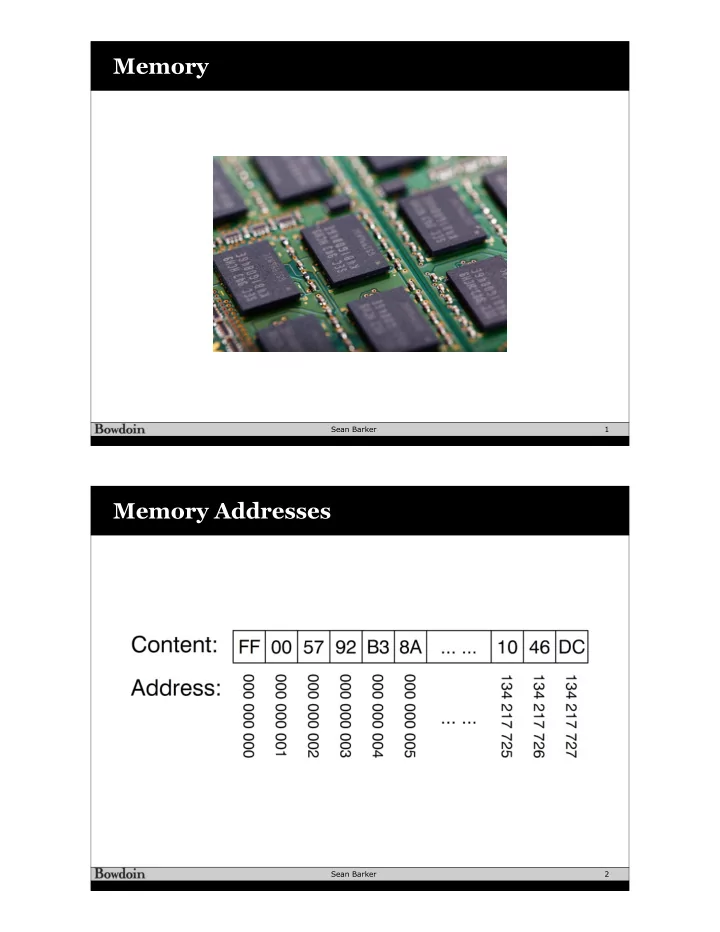
Memory Sean Barker 1 Memory Addresses Sean Barker 2 Endianness - - PDF document

memory
SMART_READER_LITE
LIVE PREVIEW

Memory Sean Barker 1 Memory Addresses Sean Barker 2 Endianness - - PDF document

Memory Sean Barker 1 Memory Addresses Sean Barker 2 Endianness int x = 0x01234567; // stored at address 0x100 Big Endian 0x100 0x101 0x102 0x103 01 01 23 23 45 45 67 67 Little Endian 0x100 0x101 0x102 0x103 67 45 23 01 67 45


slide-1
SLIDE 1

Sean Barker

Memory

1 Sean Barker

Memory Addresses

2
slide-2
SLIDE 2

Sean Barker

Endianness

3

0x100 0x101 0x102 0x103

67 45 23 01 Little Endian 67 45 23 01

0x100 0x101 0x102 0x103

01 23 45 67 Big Endian 01 23 45 67

int x = 0x01234567; // stored at address 0x100

Sean Barker

Sample Memory

4

0x20 0x1C 80 00 00 00 0x18 0x14 00 00 00 FF 0x10 0x0C 0x08 0x04 00 00 00 13 0x00 0x03 0x02 0x01 0x00 byte offset (little endian order)

Address

slide-3
SLIDE 3

Sean Barker

Variables as Addresses

5

int x; // x at 0x1C int y; // y at 0x08 x = 1; y = 0x30FA2B93;

0x20 00 00 00 01 0x1C 0x18 0x14 0x10 0x0C 30 FA 2B 93 0x08 0x04 0x00 0x03 0x02 0x01 0x00 byte offset (little endian order)

Address

x y

0x20 0x1C 0x18 0x14 0x10 0x0C 0x08 0x04 0x00 0x03 0x02 0x01 0x00 byte offset (little endian order)

Address

Sean Barker

Java References

6

class Blob { // ... instance variables ... } public void doStuff() { Blob b1 = new Blob(); Blob b2 = new Blob(); }

slide-4
SLIDE 4

Sean Barker

Java References (continued)

7

class Blob { // ... instance variables ... } public void doStuff() { Blob b1 = new Blob(); Blob b2 = b1; }

Sean Barker

Pointers

address = index of a byte in memory pointer = a piece of data storing an address

8

T* p; declare a pointer p that will point to something of type T &x address of x (get a pointer to x) *p contents at address given by pointer p (aka “dereference p” – follow the pointer)

slide-5
SLIDE 5

0x20 0x1C 0x18 0x14 0x10 0x0C 0x08 0x04 0x00 0x03 0x02 0x01 0x00 byte offset (little endian order)

Sean Barker

Pointer Example

9

int* p; // p: 0x10 int x = 8; // x: 0x1C int y = 3; // y: 0x08 p = &x; y = 1 + *p; *p = 100;

0x20 00 00 00 08 0x1C 0x18 0x14 0x10 0x0C 00 00 00 03 0x08 0x04 0x00 0x03 0x02 0x01 0x00 byte offset (little endian order)

x y p

0x20 00 00 00 08 0x1C 0x18 0x14 00 00 00 1C 0x10 0x0C 00 00 00 03 0x08 0x04 0x00 0x03 0x02 0x01 0x00 byte offset (little endian order)

x y p

0x20 00 00 00 08 0x1C 0x18 0x14 00 00 00 1C 0x10 0x0C 00 00 00 09 0x08 0x04 0x00 0x03 0x02 0x01 0x00 byte offset (little endian order)

x y p

0x20 00 00 00 64 0x1C 0x18 0x14 00 00 00 1C 0x10 0x0C 00 00 00 09 0x08 0x04 0x00 0x03 0x02 0x01 0x00 byte offset (little endian order)

x y p

void do_something(int* p1, int* p2) { int temp = *p1; *p1 = *p2; *p2 = temp; }

Sean Barker

Pointer Example

10

void main() { int x = 5; int y = 3; printf(“%d %d\n”, x, y); // “5 3” do_something(&x, &y); // swap! printf(“%d %d\n”, x, y); // “3 5” }

slide-6
SLIDE 6

int a[5]; // creation a[0] = 0xFF; // indexing a[3] = a[0]; a[5] = 0xBAD; // uh oh a[-1] = 0xBAD; // x2 a.length; // nope!

Sean Barker

Arrays in C

11

0x20 0x1C 0x18 0x14 0x10 0x0C 0x08 0x04 0x00 0x03 0x02 0x01 0x00 byte offset (little endian order)

a[0] a[4] a[0]

0x20 0x1C 0x18 0x14 0x10 0x0C 0x08 0x04 0x00 0x03 0x02 0x01 0x00 byte offset (little endian order)

a[4]

p

int a[5]; int* p;

Sean Barker

Arrays as Pointers

12

slide-7
SLIDE 7

a[0]

0x20 0x1C 0x18 0x14 0x10 0x0C 0x08 0x04 0x00 0x03 0x02 0x01 0x00 byte offset (little endian order)

a[4]

p

int a[5]; int* p; p = &a[0];

Sean Barker

Arrays as Pointers

13

a[0]

0x20 0x1C 0x18 0x14 0x10 0x0C 0x08 00 00 00 0C 0x04 0x00 0x03 0x02 0x01 0x00 byte offset (little endian order)

a[4]

p

int a[5]; int* p; p = &a[0];

Sean Barker

Arrays as Pointers

14

slide-8
SLIDE 8

a[0]

0x20 0x1C 0x18 0x14 0x10 0x0C 0x08 00 00 00 0C 0x04 0x00 0x03 0x02 0x01 0x00 byte offset (little endian order)

a[4]

p

int a[5]; int* p; p = &a[0]; // or p = a;

Sean Barker

Arrays as Pointers

15

a[0]

0x20 0x1C 0x18 0x14 0x10 0x0C 0x08 00 00 00 0C 0x04 0x00 0x03 0x02 0x01 0x00 byte offset (little endian order)

a[4]

p

int a[5]; int* p; p = a; // &a[0] *p = 0xA;

Sean Barker

Arrays as Pointers

16

slide-9
SLIDE 9

a[0]

0x20 0x1C 0x18 0x14 0x10 00 00 00 0A 0x0C 0x08 00 00 00 0C 0x04 0x00 0x03 0x02 0x01 0x00 byte offset (little endian order)

a[4]

p

int a[5]; int* p; p = a; // &a[0] *p = 0xA;

Sean Barker

Arrays as Pointers

17

a[0]

0x20 0x1C 0x18 0x14 00 00 00 0B 0x10 00 00 00 0A 0x0C 0x08 00 00 00 0C 0x04 0x00 0x03 0x02 0x01 0x00 byte offset (little endian order)

a[4]

p

int a[5]; int* p; p = a; // &a[0] *p = 0xA; p[1] = 0xB;

Sean Barker

Arrays as Pointers

18

slide-10
SLIDE 10

a[0]

0x20 0x1C 0x18 0x14 00 00 00 0B 0x10 00 00 00 0A 0x0C 0x08 00 00 00 0C 0x04 0x00 0x03 0x02 0x01 0x00 byte offset (little endian order)

a[4]

p

int a[5]; int* p; p = a; // &a[0] *p = 0xA; p[1] = 0xB; *(p + 1) = 0xB;

Sean Barker

Pointer Arithmetic

19

Equivalent!

a[0]

0x20 0x1C 0x18 0x14 00 00 00 0B 0x10 00 00 00 0A 0x0C 0x08 00 00 00 0C 0x04 0x00 0x03 0x02 0x01 0x00 byte offset (little endian order)

a[4]

p

int a[5]; int* p; p = a; // &a[0] *p = 0xA; *(p + 1) = 0xB; p = p + 2; *p = a[1] + 1;

Sean Barker

Pointer Arithmetic

20

slide-11
SLIDE 11

a[0]

0x20 0x1C 0x18 00 00 00 0C 0x14 00 00 00 0B 0x10 00 00 00 0A 0x0C 0x08 00 00 00 14 0x04 0x00 0x03 0x02 0x01 0x00 byte offset (little endian order)

a[4]

p

int a[5]; int* p; p = a; // &a[0] *p = 0xA; *(p + 1) = 0xB; p = p + 2; *p = a[1] + 1;

Sean Barker

Pointer Arithmetic

21 Sean Barker

Null-Terminated Strings

22

0x43 0x53 0x43 0x49 0x20 0x32 0x33 0x33 0x30 0x00 ‘C’ ‘S’ ‘C’ ‘I’ ‘ ‘ ‘2’ ‘3’ ‘3’ ‘0’ ‘\0’

null character

slide-12
SLIDE 12

Sean Barker

Memory Layout

23

Function context, local variables Persistent data structures Global variables String literals Program code (instructions) Addresses

Sean Barker

Dynamic Memory Allocation Example

24

#define ZIP_LENGTH 5 int* zip = (int*) malloc(sizeof(int) * ZIP_LENGTH); if (zip == NULL) { perror(“malloc failed”); exit(0); } zip[0] = 0; zip[1] = 4; zip[2] = 0; zip[3] = 1; zip[4] = 1; printf(“zip is”); for (int i = 0; i < ZIP_LENGTH; i++) { printf(“ %d”, zip[i]); } printf(“\n”); free(zip);

0x7fedd2400dcc 0x7fedd2400dc8 0x7fedd2400dc4 0x7fedd2400dc0 0x7fff58bdd938 0x7fedd2400dd0 1 8 4 2 0x7fedd2400dc0

zip

4 1 1 4 1 1 +0 +4 +8 +12 +16 +20 zip

slide-13
SLIDE 13

Sean Barker

Pointers to Pointers to ...

25

#define NUM_ZIPS 3 int** zips = (int**) malloc(sizeof(int*) * NUM_ZIPS); ... zips[0] = (int*) malloc(sizeof(int) * ZIP_LENGTH); ... int* first_zip = zips[0]; first_zip[0] = 0; zips[0][1] = 4; zips[0][2] = 0; first_zip[3] = 1; zips[0][4] = 1;

zips 4 1 1 ??? ???