Memory Management Logical vs. physical address space Fragmentation - - PDF document

memory management
SMART_READER_LITE
LIVE PREVIEW

Memory Management Logical vs. physical address space Fragmentation - - PDF document

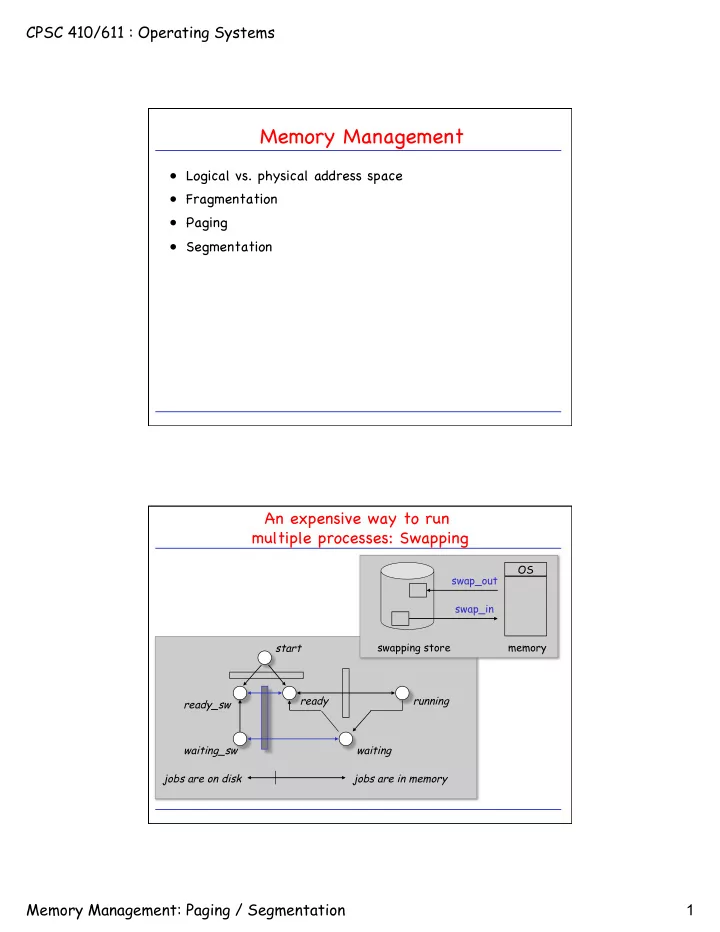
CPSC 410/611 : Operating Systems Memory Management Logical vs. physical address space Fragmentation Paging Segmentation An expensive way to run multiple processes: Swapping OS swap_out swap_in start swapping store memory


slide-1
SLIDE 1

CPSC 410/611 : Operating Systems Memory Management: Paging / Segmentation 1

Memory Management

  • Logical vs. physical address space
  • Fragmentation
  • Paging
  • Segmentation

An expensive way to run multiple processes: Swapping

waiting running start ready jobs are in memory jobs are on disk waiting_sw ready_sw OS swap_out swap_in swapping store memory

slide-2
SLIDE 2

CPSC 410/611 : Operating Systems Memory Management: Paging / Segmentation 2

Memory Management

Observations: 1. Process needs at least CPU and memory to run.

  • 2. CPU context switching is relatively cheap.

3. Swapping memory in/out from/to disk is expensive. So, we need to subdivide memory to accommodate multiple processes! Q: How do we manage this memory?

Requirements for Memory Management

  • Relocation

– We do not know a priori where memory of process will reside.

  • Protection

– No uncontrolled references to memory locations of other processes. – Memory references must be checked at run-time.

  • Sharing

– Ability to share data portions and program text portions.

  • Logical organization

– Take advantage of semantics of use. – Data portions (read/write) vs. program text portions (read

  • nly).
  • Memory hierarchy

– RAM vs. secondary storage – Swapping

slide-3
SLIDE 3

CPSC 410/611 : Operating Systems Memory Management: Paging / Segmentation 3

physical address space of process Pi CPU

< +

OS relocation register limit register addressing error! logical address space of process Pi Memory Management Unit Physical Memory

Logical vs. Physical Memory Space

process base size P1 28 1000 P2 1028 3000 P3 5034 250

partition table

  • Logical address: address as seen by the process (i.e. as seen by the CPU).
  • Physical address: address as seen by the memory.

OS 8MB 2MB

Internal Fragmentation

4MB 8MB 12MB

?!

Problem with simple Relocation: Fragmentation

External Fragmentation

P4

?

P1 P1 P2 P1 P2 P3 P1 P3

slide-4
SLIDE 4

CPSC 410/611 : Operating Systems Memory Management: Paging / Segmentation 4

Paging

  • Contiguous allocation causes (external) fragmentation.
  • Solution: Partition memory blocks into smaller subblocks (pages)

and allow them to be allocated non-contiguously.

Memory Management Unit logical memory physical memory

simple relocation

Memory Management Unit logical memory physical memory

paging

Basic Operations in Paging Hardware

Memory Management Unit CPU physical memory p d f d f p page table

d

Example: PDP-11 (16-bit address, 8kB pages)

slide-5
SLIDE 5

CPSC 410/611 : Operating Systems Memory Management: Paging / Segmentation 5

Internal Fragmentation in Paging

  • Example:

logical memory 13300B page size 4kB physical memory

  • Last frame allocated may not be completely full.
  • Average internal fragmentation per block is typically half frame size.
  • Large frames vs. small frames:
  • Large frames cause more fragmentation.
  • Small frames cause more overhead (page table size, disk I/O)

4084 bytes wasted!

Implementation of Page Table

  • Page table involved in every access to memory. Speed very

important.

  • Page table in registers?

– Example: 1MB logical address space, 2kB page size; needs a page table with 512 entries!

  • Page table in memory?

– Only keep a page table base register that points to location

  • f page table.

– Each access to memory would require two accesses to memory!

  • Cache portions of page table in registers?

– Use translation lookaside buffers (TLBs): typically a few dozens entries. – Hit ratio: Percentage of time an entry is found. Hit ratio must be high in order to minimize overhead.

slide-6
SLIDE 6

CPSC 410/611 : Operating Systems Memory Management: Paging / Segmentation 6

Hierarchical (Multilevel) Paging

  • Problem: Page tables can become very large! (e.g. 32-bit address space?)
  • Solution: Page the page table itself! (e.g. page directory vs. page table)
  • Two-level paging:

– Example: 32 bit logical address, page size 4kB

  • Three-level paging (SPARC), four-level paging (68030), ...
  • AMD64 (48-bit virtual addresses) has 4 levels.
  • Even deeper for 64 bit address spaces (5 to 6 levels)

f d f

page table (10)

  • ffset(12)

page directory (10) page table base register

Variations: Inverted Page Table

process id page no 1 2 3 … n page no proc id

  • ffset
  • ffset

3

  • Array of page numbers indexed by frame number.

– page lookup: search for matching frame entry

  • Size scales with physical memory.
  • Single table for system (not per process)
  • Used in early virt. memory systems, such as the

Atlas computer.

  • Not practical today. (Why?)
slide-7
SLIDE 7

CPSC 410/611 : Operating Systems Memory Management: Paging / Segmentation 7

Variations: Hashed Page Table

  • Used by many 64bit

architectures: – IBM POWER – HP PA-RISC – Itanium

  • Scales with physical memory
  • One table for whole system

cons:

  • How about collisions?
  • Difficult to share memory

between processes

page number

  • ffset

hash function proc id page no chain frame no

Software-loaded TLBs: Paging - MIPS Style

ASID VPN Address within page Address within frame PFN VPN/Mask ASID PFN Flags PFN Flags Process no. Program (virtual) address TLB Page table (in memory)

refill when necessary

Physical address

slide-8
SLIDE 8

CPSC 410/611 : Operating Systems Memory Management: Paging / Segmentation 8

Recap: Memory Translation -- “VAX style”

  • 1. Split virtual address
  • 2. Concatenate more-significant bits with Process ASID to

form page address.

  • 3. Look in the TLB to see if we find translation entry for

page.

  • 4. If YES, take high-order physical address bits.

– (Extra bits stored with PFN control the access to frame.)

  • 5. If NO, system must locate page entry in main-memory-

resident page table, load it into TLB, and start again.

Memory Translation -- MIPS Style

  • In principle: Do the same as VAX, but with as little

hardware as possible.

  • Apart from register with ASID, the MMU is just a TLB.
  • The rest is all implemented in software!
  • When TLB cannot translate an address, a special

exception (TLB refill) is raised.

  • Note: This is easy in principle, but tricky to do

efficiently.

slide-9
SLIDE 9

CPSC 410/611 : Operating Systems Memory Management: Paging / Segmentation 9

MIPS TLB Entry Fields

  • VPN: higher order bits of

virtual address

  • ASID: identifies the address

space

  • G: if set, disables the

matching with the ASID

VPN ASID G PFN Flags N D V

input

  • utput
  • PFN: Physical frame number
  • N: 0 - cacheable, 1 -

noncacheable

  • D: write-control bit (set to 1 if

writeable)

  • V: valid bit

MIPS Translation Process

  • 1. CPU generates a program (virtual) address on a instruction fetch,

a load, or a store.

  • 2. The 12 low-end bits are separated off.
  • 3. Case 1: TLB matches key:
  • 1. Matching entry is selected, and PFN is glued to low-order bits
  • f the program address.
  • 2. Valid?: The V and D bits are checked. If problem, raise

exception, and set BadVAddr register with offending program address.

  • 3. Cached?: IF C bit is set, the CPU looks in the cache for a copy
  • f the physical location’s data. If C bit is cleared, it neither

looks in nor refills the cache.

  • 4. Case 2: TLB does not match: TLB Refill Exception (see next page)
slide-10
SLIDE 10

CPSC 410/611 : Operating Systems Memory Management: Paging / Segmentation 10

TLB Refill Exception

  • Figure out if this was a correct translation. If not, trap to

handling of address errors.

  • If translation correct, construct TLB entry.
  • If TLB already full, select an entry to discard.
  • Write the new entry into the TLB.

Segmentation

  • Users think of memory in terms of segments (data, code, stack, objects, ....)
  • Data within a segment typically has uniform access restrictions.

Memory Management Unit

logical memory physical memory

paging segmentation

Memory Management Unit

logical memory physical memory

slide-11
SLIDE 11

CPSC 410/611 : Operating Systems Memory Management: Paging / Segmentation 11

Segmentation Hardware

Memory Management Unit CPU physical memory s d s segment table limit base <? +

Advantages of Segmentation

  • Data in a segment typically semantically related
  • Protection can be associated with segments

– read/write protection – range checks for arrays

  • Data/code sharing
  • Disadvantages?

physical memory

s d

s

limit base

<? +

s d

s

limit base

<? +

sharing

slide-12
SLIDE 12

CPSC 410/611 : Operating Systems Memory Management: Paging / Segmentation 12

10bit page# page

  • ffset

6bit

Solution: Paged Segmentation

  • Example: MULTICS

segment number

  • ffset

18bit 16bit Problem: 64kW segments -> external fragmentation! segment number 18bit 10bit page# page

  • ffset

6bit Problem: need 2^18 segment entries in segment table! 8bit 10bit page# page

  • ffset

Solution: Page the segments. Solution: Page the segment table.