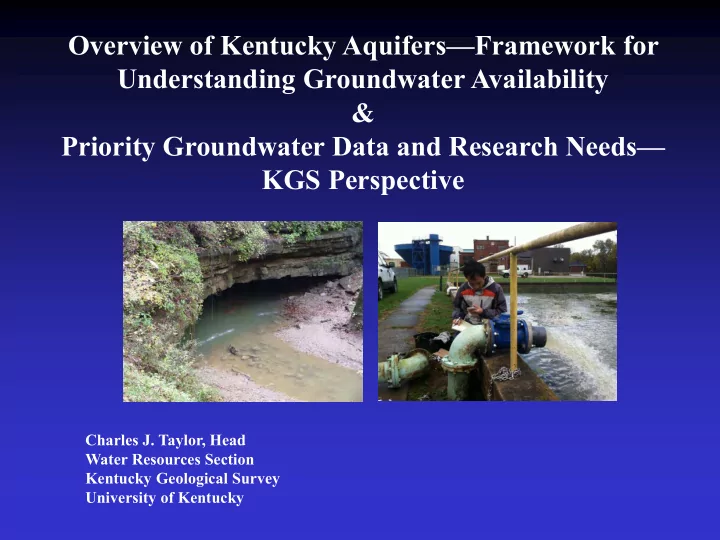
SLIDE 1 Overview of Kentucky Aquifers—Framework for Understanding Groundwater Availability & Priority Groundwater Data and Research Needs— KGS Perspective
Charles J. Taylor, Head Water Resources Section Kentucky Geological Survey University of Kentucky
SLIDE 2 Classical Definition of An Aquifer
A geological formation that is sufficiently permeable to transmit ground water and yield economically sufficient quantities of water to wells and springs.
“Aquifers come in many shapes and sizes but they are really a contained underground repository of water” –Steve Phillips, USGS, Sacramento
SLIDE 3
A Few More Aquifer Definitions:
Unconfined aquifer - An aquifer having a water table surface, open to atmospheric pressure. Confined aquifer - An aquifer bounded above and below by impermeable or lower permeability beds, with water under artesian or confining pressure (greater than atmospheric pressure). Confining unit (Aquitard)- A body of impermeable or distinctly less permeable material that restricts flow into or out an adjacent aquifer. Hydraulic head—is the height that water will rise in a well due to natural conditions in the aquifer, particularly the kinetic and potential energy of groundwater at that location. Groundwater moves from areas of higher hydraulic head to areas of lower hydraulic head.
SLIDE 4 Greater Storage and Flow Rate
Porosity and Permeability Are the Primary Factors Controlling Groundwater Occurrence & Availability
Intergranular Fracture Solution (Karstic)
SLIDE 5
A Look At Fracture and Solution Permeability In Limestone Well in Elizabethtown, Ky
SLIDE 6 Characteristics of an “Ideal” or Good Aquifer
Made of Highly Porous, Permeable, and Mostly Homogenous Geological Materials Good Saturated Thickness; Below Elevation for Base- Level Drainage Water Can Be Extracted at a Rate/Quantity Needed for Uses Geographically Extensive Water Quality Is Suitable for Intended Uses Gets Enough Recharge and Stores Enough Groundwater to Maintain Sustainability
SLIDE 7
In Reality Aquifers are Zones Within Complex Groundwater Flow Systems and Characteristics Vary
Groundwater Availability depends on What Parts of the System a Well Penetrates, the Capture Zone or Contributing Area of the Well (or Spring) and What are the Local and Regional Hydrogeologic Factors That Control Groundwater Recharge, Storage, and Flow.
SLIDE 8 In Ky Layered Stratigraphy and Topography Affect Groundwater Occurrence and Availability
Above Drainage Level Below Drainage
Dry Hole Seasonal Well Reliable Well
Above drainage, aquifers are more likely to be geographically and hydrologically isolated, and have limited recharge area.
SLIDE 9 Groundwater Moving at Different Rates and Along Different Flow Paths Affects Groundwater Recharge, Residence Time, and Groundwater Quality
Longer time of Rock Interaction Between Water and Rock Results in Increased Dissolved Mineral Content Recharge may occur at Different Time Scales Less Recharge is Available to Deeper Aquifers If Withdrawal Rates are Greater than Recharge Rates, Aquifer May be Depleted (True Regardless of Depth)
GW Flow Paths and Residence Times Also Affect Vulnerability of Aquifer (and Wells) to Contamination.
SLIDE 10
Water Levels and Response to Precip Recharge Varies In Wells Depending on Aquifer Hydraulic/ Hydrogeologic Conditions
A: Fractured Sandstone aquifer—rapid recharge, slower drainage. B: Karst Limestone aquifer—rapid recharge and drainage (“flashy” response).
SLIDE 11 Kentucky Aquifers
Kentucky is a Topographically and Geologically Diverse State.
- Aquifers are equally diverse.
Geological Materials that Serve as Aquifers include:
- Unconsolidated Sand and Gravel Deposits.
- Fractured Sandstones, Shales or Siltstones, and Coal.
- Fractured and Karstic Limestone and Dolostone.
- Porosity and Permeability Varies Greatly Among these Aquifer
Materials.
- Hence, Groundwater Storage, Flow, and Availability Varies
Greatly Depending on the Occurrence and “Arrangements” of these Aquifer Materials.
- Natural Groundwater Quality is Also Highly Variable.
SLIDE 12 Geologic Map of Kentucky
Precambrian; >570 mya;
(igneous and metamorphic rock)
Quaternary; 2 mya; sand, clay, gravel Quaternary and Tertiary; 1-5 mya; gravel and sand Tertiary; 30 mya; clay and sand Tertiary and Cretaceous; 60-70 mya; sand and clay Mississippian; 325-360 mya; shale, limestone and sandstone Devonian; 360-410 mya; shale and limestone Silurian; 410-440 mya; dolomite and shale Ordovician; 440-510 mya; limestone, dolomite, shale Cambrian; 510-570 mya;
dolomite, sandstone and shale
Cretaceous; 85-95 mya; gravel and sand Pennsylvanian; 290-325 mya; shale, sandstone and coal
A A B B
B A B A
A' A A' B B' B B' A
SLIDE 13 Ky Aquifer Systems by Physiographic Region
Rob Blair, DOW
Western Coal Field Inner Bluegrass Karst Mississippian Plateau Karst Eastern Coal Field
Jackson Purchase
Ohio River Alluvium
SLIDE 14
Principle Aquifers of the United States—
USGS HA 730-K Seg.10 (Lloyd and Lyke, 1995) Appalachian Plateaus aquifers Interior Low Plateaus aquifers
Surficial aquifers Mississippian Embayment
SLIDE 15
Ohio River Alluvial Aquifer
Highly productive unconsolidated sand and gravel deposits along Ohio and lower Green River. Thicker deposits of alluvium along many Ky streams serve as important local aquifers.
SLIDE 16 Riverbank Infiltration and Pumping-Induced Recharge from Streams
Louisville Water Company Pilot- Scale Horizontal Collector Well Horizontal- Collector or Ranney Well Construction
SLIDE 17
Jackson Purchase Mississippian Embayment aquifer system
Highly Productive Layered Aquifer System of Semi-Consolidated Sands and Alternating Clayey Confining Layers. Part of Much Larger Mississippian Embayment Regional Aquifer System (MERAS)
SLIDE 18
Two of the Major Aquifer Zones in the JPA
SLIDE 19 Purchase Area Aquifers Are Among State’s Most Productive and Are of Interest for High-Yield Irrigation Wells
Aquifer Thickn ess (ft) Hydraulic Conductivity (gpd/ft2) Transmissivity (gpd/ft) Specific Capacity (gpm/ft) Well Yields (gpm) Mississippi River Valley Alluvial Aquifer 0-1001 2,0006 170,0006 > 10002,3 0-2002 Upper Claiborne Aquifer 0-3001 ≤ 3002 Middle Claiborne Aquifer 0-2001 2,0005 300,0005 545 > 10002,3 0-4002 Lower Claiborne-Upper Wilcox Aquifer 0-4001 Middle Wilcox Aquifer 0-2001 < 1002 Lower Wilcox Aquifer 0-2001 125 < 1002 McNairy-Nacatoch Aquifer 0-4001 32,0004 1-274 > 10002,3
1Lloyd and Lyke, 1995 4Boswell and others, 1965 6Boswell and others, 1968 (Data used from 2Davis and others, 1971 5Hosman and others, 1968
Dyer, Tennessee.)
3Davis and others, 1973
SLIDE 20
Interior Low Plateaus Mississippian aquifers
Karst limestone aquifers, capped in places with fractured sandstones.
SLIDE 21 Cross- section of Mammoth Cave Area Limestone and Sandstone Aquifers
Right: Diagram to illustrate change in depth of fresh water circulation and water quality in limestone bedrock.
SLIDE 22 Hydrogeologic Setting and Features Typical
- f Mississippian Low Plateau Karst
SLIDE 23 Mississippian Karst Notable for Large Springs
“Spring flows were ranked by minimum annual discharge, which ranged from 0.15-0.68 m3/s.” (2,378 – 10,780 gpm)
SLIDE 24
Interior Low Plateaus Ordovician-Silurian- Devonian aquifers
SLIDE 25
Hydrogeologic Features of Inner Bluegrass Karst
For comparison with Mississippian karst, springs in the IBK typically range about 0.02 - 0.33 m3/s (269- 5,386 gpm).
SLIDE 26 KY Karst Aquifers Are Highly Compartmentali zed Into Subsurface Basins Similar to Surface Streams
Karst Atlas maps are available for much of Kentucky and can be downloaded as .PDF files from the KGS website: http://www.uky.edu/KGS/water/ research/kaatlas.htm
Dye-tracer tests are used to delineate subsurface flow paths and basin boundaries.
Portion of the Campbellsville 30x60’ quadrangle karst atlas map showing multiple karst basins.
SLIDE 27
Pennsylvanian Clastic Aquifers— Western Coal Field
SLIDE 28 Pennsylvanian Channel Sandstone aquifers in WKy Coal Field
Generalized stratigraphic column showing relation of channel sandstone aquifers to other bedrock units. (Modified from Davis and others, 1974) (Illustrations courtesy
SLIDE 29
Appalachian Plateaus—Eastern Coal Field
SLIDE 30 Typical Eastern Coal Field Stress- Relief Fractured Aquifer System
Above drainage, coal beds and fractured sandstones may be significant perched aquifers. Fractures and interlayered rocks
permeability control downward migration of groundwater.
SLIDE 31 Private Water Wells in (52,000 records).
Distribution of Water Wells in Kentucky Gives Us A Clue as To Groundwater Availability and Suitability of Aquifers
Sources: KGS Groundwater Data Repository; KDOW Certified Water Well Drillers Well Construction Records Irrigation Wells in (1,300 records).
SLIDE 32 Distribution and Withdrawals from Public Groundwater Suppliers
Courtesy of Bill Caldwell, KDOW
SLIDE 33 Summary
- Kentucky is a topographically and geologically diverse state.
- Consequently, our aquifers and their hydrologic characteristics are equally
diverse.
- Groundwater is available in almost all of the state—depending on
requirements/plans for use.
- The most productive granular aquifers are located in thicker and more
permeable sand and gravel deposits along the Ohio River and in JPA- Mississippian Embayment.
- The most productive consolidated (bedrock) aquifers are located in the
Mississippian karst.
- However, highly productive wells can be obtained in many bedrock aquifers
depending on local hydrogeologic conditions and fracture or karst permeability.
- The diversity in aquifer types and the dominance of complex fractured/karst
aquifers contributes to difficulty in mapping aquifers, quantifying their hydrologic properties, and assessing groundwater availability in many parts
SLIDE 34
Questions and Comments