
SLIDE 1
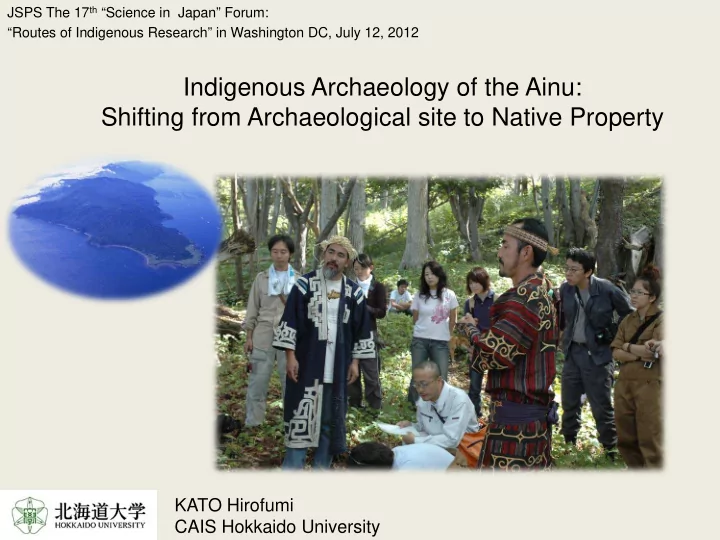
Indigenous Archaeology of the Ainu: Shifting from Archaeological site to Native Property
JSPS The 17th “Science in Japan” Forum: “Routes of Indigenous Research” in Washington DC, July 12, 2012
KATO Hirofumi CAIS Hokkaido University
Indigenous Archaeology of the Ainu: Shifting from Archaeological - - PowerPoint PPT Presentation
JSPS The 17 th Science in Japan Forum: Routes of Indigenous Research in Washington DC, July 12, 2012 Indigenous Archaeology of the Ainu: Shifting from Archaeological site to Native Property KATO Hirofumi CAIS Hokkaido University
JSPS The 17th “Science in Japan” Forum: “Routes of Indigenous Research” in Washington DC, July 12, 2012
KATO Hirofumi CAIS Hokkaido University
Ryukyu People and Ryukyu Culture Main islander Japanese and Japanese Cultural Complex Ainu and Northern Cultural Complex
“Northern, Middle, and Southern Culture”
Tobinitai
Culture (11-13 century)
Satsumon Culture (7-13 century) Ohotsk Culture (4-10 century) Epi-Jomon Culture (BC3-AD4-5) Yayoi Culture (BC5-AD3) Kofun Period (AD3-AD7) Ancient State (AD7-11 century) Medieval State (12-16 century) In Hokkaido Island In the Central part of Japanese Archipelago from Agricultural Society to the State Formation The flow of linear time “Ainu” Culture (13- 19century) Sustainable Hunter-Gatherer Society (Society against the State) The flow of cyclical time
The Difference of the Historical Dynamism between Honshu (main) island and Hokkaido (Northern) islands
Jomon Culture
Ainu’s robe ‘ATSUSHI’ Ainu people as Indigenous people in Japan
■ As useful resources for reconstruction of Past
Minzokugaku Kenkyu 16 (3-4).
*K. Kindaichi pointed out in his book “The research of the Ainu” (1924) ◆The significance and aim of Ainu studies: They have “special value as “living catalogue of primitive society”, “Aborigine in Japanese territory”, and “Paleo-ethnos in Asia”. ( from Kindaichi 1924: 3-5 )
KINDAICHI Kyosuke (1881-1971)
■ “Ainu people are using shell (Margaritifera laevis) as the cuttling tool for millet, this method is similar with custom had been used rice ear cutting by Yayoi period.” ■ ”The Emishi who come out in our literature, was the Ainu. Now the Ainu can
living items still now, and through them we can know our ancient life style. It wil make sense the Ainu studies is important for us.” from “ Shell midden of the Ainu” 1952
駒井和愛(1905-1975)
■The Significance and issues on Ainu archaeology: ① The Ainu culture is very useful resources for interpretation of Japanese prehistoric culture, because of the Ainu culture has strongly conveyed the Jomon tradition in Northeast Japan. ② The Ainu society is very important reference for human history, as a reason why the Ainu society has the most developed social organization in hunter- gatherers. from T. FUJIMOTO 1984 “Issues around the Ainu archaeology”, Hokkaido Koukogakuy 20.
FUJIMOTO Tsuyoshi (1936-2010)
■ Yayoj culture + rice-faming + metal using + domesticated animal (dog, pig, chicken) + estate + class society + transition to early state + craftman and specialization
Jomon culture Yayoi Culture BC.50
Central of Japanese Archipelago Hokkaido Island
Jomon culture AD 3oo Kofun Period Epi- Jomon culture BC.3o
+ hunting and fishing + non domestication (except for dog) + semi-sedentaly life style (especially late stage) + egalitarian society + small population size + reciprocal exchange
①The practice of mainstream archaeology as ethnocentric and particular, colonizing, and in the service of the state. ② It is based on, and generally perpetrates, the value of Western cultures. ③Spacial bias is particularly severe in three variation: artefact density, artefact visibility, and intensity of ground modification. ④It is time to move beyond the colonial strategy of reducing the significance
circumscribing and containing Indigenous interests. based on H. M. Wobst et al. 2010
Picture from C. Gosden 2004 Archaeology and Colonialism
⇒ New concept and practice of Indigenous archaeology in order to solve the issues of current situation in Hokkaido Island. ■ Indigenous archaeology is a form of archaeology, and “research ‘about’ Indigenous peoples to focus on research that is conducted with, and for, Indigenous peoples.” (Wobst 2005) + The background of the emergence of Indigenous archeology, there are issues concerning the preservation and utilization of Indigenous cultural heritage as the follow: 1) Why excavate (the aim of archaeology) ? ⇒Who benefits from archaeological research? 2) How to use archaeological resources? ⇒ Do archaeologist have a right to control the past of other? 3) Who own the past? ⇒For whom the artifacts of archaeology are a living heritage?
研究計画 Research Planning 研究の実施 Investigation 研究成果の還元 Resolving of results and Academic Information
Collaboration with local community / Indigenous people Concern on research ethics Collaboration with local community / Indigenous people Local community and Indigenous people Assessments and suggestions
The World Heritage ‘Shiretoko’
Comparative Studies Worldwide Collaboration
(University of Oklahoma) Ulla Udagaard ( SILLA, National Museum of Denmark)
Ainu people Share of time and memories Local community Researchers Organizing project
Center for Ainu and Indigenous studies
Center for
Tourism studies
1) Organizing field school for students. Instructors are different specialist from USA, Denmark and UK so on. 2) Archaeological field practice for local community members 3) Heritage Management in archaeological sites ( Eco and heritage tour using archaeological sites)
The Concentration of the arms and legs bone of bear with Pottery and arrow heads by obsidian
2009年 出土ヒグマ頭蓋骨 2004年 出土ヒグマ頭蓋骨 Bear skull found in 2004 Dated 15 century by AMS dating Bear skull found in 2009 Dated 17-20 century by AMS dating
Tobinitai culture (ca.900-1200AD) Satsumon culture
(ca.600-1200AD)
Historical “Ainu” Culture
(AD-13 to 19)
Okhotsk culture (ca.300-800AD ) Ikushina site: 18 century Otafuku-iwa site :13 century Cape Chashi-kotsu B site: 11 century Epi-Jomon Culture Ikushina site: 15 century Bear skull found in 2004 Dated 15 century by AMS dating
Using as Indigenous trail tours Local name Archaeological sites/ Sacred sites information Archaeological finds Organizing Exhibition in tourist hotel and Heritage center Constructing DB Back to the community
Canada: University of Alberta, University of Calgary, Simon-Fraser University USA: UCLA, University of Hawaii UK: University of Oxford, University of Cambridge Netherland:University of Leiden Germany: Free University of Berlin Romania: University of Bucharest Taiwan: National Taiwan University Japan: University of Ryukyus, Keio university, Tokyo University, Hokkaido University
Hokkaido Jomon Population 北海道縄文集団 Epi-Jomon Culture 北海道続縄文文化集団 Satsumon Culture 擦文文化集団 Ainu people アイヌ民族 Okhotsk Culture
オホーツク文化集団
■The “historical Ainu” culture was formed on
13century
There are two different cultural lineages before Ainu Culture One of them is Satsumon Culture: + inland territory + cereal agriculture + depend on hunting and fishing Another one is Okhotsk Culture: + coastal distribution + marine hunter-gatherers + bear cult + domestication of pig and dog Both groups were active trader with neighboring area.
Mokhe Culture 靺鞨 AD 6−10c Tokalev Culture 〜AD 5c. Okhotsk Culture 7-10c. Old Kol’yak Culture AD 5-17c.
Balhae 渤海国 698-926
AD 3−4c.:Initial:Susuya phase AD 5−6c.: Early:Towada phase AD 7-8 c.: Middle: Kokumon phase AD 9-10 c. Late:Haritsukemon phase AD 11-13 c. Final:Tobinitai/Motochi phase