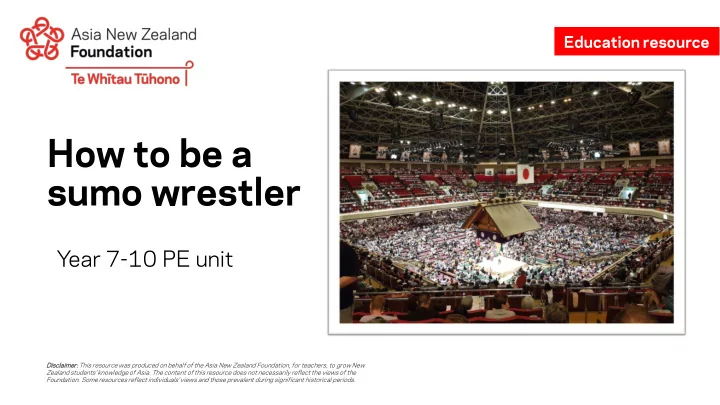
How to be a sumo wrestler Year 7-10 PE unit Discl claim aimer: - - PowerPoint PPT Presentation

how to be a sumo wrestler
SMART_READER_LITE
LIVE PREVIEW

How to be a sumo wrestler Year 7-10 PE unit Discl claim aimer: - - PowerPoint PPT Presentation

Education resource How to be a sumo wrestler Year 7-10 PE unit Discl claim aimer: This resource was produced on behalf of the Asia New Zealand Foundation, for teachers, to grow New Zealand students knowledge of Asia. The content of this


slide-1
SLIDE 1

Education resource

Discl claim aimer: This resource was produced on behalf of the Asia New Zealand Foundation, for teachers, to grow New Zealand students’ knowledge of Asia. The content of this resource does not necessarily reflect the views of the

  • Foundation. Some resources reflect individuals’ views and those prevalent during significant historical periods.

Year 7-10 PE unit

How to be a sumo wrestler

slide-2
SLIDE 2

History

  • Sumo is Japan's oldest sport, dating back to the 5th

century.

  • Sumo started as a Shinto ritual to ask gods for a good
  • harvest. Many of the rituals associated with the sport

trace back to the Shinto religion.

  • Early sumo had few rules and was a rough martial art

involving elements of boxing and wrestling.

  • Sumo was used to train samurai and settle disputes.
  • In the 14th century sumo became a professional sport.
  • In the 16th century sumo wrestlers started touring

Japan.

slide-3
SLIDE 3

Life of a sumo wrestler

  • All sumo wrestlers live in stables where they train, eat and sleep. They

cannot leave the stable without the stable master’s (coach’s) permission.

  • Sumo is hierarchical, with younger and older wrestlers being treated
  • differently. Young wrestlers prepare meals and clean the stable, and
  • lder wrestlers mentor the younger wrestlers.
  • Training starts at 7am and runs until lunchtime. Training involves

stretching, weights training, working on the movements, wrestling each

  • ther and Shinto rituals.
slide-4
SLIDE 4

Life of a sumo wrestler (continued)

  • Lunch is the first meal of the day. Wrestlers eat a dish called

, a large stew with protein such as chicken, eggs, fish and beef, tofu and vegetables. Rice is also eaten.

  • The average sumo wrestler consumes 20,000 calories a day (10

times more than an average male).

  • After lunch, sumo have a sleep and then train again in the

afternoon.

slide-5
SLIDE 5
  • Shubatsu is a purification ceremony. Salt is thrown into the ring to purify it before a

match Shubatsu video

  • Shiko (stomp) - Before a match, wrestlers stomp the ground to scare away evil
  • spirits. Shiko video
  • Wrestlers go back to their corner and receive the

, a ladleful of the “strength water” with which they rinse their mouth, and use the , a piece of paper to wipe their lips afterwards. Pre-match rituals video

  • Once the bout is over, the two wrestlers return to their respective sides and bow
  • again. The loser leaves the ring while the winner squats and makes a swiping motion

with his right hand. If there is prize money for the bout it is handed over by the (referee) on his (war fan).

  • Before picking it up the winner performs a three-stroke motion in the air called
  • tegatana. Tegatana video

Rituals

slide-6
SLIDE 6

Rules

  • The basic aim of Sumo wrestling is to get your opponent out of the

ring, or make them touch any part of the ring with any part of their body apart from their feet.

  • When both wrestlers put their hands on the ground the match

begins.

  • A wrestler is disqualified if they pull hair, eye gouge, hit with a closed

fist, choke or grab the crotch area of their opponent.

  • The match can also end if one of the wrestlers loses his

, or

  • loincloth. The wrestler who loses their loincloth is disqualified.
slide-7
SLIDE 7

Techniques and strategies

  • Shiko: The Shiko movement is part of a Shinto ritual used to scare away

evil spirits. Sumo wrestlers do slow repetitions of hundreds of shiko in a row as a warm up. Shiko video

  • Mata-wari: Full leg splits, with face and chest on the floor. Sumo

wrestlers are extremely flexible and must be able to do the splits. Mata- wari video

  • Suri-ashi: Sliding the feet, in sync with the arms, establishes the basic

posture and movement style for Sumo. It’s critical to stay low and keep connected with the ground. Suri-ashi video

slide-8
SLIDE 8

Techniques and strategies (continued)

  • Tachi-ai: The opening charge in sumo is explosive.

Matches are often won by beating the opponent off the

  • line. Tachi-ai video
  • Koshi-wari: Compress the upper body, and lower your

back, bending the knees. This develops flexibility and strength, training the wrestler to maintain a low stance. Koshi-wari video

slide-9
SLIDE 9

Yokozuna (Grand champion)

  • At the moment there is one

(Grand champion) called Asashōryū Akinori from Mongolia.

  • Once a wrestler reaches the rank of

, he cannot lose the title. However, he is expected to retire as soon as his results start to decline.

  • There have been less than 100

since the 1600s.

  • Photo - From the sumo museum of some of the past
slide-10
SLIDE 10

Tochinoshin

  • Tochinoshin Tsuyoshi is from Georgia and is

currently one of the top sumo wrestlers.

  • Tochinoshin weighs 170kgs and is one of the

tallest wrestlers ever at 1.92m.

slide-11
SLIDE 11

Sumo facts

  • Sumo wrestlers are not allowed to drive cars! This is a rule

enforced by the Sumo Federation after one of their wrestlers had a car crash.

  • The

(the belt a wrestler wears) can be up to 9 metres long.

  • Sumo wrestlers must wear traditional robes, grow their hair and

wear their hair up at all times when in public.

  • There are no weight classes in sumo.
slide-12
SLIDE 12

www.asianz.org.nz