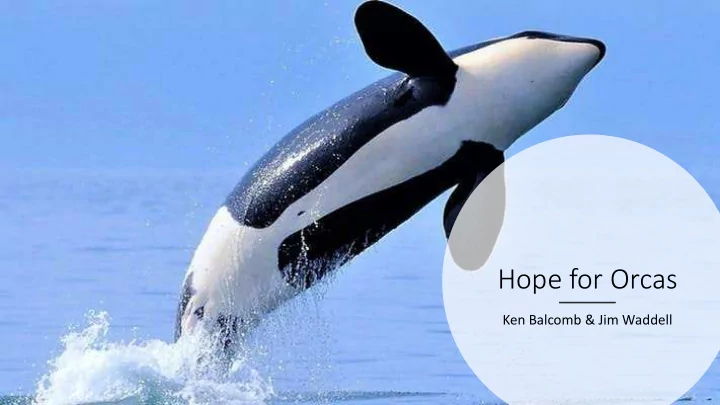
SLIDE 1 Hope for Orcas
Ken Balcomb & Jim Waddell
SLIDE 2 Save Salmon, Save Money, Save Orca
Credit: Center for Whale Research, Ken Balcomb Jim Waddell, Jim Fetter & EPA Region 10
Jim Waddell, Retired Corps of Engineers
SLIDE 3 Salmon and the 4 Lower Snake River Dams
Lower Granite Lower Monumental Little Goose Ice Harbor
SLIDE 4 The 4 Lower Snake River Dams
You are here
SLIDE 5 What does the Corps say?
The Corps of Engineers built and maintain the 4LSRD
http://www.nww.usace.army.mil/Library/2002-LSR-Study/
SLIDE 6 2002 Environmental Impact Statement
7 Years & $33 Million spent on generating the 2002 EIS 4 Alternatives determined and studied
- Alt. 1: Do Nothing
- Alt. 2: Maximum Transport of Juvenile Salmon
- Alt. 3: Major System Improvements (Adaptive Migration)
- Alt. 4: Dam Breaching
“…the chance of meeting NMFS survival and recovery criteria for the four listed species Alt 1 would likely be the same or slightly better than Alternatives 2 and 3. Alternative 4 provides the highest probability of meeting the survival and recovery criteria…... The analyses indicate that further improvements in the hydrosystem passage system are unlikely to recover listed Snake River stocks…”
SLIDE 7 What we’ve tried for salmon since 2002…
Source: USACE, http://www.nwd.usace.army.mil/Media/Fact-Sheets/Fact-Sheet-Article-View/Article/475821/columbia-river-fish-mitigation/
the dams
barges
ladders
Systems
SLIDE 8
“For more than 20 years, the federal agencies have focused on essentially the same approach to saving [Snake River] salmon… Despite billions of dollars spent on these efforts, the listed species continue to be in a perilous state.” Judge Michael Simons, May 2016.
SLIDE 9 $1 billion & 16 years spent
improvements since the 2002 EIS was signed. $1.5B since 1988! Runs < 3% of the historic mean of 10-16 million salmon & up to 30M in Columbia/Snake Billions more on habitat, wasted/sub optimized
YEARLY SALMON COUNTS (LOWER GRANITE)
COST (THOUSANDS) 4LSRD Cost vs. Yearly Salmon Count (Lower Granite)
4LSRD Cost Salmon Counts (Lower Granite)
SLIDE 10
Salmon are declining, despite our current efforts
SLIDE 11 “Figure 4.1. SARs from smolts at uppermost Snake River dam to Columbia River returns (including jacks) for wild Snake River spring/summer Chinook, 1964-2013. … The NPCC (2014) 2%-6% objective for listed wild populations is shown for reference; SAR for 2013 is complete through 2-salt returns only.”
Reference: Fish Passage Center 2015 CSS Annual Report
Wild Salmon Survival
% SAR required for recovery
SLIDE 12 Hatchery Fish Survival
Reference: Fish Passage Center: 2015 Dworshak National Fish Hatchery Report
Figure 9. Weighted SARLGR-to-LGR for Dworshak NFH spring Chinook (1997–2013) and Clearwater-B hatchery steelhead (2008–2012). Migration year 2013 is incomplete for yearling Chinook, with Age 2-salt adult returns through 9/14/2015. http://www.fpc.org/hatchery/dworshakhatchery2015.pdf
% SAR required for recovery
SLIDE 13
What’s the current situation?
(note the scale)
SLIDE 14
Bonneville Power Administration (BPA)
BPA funds the hydro power production (92% of the 4LSRD)
SLIDE 15
Bonneville Power Administrator Briefing Financial Situation
SLIDE 16 Bonneville Power Administration
Historical Priority Firm Power Rates
FY 2010 – 2019
“As wholesale market prices (blue) have trended downward, BPA’s Priority Firm power rates (green) have trended upward.” BPA 2018 Strategic Plan,
SLIDE 17 Bonneville Power Administration
Source: https://transmission.bpa.gov/Business/Operations/Wind/baltwg3.png
surplus hydro power was being sold at to CA $22/MWh
$21/MWh!
SLIDE 18 “BPA’s preference customer and direct-service industry loads have steadily declined since 2014.” BPA 2018 Strategy Report,
Bonneville Power Administration
BPA’s Preference Customer and Direct- Service Industry Loads
SLIDE 19
Bonneville Power Administration
Do We Really Need the 4LSRD?
SLIDE 20
Habitat Funding is the Target for Budget Cutbacks Wind Was “Curtailed” 40 Times In 2017 BPA Has Nearly Zero Days Cash Reserve Customers Are Bailing Out Because of BPA’s High Cost
Bonneville Power Administration
93,000 Hours of Production, Only 2 Hours Were Needed Removing High Cost Under Performing Assets is Only Way Out of Insolvency For BPA
SLIDE 21 4L 4LSRD C Cost/E /Econ
ics: the Bad e Bad
Benefit to Cost ratio over the life of the four dams is $0.15 to $1 Annual expenditures over the last 5 years have exceeded earnings LSR Dams are 2-3 times more expensive than mainstem dams on Columbia Three Turbine rehabs at Ice Harbor are now 3
- 4 times costlier than original
estimates and 10 years behind schedule. Turbine rehabs of remaining 21 turbines not economically viable for BPA thus consumers. Oversupply of power in PNW increasing due to conservation, wind & solar.
SLIDE 22
But There Is A FAST Way Out!
Save Salmon Save Money Save Orca All at the same time in 2018!
SLIDE 23 4L 4LSRD C Cost/E /Econ
ics: the G e Goo
Corrected breach cost now around $340 million, not $2 or $3 billion Benefit to cost ratio is at least $4 to $1, if the hydro power is replaced Power replacement unnecessary and will free up grid space allowing more wind and solar 2000 megawatts of solar alone waiting in BPA’s Integration que! Breaching will save money for BPA/Corps which can be used on higher value dams and habitat restoration efforts. Eg., Puget Sound Near Shore ($400 million needed) Provides 4 thousand more jobs in State Land lease for restored viticulture and orchards could add $15 million a year to State School budgets and $65.8 million in direct economic benefit
SLIDE 24
When we b breach ach t the 4L 4LSRD…
Habitat restoration investments will be optimized in the Snake basin due to large numbers of returning fish that can make use of previous improvements. Opens roughly 80 miles of Chinook spawning and rearing habitat Millions in fish mitigation funding can shift to riparian restoration on lower Snake and habitat work on other tributaries. More Corps funds available to other restoration initiatives, such as Puget Sound Near Shore Restoration. Increased Snake runs relieve fishing and prey pressures on Salish Sea and Coastal stocks, speeding their recovery.
SLIDE 25 When we b breach ach t the 4L 4LSRD…
Harvest
More salmon and steelhead for fisheries, endangered Southern Resident Killer Whales, and other marine mammals and critters. Removes stocks from endangered status thus eliminating incidental take restrictions in mixed stock fisheries. Increased fishing of larger fish has numerous spinoff economic benefits to the State and region.
Hatcheries
Lower Snake Compensation Plan hatcheries built to mitigate salmon losses due to dam construction along mainstem should be closed. Others modified of phased
- ut over time. BPA savings go to other fish and wildlife projects.
SLIDE 26 When we b breach ach t the 4L 4LSRD…
And lets not forget the greater PNW ecosystem..
Greater numbers of larger salmon will increase the amount of biomass and nutrients moving from the ocean to the interior Other endangered aquatic species, such as lamprey and sturgeon, will benefit with breaching Riparian areas in the Snake basin will see sustainable increases in
- verall diversity and population density.
Fewer algae producing reservoirs reduces methane emissions, a powerful global warming gas.
SLIDE 27
But, Can It Be Done and In Time? YES!!
+ =
SLIDE 28
Image from the Corps 2002 EIS… So they did study it!!
SLIDE 29 But, Can It Be Done and In Time? YES!!
Corps can place 4LSRD into a ”non-operational” status without Congressional authorization, since dams do not provide an economic benefit and are causing significant harm to the environment. Since 4LSRD are 92% hydro, BPA pays the breach bill under the allocation rules and the 1980 Power Planning Act as Fish Mitigation. NEPA? The Corps has the 2002 EIS that covers breaching, the only remaining reasonable alternative, can be updated in a matter of months. Breaching via removal of earthen berm portion of dam by controlled hydraulic breach requires little further engineering or complex contracting. Neither the ongoing litigation over the 2014 Federal Biological Opinion nor the Court’s
- rder for a new EIS constrains the Corps from breaching the dams through channel
bypass now. Could and should begin in 2018!
SLIDE 30
How YOU Can Help Breach the 4LSRD
Next week is Action Week! Call each stakeholder and tell them your opinion! Write a post card today and leave it with a Dam Sense Volunteer Talk to your local PUD and Government to put pressure on BPA to breach the 4LSRD
SLIDE 31
What Questions do you have?