Fundamental Symmetries in Nuclear Physics Electroweak Interactions - - PowerPoint PPT Presentation

fundamental symmetries
SMART_READER_LITE
LIVE PREVIEW

Fundamental Symmetries in Nuclear Physics Electroweak Interactions - - PowerPoint PPT Presentation

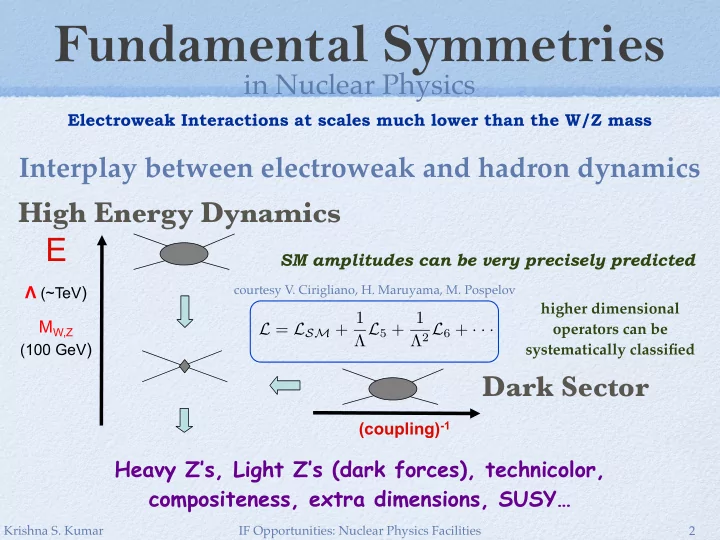
Fundamental Symmetries in Nuclear Physics Electroweak Interactions at scales much lower than the W/Z mass Interplay between electroweak and hadron dynamics High Energy Dynamics E SM amplitudes can be very precisely predicted (~TeV )


slide-1
SLIDE 1

Krishna S. Kumar IF Opportunities: Nuclear Physics Facilities

Fundamental Symmetries

2

Electroweak Interactions at scales much lower than the W/Z mass Λ (~TeV)

E

MW,Z

(100 GeV)

Heavy Z’s, Light Z’s (dark forces), technicolor, compositeness, extra dimensions, SUSY…

L = LSM + 1 ΛL5 + 1 Λ2 L6 + · · ·

higher dimensional

  • perators can be

systematically classified

SM amplitudes can be very precisely predicted

Dark Sector

(coupling)-1

High Energy Dynamics

Interplay between electroweak and hadron dynamics in Nuclear Physics

courtesy V. Cirigliano, H. Maruyama, M. Pospelov

slide-2
SLIDE 2

Krishna S. Kumar IF Opportunities: Nuclear Physics Facilities

Near-Term Planning

3

2013 Subcommittee Report on the Implementation of the 2007 Nuclear Physics Long Range Plan

Tribble Committee Report Section on Fundamental Symmetries

slide-3
SLIDE 3

Krishna S. Kumar IF Opportunities: Nuclear Physics Facilities

Nuclear Facilities Subpanel

4

Current Nuclear User Facilties

ATLAS (Argonne Tandem Linear Accelerator System) here at ANL CEBAF (Continuous Electron Beam Accelerator Facility) at Jefgerson Lab RHIC (Relativistic Heavy Ion Collider) at Brookhaven National Lab

Proposed Facilities

Electron Ion Collider (EIC) Readiness: (b) Significant scientific/ engineering challenges.... Facility for Rare Isotope Beams (FRIB) Readiness: (a) Ready to initiate construction Ton-Scale Neutrinoless Double Beta Decay Experiment(s) Readiness: (b) Significant scientific/ engineering challenges..

All 6 facilities are deemed “absolutely central” to the mission of Nuclear Physics Chaired by R. Redwine (MIT)

slide-4
SLIDE 4

Krishna S. Kumar IF Opportunities: Nuclear Physics Facilities

Nuclear Facilities: Next Decade

(Neutron Beams at NIST) Spallation Neutron Source at Oakridge

Fundamental Neutron Physics Beamline

Polarized Electron Beams at Jefferson Laboratory

Energy Upgrade: ~ 300M$, ~75% complete 12 GeV to a new Hall D , 11 GeV to existing Halls A, B and C pilot beams end of 2013 , first physics beams late 2014

Rare Isotope Facility at Michigan State: FRIB

~600M$ project currently awaiting CD-2 approval (successful review) Physics targeted for ~2020 (based on current funding profile)

Polarized Electron Ion Collider

Currently in conceptual design stage Targeted for endorsement by the next Nuclear Physics Long Range Plan ~0.5 to 1B$ at RHIC (eRHIC) or JLab (ELIC) would be next big construction project after FRIB

5

Impact on Fundamental Symmetries Research

slide-5
SLIDE 5

Krishna S. Kumar IF Opportunities: Nuclear Physics Facilities

Dark Photon Searches Parity Violation

Search for new flavor-conserving neutral current interactions Qweak: elastic electron-proton scattering MOLLER: electron-electron scattering SOLID: electron deep-inelastic scattering

The JLab 12 GeV Upgrade

6

Opportunities

must reach: Λ ~ 10 TeV

Look for tiny but measurable deviations from precisely calculable predictions for SM processes

1 Λ2 L6

6 GeV CEBAF 11 GeV 12

Two 0.6 GeV linacs

1.1

CHL-2

Upgrade magnets and power supplies

Enhanced capabilities

in existing Halls Lower pass beam energies still available

slide-6
SLIDE 6

Krishna S. Kumar IF Opportunities: Nuclear Physics Facilities

Most sensitive result: SLAC E158 (electron-electron scattering)

Parity-Violating Electron Scattering

7

  • Aγ + AZ + Anew
  • 2

→ A2

γ

⌅ 1 + 2 ⇥AZ Aγ ⇤ + 2 ⇥Anew Aγ ⇤⇧

Electromagnetic amplitude interferes with Z-exchange as well as any new physics APV is a function of sin2θW ; precisely predicted

Search for new source of neutral current parity violation

f

2

f

2

l1 l1

Z

multi-TeV scale

Anew ∼ (0.001 − 0.01) · GF

3% SLAC E158

Limits on new contact interactions ~ 0.5 to 1 TeV

slide-7
SLIDE 7

Krishna S. Kumar IF Opportunities: Nuclear Physics Facilities

28 m

LH2 target spectrometer detector array

MOLLER

8

δ(QeW) = ± 2.1 % (stat.) ± 1.0 % (syst.)

δ(APV) = 0.73 parts per billion

APV = 35.6 ppb

Luminosity: 3x1039 cm2/s

75 μA 80% polarized

Flagship electroweak measurement at the upgraded Jefferson Lab facility

δ(sin2θW) = ± 0.00026 (stat.) ± 0.00012 (syst.) ~ 0.1% Matches ¡best ¡collider ¡(Z-­‑pole) ¡measurements! ¡

best contact interaction reach for leptons at low OR high energy

To do better for a 4-lepton contact interaction would require: Giga-Z factory, linear collider, neutrino factory or muon collider

Cost ¡~ ¡20M$ Target ¡run ¡start ¡2017 11 ¡GeV ¡Møller ¡ sca<ering

Le1e2 =

  • i,j=L,R

g2

ij

2Λ2¯ eiγµei¯ ejγµej

Λ

  • |g2

RR − g2 LL|

= 7.5 TeV

QW = 1 − 4 sin2 θW

1 Λ2 L6

+

slide-8
SLIDE 8

Krishna S. Kumar IF Opportunities: Nuclear Physics Facilities 9

SOLID at Jefferson Laboratory

Strategy: sub-1% precision over broad kinematic range for sensitive Standard Model test and detailed study of hadronic structure effects

Simultaneous measurements of ~ 25 (x,Q2) points

Proposed to run in Hall A after 12 GeV Upgrade

APV = GFQ2 2πα a(x) + f (y)b(x)

[ ]

For 2H, assuming charge symmetry, structure functions largely cancel in the ratio:

a(x) = 3 10 (2C1u − C1d)

[ ] +

b(x) = 3 10 (2C2u − C2d ) uv(x) + dv(x) u(x) + d(x) ⎡ ⎣ ⎢ ⎤ ⎦ ⎥ +

APV in Electron-Nucleon DIS: e- N X e- Z* γ*

4 months at 11 GeV 2 months at 6.6 GeV Error bar σA/A (%) shown at center of bins in Q2, x

sea quarks

standard model

higher twist charge symmetry violation

liquid deuterium target CLEO-II Solenoid Ciq’s are functions

  • f sin2θW
slide-9
SLIDE 9

Krishna S. Kumar IF Opportunities: Nuclear Physics Facilities

Physics Reach

10

proposed

low energy published

  • ngoing

MS

)

Z

(M

W

θ

2

sin

0.23 0.231 0.232

Moller ± 0.00029

0,l fb

A 0.23071 ± 0.00053 )

τ

(P

l

A 0.23131 ± 0.00041

(SLD)

l

A 0.23070 ± 0.00026

0,b fb

A 0.23193 ± 0.00029

Z resonance measurements: little sensitivity to new contact interactions

MOLLER (ee) JLab, 11 GeV QWeak (ep) JLab, 1,165 GeV P2 (ep) Mainz, 137 MeV

Sensi6vity ¡to ¡R-­‑ Parity-­‑viola6ng ¡ Supersymmetry Ramsey-Musolf and Su, Phys.

  • Rep. 456 (2008)

E141 E774 KLOE BaBar

ae aΜ

a

Μ

e x p l a i n e d

APEX Test MAMI

For ∆2106

Moller MESA APV Combined 5 10 50 100 500 1000 1107 5107 1106 5106 1105 5105 1104 mZd MeV 2

⇥Z = mZd MZ

  • Dark Photons:

Beyond kinetic mixing; introduce mass mixing with Z

arXiv:1203.2947v2 Davoudiasl, Lee, Marciano

arXiv:1203.1102v1 Buckley and Ramsey-Musolf

150-200 GeV Leptophobic Z’

slide-10
SLIDE 10

Krishna S. Kumar IF Opportunities: Nuclear Physics Facilities

Electron Ion Collider

11

The Proposal:

A high energy, high luminosity (polarized) ep and eA collider and a suitably designed detector Both planned to be STAGED

Two Machine Designs

eRHIC at Brookhaven National Laboratory using the existing RHIC complex ELIC at Jefferson Laboratory using the Upgraded 12GeV CEBAF

  • Ee=10 GeV (5-30 GeV variable)
  • Ep=250 GeV (50-325 GeV Variable)
  • Sqrt(Sep) = 100 (30-200) GeV
  • High energy collisions of polarized electrons and protons and nuclei afford a

unique opportunity to study electro-weak deep inelastic scattering – Electroweak structure functions (including spin) – Significant contributions from W and Z bosons which have different couplings with quarks and anti-quarks

  • Parity violating DIS: a probe of beyond TeV scale physics

– Measurements at higher Q2 than the PV DIS 12 GeV at Jlab – Precision measurement of Sin2ΘW

  • New window for physics beyond SM?

– Lepton flavor violation search

arXiv: 006.5063v1 [hep-ph]

  • M. Gonderinger et al.

“Parasitic” Opportunity: Electroweak & BSM Physics

slide-11
SLIDE 11

Krishna S. Kumar IF Opportunities: Nuclear Physics Facilities

Electron-Tau Conversion

12

  • Limits on LFV(1,3) experimental searches are significantly worse

than those for LFV(1,2)

  • Especially if there are BSM models which specifically allow and

enhance LFV(1,3) over LFV(1,2) – Minimal Super-symmetric Seesaw model

  • J. Ellis et al. Phys. Rev. D66 115013 (2002)

– SU(5) GUT with leptoquarks

  • I. Dorsner et al., Nucl. Phys. B723 53 (2005)
  • P. Fileviez Perez et al., Nucl. Phys. B819 139 (2009)
  • M. Gonderinger & M.Ramsey Musolf, JHEP 1011 (045) (2010);

arXive: 1006.5063 [hep-ph] – 10 fb-1 e-p luminosity @ 90 GeV CM would have potential – Detector & analysis efficiencies assumed 100% – HERA experience: effective efficiencies 5-15%

  • Clearly there is an opportunity for EIC: “icing on the cake”

Search for Charged Lepton Flavor Violation

τ e γ

τ e

A Z,N

( )

X

Detailed MC study in progress: Event Topology

τ → e + γ

e → τ

leptoquark signature HERA Searches

Talk by A. Deshpande in joint session with Charged Leptons Studies validate intial estimates that competitive limits can be obtained with 100 fb-1

slide-12
SLIDE 12

Zheng-Tian Lu Physics Division, Argonne National Laboratory Department of Physics, University of Chicago

  • Search for EDMs
  • Measure the Neutron
  • Test QCD
  • !" #$
slide-13
SLIDE 13

Mass Scale & φCP Sensitivity

γ

e

ψ

ϕ ϕ

  • sinφCP ~ 1 ! M > 5 TeV
  • M ~ 500 GeV!

sinφCP < 10-2

  • “EDMs extremely well motivated by possible CP violation in Hγγ and

possible heavy msusy , should be pushed as far as possible”

  • - Bill Marciano, 4/25/2013

T

EDM Spin EDM Spin

_ + P

EDM Spin

_ + + _

2

sin

f f CP

m d e φ ∝ ⋅ ⋅ Λ Can provide the missing link for explaining matter – antimatter asymmetry

Electroweak baryogenesis. Morrisesy & Ramsey-Musolf, arXiv:1206.2942 (2012)

slide-14
SLIDE 14

Region of Enhancers

Radon (Rn) Francium (Fr) Radium (Ra)

  • Favorable nuclear and atomic properties
  • No stable isotopes
  • Review article: EDM of Nucleons, Nuclei, and Atoms

Engel, Ramsey-Musolf, van Kolck, arXiv:1303.2371 (2013) Present: 225Ra: 107 – 108 /s Radioactive isotope facilities:

  • FRIB (B. Sherrill, MSU) 225Ra: 109 - 1010 /s
  • ISOL@FRIB, Project-X (J. Nolen, Argonne)
  • 1 mA of protons on thorium target
  • 225Ra: 1013 /s, 223Rn: 1011 /s
slide-15
SLIDE 15

! Progress

  • 2007 – Magneto-optical trap (MOT) of radium realized;

J.R. Guest et al., Phys. Rev. Lett. (2007)

  • 2010 – Optical dipole trap (ODT) of radium realized;
  • 2011 – Atoms transferred to the measurement trap;

R.H. Parker et al. Phys. Rev. C (2012)

  • 2012 – Spin precession of Ra-225 observed.

Outlook

  • Next 5 years: 10 – 100 x 10-28 e-cm
  • 2020 and beyond: 1 x 10-28 e-cm *

* at an accelerator-based isotope production facility

We acknowledge support by DOE, Office of Nuclear Physics

Magneto-optical trap 1 mm, 40 µK Ra atoms trapped

slide-16
SLIDE 16

=

a

ω

  • E

E E E

ds d E dt = ×

  • At the magic momentum

the spin and momentum vectors precess at the same rate in an E-field

0.7 / m p GeV c a = =

  • Y. Semertzidis, BNL

Limits and Sensitivities

  • 2020: 0.1 x 10⁻²⁸ e-cm
  • Ultimate: 0.01 x 10⁻²⁸ e-cm

A proposed proton EDM experiment

  • 40 m radius, all-electric storage ring
  • Brookhaven National Lab
  • Fermi Lab: accumulator ring, need polarized proton source
slide-17
SLIDE 17
  • “Clearly, if EDM is found, we will need multiple systems to identify the origin of

new CP violation.” -- B. Filippone, Caltech

  • M. Pospelov, A. Ritz,

Annals Phys.(2005)

slide-18
SLIDE 18
  • B. Filippone, Caltech

Dispersion curves for He-II and free neutrons Golub & Pendlebury

  • Phys. Lett. (1977)

Limits and Sensitivities

  • Current: 300 x 10-28 e-cm
  • Next 5 years: 50 – 100 x 10-28 e-cm
  • 2020 and beyond: 3 – 5 x 10-28 e-cm

%& '((

slide-19
SLIDE 19
  • Dedicated sources and CN beams optimized for particle and nuclear

physics experiments can dramatically increase the physics reach of current and planned experiments

800 MeV p+ 800 MeV p+ Bi(300K)

W W

D2 (70% ortho, 19K) 40L- He Be(20K) 53c m D2O (5cm)

Neutron-Antineutron Oscillations Hadronic Parity Violation Interferometry Neutron EDM Gravitational Bound States Mirror Neutron Search Weak Decays WISPS Limits on Neutron El. Charge Dark Energy Tests

Cold Neutrons UCN Physics Opportunities at the Intensity Frontier:

Project X N-Nbar Source Concept for LANL UCN Source

Ideas (CN) (UCN) (CN or UCN)

  • A. Young, NCState
slide-20
SLIDE 20

"#$%& UCNA and UCNB

Angular correlations using Polarized UCN

UCNτ

Lifetime using magnetically stored UCN (holding time ≈17 s)

(volume ≈ 700 liter)

β-asymmetry ν-asymmetry

All limited by available UCN current...(total production) Roughly factor of 5 before experiments “saturate” potential

0.3% 0.1% 1 s

  • A. Young, NCState
slide-21
SLIDE 21

πl & β

Light squarks, heavy sleptons Light selectrons, heavy squarks & smuons Light smuons, heavy squarks & selectrons Bauman et al ‘12

CKM Unitarity Pion leptonic

Battacharya et al ‘11

Scalar Tensor

Weak Decays LHC

Present

MSSM

Bauman et al ‘12

CKM Unitarity Future

  • M. Ramsey-Musolf,

Wisconsion

slide-22
SLIDE 22

26 April 2013 11

'#()* +

  • Test Fundamental Prediction of QCD Gauge

formalism and factorization

– Does the Sivers’ function change sign?

  • Requires Polarized beam

– Advantage—the beam is a blow torch—Luminosity – Disadvantage—polarized beam is presently virtual – Cost: $6.5M + 65% (contingency and management) = $10.5M

  • P. Reimer, Argonne
slide-23
SLIDE 23

&

  • Fundamental symmetries are of great interests to both particle physics

and nuclear physics communities:

  • EDMs, n-nbar, weak decays…
  • Research opportunities with Project X

(http://projectx.fnal.gov/index.shtml)

  • Partnerships on critical R&D issues among DOE/NP+HEP, NSF/NP+EPP,

NIST

  • Join neutrinos and fundamental symmetries interest group

(https://lansce.lanl.gov/adeps/NuFunSym.shtml) Based on remarks by R. S. Tschirhart, FNAL