Cryptocurrencies Outline and Distributed Electronic payments - - PowerPoint PPT Presentation

cryptocurrencies
SMART_READER_LITE
LIVE PREVIEW

Cryptocurrencies Outline and Distributed Electronic payments - - PowerPoint PPT Presentation

Cryptocurrencies and Distributed Consensus May 2019 Cryptocurrencies Outline and Distributed Electronic payments Consensus Secure transactions Secure execution: contracts PROF. DR. IR. BART PRENEEL COSIC KU LEUVEN, BELGIUM AND IMEC


slide-1
SLIDE 1

Cryptocurrencies and Distributed Consensus May 2019 1

Cryptocurrencies and Distributed Consensus

  • PROF. DR. IR. BART PRENEEL COSIC KU LEUVEN, BELGIUM AND IMEC

FIRSTNAME.LASTNAME@ESAT.KULEUVEN.BE

1

9 MAY 2019

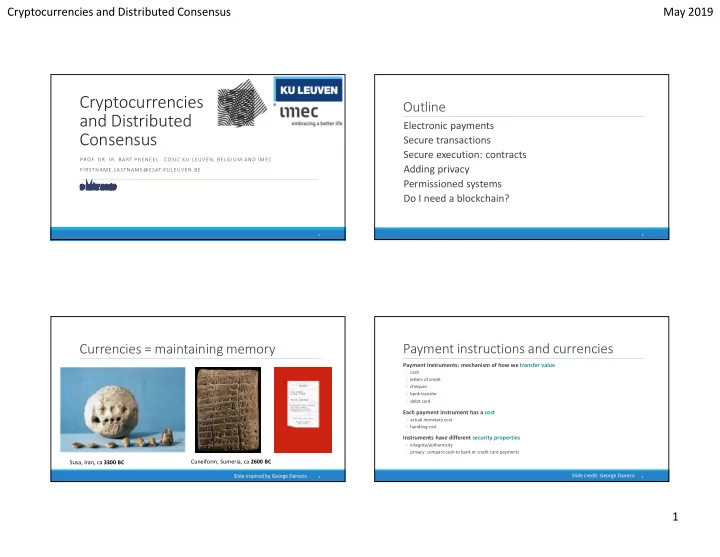
Outline

Electronic payments Secure transactions Secure execution: contracts Adding privacy Permissioned systems Do I need a blockchain?

2

Currencies = maintaining memory

3

Slide inspired by George Danezis

Susa, Iran, ca 3300 BC Cuneiform, Sumeria, ca 2600 BC

Payment instructions and currencies

Payment Instruments: mechanism of how we transfer value

  • cash
  • letters of credit
  • cheques
  • bank transfer
  • debit card

Each payment instrument has a cost

  • actual monetary cost
  • handling cost

Instruments have different security properties

  • integrity/authenticity
  • privacy: compare cash to bank or credit card payments

Slide credit: George Danezis

4

slide-2
SLIDE 2

Cryptocurrencies and Distributed Consensus May 2019 2

5

Cash

bearer instrument

  • ff-line payments

low and medium value privacy, coins not traceable widely accepted bank: risk of forgery, cost of transport user: theft and loss, change, physical presence government: money laundering

200000 400000 600000 800000 1000000 # counterfeit Euro notes

6

€/£/$ Counterfeiting

> 22 billion € notes in circulation with value of € 1.2 trillion 2018: fraudulent: 563,000 or 1 in 39,000

new 5/10/20/50/100+200 € bill in May’13/Sep’14/Nov’15/Apr’17/May’19

1995: $ 15.5 million (1% digitally produced) 2005: $ 61 million (45% digitally produced) 2015: $ 147 million (61% digitally produced) Fraudulent: 1 to 2 in 10,000 $1.2 trillion genuine in 2015 redesign: 1928, 1990, 1996-2003, 2003-2013

2002 to 2018 1999 to 2011 3.5 billion £ notes in circulation with value of £ 70 billion 2016: fraudulent: 347,000 or 1 in 10,000 new 5/10/20 £ bill in ‘16/’17/’20

7

Common features e.g. $/€

pattern detected by scanners and copiers

8

Payment by instruction

Financial Institutions

(clearing and settlement)

Issuer Acquirer Customer Merchant

Communicate through account Payment instruction (credit card slip, cheque) Authorization

  • n-line/off-line
slide-3
SLIDE 3

Cryptocurrencies and Distributed Consensus May 2019 3

9

Payment by instruction

Convenient Reduced risk Identify users: manual signatures, magstripe cards, smart cards Traceable Verification expensive:

  • credit/debit card: on-line, tamper resistant modules
  • check: off-line, delay, processing cost

10

Electronic cash [David Chaum]

Financial Institutions

(clearing and settlement)

Issuer Acquirer Customer Merchant

Withdrawal

  • r load

Payment (cash transfer) Deposit

  • n-line/off-line

11

Electronic cash

Convenient, no physical presence Reduced risk Cost effective for low value Untraceable and unlinkable More expensive than traceable systems, new technology Verification inexpensive:

  • on-line: no tamper resistant modules
  • off-line: reduced risk, doublespending

E-cash is not a new currency: real money (value) sits in the bank

1990-1998

Early examples: MojoNation (2000-2002) and BitTorrent

MojoNation

  • Peer-to-peer file storage service paid with “Mojo”
  • Employed Bram Cohen (BitTorrent) and Zooko
  • Collapsed under hyperinflation

Slide credit: George Danezis

12

BitTorrent

  • Simplification of MojoNation
  • One can think of BitTorrent's tit-for-tat incentives as being time‐limited,

file‐specific, and non‐transferrable bilateral accounting

  • No need for “full” currency
slide-4
SLIDE 4

Cryptocurrencies and Distributed Consensus May 2019 4

Early examples (2): e-gold (1996-2008)

1 million user accounts by 2002 centralized ledger of transactions currency backed by real commodity, gold network of international e-gold resellers Becomes a crime magnet: difficult to identify customers yet easy to transfer internationally

  • US Patriot Act (2001) requires money transmitters to be regulated
  • In 2008 directors face charges of money laundering and operating without a license. They are found

guilty and get away with fines, and suspended sentence.

Asserts liquidated: $90M in gold (more than the central banks of bottom 1/3 countries)

  • California (2010) and other states: all digital value transfer systems are money transmitters

Slide credit: George Danezis

13

Risk of centralized system out of control

14

Bitcoin (2008): Satoshi Nakamoto

No central bank

X

Everyone can produce money Everyone can verify transactions

What is Bitcoin? (2008)

E‐currency with distributed generation and verification of money Transactions

  • irreversible
  • inexpensive
  • over anonymous peer-to-peer network
  • broadcast within seconds and verified within 10 to 60 minutes by inclusion in hash chain
  • double spending prevention using a public decentralized ledger (chaining mechanism)

Pseudonymous

  • Money is linked to public key – can generate arbitrary key pairs and move money around
  • But in many cases identification is possible

15

https://www.youtube.com/watch?v=t5JGQXCTe3c

Hash functions (1975): one-way easy to compute but hard to invert

16

This is an input to a crypto- graphic hash function. The input is a very long string, that is reduced by the hash function to a string of fixed

  • length. There are additional

security conditions: it should be very hard to find an input hashing to a given value (a preimage) or to find two colliding inputs (a collision). 1A3FD4128A198FB3CA345932

f

RIPEMD-160 SHA-256 SHA-512 SHA-3

X

slide-5
SLIDE 5

Cryptocurrencies and Distributed Consensus May 2019 5

Digital signatures (1975): “equivalent” to manual signature

17

Donald agrees to pay to Hillary 100 Bitcoins on Feb. 22 2017 Public key Private key

Merkle tree (1979)

Using a hash function f to authenticate a set of messages through a logarithmic number of values Applications: digital signatures, revocation…

18

root

x12 x5678

Timestamping (1990)

Collect documents and hash them with a Merkle tree Chain these trees together with a hash chain Publish intermediate values on a regular basis

19

f f f

t1 t2 t3

hash chain

Timestamping: Surety Technologies (1994)

20

http://www.surety.com/

https://www.belspo.be/belspo/organisation/Publ/pub_ostc/NO/rNOb007_en.pdf

Belgian TIMESEC project (1996-1998) Estonia: Cybernetica

slide-6
SLIDE 6

Cryptocurrencies and Distributed Consensus May 2019 6

Byzantine generals problem

(can deal with at most 1/3 traitors if permissioned)

21 22

Paying with Bitcoin

naam bedrag

1BxgB4tjcoDnz1LC7bRqyybbE8YNigUQn5

70,00

19EULTY5DMyvDM6krKtcuvcUoHT4T3QmQL

80,02

1CMMwinpNduzooWeJ4sK9u7Lkp4YAyK2Lw

5,00

16PVjaawyWqWnzyttJTAyv7hTcPNmRnVzY

2,50

16LNAxwBQupD7yDC8RUSRhyb62BFAZtgae

0,17

12tQUEb8zzdQSXkgt1553z7zS6Fm1cMQZB

10,00

16VTrwYYCLUNgzB8Xs8fYtWWxHR4wdyHm5

2,30 +1,00

  • 1,00

Donald Hillary

Block chain

23

Paying with Bitcoin

naam bedrag

1BxgB4tjcoDnz1LC7bRqyybbE8YNigUQn5

70,00

19EULTY5DMyvDM6krKtcuvcUoHT4T3QmQL

80,02

1CMMwinpNduzooWeJ4sK9u7Lkp4YAyK2Lw

5,00

16PVjaawyWqWnzyttJTAyv7hTcPNmRnVzY

3,50

16LNAxwBQupD7yDC8RUSRhyb62BFAZtgae

0,17

12tQUEb8zzdQSXkgt1553z7zS6Fm1cMQZB

9,00

16VTrwYYCLUNgzB8Xs8fYtWWxHR4wdyHm5

2,30 Donald Hillary

Block chain

24

Paying with Bitcoin

Donald agrees to pay to Hillary 1 Bitcoin. March 15, 2018 Public key Private key

12tQUEb8zzdQSXkgt15 53z7zS6Fm1cMQZB

slide-7
SLIDE 7

Cryptocurrencies and Distributed Consensus May 2019 7

25

Paying with Bitcoin

Anyone can verify a digital signature Anyone can verify whether the “account” of Donald contains enough money

26

Managing the blockchain

Miners all over the world follow up all the transactions But due to communication errors or fraud there are multiple versions

27

Voting? Sybil attack

28

Puzzles (a lottery) – [Dwork-Naor’92][Hashcash]

slide-8
SLIDE 8

Cryptocurrencies and Distributed Consensus May 2019 8

Why does Bitcoin have value?

The worth of a thing is the price it will bring

29

Market price in USD (market cap  105 B$)

30

2011 bubble 1 Bitcoin  $6,000 2019-05-09 China + Korea ban Cyprus crisis Mount Gox

Market price in USD (market cap  105 B$)

31

1 Bitcoin  $6,000 2019-05-09 China + Korea ban Yet another hack

Coinbase has grown from 5.5M to 20+M clients since Jan. 2017

Only in theory in 2019

How do I get Bitcoin?

32

ATM exchange mine at home

slide-9
SLIDE 9

Cryptocurrencies and Distributed Consensus May 2019 9

Bitcoin Transaction: send money from one

public key (address) to another one

Transaction A In Out Out Transaction B In Out In 50 BTC Transaction C In Out Out Out 10 BTC 5 BTC In 15 BTC 8 BTC 42 BTC 10 BTC 7 BTC 6 BTC

33

Slide credit: F. Vercauteren

Block Chain: a public decentralized ledger

Bitcoin transactions

34

f f f

t1 t2 t3

block chain

(216 Gbyte)

nonce1 nonce2 nonce3 “small” “small” “small”

Block 1 Block 2 Block 3

Also include in every block timestamp and difficulty level of puzzle

35

first transaction in a block is a coinbase transaction: transfers reward + all transaction fees to the miner Block #572932

Mining rewards

Figure by Chris Pacia

36

Total number of Bitcoins is limited to 21 million, each divided in 8 decimal places leading to 21×1014 units

slide-10
SLIDE 10

Cryptocurrencies and Distributed Consensus May 2019 10

Mining difficulty level

Target: mining 1 block should take roughly 10 minutes

mining computing power changes over time; update level every 2016 blocks

37

Mining hash rate of Bitcoin network

38

50 EH/s = 50 ExaHash per second = 50 . 1018 hash/second = 265.4 hash/second (282 hash/day) Exa Peta Tera Giga Mega Kilo

Miners revenue (per day): 10 M$

39

Mining has become industrial

40

Slide credit: Joseph Bonneau

slide-11
SLIDE 11

Cryptocurrencies and Distributed Consensus May 2019 11

Mining equipment on Amazon (Feb. 2017)

41

Sept 2017: $4500 Oct 2017: $3500 Nov 2017: $4098 Dec 2017: $5899 Jun 2018: $1849 Sep 2018: $1000

  • Apr. 2019

Innosilicon T2 Turbo 24 TH/s $1900 1980 Watt 0.08 W/GH

Energy cost: 50 TWh per year (same as Greece)

42

https://digiconomist.net/

Cost of leaderless consensus

Distributed consensus protocol:

  • whichever coalition deploys most hash power, has control of the block chain
  • 5 1019 hash/second is a significant cost.
  • not performing any useful task!

Electricity + Networking costs:

  • 0.10-0.20 W/GH/s or 8000 MWatt
  • @10 cent per KWh: 1 block costs 25-50K$ electricity (12.5 BTC = +/-70 K$)
  • 0.3% of global electricity consumption; 1 transaction “uses” power of 35 US

households in a day

43

Profit calculator: http://www.vnbitcoin.org/bitcoincalculator.php Energy estimates: https://digiconomist.net/bitcoin-energy-consumption

Number of transactions per day

44

2-4 transactions/s Peak: 7 transactions/s large share goes to a few addresses Alipay peak 120.000/s Visa peak 25.000/s Western Union peak: 750/s

slide-12
SLIDE 12

Cryptocurrencies and Distributed Consensus May 2019 12

Cost per transaction

Visa fees: 2-5% Western Union fees: 2-10%

45

transaction fee/block: 0.5-2 BTC average cost per transaction 5-140$ transaction fees: 1-4% of volume

100$ 2%

Bitcoin (Soft) Forks

Communication error (network split) or attack (see later):

Block n Block n+1 Block n+2 Block n+1 Block n+3

46

  • Miners: work on longest chain (most difficult one)
  • If two have same length: choose block that arrived first
  • Transactions in orphan blocks are rebroadcast
  • Transaction is typically accepted after it is included in 6 blocks (60 minutes)

Average block size

47

1 Mbyte

Larger block size?

Higher transaction confirmation throughput

  • More transactions with lower fees

But

  • higher network bandwidth
  • more signature verifications
  • more memory to store unspent transaction output (UTXO)

Different implications for miners and public nodes Resulted in hard forks: Bitcoin cash (Aug’17), Bitcoin Gold (Oct’17) and Bitcoin SV (Nov’18)

48

slide-13
SLIDE 13

Cryptocurrencies and Distributed Consensus May 2019 13

Bitcoin as a currency

Who has control of the money supply in a currency?

  • By convention it follows a well understood and committed curve that will max out
  • Convention enforced by software

Who gets the new money? Who deletes the old money?

  • No money is deleted (if you want a laugh: go suggest random deletions!)
  • Money is created by hashing blocks and adding them to the block chain
  • The miner gets the new coin

How do we make sure we will always remember who has how much money?

  • Large block--chain is recorded by all (May’19 216 GByte!)
  • Authoritative one is the longest – race for aggregate CPU power

Who has it to start with? (Does it matter?)

  • Satoshi Nakamoto

Easy to use? What if something goes wrong?

49

Slide credit: George Danezis

Is Bitcoin is the money of the future?

3 main purposes of money

  • medium of exchange
  • store of value
  • unit of account

50

Computer scientists set the monetary policy We don’t understand Bitcoin

Is Bitcoin is the money of the future?

2013

51

2019

Does Bitcoin offer privacy?

52

slide-14
SLIDE 14

Cryptocurrencies and Distributed Consensus May 2019 14

Limits of pseudonymity

  • Betcoin gambling site was hacked in April 2012
  • 3,171 BTC were stolen in total (2902, 165, 17, and 87 BTC)
  • Did not move until March 15 2013 (BTC goes up)
  • Aggregated with other small addresses into one large address
  • Then began a peeling chain
  • After 10 hops, a peel went to Bitcoin-24,
  • And in another 10 hops a peel went to Mt. Gox

in total, 374.49 BTC go to known exchanges, all directly off the main peeling chain, which originated directly from the addresses known to belong to the thief.

53

Slide credit: George Danezis

Total market cap 186 B$

https://coinmarketcap.com/all/views/all/

54

Total value of all gold? Total value of stock exchange? 7.5 T$ 70 T$

Ethereum (ETH)

https://www.ethereum.org/ https://etherscan.io/

White paper 2013, live July 2015 Smart contract (scripting) functionality: deterministic exchange mechanisms controlled by digital means that can carry out the direct transaction of value between untrusted agents

  • E.g. self-contained fair casinos, currency swaps…

Decentralized Turing-complete virtual machine Currency is called “ether” – internal transaction pricing with “gas” (anti-DDOS and spam) Ethereum forks

  • 2016: DAO hack led to ETC fork (Ethereum classic)
  • Q4/2016: 2 additional forks

Quorum: permissioned ledger developed by Morgan-Stanley on top of Ethereum

55

Ethereum (ETH) (compared to Bitcoin)

block time of 12 s (600 s) memory hard algorithm based on Keccak-256 – almost SHA-3 (SHA-256 on ASICs) 70 transactions per block (2000-2500) smart contracts (limited scripting) more complex reward scheme, linear volume (decreasing to limit

  • f 21 million BTC)
  • reward 5 ETH per block (12.5 BTC per block but decreasing)
  • uncles get reward so no pools (orphans get no reward)

proof-of-work may evolve to proof of stake (no plans) 1 ETH = 1018 wei (1 BTC = 108 satoshi)

56

slide-15
SLIDE 15

Cryptocurrencies and Distributed Consensus May 2019 15

Ethereum (ETH) graphs

57

1 ETH = 171$ 150 THash/sec Market cap 18 B$

Business and governments

tend to dislike

  • distributed control
  • full transparency
  • unclear governance (or anarchy)
  • uncontrolled money supply

58

restrict

  • write, verify or read
  • to non-monetary applications

59

Distributed Ledger: a range of solutions

Public Blockchain

  • No central point of

control by individuals, corporations or governments

  • Permissionless to

participate

  • Concensus based on

“proof of work”

  • Examples:
  • Bitcoin
  • Ethereum

Consortium/Hybrid Blockchain

  • Controlled by more than

two individuals, corporations or governments

  • Permission on

participation from consortium necessary

  • Arbitrary consensus

mechanism

  • Readability of the

blockchain can be public

  • r restricted to the

consortium

  • Example: RSCOIN

(UCLondon) Fully Private Blockchain

  • Controlled by one

individual, corporation or government (no consensus needed)

  • Permission on

participation from owner necessary

  • Readability of the

blockchain can be public

  • r restricted to one

Blockchain opportunities

60

Consensus Provenance Immutability Finality Transparency Accountability

Reduce overheads and controls trusted third parties intermediaries gatekeepers and censors

Cost savings

slide-16
SLIDE 16

Cryptocurrencies and Distributed Consensus May 2019 16

Shared replicated permissioned ledger

61 Party C’s Records Auditor records Counter-party Bank records

re co rd s Ledger L e d g e r

Ledger Party A’s Records Ledger Party B’s Records

Figure https://blogs.wsj.com/cio/2016/02/02/cio-explainer-what-is-blockchain/

All technical building blocks of distributed ledgers were developed by 1990

2015

Shared ledger

Smart contracts: $300M by 2023 (CACG 32%)

https://www.marketresearchfuture.com/reports/smart-contracts-market-4588

62

Permissioned Permissioned Smart Contracts Smart Contracts Consensus Consensus Security and Privacy Security and Privacy

Gartner Hype Cycle Emerging Technologies Cryptocurrencies 2014-2015

63

Gartner Hype Cycle Emerging Technologies Blockchain 2016-2017

64

slide-17
SLIDE 17

Cryptocurrencies and Distributed Consensus May 2019 17

Gartner Hype Cycle Emerging Technologies 2018 and for Blockchain Business

65

Blockchain challenges

66

Scalability Consensus mechanisms Transparency versus privacy Governance of decentralization Key management Cryptography: agility & post- quantum Interoperability Regulation Business cases

Blockchain challenges: scalability

Throughput Latency Storage per node

67

Blockchain challenges: scalability

5 billion users 1000 transactions/year transaction size: 1 Kbyte storage: 5.1015 byte/year = 5 Petabyte/year

68

32 billion IoT devices 31.5 million transactions/device per year transaction size: 1 Kbyte storage: 1021 bytes = 1 Zettabyte/year communications: 256 1012 bit/s = 256 Terabit/s

Bitcoin: 1 Mbyte/10 min = 1.7 Kbyte/s = 14 Kbit/s Cisco (2022 forecast): 587 Exabyte mobile traffic per year = 149 Terabit/s (82% is video!)

slide-18
SLIDE 18

Cryptocurrencies and Distributed Consensus May 2019 18

Blockchain challenges: scalability

solutions separate applications sharding – changes trust assumptions trusted verification – e.g. Simplified Payment Verification payment channels – e.g. Lightning network

69

Blockchain challenges: consensus mechanism

Proof of Work (PoW):

  • high energy consumption
  • dilemma: concentration (ASICs) or malware (memory hard functions)

Proof of Stake (PoS): Algorand, Orobouros Praos, Ethereum Casper, Peercoin, Nxt, BlackCoin Proof of Elapsed Time (PoET): Intel Sawtooth Lake Consortium with simple voting or Byzantine Fault Tolerance

  • central party to appoint members
  • or prior agreement on members

70

Blockchain challenges: transparency versus privacy

Full transparency for verifiability Privacy required for finance, e-health, strategic business processes Fully encrypted processing too expensive: Hawk on Ethereum Partial privacy for cryptocurrencies is feasible Privacy for transaction logging: Opacity Restricted access in permissioned ledgers

71

Adding privacy

Monero: $ 1132 M Dash: $ 1032 M Zcash: $ 375 M Verge: $ 108 M Zcoin (!): $ 49 M PIVX: $ 35 M

72

slide-19
SLIDE 19

Cryptocurrencies and Distributed Consensus May 2019 19

Distributed logging + privacy

73

http://www.project-opacity.com/

Blockchain challenges: governance of decentralized systems

IT systems tend to evolve toward monopolies or oligopolies

  • even open source projects have their “benevolent dictators”

Decentralization is response to mass surveillance and abuses Decentralization at multiple levels

  • transaction approval
  • governance (meta-decisions) – today often centralized

Which decisions to (de-)centralize Separation of powers Accountability

74

Can we learn from centuries of political science?

Centralization of Bitcoin mining

75

2017 2018 2019 2016 2015

Centralization: https://arewedecentralizedyet.com/

76

slide-20
SLIDE 20

Cryptocurrencies and Distributed Consensus May 2019 20

Blockchain challenges: key management

Cryptography reduces protection of information to that of keys Critical information requires better key management Strong potential for secret sharing and threshold systems

77

Blockchain challenges: cryptography crypto agility

Most blockchains have fixed crypto algorithms Update requires hard fork Exceptions

  • Crypto in smart contracts
  • Hyperledger Fabric: plug-in consensus mechanism

78

Do you need a blockchain?

[Greenspan 2016][Wüst-Gervais 2017]

79

Store state?

Multiple writers? Trusted party?

All writers known? All writers trusted?

Need public verifiability?

Database

Permissionless blockchain Public Permissioned blockchain Private Permissioned blockchain

no yes yes yes yes yes yes no no no no no Interactions between transactions relevant

The death of blockchain?

80

  • nly 9% invests
  • technology immature
  • complex, not off-the-shelf
  • lack of standards
  • overly ambitious scope
  • misunderstanding of how

blockchain could help the supply chain

slide-21
SLIDE 21

Cryptocurrencies and Distributed Consensus May 2019 21

Conclusion: blockchain

Exciting new technology for distributed consensus

  • most components are 25 years old

Majority of applications only use the old components But still strong interest in re-engineering business models

Novel ways to deploy crypto to achieve resilience, security and privacy

81

Pointers

http://www.bitcoin.org http://www.blockchain.com http://www.vnbitcoin.org/bitcoincalculator.php http://randomwalker.info/bitcoin/ http://www.coindesk.com/ Nathaniel Popper, Digital Gold, Harper, 2015 Advanced http://mapofcoins.com/bitcoin

  • S. Nakamoto. (2008) Bitcoin: A peer-to-peer electronic cash system.[Online]. Available: http://www.bitcoin.org/bitcoin.pdf

Arvind Narayanan, Joseph Bonneau, Edward Felten, Andrew Miller, Steven Goldfeder. Bitcon and cryptocurrency technologies, Princeton University Press, 2016

  • A. Biryukov, D. Khovratovich, I. Pustogarov: Deanonymisation of Clients in Bitcoin P2P Network. ACM Conference on Computer and

Communications Security 2014: 15-29

  • S. Meiklejohn, M. Pomarole, G. Jordan, K. Levchenko, D. McCoy, G.M. Voelker, S. Savage: A fistful of bitcoins: characterizing payments

among men with no names. Internet Measurement Conference 2013: 127-140

  • D. Ron, A. Shamir: Quantitative Analysis of the Full Bitcoin Transaction Graph. Financial Cryptography 2013

82

Questions?

83

Bart Preneel, COSIC KU Leuven and imec

Kasteelpark Arenberg 10, 3000 Leuven homes.esat.kuleuven.be/~preneel/ Bart.Preneel@esat.kuleuven.be @CosicBe ADDRESS: WEBSITE: EMAIL: TWITTER: +32 16 321148 TELEPHONE:

84