Applying Pharmacy Scientific Principles to the Laws Associated with - - PowerPoint PPT Presentation

applying pharmacy scientific principles to the laws
SMART_READER_LITE
LIVE PREVIEW

Applying Pharmacy Scientific Principles to the Laws Associated with - - PowerPoint PPT Presentation

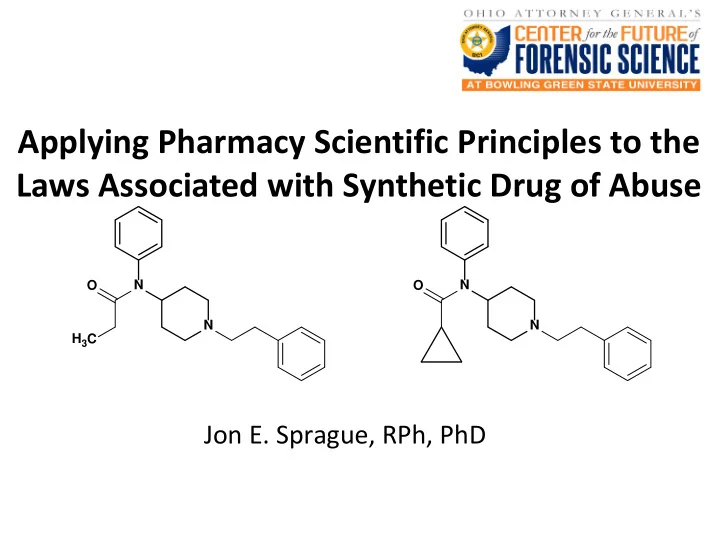
Applying Pharmacy Scientific Principles to the Laws Associated with Synthetic Drug of Abuse O N O N N N H 3 C Jon E. Sprague, RPh, PhD What is a pharmacophore? the portion of drug molecule required for pharmacological activity O O O


slide-1
SLIDE 1

Applying Pharmacy Scientific Principles to the Laws Associated with Synthetic Drug of Abuse

Jon E. Sprague, RPh, PhD

N N O H3C N N O
slide-2
SLIDE 2
slide-3
SLIDE 3

What is a pharmacophore?

  • the portion of drug molecule required for

pharmacological activity

O O N O O O

Phenanthrene Heroin

slide-4
SLIDE 4

What is a pharmacophore?

  • the portion of drug molecule required for

pharmacological activity

O O N O O O

Phenanthrene Heroin

slide-5
SLIDE 5

HO HO N O O O N O O O O O N O OH

Phenanthrene Heroin Morphine Oxycodone

slide-6
SLIDE 6

Drug-Targets

  • Receptors
  • Enzymes
  • Membrane Transporters
slide-7
SLIDE 7

Fentanyl: Targets

  • Pharmacological targets

– Opioid receptors

  • Members of the GPCR family

– Mu, delta, and kappa » Gαi and Gαo » Inhibition AC, voltage-gated Ca2+ channels » Activation of MAPK, inwardly rectifying K+ (GIRK) channels

  • Results in decreased neurotransmitter release and

inhibition of neuronal firing

7

slide-8
SLIDE 8

Fentanyl: Pharmacology

µ-receptors:

  • Gi coupled
  • decrease release

glutamate substance P

slide-9
SLIDE 9

Fentanyl: Pharmacology

slide-10
SLIDE 10

Fentanyl: Pharmacology

slide-11
SLIDE 11

Amino Acids

Aspartic Acid Glutamic Acid Arginine Lysine Histidine

slide-12
SLIDE 12

Drug-Receptor Binding

  • Hydrogen bonds

HBD and HBA

  • Ionic bonds
slide-13
SLIDE 13

Fentanyl: Pharmacology

Kaserer et al., 2016

slide-14
SLIDE 14

Common HBD and HBA

R H O

R R O

R OH

R O R

R OH O

R Cl O

R O O R

R O R O O

R H N R

Aldehyde Ketone Alcohol Ether Carboxylic Acid Acid Chloride Ester Anhydride Amine

slide-15
SLIDE 15

Functional Groups

  • In a chemical sense, a drug can be described

as a core scaffold decorated by functional groups

  • Functional groups provide HBD, HBA and may

increase lipophilicity

slide-16
SLIDE 16

HO HO N O O O N O O O O O N O OH

Phenanthrene Heroin Morphine Oxycodone

slide-17
SLIDE 17

The Pharmacophore Rule was written so chemists would be able to identify the basic structural elements required for a compound to bind to the cannabinoid structure.

The Pharmacophore Rule

slide-18
SLIDE 18

Application of Pharmacophores to the Synthetic Cannabinoids

slide-19
SLIDE 19

a b C

JWH-018

Source: Aung et al., 2000

slide-20
SLIDE 20

The Cannabinoid Receptors

CB1R CB2R

extracellular intracellular

slide-21
SLIDE 21

Receptor Binding

Chemical Analog CB1 Ki (nM) CB2 Ki (nM) JWH-018 9.0 (least potent) 2.9 AM2201 1.0 2.6 JWH-081 1.2 12.4 (least potent) JWH-122 0.69 1.2 JWH-210 0.46 (most potent) 0.69 (most potent)

Aung, M.M. et al., Drug and Alcohol Dependence, 2000. 60(2): p. 133-140. Huffman, J. W., et al. Bioorganic & medicinal chemistry, 2005. 13(1), 89-112. Makriyannis A. and Deng H. Patent: Cannabimimetic Indole Derivatives (2008)

slide-22
SLIDE 22

1 Chemical Scaffold 2

Alkyl or Aryl Side Chain

3

Carbonyl or ester

4

Cyclohexane Chemical Scaffold

slide-23
SLIDE 23

1

Chemical Scaffold

A chemical scaffold consists of substituted or nonsubstituted ring structures that facilitate binding of required elements (such as indole compounds, indazoles, benzimidazole,

  • r other ring types.

Why is this important?

The indole ring structure provides the scaffold for the molecule. The scaffold is where the functional groups are added to the compound.

N O

slide-24
SLIDE 24

Common Scaffolds

N H N H N H N N H N N N H N N H

O

S

Indole Indoline Indazole Benzimidazole 4-Azaindole 7-Azaindole Benzofuran Benzothiophene

slide-25
SLIDE 25

Take a moment to review the details for the second requirement. When you are finished, click Next.

2

Alkyl or Aryl Side Chain An Alkyl or Aryl side chain off the chemical scaffold provides hydrophobic interaction with the CB1 and CB2 receptors. Why is this important? The side chain in this photo shows a total of five carbons. For optimal binding to CB1 and CB2 receptors, at least four to six carbons must be present.

N O

slide-26
SLIDE 26

3

Carbonyl or ester A Carbonyl, ester, or equivalent is present for hydrogen bonding Why is this important? Hydrogen bond donors (HBD) and acceptors (HBA) allow for drugs to bind to the amino acids of the receptor.

N O

slide-27
SLIDE 27

Common HBD and HBA

R H O

R R O

R OH

R O R

R OH O

R Cl O

R O O R

R O R O O

R H N R

Aldehyde Ketone Alcohol Ether Carboxylic Acid Acid Chloride Ester Anhydride Amine

slide-28
SLIDE 28

Finally, let’s take a look at the fourth requirement. Click on the image and then click Next to continue.

4

Cyclohexane A Cyclohexane, naphthalene ring, substituted butanamide, or equivalent is present for steric requirements for CB1 and CB2 receptor binding. Why is this important? Mains rigidity to the molecule for binding to the CB1 and CB2 receptors (proper orientation).

N O

slide-29
SLIDE 29

Steric Substitutions

C H3 CH3 C H3 CH3 C H3

N

N

NH O NH2

Cyclohexane Naphthalene Carbazole Tetramethylcyclopropyl Quinoline

3-methyl-2- (methylamino) butanamide

slide-30
SLIDE 30

Application of Pharmacophores to the Synthetic Cathinones

slide-31
SLIDE 31

Chemistry

H N O H N O O O N O O O mephedrone methylone MDPV

slide-32
SLIDE 32

Cathinone Pharmacophore

4F-α-PVP

N O

F

slide-33
SLIDE 33

O NH CH3 CH3 O O

O N H CH3 CH3 O O

O N H CH3 O O C H3

Methylone Butylone Pentylone

O N CH3 O O

O N CH3

O N CH3 O O

MDPPP alpha-PVP MDPV

slide-34
SLIDE 34

Fentanyl: Legal Updates

  • Expansion of the “pharmacophore rule”

Ohio Administrative Code 4729-11-02

N N O C H3

slide-35
SLIDE 35

Fentanyl: Opioid Pharmacophore

  • Highlighted structure present in µ-

receptor binders:

N N O C H3

slide-36
SLIDE 36

Fentanyl: Opioid Pharmacophore

  • Binding to the mu receptor requires the

following:

  • 1. protonated amine nitrogen
  • 2. polar function for hydrogen bonding
  • 3. one aromatic ring for lipophilic interaction
  • 4. another aromatic ring for electron transfer

Dosen-Micovic et al., 1996

slide-37
SLIDE 37

Fentanyl: Legal Updates

  • Expansion of the “pharmacophore rule”
  • Required structural components:
  • 1. Chemical scaffold consisting of a

Nitrogen containing 5, 6 or 7 member ring and;

N N O CH3

slide-38
SLIDE 38

Fentanyl: Legal Updates

  • Expansion of the “pharmacophore rule”
  • 2. A second Nitrogen attached to the ring

structure

N N O CH3

slide-39
SLIDE 39

Fentanyl: Legal Updates

  • Expansion of the “pharmacophore rule”
  • 3. A polar group attached to the chemical

scaffold

N N O CH3

slide-40
SLIDE 40

Fentanyl: Legal Updates

  • Expansion of the “pharmacophore rule”
  • 4. An alkyl or aryl substitution attached to the

chemical scaffold

N N O CH3

slide-41
SLIDE 41

Cyclopropyl fentanyl

N N O

1

2 3 4

slide-42
SLIDE 42

Ocentanyl

N N O O F

slide-43
SLIDE 43

para-Fluorobutyryl fentanyl

N N O F

slide-44
SLIDE 44

Furanyl fentanyl

N N O O

slide-45
SLIDE 45
slide-46
SLIDE 46

DEA Requirements

  • A. Replacement of the phenyl portion of the

phenethyl group by any monocycle, whether

  • r not further substituted in or on the

monocycle;

  • B. Substitution in or on the phenethyl group

with alkyl, alkenyl, alkoxyl, hydroxyl, halo, haloalkyl, amino or nitro groups

slide-47
SLIDE 47

DEA Requirements

  • C. Substitution in or on the piperidine ring with

alkyl, alkenyl, alkoxy, ester, ether, hydroxyl, halo, haloalkyl, amino, or nitro groups;

  • D. Replacement of the aniline ring with any

aromatic monocycle whether or not further substituted in or on the aromatic monocycle; and/or

  • E. Replacement of the N-propionyl group by

another acyl group

slide-48
SLIDE 48

General References

  • 1. Alexandros Makriyannis and Hongfeng Deng. Patent: Cannabimimetic Indole Derivatives (2008).
  • 2. Aung, M.M., G. Griffin, J.W. Huffman, M.J. Wu, C. Keel, B. Yang, V.M. Showalter, M.E. Abood, and B.R.

Martin, Influence of the N-1 alkyl chain length of cannabimimetic indoles upon CB1 and CB2 receptor

  • binding. Drug and Alcohol Dependence, 2000. 60(2): p. 133-140.
  • 3. Dosen-Micovic, I. Roglic, G., Micovic, V., Ivanovic, M. Conformational study of fentanyl and its analogs 1.

Conformational space of the N-phenethyl substituent. Elec J Theoretical Chem. 199-210; 1996.

  • 4. Huffman, J. W., Zengin, G., Wu, M., Lu, J., Hynd, G., Bushell, K., et al. (2005). Structure-activity

relationships for 1-alkyl-3-(1-naphthoyl)indoles at the cannabinoid CB(1) and CB(2) receptors: steric and electronic effects of naphthoyl substituents. New highly selective CB(2) receptor agonists. Bioorganic & medicinal chemistry, 13(1), 89-112. doi: 10.1016/j.bmc.2004.09.050.

  • 5. Jordon, A. M.; Roughley, S.D. Drug discovery chemistry: a primer for the non-specialist. Drug Discovery
  • Today. 14:731-744; 2009.

6. Kaserer, T., Lantero, A., Schmidhammer, H., Spetea, M., Schuster, D. µ Opioid receptor: novel antagonists and structural modeling. Scientific Rep. 1-15; 2016. 7. Worst TJ, Sprague JE. The “pharmacophore rule” and the spices. Forensic Toxicol. 33(1):170-173; 2015.

  • 8. Federal Register. Vol. 83(25): 5188-5192; 2018.