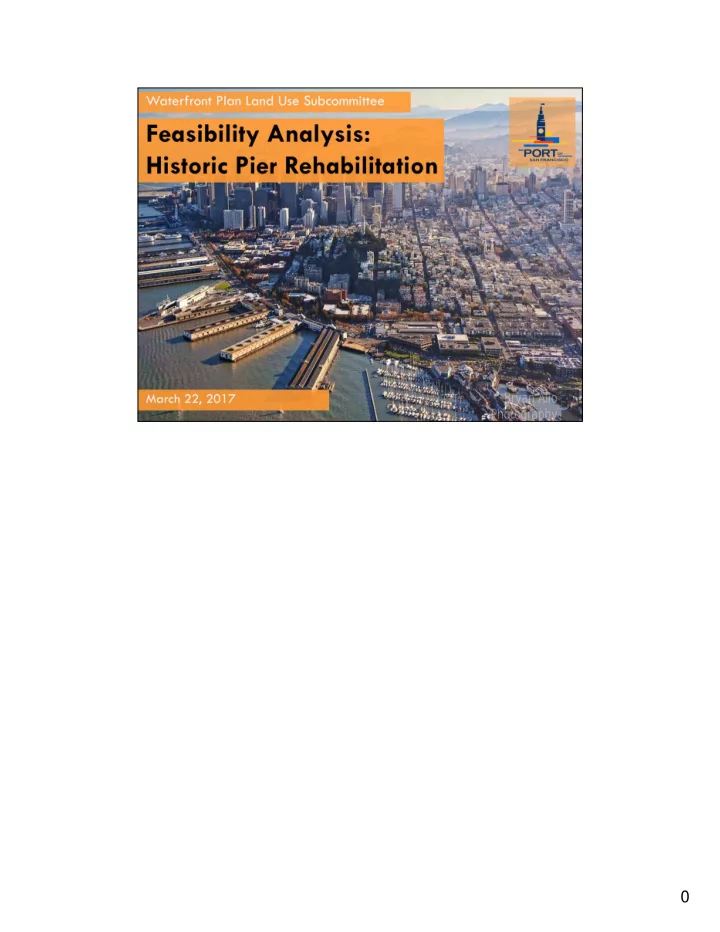
SLIDE 1
SLIDE 2 Overview of Port properties committed and/or capital improvements for trust uses:
- Parks and waterfront public access
- Maritime and water-dependent facilities and operations
- Trust-consistent Maritime mixed use developments approved by State Lands
Commission and Port Commission
1
SLIDE 3 Many of remaining Port properties facing substantial capital repair needs, vacancies, or development opportunities are located in the Embarcadero Historic District. The historic finger piers and bulkhead buildings are part of this National Register resource. The Ferry Building, Pier 1, Piers 1½-5, and the Exploratorium at Pier 15 have been successfully rehabilitated and reopened for public enjoyment, meeting National historic preservation
- standards. While precious, the remaining piers and bulkheads are old and
require expensive repairs. The Waterfront Plan Update should include policies and strategies for repair, reuse and rehabilitation to optimize the remaining lifetime of these facilities, while also looking ahead to plan for sea level rise and waterfront resilience.
2
SLIDE 4 This chart describes seven key categories that reflect the ways in which improvements to Embarcadero Historic District resources can deliver public trust benefits. Different facilities, pier condition, proposed uses, and public benefit improvements result in a variety of ways in which a project can provide public trust improvements; there is no one-size fits all approach. The matrix illustrates a spectrum of ways to achieve different public trust
- bjectives at varying scales, with the top row representing the most desirable
form of improvement, by category.
3
SLIDE 5
Uses alone do not reflect whether public trust benefits will be achieved. The qualities of how uses are programmed, designed and operated, and how they enhance the architecture and reveal the Port’s maritime history all play a part in determining how uses deliver public trust objectives.
4
SLIDE 6
Pier 1 development project achieved public trust objectives in the orange colored boxes.
5
SLIDE 7
The Exploratorium project delivered public trust benefits in a different manner from Pier 1. This illustrates how each development or Port project can achieve public trust objectives differently.
6
SLIDE 8
Pier 9 is a multi-tenanted facility managed by the Port, with maritime and non-maritime tenants. Even in shorter term, interim leases, the Port seeks to achieve public trust objectives.
7
SLIDE 9 The following slides are to provide graphic representations to convey the public trust
- bjectives described in the table.
8
SLIDE 10
9
SLIDE 11
10
SLIDE 12
11
SLIDE 13
12
SLIDE 14
13
SLIDE 15
14
SLIDE 16 To briefly recap from a previous Land Use Subcommittee presentation, the Port hired EPS and its consultant team to analyze the financial feasibility of different mixes of uses for piers, for long-term and intermediate term leases. The longer the term of leases, the more ability to provide public trust
- benefits. The black check boxes in this chart indicate public benefits that can
be achieved in the given timeframe; the grey check boxes indicate additional public benefit objectives that would be sought but not guaranteed. The Use Buckets indicate use types that can be sought under short, intermediate, and long-term leases. Commercial uses are arrayed from top to bottom, ranging from low to high rental rates; maritime uses are sought in all types of leases, wherever feasible.
15
SLIDE 17
16
SLIDE 18
17
SLIDE 19
18
SLIDE 20
19
SLIDE 21
20
SLIDE 22
21
SLIDE 23
22
SLIDE 24
Retail (including restaurant) uses, types and rental rates are highly location- specific, and limited in the amount of square footage that can be developed in any given site.
23
SLIDE 25 Production, Distribution and Repair (PDR) cover a broad range of industrial activities, ranging from basic warehouse storage of goods, to light manufacturing, assembly and repairs, to high-tech based design and innovation research and development, which can pay relatively high rental
- rates. Thus, rental rates range from $24 to 54/s.f.
24
SLIDE 26 EPS included consideration of hotels in the market survey because it is a public trust use, although currently prohibited on Port piers under Proposition
- H. The hotel market survey included luxury and upscale hotel markets in the
waterfront area.
25
SLIDE 27
26
SLIDE 28
27
SLIDE 29
EPS also includes “Publicly-oriented” cultural, recreational, and assembly types of uses in its market survey. These activities vary widely, and do not subscribe to standardized characteristics like for office, hotel or retail. The uses researched for the survey pay relatively low rental rates.
28
SLIDE 30
29
SLIDE 31 Three initial scenarios analyzed by EPS are long-term development programs, assuming a public-private partnership model. The use programs were analyzed for a pier in good condition, and a pier that is in worse
- condition. The analysis thus took into account differing repair/rehabilitation
costs and revenues to determine whether they were financially feasible and, if so, estimated annual revenues generated for the Harbor Fund, to support capital improvements Port-wide.
30
SLIDE 32
31
SLIDE 33
32
SLIDE 34
33
SLIDE 35 This comparison chart conveys the public trust improvements and benefits, as outlined in the previous public trust objectives matrix earlier in the presentation, and a scorecard to reflect the relative value in each trust
- category. A 4-anchor represents the highest public trust value.
34
SLIDE 36
The EPS team includes SiteLab urban designers and Carey and Company historic architects who conducted analysis to determine that it is possible to adapt a historic finger pier for hotel use, and still respond to Secretary of Interior Standards for historic rehabilitation. EPS will analyze and present the financial feasibility of a hotel-based scenario at a future Land Use Subcommittee meeting.
35
SLIDE 37
36
SLIDE 38
37
SLIDE 39
38
SLIDE 40
39
SLIDE 41
40
SLIDE 42 EPS also is preparing further economic feasibility analysis of intermediate lease scenarios, to be presented at the April 12th Land Use Subcommittee
- meeting. Long-term development projects take years to complete, and the
Port needs to maintain ongoing leasing, management and improvement of its properties in the meantime. The Port also seeks effective leasing strategies to manage facilities in the face of growing flood risk from sea level rise, which is a growing constraint on the 50-66 year leases for long-term development. Given the age and increasing repair costs, the EPS analysis will examine the lease terms needed to amortize the cost of improvements for 2 intermediate lease term scenarios.
41
SLIDE 43
Over half of Port leases are for 5 years or less. While this provides flexibility to the Port for different tenant opportunities, short term leases generally do not deliver repairs or improvements that extend useful life, and increases exposure to vacancies during down markets and less stable revenue stream.
42
SLIDE 44
43
SLIDE 45
EPS will study 2 intermediate-term lease scenarios. Both assume higher- revenue retail uses in portions of bulkhead and limited amount of PDR/R&D tenants in portions of the pier shed. All repairs comply with Secretary Standards for historic rehabilitation: Scenario 1 – higher investment assumed includes a seismic joint between the bulkhead and pier shed, to allow a modest increase in occupancy in the bulkhead and shed; public access/maritime berthing improvement on one of the aprons. Scenario 2 – lower investment provides for some building shell improvements (e.g. repairs, a new roof) without increasing occupancy. In addition to revenue, Port seeks to keep buildings filled to protect against accelerated deterioration, vandalism and security threats in vacant facilities.
44
SLIDE 46
45
SLIDE 47
46