Unit 9: Basic Contract Law 1 Contracts: Expressed vs Implied, - - PDF document

unit 9 basic contract law
SMART_READER_LITE
LIVE PREVIEW

Unit 9: Basic Contract Law 1 Contracts: Expressed vs Implied, - - PDF document

9/13/2019 Unit 9: Basic Contract Law 1 Contracts: Expressed vs Implied, Unilateral vs Bilateral Validity of Contracts Essential Elements of a Contract Performance of Contract Breach of a Contract Auctions 2 Contract a legally


slide-1
SLIDE 1

9/13/2019 1 Unit 9: Basic Contract Law

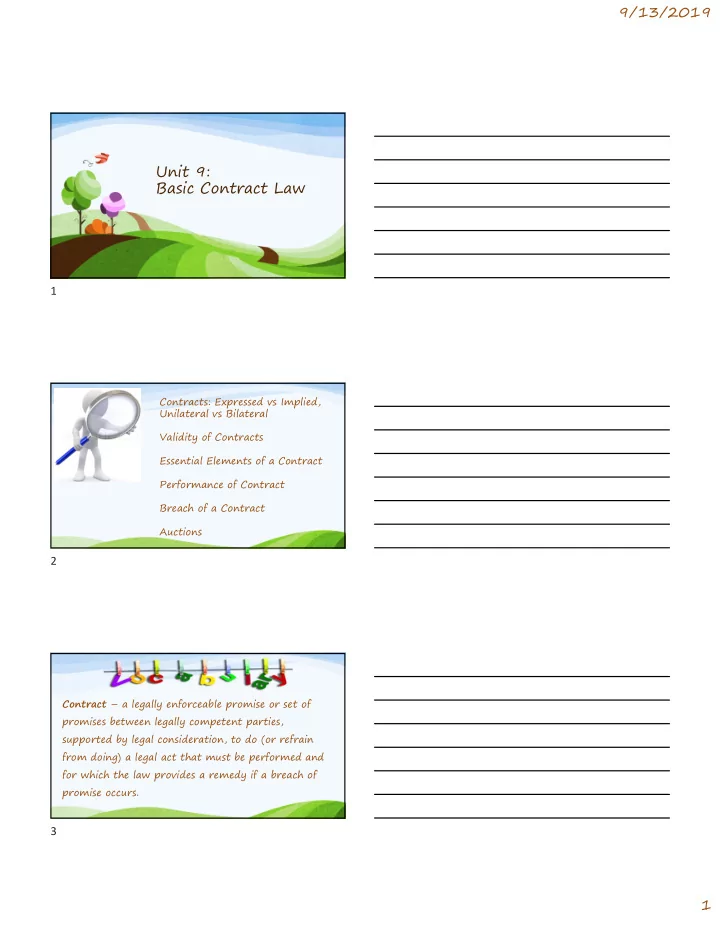
Contracts: Expressed vs Implied, Unilateral vs Bilateral Validity of Contracts Essential Elements of a Contract Performance of Contract Breach of a Contract Auctions Contract – a legally enforceable promise or set of promises between legally competent parties, supported by legal consideration, to do (or refrain from doing) a legal act that must be performed and for which the law provides a remedy if a breach of promise occurs.

1 2 3

slide-2
SLIDE 2

9/13/2019 2

A Contract Must Be the Following:

  • Voluntary – no one can be forced into a contract
  • Agreement or Promise – contract is basically a

legally enforceable promise

  • Legally Competent Parties – the law must view

both parties as capable of making a legal promise

A Contract Must Be the Following:

  • Legal Consideration – something of value
  • Legal Act – a contract can’t force someone to do

an illegal act

Pg 259

Types of Contracts

Express Contracts – oral or written Implied Contracts – formed as the result of an action or conduct

Statue of Frauds says that any contracts dealing with real estate must be in writing

4 5 6

slide-3
SLIDE 3

9/13/2019 3

Types of Contracts

Bilateral Contracts – both parties must act .. A promise for a promise Unilateral Contracts – one party persuades a second party to do something (ie an option)

Types of Contracts

Executory Contract: something remains to be done by one party or both parties Executed Contract: all commitments have been fulfilled and monies are disbursed

Validity of Contracts Figure 9.1, pg 256

Classification of Contract Legal effect Example Valid Binding and enforceable on both parties Agreement complies with essentials of a valid contract Void No Legal Effect Contract for an illegal purpose Voidable Valid but may be disaffirmed by one party Contract with a minor, coercion, mental illness, undisclosed material fact Unenforceable Valid between the parties, but neither party may force performance Certain oral agreements

7 8 9

slide-4
SLIDE 4

9/13/2019 4

Essential Elements of a Valid Contract

1.Legally competent parties

  • Mental capacity
  • 18 years old

2.Mutual assent or deliberate agreement

  • Meeting of the Minds

Pg 257

  • 4. Consideration
  • Something of legal value
  • Courts won’t enforce

“free” agreements

Essential Elements of a Valid Contract

  • 3. Legality of object

Earnest Money Deposit – Expression of good faith (not required to create a valid contract)

Formation of a Contract Requirement for Reality of Consent:

  • 1. Contracts signed while a person is under duress or

undue influence (drugs/alcohol) may be voidable by that person or by a court

  • 2. Misrepresentation, fraud or mistake of fact could

render a contract voidable by the injured party

Reality of Consent reached when the above does NOT exist

10 11 12

slide-5
SLIDE 5

9/13/2019 5

Revocation of an Offer

Counteroffer: a change in any of the terms

Pg 262

The offeror is relieved of the original offer because in effect, the offeree rejected it by making changes

Revocation of an Offer

1.An offer or a counteroffer may be revoked at any time before it has been accepted (even if the person making the offer or counteroffer agreed to keep the offer open for a set period of time). 2.A real estate broker stands in the shoes of the principal and communication of acceptance or revocation to an agent is the same as communication directly to the principal

Pg 258

Revocation of an Offer

  • 3. All offers must be delivered immediately, but in

North Carolina no case later than 3 days after execution

Pg 262

13 14 15

slide-6
SLIDE 6

9/13/2019 6

Agreement in Writing and Signed

  • In NC, Statute of Frauds for transferring real estate -

signed by the party to be bound by the agreement

  • Based on common-law doctrine
  • Certain types of contract must be in writing to be

enforceable in court

  • Deeds

Contracts for Sale

  • Mortgages

Options

  • Easements

Leases longer than 3 years

NCREC Rule A.0104 Listing Agreements and Buyer Representation Agreements are not mandated by Statute of Frauds. However, as they are both employment contracts and NCREC says they must be in writing Formation of a Contract Parol Evidence Rule from Common Law No oral agreements that contradict the terms of a written contract may be considered in a lawsuit based on the written agreement

Pg 259

16 17 18

slide-7
SLIDE 7

9/13/2019 7

Performance of a Contract

  • a. Time is of the essence: The contract must be

performed within the stipulated time or the party that did not perform within the timeframe is liable for breach of the contract. Usually by 5 pm

  • b. If a date is not followed by “time is of the essence”

it is a “general” target date that all parties should attempt to meet.

Performance of a Contract

  • c. Not complying with the date is NOT an automatic

termination of the contract; contract becomes voidable by the non-breaching party if not finished in a “reasonable amount of time”

Performance of a Contract

  • Assignment: Substitution of Parties

In North Carolina Offer to Purchase is not assignable without mutual written consent

  • Novation: the substitution of a new contract for an

existing contract Nova = New

Pg 260

19 20 21

slide-8
SLIDE 8

9/13/2019 8

Discharge of a Contract

Breach contract if one party defaults; cancelled by:

  • Partial performance (accord and satisfaction)
  • Substantial performance
  • Impossibility of performance
  • Mutual agreement of the

parties to cancel

  • Operation of law

Page 261

General Rules for Interpretation of Contracts:

  • Inconsistent preliminary negotiations irrelevant
  • Contract interpreted as a whole
  • Contract judged as reasonable vs. unreasonable
  • Popular interpretation of ordinary words
  • Written provisions considered over pre-printed

language

  • Party that created ambiguity will not be favored

Default - Breach of Contract

Breach = violation (no legal excuse) of any terms or conditions of a contract; Injured party may:

  • 1. Sue the breaching party for compensatory damages (not the buyer in NC)
  • 2. Be entitled to collect liquidated damages (EMD)
  • 3. Sue for consequential damages for loss of profits (REASONABLY FORESEEN)
  • 4. File a court action for specific performance
  • 5. Rescission (not getting disclosures in a timely manner)

22 23 24

slide-9
SLIDE 9

9/13/2019 9

Default – Breach of Contract

Statute of Limitations – North Carolina law allows a specific time limit during which parties to a contract can bring legal suit to enforce their rights

Broker’s Authority to Prepare Documents

  • Broker cannot draft legal documents for others

(unlawful practice of law)

  • But is allowed to fill in the blanks on approved

preprinted forms NC G.S. 93A-6(a)(11) Licensees will be disciplined

  • Broker can’t advise how to take title to property

Addenda - (aka Rider) additional terms or conditions to a contract all changes and additions should be dated and must be initialed in the margin or on the rider by both parties

Examples of Addendums: FHA/VA New Construction Back-Up Contract Additional Provisions Additional Signatures Lead-Based Paint or Lead-Based Paint Hazard

25 26 27

slide-10
SLIDE 10

9/13/2019 10

Addendum – means including an additional document in the already existing one; becomes a part of the legal and binding contract Vs Amendment – means changes made in an already existing agreement; are only part of a contract until negotiations.

AUCTION SALES

Real estate auctioneer needs:

  • a real estate license and
  • an auctioneer license

Not the same as a mere crier of sales who is exempt from a real estate license

AUCTION SALES

Two types:

  • 1. Auctions with reserve—the seller reserves the

right to stop the bidding if the high bid does not reach the minimally acceptable bid for the seller

  • 2. Auctions without reserve—the seller

agrees to accept the high bid, no matter what the terms of that bid; aka an “absolute auction” in North Carolina

28 29 30

slide-11
SLIDE 11

9/13/2019 11

31