
SLIDE 1
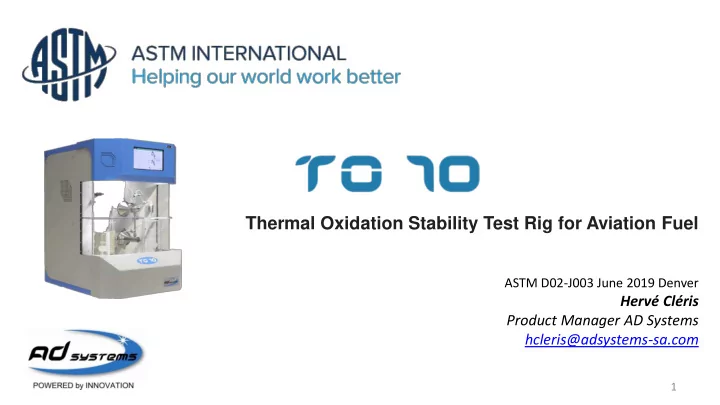
Thermal Oxidation Stability Test Rig for Aviation Fuel
ASTM D02-J003 June 2019 Denver
Hervé Cléris Product Manager AD Systems hcleris@adsystems-sa.com
1
Thermal Oxidation Stability Test Rig for Aviation Fuel ASTM D02-J003 - - PowerPoint PPT Presentation
Thermal Oxidation Stability Test Rig for Aviation Fuel ASTM D02-J003 June 2019 Denver Herv Clris Product Manager AD Systems hcleris@adsystems-sa.com 1 Introduction The TO10 has been designed to meet specific needs Fuel flow control
Thermal Oxidation Stability Test Rig for Aviation Fuel
ASTM D02-J003 June 2019 Denver
Hervé Cléris Product Manager AD Systems hcleris@adsystems-sa.com
1
www.adsystems-sa.com
The TO10 has been designed to meet specific needs
➢ Fuel flow control using double syringe device:
❖
Perfect flow control (3mL/min +/-1%)
❖
Perfect volume control (450mL +/-1%) ➢ Heater tube thermocouple:
❖
Embedded calibration ➢ Bus bar temperature control:
❖
Temperature profile repeatable from test to test
❖
Independent control of the 2 bus bars ➢ Aeration control:
❖
Flow and humidity control
2
www.adsystems-sa.com
❖ 15 samples ❖ Breakpoints: 235°C to > 380°C
❖ Alcor (PAC)
❖ PAC Mk II, III and IV and AD Systems TO10 ❖ Tube rating – DR10 (ITR D3241-annex 2)
3
Name Description
9475 BP UK – Jet A1 9490 TOTAL - Merox US-J01 BP – Jet A US-J05 Chevron KC1904 Jet A1 (Airport) 9473 Jet A1 (Airport) - SGS 9479 CEPIA F34 9480 CEPIA F35 US-J02 Chevron US-J03 Chevron US-J07 Chevron US-J04 Chevron US-J06 Chevron US-J08 Jet A1 TK33 Jet A
www.adsystems-sa.com
4
www.adsystems-sa.com
5
Fuel TO10 MK IV Comments
US-J02
235 240
Delta P > 25mmHg US-J07
250 260
US-J03
250 275
9475
260 260
Delta P > 25mmHg KC1904
265 260
9473
270 275
9480
275 275
9479
275 285
US-J01
280 290
US-J05
280 295
9490
285 285
US-J04
>380 N/A
aborted on MK IV on low flow alarm US-J06
>380 >375
US-J08
>380 >375
TK33
>380 >375
220 230 240 250 260 270 280 290 300 220 240 260 280 300
The average of Mark IV results is 6.8 ° C higher than TO10 results
www.adsystems-sa.com
6
Fuel TO10 MK II MK III
US-J01
280 275 280
US-J05
280 270 305
US-J03
250 250 255
SGS Harfleur results
240 250 260 270 280 290 300 310
US-J03 US-J01 US-J05
Breakpoint temperature (°C)
SGS Harfleur results
TO10 results are between Mark II and Mark III results
www.adsystems-sa.com
7
Fuel TO10 AD Systems TO10 Intertek
9475
260 260
9490
285 280
US-J01
280 275
US-J05
280 275
KC1904
275 275
250 255 260 265 270 275 280 285 290 295 300 250 260 270 280 290 300
Intertek UK lab(°C) AD Systems lab(°C) AD Systems lab versus Intertek UK lab (TO10 breakpoints results)
www.adsystems-sa.com
8
The differences observed on Breakpoints between the different versions of the apparatus used (Mark II, III and IV) do not allow an overall comparison of all results. We observe that the results of the TO10 are reproducible independent of the laboratories and the operator. The Breakpoints obtained on the TO10 are close to the Mark II. The Breakpoints obtained on Mark III and Mark IV are generally higher. Average bias observed with Mark IV is 6.8°C (from 0 to 20 ° C depending on the samples). Lower results Higher results Mark II TO10 Mark III and IV
www.adsystems-sa.com
9