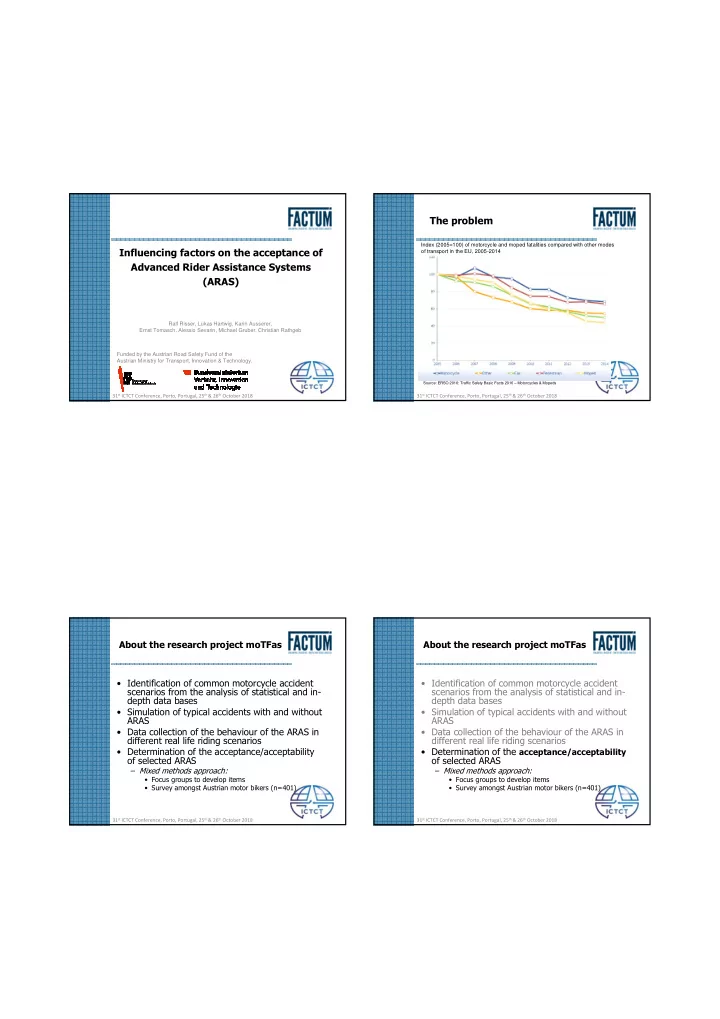
The problem Index (2005=100) of motorcycle and moped fatalities - - PDF document

the problem
SMART_READER_LITE
LIVE PREVIEW

The problem Index (2005=100) of motorcycle and moped fatalities - - PDF document

The problem Index (2005=100) of motorcycle and moped fatalities compared with other modes Influencing factors on the acceptance of of transport in the EU, 2005-2014 Advanced Rider Assistance Systems (ARAS) Ralf Risser, Lukas Hartwig, Karin


slide-1
SLIDE 1

31st ICTCT Conference, Porto, Portugal, 25th & 26th October 2018

Influencing factors on the acceptance of Advanced Rider Assistance Systems (ARAS)

Ralf Risser, Lukas Hartwig, Karin Ausserer, Ernst Tomasch, Alessio Sevarin, Michael Gruber, Christian Rathgeb Funded by the Austrian Road Safety Fund of the Austrian Ministry for Transport, Innovation & Technology. 31st ICTCT Conference, Porto, Portugal, 25th & 26th October 2018

The problem

Index (2005=100) of motorcycle and moped fatalities compared with other modes

  • f transport in the EU, 2005-2014

Source: ERSO 2016: Traffic Safety Basic Facts 2016 – Motorcycles & Mopeds

31st ICTCT Conference, Porto, Portugal, 25th & 26th October 2018

About the research project moTFas

  • Identification of common motorcycle accident

scenarios from the analysis of statistical and in- depth data bases

  • Simulation of typical accidents with and without

ARAS

  • Data collection of the behaviour of the ARAS in

different real life riding scenarios

  • Determination of the acceptance/acceptability
  • f selected ARAS

– Mixed methods approach:

  • Focus groups to develop items
  • Survey amongst Austrian motor bikers (n=401)

31st ICTCT Conference, Porto, Portugal, 25th & 26th October 2018

About the research project moTFas

  • Identification of common motorcycle accident

scenarios from the analysis of statistical and in- depth data bases

  • Simulation of typical accidents with and without

ARAS

  • Data collection of the behaviour of the ARAS in

different real life riding scenarios

  • Determination of the acceptance/acceptability
  • f selected ARAS

– Mixed methods approach:

  • Focus groups to develop items
  • Survey amongst Austrian motor bikers (n=401)
slide-2
SLIDE 2

31st ICTCT Conference, Porto, Portugal, 25th & 26th October 2018

Source: Vlassenroot et. al. (2005): Towards defining a unified concept for the acceptability of Intelligent Transport Systems (ITS)

Acceptance or acceptability?

31st ICTCT Conference, Porto, Portugal, 25th & 26th October 2018

ARAS under examination

  • Blind spot monitoring
  • Curve warning
  • Forward collision warning
  • Cornering ABS
  • Traction control
  • Autonomous emergency braking

31st ICTCT Conference, Porto, Portugal, 25th & 26th October 2018

ARAS under examination – which

  • nes are already available?
  • Blind spot monitoring
  • Curve warning
  • Forward collision warning
  • Cornering ABS
  • Traction control
  • Autonomous emergency braking

31st ICTCT Conference, Porto, Portugal, 25th & 26th October 2018

The survey

  • Online survey (n=401) conducted in

winter 2017/2018

  • Items about:

– Risk-perception & risk-taking behaviour – Attitudes towards other road users – Social-demographic data – 9-10 items (with Likert-scale) for the evaluation of ARAS

slide-3
SLIDE 3

31st ICTCT Conference, Porto, Portugal, 25th & 26th October 2018

Acceptance or acceptability?

Source: Vlassenroot et. al. (2005): Towards defining a unified concept for the acceptability of Intelligent Transport Systems (ITS)

31st ICTCT Conference, Porto, Portugal, 25th & 26th October 2018

Results: perceived effectiveness

This system could prevent traffic accidents (n=401)

10 20 30 40 50 60 70 strongly agree agree neither agree nor disagree disagree strongly disagree in percent Blind-spot monitoring Curve warning Forward collision warning Cornering ABS Traction control AEB

31st ICTCT Conference, Porto, Portugal, 25th & 26th October 2018

Results: perceived usefulness

I would like to have this system on my motor bike (n=401)

10 20 30 40 50 60 strongly agree agree neither agree nor disagree disagree strongly disagree in percent Blind-spot monitoring Curve warning Forward collision warning Cornering ABS Traction control AEB

31st ICTCT Conference, Porto, Portugal, 25th & 26th October 2018

Results: influencing factors

Mileage Year-round riding (4 seasons) Use of the motor bike for commuting (! low n for

commuters)

Self-critical perception of the dangers of riding Non-sportive riding style Sex (! low n for female riders) Positive view of assistance systems and technological innovations Past accidents and injuries Experience with a system in passenger cars No (significant) influence Influence

Influence on the positive evaluation/acceptance of ARAS

slide-4
SLIDE 4

31st ICTCT Conference, Porto, Portugal, 25th & 26th October 2018

Acceptance scores

Acceptance scores of examined ARAS Maximum achievable score = 100 48 51 71 60 34 46 10 20 30 40 50 60 70 80 Blind-spot monitoring Curve warning Forward collision warning Cornering ABS Traction control AEB Score

31st ICTCT Conference, Porto, Portugal, 25th & 26th October 2018

Conclusion

  • currently available systems
  • systems currently available in passenger

cars

  • systems that activate in emergencies only

Acceptance is higher for… Riders‘ individual attitudes towards technology and their risk-taking behaviour/riding style matter a lot, too!

31st ICTCT Conference, Porto, Portugal, 25th & 26th October 2018

Thank you for your attention!

lukas.hartwig@factum.at

Acknowledgements for their essential contributions to this project to: Funded by the Austrian Road Safety Fund of the Austrian Ministry for Transport, Innovation & Technology. 31st ICTCT Conference, Porto, Portugal, 25th & 26th October 2018

Literature

European Road Safety Observatory (ERSO) (2016): Traffic Safety Basic Facts 2016 – Motorcycles & Mopeds. On: https://ec.europa.eu/transport/road_safety/sites/roadsafety/files/pdf/statistics/dacota /bfs2016_motomoped.pdf Vlassenroot, S.; Brookhuis, K.; Marchau, V.A.W.J. ; Witlox, Frank (2005) : Towards defining a unified concept for the acceptability of Intelligent Transport Systems (ITS): A conceptual analysis based on the case of Intelligent Speed Adaptation (ISA). Transportation Research Part F: Traffic Psychology and Behaviour, Jg.13, Nr.3, S.164–178.