SOLAR TECHNOLOGIES FOR AGRI-BUSINESSES Gerry Flores Photovoltaic - - PowerPoint PPT Presentation

solar technologies for agri businesses
SMART_READER_LITE
LIVE PREVIEW

SOLAR TECHNOLOGIES FOR AGRI-BUSINESSES Gerry Flores Photovoltaic - - PowerPoint PPT Presentation

SOLAR TECHNOLOGIES FOR AGRI-BUSINESSES Gerry Flores Photovoltaic Engineer, Energy Innovation Manager NSW FARMERS ASSOCIATION 15/11/2014 This activity received funding from the Department of Industry as part of the Energy Efficiency Information


slide-1
SLIDE 1

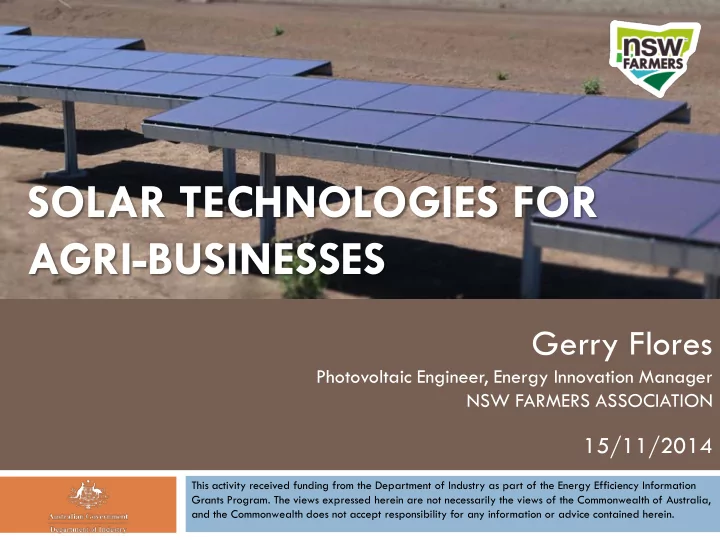
SOLAR TECHNOLOGIES FOR AGRI-BUSINESSES

Gerry Flores

Photovoltaic Engineer, Energy Innovation Manager NSW FARMERS ASSOCIATION

15/11/2014

This activity received funding from the Department of Industry as part of the Energy Efficiency Information Grants Program. The views expressed herein are not necessarily the views of the Commonwealth of Australia, and the Commonwealth does not accept responsibility for any information or advice contained herein.

slide-2
SLIDE 2

Electricity and gas price hikes are driving adoption of renewable energy

5 10 15 20 25 30 35 Jan-00 Jul-00 Jan-01 Jul-01 Jan-02 Jul-02 Jan-03 Jul-03 Jan-04 Jul-04 Jan-05 Jul-05 Jan-06 Jul-06 Jan-07 Jul-07 Jan-08 Jul-08 Jan-09 Jul-09 Jan-10 Jul-10 Jan-11 Jul-11 Jan-12 Jul-12 Jan-13 Jul-13 Jan-14 Average residential electricity costs ($c/kWh)

Weighted Average for All Capital Cities Melbourne Brisbane Adelaide Perth Hobart Darwin Canberra Sydney 8 per. Mov. Avg. ( Weighted Average for All Capital Cities)

slide-3
SLIDE 3

Farmers have been at the forefront of solar PV uptake

 Average solar penetration in Australia is 22%  In rural and regional areas the average is 29%

32% 31% 28% 27% 23% 18% 0% 5% 10% 15% 20% 25% 30% 35% Other Rural Regional – High Regional – Low Major Urban – Non-Capital City Major urban – Capital City

Average solar penetration

Sources: RECAA www.recagents.asn.au/wp-content/uploads/2014/04/GET-Postcode-report-for-RAA-April-2014.pdf

Capital cities and urban 68% Other 0% Rural and regional 32%

Number of dwellings across Australia (%)

Capital cities and urban Other Rural and regional Capital cities and urban 58% Other 0% Rural and regional 42%

Number of PV systems installed across Australia (%)

Capital cities and urban Other Rural and regional

slide-4
SLIDE 4

Effective steps towards energy management

Renewable energy

Energy efficiency Energy conservation and time of use management Energy analysis

slide-5
SLIDE 5

 Integrated PV systems

 Grid-connected PV systems  Stand-alone PV systems

 Water pumping -> stock and domestic & irrigation  Solar-hot-water

Types of solar systems for farm businesses

slide-6
SLIDE 6

Solar Cells

 Energy from photons (in sunlight) is absorbed by a

semiconductor material by ‘knocking’ electrons loose from their atoms

 Electrons are then ‘collected’ and due to the composition

  • f solar cells, they can only flow in one direction. This

generates DC electricity.

 To generate a useful level of electricity, multiple cells are

stringed together in individual solar panels, and multiple panels, and other power electronics such as inverters are used to condition the generated electricity into the appropriate current (AC or DC) and the required voltage

  • levels. These components constitute a photovoltaic (PV)

system.

slide-7
SLIDE 7

Types of Solar Cells/Panels

 Crystalline silicon

 Mono-crystalline -> more efficient, more expensive  Multi-crystalline -> almost as efficient, less expensive

 Mainstream thin film technologies

 Amorphous silicon -> less efficient  CdTe -> Utility scale only

 Emerging

 CIGS  Organic solar cells  Perovskite cells

slide-8
SLIDE 8

Solar irradiance

The levels of solar irradiance changes throughout the day and year

Mornings and afternoons have lower levels

Summer has higher levels than winter

kW-> unit of power

kWh -> unit of energy

Solar radiation power is measured in kW/m²

Solar radiation energy is measured in (kWh/m²).

1 kWh/m² is also known as 1 Peak Sunshine Hour (PSH)

slide-9
SLIDE 9

 Most common type of system  3 GW+ installed across Australia  56.4% average yearly growth over the last 10 years

Grid connected systems

Black coal 44.8% Brown coal 19.1% Gas 20.5% Oil 1.8% Other fossil fuels 0.8% Bioenergy 1.3% Wind 2.9% Hydro 7.3% Solar PV 1.5% Renewables 13.1%

slide-10
SLIDE 10

 Key energy saving opportunity for:

 Intensive animal farms  Intensive producers, horticulturists  Businesses with equipment running

year-round (cool rooms, grain mills, frequent irrigation)

Grid connected systems

slide-11
SLIDE 11

 Solar resource

 Use Clean Energy Regulator’s (CER) ‘Postcode zones for solar panels’ for

general planning http://ret.cleanenergyregulator.gov.au/ArticleDocuments/205/RET-sgu- postcode-zones_0312.doc.aspx

Grid-connected solar – Design Factors

Zone Estimated yearly kWh generated /kWp installed Average generation per day (kWh) 1 1,622 4.44 2 1,536 4.21 3 1,382 3.78 4 1,185 3.24

slide-12
SLIDE 12

Grid-connected solar – Design Factors

Placement and orientation of PV panels

 Orientation – Optimal for a system in the southern hemisphere is facing north, however:

 Further eastward orientation can increase generated power in the morning  Further westward orientation can increase generated power in the evening

 Tilt-A tilt equal to the location’s latitude will result in the greatest annual power output.

 A lower tilt (flatter) will increase power generated during summer  An increased tilt (steeper) will increase power generated during winter

slide-13
SLIDE 13

Grid-connected solar – Design Factors

 Placement and orientation of PV panels

 Mounting - Cheapest mounting option is on a fixed tilt & orientation on a roof

 Ground mounting is sometimes required and will increase costs.  Single or double axis tracking can improve generated power by 10-25% but the cost

premium and maintenance requirements typically outweigh this additional benefit.

slide-14
SLIDE 14

 Sizing

Grid-connected solar – Design Factors

slide-15
SLIDE 15

 Appropriately sized systems have a simple payback rate of 3-6

years

 Internal rate of return of 20% or more  Pricing trends can be accessed online:

solarchoice.net.au/blog/?s=pv+price+index

 Calculators also available to help estimate payback

http://www.solarchoice.net.au/blog/solar-power-system-payback- calculator

Grid-connected solar - Pricing

slide-16
SLIDE 16

 Consists of a solar system that is not connected to the

electricity grid

 Use energy storage technologies (batteries, water tank)  Permits availability of power on cloudy days, nightime  Must compare financial feasibility with cost of alternatives:  connection point to the grid  a diesel/petrol generator  Typical financially prudent system will use solar + small

battery bank + diesel genset backup

Stand-alone systems

slide-17
SLIDE 17

 Key energy management opportunity for:

 Isolated homesteads  Sheering sheds  Watering points with no grid connection

Stand-alone systems

slide-18
SLIDE 18

Solar water pumping for stock and domestic purposes

 Solar systems can provide pumping power throughout

they year

 When designed properly, they can give a steady and

reliable water supply

Solar pump replaces petrol driven pump in Southern NSW (photo courtesy of Solar Online Australia, GSES)

slide-19
SLIDE 19

Solar water pumping for stock and domestic purposes

 A typical solar powered stock or domestic pumping system

includes

 a solar array  system controllers (for the array and the pump),  an electric motor, and  a water pump that moves the water from a source to its delivery point,

typically a storage tank.

slide-20
SLIDE 20

Solar water pumping for stock and domestic purposes

 There are multiple benefits of solar pumping systems

  • ver conventional systems

 Cutting bills for mains electricity and diesel  Operate independently and reliably in isolated locations  If fully replacing mains electricity, removes need for

connecting power lines and poles

 If replacing diesel, removes noise, fumes and fuelling runs  Easily scalable – add more panels to increase output  Flexible - can be integrated with mains electricity supply  Fewer breakdowns and less maintenance.  Protection from rising energy costs

slide-21
SLIDE 21

Solar water pumping for stock and domestic purposes – Design Factors

 Design process is involved

 Key step is to determine daily and seasonal water requirements and fluctuations

throughout the year

 Size of pump and array can then be determined

slide-22
SLIDE 22

Solar water pumping for stock and domestic purposes – Design Factors

 Full details are covered in our ‘Solar PV pumping guide’ (launching soon)

And to be presented in future webinar

 Software provided by ‘Mono’ can be used to help design systems:

www.solarcass.com

slide-23
SLIDE 23

Solar water pumping – Irrigation

 Viable for stable year-round irrigation requirements:  Horticulture (orchards)  Drip irrigation  More challenging on a cost basis for crops which

requiring large amounts of water in isolated events

1 2 3 4 5 Jan Feb M… A… may June July Aug Sept Oct Nov Dec

Blueberry (L/day per plant)

Blueberry (L/day per plant)

The water requirements of a cotton crop with an irrigation scheme that runs for approximately six months of the year (Source: WATERpak, Cotton Research and Development Corporation).

slide-24
SLIDE 24

Solar water pumping – Irrigation

slide-25
SLIDE 25

Solar water pumping – Irrigation

 Cost breakdown of solar pump design for large

irrigation system

slide-26
SLIDE 26

 Widely deployed on Australian farms  Can provide all or a large portion of the energy needed

for water heating.

 Works in conjunction with an electric or natural gas

“booster,” to provide additional heat and maintain desired temperature points for stored water.

 It is a key energy saving measure for:  Residences or worker accommodation  Dairy farms (high temperature water is

used to wash equipment after milking)

Solar-hot-water

slide-27
SLIDE 27

Solar hot-water

May be less expensive

Operates most efficiently in the middle of the day

More sensitive to frost causing damage to the collectors.

Can be more expensive.

Can heat water to a higher temperature as they have a greater surface area exposed to the sun at any one time (approximately 40 per cent more efficient).

Can be used in sub-zero and overcast conditions (can extract heat out of the air on a humid day).

Risk of overheating. As the water reaches its maximum temperature in the tank the pressure and temperature valve automatically activate and release some hot water to allow for cold water to come back in, reducing the temperature build-up. To minimise the risk, the number of tubes must match the quantity of water to be heated.

Lighter—some lightweight designs can be mounted on walls and even poles.

Uses smaller roof area.

Less corrosive than flat plate systems.

Are durable and broken tubes can be easily and cheaply replaced.

Flat plate systems Evacuated tubes
slide-28
SLIDE 28

Solar hot-water – Design factors

 Identify space for mounting solar collectors  Consult with qualified professionals  If possible, tilt for winter  Pricing on solar hot water systems can vary

depending on size and requirements. Typical residential installations have payback rates which are similar to PV (4-6 years).

slide-29
SLIDE 29

Heating water – PV or SHW?

Short answer:

Each case requires an individual assessment of the site and its requirements to determine the most appropriate system.

Efficiency

Solar hot water systems -> 40-60% efficient (APRICUS AUSTRALIA, 2014).

Solar PV systems -> at most 20% efficient

Likely answer:

For most farms undergoing a full upgrade of their water heating system a solar-hot water system is the better option. Upgrading a whole system also minimises installation costs and can ensure that all components are warranted to work together over a longer period.

Still, there may be niche cases where more PV may be cheaper.

E.g. if solar PV is being installed anyway, and a storage tank with an electric heater is already available, adding more PV is possibly cheaper

Savings from this option can be further maximised by installing devices that automatically turn on an electric water heater when there is excess solar generation available.

slide-30
SLIDE 30

 Panel warranty (80% nominal power after 20 years)  Inverter warranty (5- 10 years)  Installation warranty (5 to 10 year)  Clean Energy Council (CEC) Accredited  Tier 1 products if possible  Products with presence in Australia  Experienced and reputable installer  Find and compare quotes from multiple

  • installers. Sites to help with this:

 www.solarquotes.com.au  www.solarchoice.net.au

Due diligence on installers and warranties

slide-31
SLIDE 31

 STCs via the Renewable Energy Target  ESCs (Energy Saving Credits)  Financing options

 Interest free financing  Solar leasing (PPA)

 Finance options for energy efficiency and renewable

energy guide from Office of Environment and Heritage (OEH)

 http://www.environment.nsw.gov.au/business/financing-

  • ptions.htm

Costs, incentives and financing

slide-32
SLIDE 32

Renewable energy lifecycle economics

slide-33
SLIDE 33

Renewable energy lifecycle economics

slide-34
SLIDE 34

 Pricing -> still prohibitive for most scenarios

 Price points from supplier surveys in the range of $750-

$1000 per kWh of installed capacity

 Amortised capital costs point to an average cost above

20c per kWh supplied

 Cheaper than peak power so viable in certain scenarios

 Various types of batteries and no clear winner yet

 Lithium Fe Phosphate, Lithium Ion  Flow batteries -> Vanadium redox, Zinc Bromide  Lead acid still dominates

Current state of battery technology

slide-35
SLIDE 35

 NSW Solar bonus scheme to end on December 31 2016

 Generated power from systems currently on this scheme

likely surpasses current immediate on-site demand

 Renewable energy Industry expects price drop in battery

technology to allow these systems to maximise their utility

The pivotal future-role of batteries

slide-36
SLIDE 36

NSW Farmers -> various resources to help farmers save energy:

35 Factsheets on Energy Planning, Energy Purchasing, Efficient Farm Vehicles, Energy & Irrigation, Renewable Energy, Energy in Farm Facilities www.tinyurl.com/NSWFarmersEnergyFactsheets

Energy Innovation Planning Tool www.tinyurl.com/NSWFarmersEnergyTool

AgInnovators Web Portal (aginnovators.org.au)

Clean Energy Council (cleanenergycouncil.org.au/)

Australian Solar Council (solar.org.au/)

RenewEconomy (reneweconomy.com.au) Soon to launch:

Solar PV pumping guide

Guide to on-farm energy generation

Information

Call our energy team on 02 9478 1013

slide-37
SLIDE 37

Energy hotline

 02 9478 1013  gerryf@nswfarmers.org.au

slide-38
SLIDE 38

Future events and publications

 Solar PV pumping Guide

 Solar PV pumping webinar

 Guide to Energy Generation on Farm  Waste-to-energy webinar

 Delivered by waste-to-energy expert Fernando Johnstone  Register here:

https://attendee.gotowebinar.com/register/42923508221 30461186