Requirements & Promises of Functions Advertised Requirements - - PDF document

requirements promises of functions
SMART_READER_LITE
LIVE PREVIEW

Requirements & Promises of Functions Advertised Requirements - - PDF document

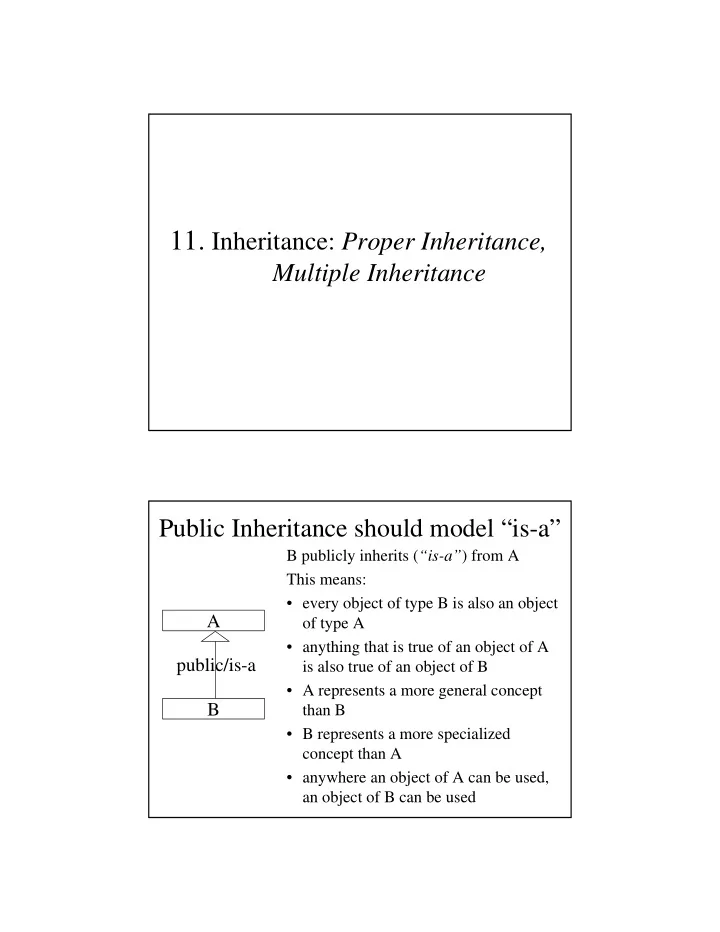
11. Inheritance: Proper Inheritance, Multiple Inheritance Public Inheritance should model is-a B publicly inherits ( is-a ) from A This means: every object of type B is also an object A of type A anything that is true of


slide-1
SLIDE 1
  • 11. Inheritance: Proper Inheritance,

Multiple Inheritance Public Inheritance should model “is-a”

B publicly inherits (“is-a”) from A This means:

  • every object of type B is also an object
  • f type A
  • anything that is true of an object of A

is also true of an object of B

  • A represents a more general concept

than B

  • B represents a more specialized

concept than A

  • anywhere an object of A can be used,

an object of B can be used

A B public/is-a

slide-2
SLIDE 2

Requirements & Promises of Functions

  • Advertised Requirements (Pre-Condition)
  • Advertised Promise (Post Condition)

Expressing Requirement & Promise Unfortunately in C++ : use Disciplined and Consistent Comments

Example : class Stack { int top() const; // PURPOSE: returns the top // element // REQUIRE: numElems() != 0 // PROMISE: nothing void push(int elem); // PURPOSE: pushes elem onto the //top of stack // REQUIRE: numElems() < 10 // PROMISE: numElems() == INITIAL(numElems()) + 1 // PROMISE: top() == elem

Substitutability

Advertised Behavior of the Derived class is Substitutable for that of the Base class Substitutability: Derived class Services Require no more and promise no less than the specifications

  • f the corresponding services in the base class

Example: int Base::fn(int x); // REQUIRE: x is odd // PROMISE: Returns an even int int Derived::fn(int x); // REQUIRE: x is int // PROMISE: Returns 8

slide-3
SLIDE 3

Liskov Substitutability Principle(LSP)

“Any Derived class object must be substitutable where ever a Base class object is used, without the need for the user to know the difference”

Inheritance appears Simple

class Bird { ... // has beak, wings, etc.. public: virtual void fly(); // Bird can fly }; class Parrot : public Bird { // Parrot is a bird ... public: virtual void Mimic(); // Can Repeat words, ... }; Parrot mypet; mypet.Mimic(); // my pet being a parrot can Mimic() mypet.fly(); // my pet “is-a” bird, can fly

slide-4
SLIDE 4

Yes, it just appears simple

class Penguin : public Bird {... // Penguin is Bird }; This inheritance says that Penguins can fly!!! Result of Incorrect understanding from an imprecise (language) statement Birds can fly does not mean all birds can fly. In general, birds that have the ability to fly, can fly.

“Penguins may try to fly, but will fail”- Design

class Bird { ... // has beak, wings, etc.. public: virtual void fly(); // Bird can fly }; class Penguin : public Bird { // Penguin is a Bird ... public: virtual void fly() { error (“Penguins don’t fly!”); } };

  • Does not model “Penguins can’t fly”
  • Models “Penguins may fly, but if they try it is an error”
  • Run-time error if an attempt is made to fly - not desirable
  • Think about Substitutability - Fails LSP

void PlayWithBird (Bird& abird) { ... abird.fly(); // OK if bird // happens to be // Parrot. // OOPS if bird // happens to be // Penguin ... }

slide-5
SLIDE 5

“Not all birds fly, Penguins can’t” - Design

class Bird { ... // has beak, wings, etc.. ... // No fly function - Birds have beak, wings, ... don’t want to say anything about // flying here }; class FlyingBird : public Bird { ... // A Bird that can fly public: virtual void fly(); }; class NonFlyingBird : public Bird { ... // A Bird that can’t fly }; class Parrot : public FlyingBird {...}; class Penguin : public NonFlyingBird {...};

More examples on Inheritance?!

  • Does class Square inherit from class Rectangle?
  • Does class “Basket of Bananas” inherit from

“Basket of Fruits” ?

slide-6
SLIDE 6

Design should be based on Requirements and Requirements

“The best design depends on what the system is expected to do, both now and in the future.”

Multiple Inheritance

An object is a “kind-of” more than one type AquaticBeing swim() TerrestrialBeing walk() Amphibian adopt()

slide-7
SLIDE 7

Ambiguous Functions in Multiple Inheritance

TA sam; sam.GoToClass(); ???? TA has to override the GoToClass() function

Sam Object Student Data Teacher Data TA Data

Student Teacher GoToClass() Teach() GoToClass() Study() TA

Duplication of Base Class Data in Multiple Inheritance

class Window { ... } // Represents a Window on the Computer class WindowWMenu : public Window {...} class WindowWScrollBar : public Window {...} class WindowWMenuAndScrollBar : public WindowWMenu, public WindowWScollBar {...} WindowWMenuAndScrollBar mywindow; mywindow Object Window Data WindowWMenu Data WindowWMenuAndScrollBarData Window Data WindowWScrollBar Data

slide-8
SLIDE 8

Virtual Base Class

class Window { ... } // Represents a Window on the Computer class WindowWMenu : public virtual Window {...} class WindowWScrollBar : public virtual Window {...} class WindowWMenuAndScrollBar : public virtual Window, public virtual WindowWMenu, public virtual WindowWScollBar {...} WindowWMenuAndScrollBar mywindow; mywindow Object Window Data WindowWMenu Data WindowWMenuAndScrollBarData WindowWScrollBar Data

Problems With Repetitive Calls to Functions in Multiple Inheritance

WindowWMenu::draw() {Window::draw(); ... } WindowWScrollBar::draw() {Window::draw(); ... }

WindowWMenuAndScrollBar::draw()

{ WindowWMenu::draw(); WindowWScrollBar::draw(); ... } mywindow.draw(); // Window::draw will be called // twice.

Window draw() draw() WindowW Menu draw() WindowW ScrollBar draw() WindowWMenu AndScrollBar

slide-9
SLIDE 9

Lab Work: Details provided on-line.